TL;DR:
Elon Musk has officially launched the $25 billion TERAFAB megaproject in Austin, Texas. This colossal investment is designed to fundamentally transform the AI data processing infrastructure market by eliminating global chip manufacturing bottlenecks. The initiative uniquely integrates the artificial intelligence capabilities of Tesla, SpaceX, and xAI to create a vertically integrated, independent ecosystem. This bold move will drastically impact AI engineers, CTOs, and the global technology supply chain, ushering in a new era of scalable computing power.
Elon Musk has officially announced the $25 billion TERAFAB megaproject in Austin, Texas. This gigantic investment aims to fundamentally reshape the AI data processing infrastructure market by resolving the severe global chip manufacturing bottlenecks.
The project uniquely integrates the artificial intelligence capabilities of Tesla, SpaceX, and xAI. By doing so, it establishes a vertically integrated, independent ecosystem that drastically reduces reliance on external hardware suppliers in the highly competitive semiconductor market.
The announcement has sent shockwaves through Silicon Valley, as an in-house chip manufacturing and data center strategy of this magnitude rewrites industry rules. CTOs and AI engineers worldwide are now analyzing how to respond to this paradigm shift and ensure their own companies remain competitive.

Introduction: The AI Infrastructure Bottleneck and the Winds of Change
The evolution of artificial intelligence is accelerating at an unprecedented pace, but physical realities are beginning to stifle innovation. The parameter count of large language models (LLMs) is growing exponentially, demanding a brutal amount of computational capacity.
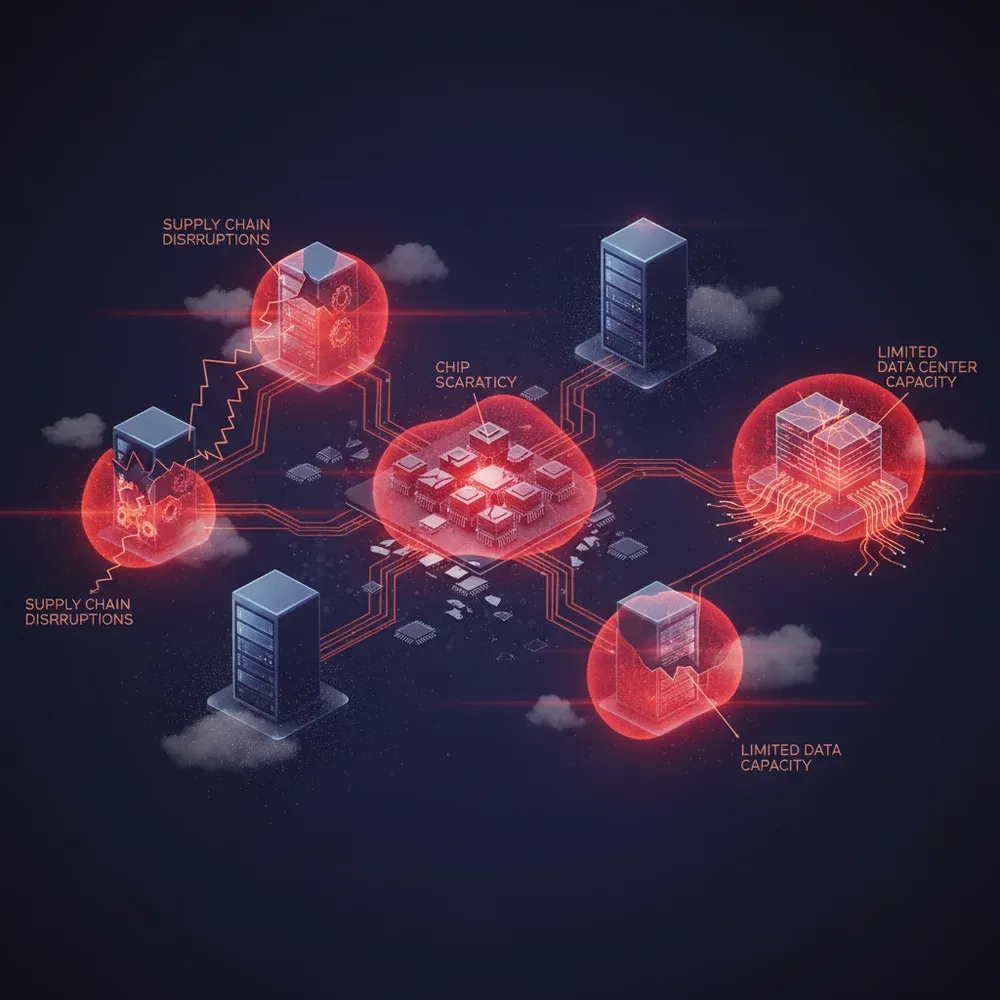
Currently, global AI development hinges on a severely constrained bottleneck: global chip manufacturing capacity. Demand vastly outstrips supply, which not only drives prices sky-high but also drastically slows down development cycles for new models.
This hardware scarcity has led tech giants to aggressively pursue proprietary solutions. The global AI infrastructure race has entered a new phase, where compute has officially become the new oil.
What is AI Data Processing Infrastructure?
AI data processing infrastructure encompasses all hardware, software, and networking components required to train, run, and scale AI models. This includes GPUs, specialized AI chips, servers, storage systems, and high-speed networks that enable efficient data flow.
The Current Landscape: Why is the AI World Struggling to Scale?
To understand the significance of TERAFAB, we must first examine the flaws in the current system. The market is dominated by a few key players whose manufacturing capacity is heavily dependent on TSMC's (Taiwan Semiconductor Manufacturing Company) fabrication plants.
Modern AI chips, such as NVIDIA's latest accelerators, require highly complex CoWoS (Chip-on-Wafer-on-Substrate) packaging technology. The manufacturing capacity for this specific technology is finite, resulting in waitlists that span months or even years for enterprise server farms.
Furthermore, energy consumption has become a critical issue. The power demands of today's massive data centers rival those of small cities. Current cooling technologies and electrical grids simply cannot support the scaling of existing hardware architectures.
Together, these factors have created a fragile ecosystem that could collapse at any moment due to geopolitical conflicts or supply chain disruptions. The technological war between Cerebras and Nvidia clearly illustrates the industry's desperate search for viable alternatives.
The TERAFAB Megaproject: Elon Musk's Answer to the AI Infrastructure Crisis
Elon Musk recognized that future technological dominance relies not just on software algorithms, but on absolute control over the underlying hardware. TERAFAB is not just another data center; it represents a complete paradigm shift in semiconductor manufacturing.
The $25 billion budget allows for the procurement of state-of-the-art lithography equipment and the construction of a fully automated production line in Austin. This strategic move drastically reduces logistical costs and shipping times.
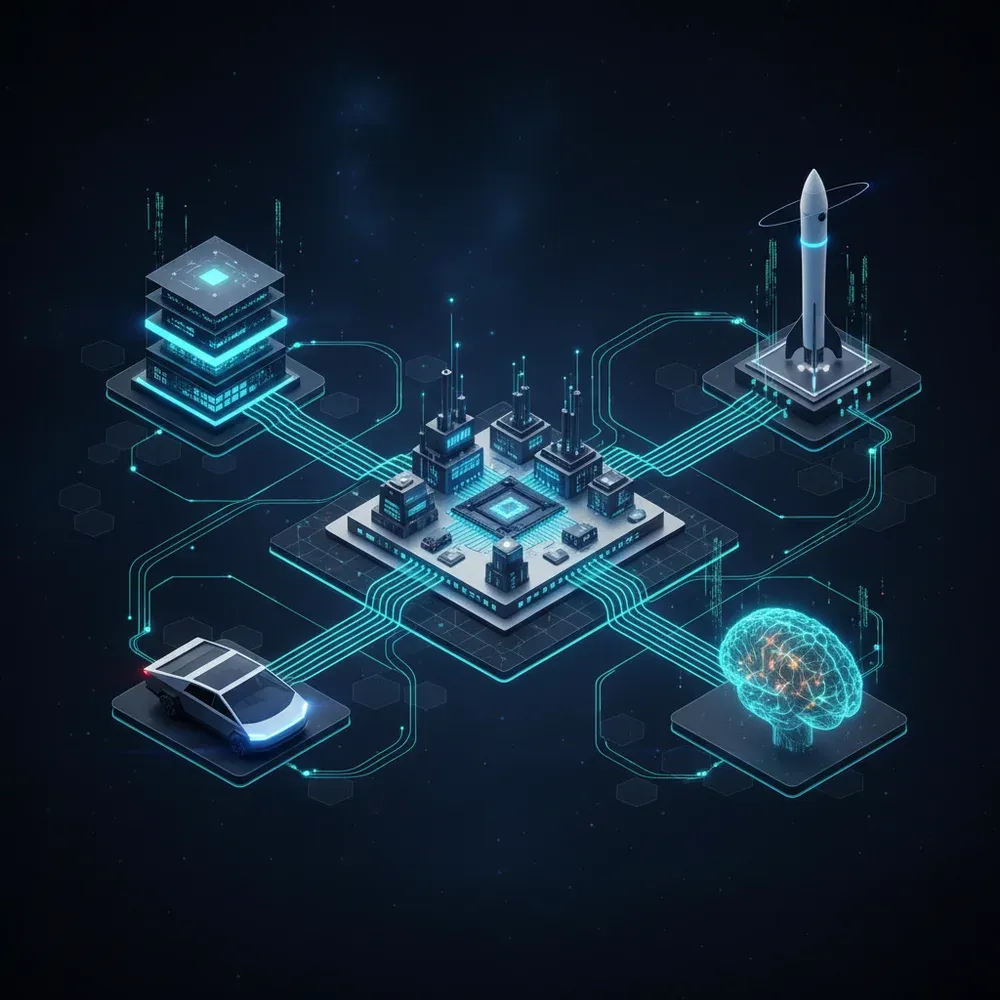
The true brilliance of the project lies in its synergies. Tesla brings the visual data processing required for Full Self-Driving (FSD), SpaceX provides global data routing via the Starlink network, and xAI contributes the massive compute demands for training its Grok language models.
This tripartite integration means that TERAFAB chips are not optimized for general use, but specifically for these extreme, high-performance tasks. The result is a closed, yet incredibly efficient ecosystem that is nearly impossible for traditional manufacturers to replicate.
TERAFAB's Technological Pillars: Chip Manufacturing, Data Centers, and Software Integration
The technological foundation of TERAFAB is entirely custom silicon design. Instead of relying on traditional GPU architectures, engineers are designing tensor-core-specific chips that maximize the FLOPS-per-Watt ratio.
At the data center level, TERAFAB is revolutionizing thermal management. Moving away from traditional air cooling, they are implementing Direct-to-Chip Liquid Cooling systems capable of handling extreme heat generation while drastically improving Power Usage Effectiveness (PUE) metrics.
Software integration is equally critical. The co-design of hardware and software allows compilers to perfectly exploit the unique memory hierarchy and bandwidth of the custom chips.
This approach eliminates the performance overhead caused by standard software abstraction layers. Consequently, xAI's Grok models can be trained orders of magnitude faster and cheaper than on competitors' cloud-based systems.
Impact on AI Engineers and Developers: New Opportunities and Challenges
For AI engineers, the emergence of TERAFAB signifies the opening of an entirely new playground. Compromises forced by limited compute capacity—such as reducing batch sizes or aggressively quantizing models—may soon become a thing of the past.
However, this also presents significant challenges. Developers will need to learn how to optimize for new, non-traditional architectures. Breaking the CUDA dominance means mastering new frameworks and low-level programming toolchains.
The development of enterprise data processing AI agents will also accelerate. Massive, affordable compute capacity will allow companies to run not just one large model, but thousands of specialized, communicating agents in real-time.
Is your team ready for the new AI era?
Don't get left behind in the technological revolution. Optimize your enterprise processes with cutting-edge AI solutions.
Discover our Data Processing AI AgentsStrategic Decisions for CTOs and Enterprise Leaders: Preparing for Change
TERAFAB is not just a technological issue; it's a hard-hitting business reality. CTOs must re-evaluate their cloud strategies. The pricing models of traditional hyperscalers (AWS, Azure, GCP) may soon become uncompetitive against new, vertically integrated systems.
Enterprise leaders must decide whether to continue renting compute capacity or if it's more cost-effective to build their own hybrid infrastructure. Total Cost of Ownership (TCO) calculations will fundamentally change as AI chip pricing and performance reach new levels.
The era of data processing AI agents demands real-time, low-latency systems. Those who do not redesign their IT architecture now will face an insurmountable competitive disadvantage in the next 3-5 years.
Professional website development and frontend architectures will also transform, as more AI logic must be integrated directly into user interfaces, requiring robust backend infrastructure.

Transformation of the Global Supply Chain and Geopolitical Impacts
The choice of Austin for TERAFAB is highly strategic. The US government, through the CHIPS Act, is pouring billions into domestic semiconductor manufacturing to reduce dependence on Taiwan and Asia. Musk's project is the crown jewel of this endeavor.
Through vertical integration, Tesla and xAI bypass the vulnerabilities of the traditional supply chain. They no longer need to worry about maritime shipping crises, rare earth metal shortages, or chip deficits caused by geopolitical tensions.
This move may force other tech giants (Apple, Google, Meta) to follow suit, potentially leading to a new, multipolar world order in chip manufacturing where hardware sovereignty is the ultimate asset.
Musk on TERAFAB
"Musk's $25 billion TERAFAB chip megaproject, spanning Tesla, SpaceX, and xAI, aims to address lagging production from existing manufacturers and rewire the AI industry from Austin, Texas."
The Future of AI Data Processing Infrastructure: What Comes After TERAFAB?
TERAFAB is just the first step. As the technology matures, computing capacity will become increasingly decentralized. In the future, edge AI devices, autonomous vehicles, and satellites (like Starlink) could merge into a single, global, distributed supercomputer.
The integration of quantum computing with traditional AI chips could represent the next massive leap. Hybrid architectures will be capable of solving optimization problems that are currently unimaginable on standard silicon.
Sustainability will also play a key role. Future data centers will likely be connected directly to renewable energy sources (such as dedicated nuclear reactors or massive solar farms), completely decoupling them from overburdened national electrical grids.

Conclusion: Is Your Enterprise Ready for the AI Infrastructure Revolution?
Elon Musk's TERAFAB project has made one thing crystal clear: the next phase of the AI revolution will be dominated not by software tricks, but by raw, scalable, and independent hardware infrastructure. The $25 billion wager rewrites the rules of the game.
As an enterprise leader and technology decision-maker, you must act now. Whether it involves deploying an intelligent RAG AI chatbot or implementing complex custom automation, understanding the underlying infrastructure is critical to success.
Do not wait until your competitors gain the upper hand through faster and cheaper AI capabilities. Start redesigning your IT strategy today and prepare for the era of limitless computational power.
Automate your business with the technology of tomorrow!
AiSolve helps you integrate cutting-edge AI solutions, from custom development to smart customer service.
Request a Free ConsultationFrequently Asked Questions About TERAFAB
How will TERAFAB impact existing AI chip manufacturers like NVIDIA or Intel?
TERAFAB poses a serious challenge to current monopolistic manufacturers, particularly NVIDIA. Although Musk's companies are currently among NVIDIA's largest customers, building proprietary manufacturing capacity will drastically reduce dependence on external suppliers in the long run. This could lead to a price war, accelerated development cycles, and a reshuffling of market shares, forcing Intel and AMD to innovate faster as well.
What security and privacy concerns might arise with such an integrated AI infrastructure?
A vertically integrated system that processes Tesla's visual data, SpaceX's network traffic, and xAI's language models within a single infrastructure represents unprecedented data centralization. The primary concern is the creation of a "single point of failure" and the potential lack of privacy controls over massive, cross-referenced datasets. Cybersecurity defenses must be military-grade to prevent the leakage of intellectual property and sensitive user data.
What is the expected timeline for TERAFAB's full operation and broader impact?
While the $25 billion investment has triggered immediate market reactions, building a semiconductor and data center complex of this scale takes physical time. The first prototype chips and test clusters will likely be operational within 18-24 months. However, full-scale production and a meaningful impact on the global supply chain (in terms of price reduction and capacity increase) will realistically materialize in a 3-5 year timeframe, around 2028-2030.
How can smaller AI startups or SMEs prepare for the changes brought by TERAFAB?
SMEs and startups should focus on software agility and specialized applications. As the price of raw compute is expected to drop due to increased market competition, smaller companies shouldn't try to compete in training massive foundation models. Instead, they should concentrate on custom automation, RAG (Retrieval-Augmented Generation) systems, and developing fine-tuned AI agents that solve specific, niche industry problems.
What role do sustainability and energy efficiency play in TERAFAB's design?
Energy efficiency is a critical pillar of the project. Given the massive power demands of modern data centers, TERAFAB is expected to rely heavily on Tesla Energy's renewable solutions, including giant Megapack battery installations and advanced solar arrays. Furthermore, the custom chip design and the implementation of direct-to-chip liquid cooling technologies are all aimed at maximizing the FLOPS-per-Watt ratio, significantly reducing the overall ecological footprint.
Will TERAFAB exclusively serve Musk's companies, or will it be available to external partners?
In its initial phases, TERAFAB will clearly operate as a closed, vertically integrated ecosystem primarily designed to meet the internal demands of Tesla (FSD), SpaceX, and xAI. However, as manufacturing capacity scales and eventually exceeds internal needs, it is highly likely that Musk will open the infrastructure (perhaps as a next-generation cloud service or AI-Compute-as-a-Service model) to external developers and enterprises, creating direct competition for AWS and Azure.
Készen állsz a saját weboldaladra?
Ingyenes konzultáció során átbeszéljük, hogyan segíthetünk vállalkozásodnak növekedni egy modern, gyors és konverzióoptimalizált weboldallal. 14 nap alatt kész, 0 Ft induló költséggel.