
In the world of technology, it's rare for an announcement to fundamentally shake the status quo of an entire field. At a recent developer conference, OpenAI unveiled exactly such a tool: the Codex App Server. This platform is not just another API or library; it's a complete framework designed to tackle the deepest challenges of developing, deploying, and monitoring custom AI agents. The announcement immediately captured the attention of AI engineers and corporate decision-makers, as it promises answers to the questions that have so far hindered the widespread adoption of complex, reliable automation.
Today, custom automation is no longer a luxury but a strategic necessity. Companies need solutions capable of handling their unique, often highly complex internal processes. This is precisely where the OpenAI Codex App Server comes in, enabling the creation of robust AI agents that can perform critical business tasks transparently, reliably, and with human oversight. This article delves deep into the technology, showcasing how it will reshape the future of automation projects.

Introduction: Why Custom Automation is Critical for Modern Enterprises?
In the age of digital transformation, businesses face an increasingly complex operational environment. Global markets, real-time data streams, and rising customer expectations place a pressure on companies that traditional, off-the-shelf software can no longer effectively manage. These pre-packaged solutions are often rigid, difficult to integrate, and fail to capture the subtle nuances of a company's unique workflows.
This is where custom automation emerges as a strategic response. It's not just about mechanizing repetitive tasks, but about building intelligent systems that can adapt, make decisions, and solve complex problems based on a company's specific ruleset and objectives. While a standard CRM system helps manage customer relationships, a custom automation solution can proactively identify customers at risk of churn based on their communication patterns, then generate and send personalized offers, all without human intervention.
Definition: What is Custom Automation?
Custom Automation refers to the design, development, and implementation of software solutions and workflows that are specifically tailored to the unique needs, processes, and goals of a particular company. Unlike mass-produced software, these systems integrate deeply with existing infrastructure and can handle challenges specific to that organization, thereby increasing efficiency, reducing errors, and providing a strategic competitive advantage.
However, implementing truly effective custom automation is fraught with technical pitfalls. How can you ensure an automated system operates reliably? How can you track its decisions and intervene if necessary? It is precisely these questions that the new generation of AI agents and the infrastructure supporting them, like OpenAI's Codex App Server, aim to answer.
The Rise of AI Agents and the Challenges of Custom Automation
The evolution of automation has led from simple scripts to complex, AI-driven agents. While early automation tools operated on predefined, rigid rules (if X happens, do Y), modern AI agents can interpret their environment, understand goals, and execute multi-step, dynamic plans to achieve them. These specialized AI agents don't just execute; they 'think'.
Imagine an AI agent tasked with optimizing a marketing campaign. It doesn't just launch ads. It continuously analyzes incoming data, interprets performance metrics, modifies targeting, rewrites ad copy, and allocates the budget among the best-performing channels. This level of autonomy holds revolutionary potential but also raises significant technical and business challenges:
- Observability: How do we see exactly what the agent is doing and why it's making certain decisions? A 'black box' system is unacceptable for critical business processes.
- Reliability: What happens if the agent makes a mistake or encounters an unexpected situation? How can we ensure that errors don't cause financial or reputational damage?
- Auditability: How can every step of the agent be traced back weeks or months later, for instance, during a regulatory audit? Documenting the decision chain is essential.
- Human-in-the-Loop: How can human approval be integrated into the process without losing the benefits of automation? Certain decisions (e.g., large payments) still require human control.
These challenges have significantly slowed the corporate adoption of complex AI agents. Developers had to spend a vast amount of time building the underlying infrastructure, logging, monitoring, and security layers, instead of focusing on the business logic itself.

Introducing OpenAI's Codex App Server: A New Era in AI Agent Development
Recognizing these market and technological gaps, OpenAI created the Codex App Server. It is a specialized application server designed specifically to run robust, enterprise-grade AI agent applications. Instead of developers having to build the entire backend infrastructure from scratch, the Codex App Server provides a ready-made, production-ready environment that includes built-in solutions to the challenges mentioned above.
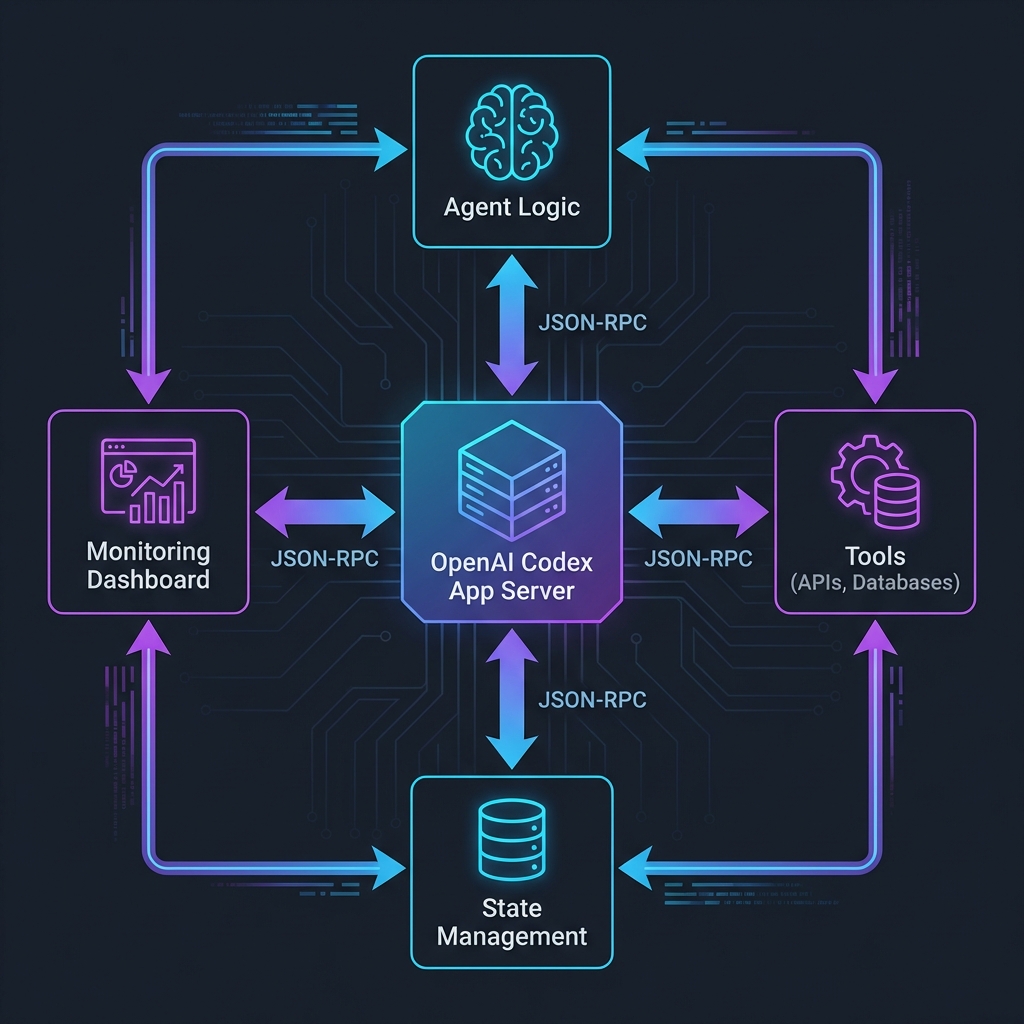
The server's primary purpose is to abstract away the infrastructural complexity of running agents. It allows AI engineers to focus exclusively on the agent's capabilities, decision-making logic, and the tools it uses (APIs, databases, internal systems). The server takes care of other critical functions: state management, real-time communication, change tracking, and handling human intervention points.
Key Concept: The Codex App Server
The Codex App Server is a managed, hosted environment that standardizes and simplifies the development and execution of AI agents. It's like an operating system for AI agents, providing the necessary resources, communication channels, and monitoring tools, so developers only need to focus on the 'application' itself—the agent's intelligence. This drastically reduces development time and increases the reliability of the final solution.
This approach represents a paradigm shift. Previously, developing an AI agent was more like a research project, filled with uncertainty and infrastructural debt. With the Codex App Server, this process becomes a much more structured, engineering discipline, where the focus is on creating reliable and scalable business value. The development of enterprise AI agents thus moves much closer to the traditional software development lifecycle.
Key Features of the Codex App Server for Custom Automation
The power of the OpenAI Codex App Server lies in its built-in, production-ready features. These are not just conveniences; they are fundamental building blocks that enable the creation of truly robust and supervisable custom automation systems. Let's examine the most important ones in detail.
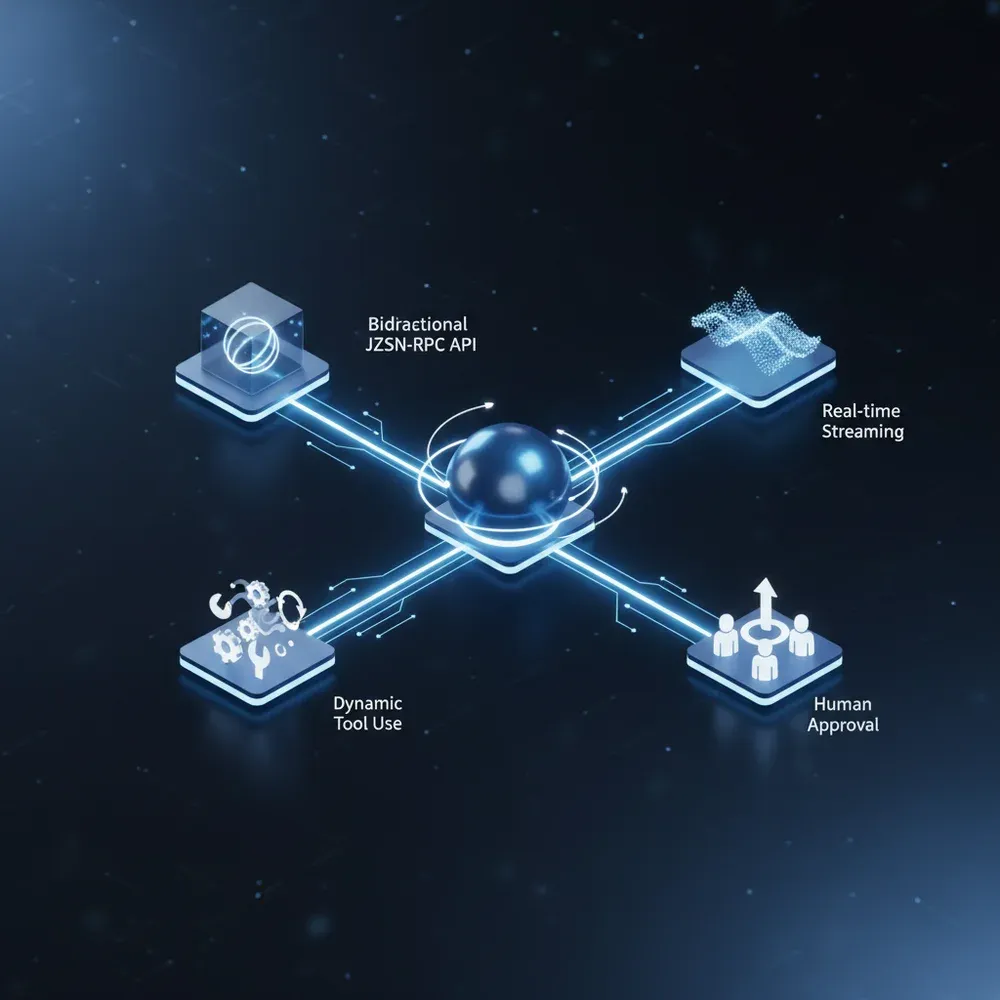
Bidirectional JSON-RPC API: Real-time Interaction and Control
Traditional web communication is often based on the request-response model (e.g., REST API). However, an AI agent's operation is much more dynamic: it continuously sends information about its state while also being able to receive commands. The Codex App Server's bidirectional JSON-RPC API enables exactly this. It creates a persistent, open communication channel between the server and the client (e.g., a monitoring dashboard).
Thanks to this, engineers can not only passively observe events but also intervene in real-time: they can pause the agent's execution, override a decision, or give it new instructions without having to restart the entire process. This kind of interactivity is essential for complex, long-running automation tasks.
Real-time Streaming of Agent Progress: Transparency and Monitoring
This feature solves the 'black box' problem. The server streams every step, thought process, and action the agent takes in real-time to monitoring interfaces. Developers can watch live as the agent analyzes a problem, selects the appropriate tool (e.g., an API call), executes it, and then interprets the result to plan the next step.
This transparency is invaluable for debugging. If the agent gets stuck or behaves unexpectedly, engineers can immediately see the exact point and context where the error occurred. Furthermore, this feature builds trust in the system among business users, as it makes the AI's operation visible and understandable.
Dynamic Tool Use: Adaptive Capabilities for Complex Tasks
Truly intelligent agents do not execute a single, rigid sequence of tasks. They are capable of dynamically choosing from a set of available tools based on the nature of the problem. These tools can be internal database queries, external API calls (e.g., weather forecasts, stock data), file management operations, or even calls to other AI models.
The Codex App Server natively supports this dynamism. The agent can 'consider' which tool is most useful in a given situation and then call it with the appropriate parameters. For example, a logistics agent might use a traffic data API for route planning, but an inventory check API if it needs to verify a product's availability.
Human Approvals and Interventions: Ensuring Safety and Accuracy
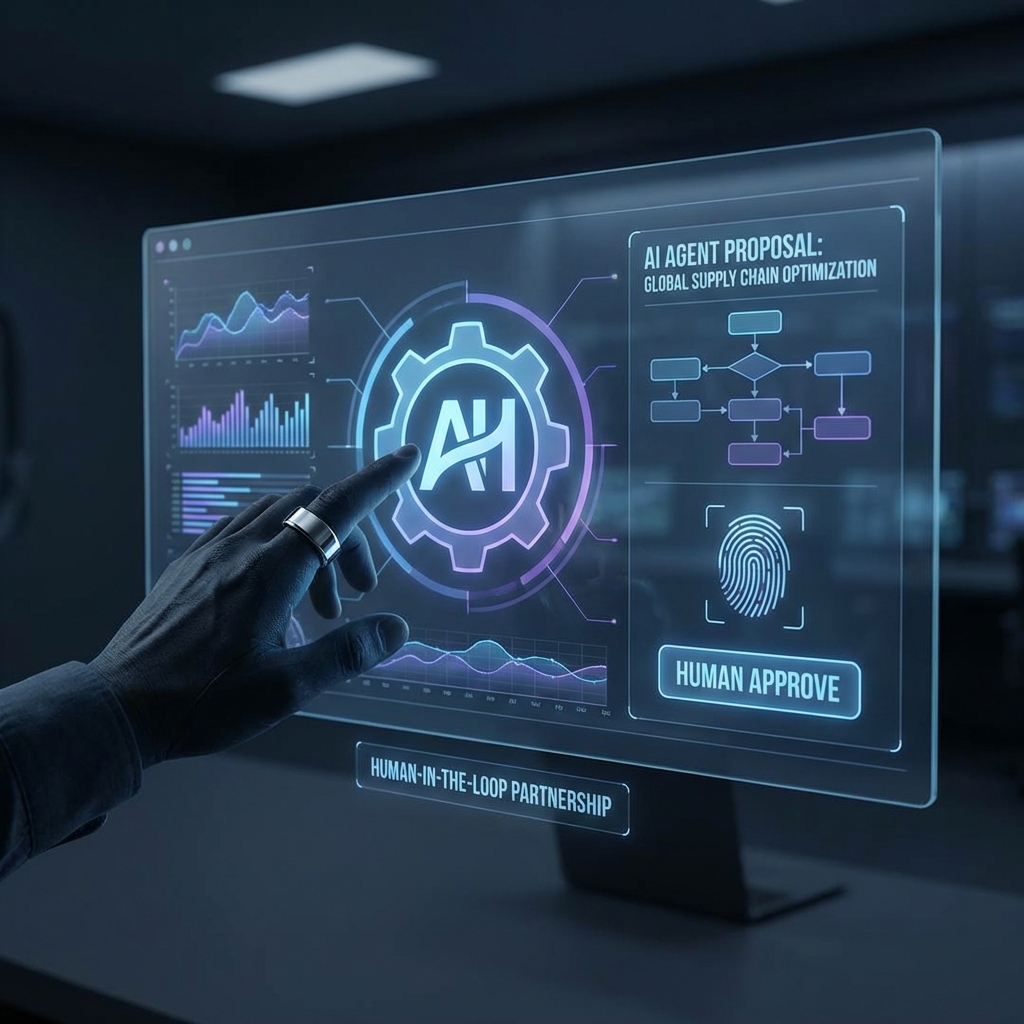
One of the biggest fears of automation is the loss of control. The Codex App Server offers built-in mechanisms for integrating human-in-the-loop approvals. Developers can easily define points in the workflow where the agent must stop and request human approval before proceeding.
Such points could include initiating a transfer over $10,000, permanently deleting a customer's account, or restarting a critical server. When the agent reaches this point, the server sends a notification to the responsible person via an interface, where they can review the context and approve or reject the action. This feature is crucial in finance, healthcare, and other high-risk industries. Managing the related security and automation issues is of fundamental importance.
Granular Diffs: Detailed Auditing and Change Tracking
To ensure auditability, the server logs every state change in extreme detail. It doesn't just record that 'the agent modified the database,' but shows the exact state before and after the change (this is called a 'diff'). This granular level of tracking allows for the precise reconstruction of what the agent did, when, and why, at any time, even months later.
This feature is essential for meeting compliance requirements (e.g., GDPR, HIPAA) and for the post-mortem analysis of complex errors. It's as if a detailed, rewindable recording is made of every single operation.
Architecture and Implementation: Building Custom AI Agents with the Codex App Server
Working with the OpenAI Codex App Server enables a well-defined, engineering-driven process. Although the specific coding details depend on the project's specifics, the high-level architecture and the steps to follow are universally applicable. Let's see how a typical project is structured.
1. Defining the Goal and Capabilities: Every project begins with understanding the business problem. What does the AI agent need to achieve? For example: 'Automate the processing and accounting of incoming invoices.' From this, the necessary capabilities must be broken down: document interpretation, data extraction, validation in the internal system, creating an accounting entry, sending a notification.
2. Implementing the Tools: Each capability must be assigned one or more 'tools.' These are essentially functions or API endpoints that the agent can call. For example:
- `read_invoice(file)`: Calls an OCR (Optical Character Recognition) service to extract the text from the invoice.
- `validate_vendor(vendor_name)`: Queries the company's ERP system to check if the vendor exists.
- `create_accounting_entry(details)`: Creates a new entry in the accounting software.
Developers write these tools to interface with their own existing systems.
3. Writing the Agent Logic: This is the agent's 'brain.' Here, you provide the high-level instructions (prompt) that describe the agent's goal, the tools at its disposal, and the procedures to follow. For example: 'Your task is to process invoices. Use the `read_invoice` tool to extract the text, then the `validate_vendor` tool for verification. If everything is correct, use the `create_accounting_entry` tool to record the item. If the vendor is unknown or the amount exceeds 5000 EUR, stop and request human approval.'
4. Configuring and Deploying the Server: The developer uploads the agent logic and tool definitions to the Codex App Server. The server takes care of creating the runtime environment, scaling, and security settings. This step can be completed in hours instead of weeks or months.
5. Connecting the Monitoring Frontend: A custom web interface must be connected to the server's bidirectional API. Through this dashboard, engineers and operators can monitor the agent's operation in real-time, view logs, and handle approval requests. This visual layer is essential for transparency and control.
This modular structure makes the system extremely flexible. If a new capability is needed (e.g., automatically archiving invoices to SharePoint), it's enough to develop a new tool (`archive_to_sharepoint`) and add it to the agent's available toolkit. The entire system doesn't need to be rewritten. This type of custom automation development is our specialty, where robust architecture and scalability are the top priorities.
Real-World Applications: Where Custom Automation Shines with Codex Server?
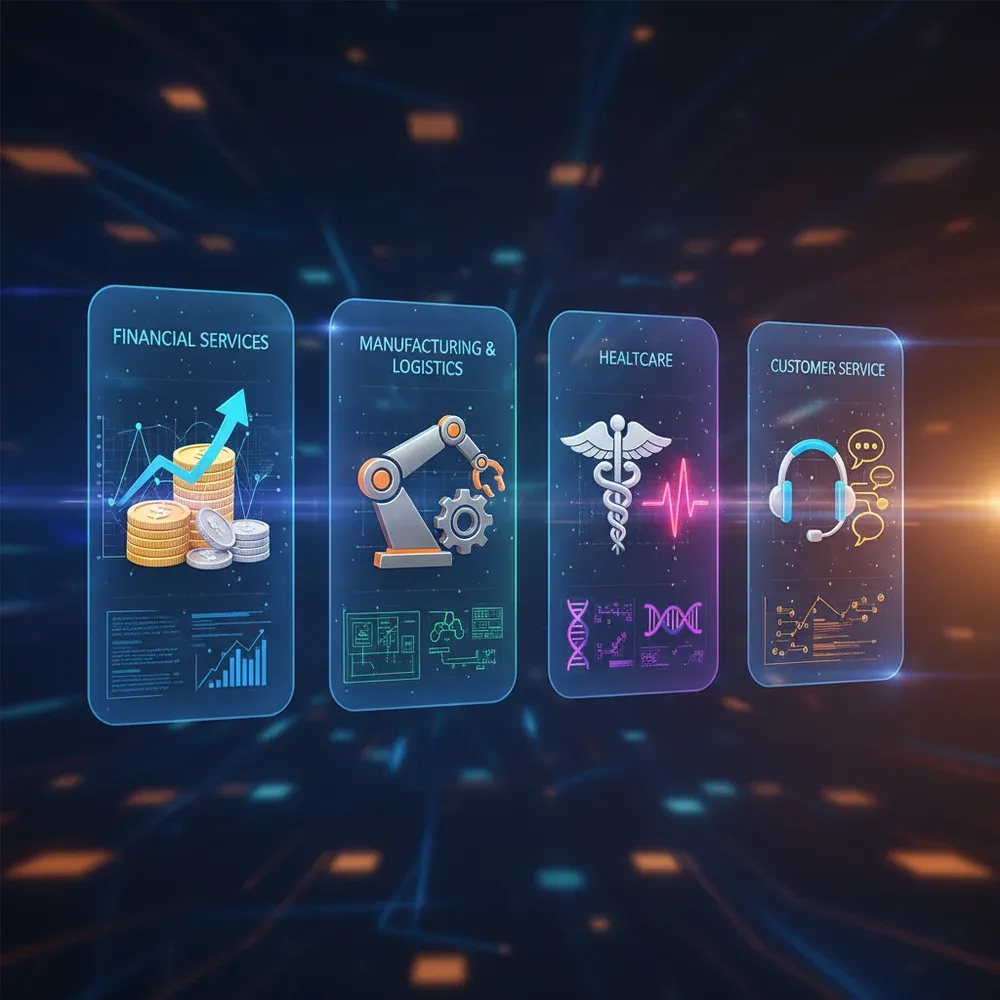
The capabilities offered by the OpenAI Codex App Server can revolutionize complex workflows in almost every industry. Its true power is demonstrated where tasks are multi-step, involve multiple systems, and require human-level decision-making. Let's look at some specific examples.
Financial Services: Risk Management and Compliance
In the financial sector, regulatory compliance and risk management are paramount. A Codex-based AI agent can continuously monitor transactions. If it detects a suspicious pattern (e.g., an unusually large transfer to a high-risk country), it doesn't just send an alert. It independently initiates an investigation process: it queries the customer's past transaction history, checks their name against international sanctions lists (using an external API), and analyzes related parties. Based on the collected information, it generates a report and then pauses to request human approval from a compliance officer to block the transaction. This drastically speeds up investigations and reduces the chance of manual errors.
Manufacturing and Logistics: Supply Chain Optimization
Imagine an AI agent overseeing the entire supply chain. If a supplier's system indicates a delay, the agent immediately takes action. It queries the current stock levels and delivery times of alternative suppliers (from several different systems), analyzes the differences in price and shipping costs, and then proposes the most optimal alternative. Before placing the new order, it can request approval from the procurement manager, presenting all the data supporting its decision. This proactive, data-driven decision-making minimizes production downtime.
Healthcare: Clinical Workflows and Research
Healthcare generates vast amounts of unstructured data (e.g., medical reports, lab results). An AI agent can process and structure this data. For example, during a clinical trial, the agent can review anonymized patient histories and identify subjects who match the research protocol. It can interpret the text of reports, extract relevant biomarkers, and compare them against inclusion criteria. At the end of the process, it creates a list of potential participants for a doctor to approve. This kind of data processing AI agent can shorten research processes by weeks or months.
Customer Service: Proactive Support and Personalized Experience
Modern customer service is no longer just about handling incoming calls. An advanced AI agent can monitor user behavior on a website or in an application. If it detects that a customer is repeatedly experiencing an error (e.g., failed payment attempts), it can proactively contact them. It automatically creates a support ticket in the internal system, attaching relevant technical logs, and notifies the customer that they are already working on the problem. This not only reduces resolution time but also significantly improves the customer experience.
Benefits for AI Engineers and CTOs: Why Invest in Codex?
The introduction of the OpenAI Codex App Server is not just a technological novelty; it also offers strategic advantages for technical leaders and development teams. The platform's impact ranges from productivity and reliability to future-proof architectures.
Summary of Strategic Benefits
- Reduced Time-to-Market: The ready-made, production-ready infrastructure drastically shortens the development cycle. Engineers don't have to deal with the basics (logging, monitoring, state management), so they can immediately focus on implementing business logic. This means faster prototyping and quicker market entry.
- Enhanced Reliability and Stability: The platform was designed by OpenAI engineers who operate some of the world's largest AI systems. The built-in error handling, state tracking, and monitoring mechanisms provide a robust foundation that would be extremely costly and time-consuming for an in-house team to build from scratch.
- Unparalleled Observability: Real-time streaming and granular diffs offer unprecedented insight into the operation of AI agents. This not only speeds up debugging but also allows for performance tuning and continuous optimization of operations. For CTOs, this means transparency and accountability.
- Future-Proof Architecture: The Codex App Server offers a standardized framework for agent development. This facilitates teamwork, onboarding new developers, and code maintainability. As AI technology evolves, the infrastructure behind the server will also be updated, so applications built on it will benefit from the latest developments without requiring a complete rewrite.
- Scalability and Performance: The server's architecture is designed to handle high loads and complex, long-running tasks. Companies can be confident that the automation solution they develop will not collapse under growing user demands or data volumes.
For a CTO, investing in the Codex App Server means their team spends less time building and maintaining infrastructure and more time creating real business value. This is a competitive advantage that allows the company to introduce innovative, AI-based automation solutions faster and more reliably.
Challenges and Solutions in Implementing Custom Automation
Although platforms like the Codex App Server significantly simplify development, implementing advanced custom automation is still a process that requires strategic planning. Companies face several challenges, but with proper preparation, these can be managed.
Integration Complexity:
Challenge: AI agents often need to communicate with multiple internal systems of different ages and technologies (ERP, CRM, databases). The APIs of these systems may be incomplete or poorly documented.
Solution: A thorough system mapping should be conducted before implementation. Creating an 'API layer' or 'middleware' can help unify access to different systems, so the AI agent only needs to communicate with this single, well-defined layer.
Data Privacy and Security:
Challenge: AI agents often access sensitive company or customer data. It must be ensured that this data is handled securely and that access complies with GDPR and other regulations.
Solution: Strict Identity and Access Management (IAM) rules must be applied. The agent should only be granted access to the data absolutely necessary for its task (least privilege principle). The auditing features of the Codex App Server help document every data access, which is essential for proving compliance.
Scalability and Costs:
Challenge: A successful automation project can grow quickly, leading to higher loads and increased running costs. Forecasting and controlling costs is key.
Solution: Scalability must be considered during the design phase. An architecture should be chosen that allows for the independent scaling of components. Cloud services (like what Codex is built on) provide flexibility, but cost monitoring and optimization (FinOps) require continuous attention.
Lack of Expertise:
Challenge: Developing AI agents requires specialized knowledge that is still relatively rare in the market. Finding and retaining the right talent can be difficult.
Solution: Companies need to invest in training their existing developers. It is also wise to partner with specialized firms like AiSolve, which have the necessary experience and expertise to successfully implement custom automation projects. This can accelerate implementation and reduce internal risks.
Future Outlook: The Evolution of Custom Automation and AI Agents
Technologies like the OpenAI Codex App Server are not the end goal, but the beginning of a new era in custom automation. In the future, AI agents will become even more intelligent, autonomous, and integrated into corporate operations. Here are some key trends to expect:
Complex, Multi-Agent Systems: The future is not about a single, all-knowing AI, but about the collaboration of specialized agents. Imagine a system where a 'researcher' agent gathers data, an 'analyst' agent interprets it, a 'strategist' agent makes recommendations, and a 'communicator' agent prepares the reports. These agents will communicate with each other to solve complex business problems collectively, as we analyzed in our article on the revolution of multi-agent workflows.
Deeper Human-AI Collaboration: Human approval will increasingly transform into a form of partnership. The AI will not just ask for permission but will explain the logic behind its decisions, offer alternatives, and learn from human feedback. Monitoring dashboards will become interactive, collaborative workspaces where humans and machines work together to achieve the best results.
Self-Healing and Self-Optimizing Systems: Future AI agents will be able to monitor their own performance. If an API they use is slow or faulty, they might automatically try to find an alternative. They will continuously analyze their own workflows and suggest optimizations, reducing the need for manual maintenance.
Ethical and Governance Frameworks: As agents gain more autonomy, the development of ethical and governance frameworks to regulate their operation will become increasingly important. Companies will need to establish clear rules about what decisions agents can make on their own and when human oversight is required. The auditing capabilities of the Codex App Server will be fundamental to enforcing these rules.
This future is closer than we think. Companies that start building their competencies and investing in such advanced automation platforms today will gain a significant competitive advantage in the years to come.
Why Choose Us for Your Custom Automation Projects?
Revolutionary technologies like the OpenAI Codex App Server hold immense potential, but unlocking it requires deep expertise and a strategic mindset. At AiSolve, we don't just develop software; we solve business problems using the most advanced AI technologies.
Our expert team has up-to-date knowledge in AI agents, large language models, and complex system integration. We are aware of the practical challenges—from connecting to existing systems to complying with strict data protection regulations—that arise during an enterprise-level automation project. We don't just deliver technology; we offer a full-fledged partnership that extends from strategic planning and implementation to ongoing support and optimization.
We know that every company is unique. That's why our approach is never 'one-size-fits-all.' We deeply understand your business processes, identify the most valuable automation opportunities, and design and build custom automation solutions that deliver real, measurable results. Whether it's increasing operational efficiency, reducing costs, or creating a brand-new AI-based service, we will help you realize your vision.
Conclusion: Elevate Your Business with Custom Automation
The OpenAI Codex App Server clearly signals the direction of the future: custom automation is becoming more intelligent, reliable, and accessible. The era of 'black box' AI that is difficult to supervise is coming to an end, replaced by transparent, auditable, and human-controlled AI agents. This shift allows companies to automate critical and complex processes that were previously considered too risky.
The question is no longer whether to invest in custom, AI-driven automation, but whether a company can afford to be left behind. The advantages in efficiency, accuracy, and adaptability will soon become fundamental competitive factors. Organizations that act now and start building the automation systems of the future will lay the foundation for their long-term success.
Don't wait for your competitors to get ahead! Contact us today to schedule a free consultation, where we can assess how our custom automation solutions can help your business reach the next level.
Frequently Asked Questions
How scalable is custom automation with OpenAI's Codex App Server?
The Codex App Server was designed with enterprise-level scalability in mind. As a managed, cloud-based service, its underlying infrastructure can handle high loads and complex, concurrently running agent processes. The key to its scalability lies in the server's state management and asynchronous communication architecture, which allows agents to run efficiently without blocking each other's resources. In practice, this means the system can scale from a few initial transactions to hundreds of thousands or even millions of events per day without needing to re-architect the core solution.
What are the security considerations when using AI agents for custom automation?
Security is multi-layered. First, network security: communication between the Codex App Server and internal systems must be secured via encrypted channels (e.g., VPN, mTLS). Second, access management (IAM): the agent should only have the minimum necessary permissions (least privilege principle). Third, protection against prompt injection: you must ensure that data from external sources (e.g., the text of an incoming email) cannot manipulate the agent's core instructions. Finally, the granular auditing feature of the Codex App Server is crucial, as it allows for the post-mortem verification of every single operation and data access, which helps in detecting security incidents and proving compliance.
What programming languages does OpenAI's Codex App Server support?
OpenAI typically takes a language-agnostic approach to its APIs and server products. While official client libraries are usually released first in Python due to its extensive support in the AI/ML ecosystem, the underlying JSON-RPC API of the Codex App Server is an open standard. This means a client can be written in any programming language capable of WebSocket or HTTP communication and JSON data handling. Thus, development teams can use their existing technology stack, be it Go, Java, Rust, or TypeScript/Node.js, without needing to learn a new language.
How can the Codex App Server be integrated with existing enterprise systems?
Integration is achieved through the 'tools' used by the agent. These tools are essentially adapters or connectors between the Codex App Server and existing systems. In practice, developers write functions (e.g., in Python or Go) that call the APIs of the company's internal systems (e.g., a REST endpoint of an SAP system or an SQL query to an internal database). These functions are registered with the agent as usable tools. When the agent needs data or needs to perform an action, it calls the appropriate tool, which handles the communication with the target system in the background. This layered approach ensures that the agent's logic remains independent of specific system implementations.
What role does human-in-the-loop play in custom AI automation?
Human-in-the-Loop (HITL) is a critical safety and quality assurance component. Its role is multifaceted: 1) Approver: Before high-risk or irreversible operations (e.g., money transfers, database deletions), the agent pauses and requests human approval. 2) Supervisor: If the agent is uncertain about a decision or its confidence level is low, it can ask for human help to choose the correct path. 3) Teacher: Human interventions and corrections can serve as data points for fine-tuning future AI models, so the system learns from its mistakes and becomes more accurate over time. The Codex App Server natively supports these pause and intervention points in workflows.
What are the costs associated with developing a custom automation solution using the Codex Server?
The costs consist of several items. 1) Development Cost: This is the largest initial item, including the labor costs for strategy, tool development (integration with existing systems), writing the agent logic, and creating the monitoring interface. 2) Running Cost (OpenAI): This consists of the usage fee for the Codex App Server and the cost of API calls to the underlying AI model (e.g., GPT-5), which is usually billed based on the number of processed tokens (amount of data). 3) Infrastructural Costs: This includes the fees for any other necessary cloud services (e.g., databases, API gateways). 4) Maintenance and Optimization Cost: The ongoing monitoring, fine-tuning, and adaptation of the system to new business needs. Although the initial investment can be significant, the ROI (Return on Investment) of a well-designed automation is usually realized quickly through increased efficiency and reduced manual errors.
Készen állsz a saját weboldaladra?
Ingyenes konzultáció során átbeszéljük, hogyan segíthetünk vállalkozásodnak növekedni egy modern, gyors és konverzióoptimalizált weboldallal. 14 nap alatt kész, 0 Ft induló költséggel.