TL;DR: The Revolution of Data Processing AI Agents in the Quantum-Classical Hybrid Era
The technological world has once again turned its attention to NVIDIA as the company recently unveiled its latest innovation: the Ising-7B, Ising-30B, and Ising-MoE (Mixture of Experts) artificial intelligence models. These models are not just aimed at traditional language processing; they are specifically built to serve quantum-classical hybrid systems, and more specifically, the CUDA-Q platform. This announcement fundamentally redraws what we previously thought about the capabilities of data processing AI agents.
Quantum computing has been the promise of the future for decades, but the instability of physical qubits and decoherence have so far hindered widespread industrial application. NVIDIA's new models target this problem by deploying intelligent, autonomous agents for the real-time management of Quantum Error Correction (QEC). Running on classical GPUs, these agents process syndrome data coming from quantum processing units (QPUs) in a matter of microseconds.
This article provides an in-depth analysis of this paradigm shift. We examine how these hybrid architectures work and why they are essential for modern enterprise infrastructures. We explore the technical background of the Ising models, the role of reinforcement learning, and how CTOs can begin preparing for this new era.
Introduction: The Era of Data Explosion and Quantum-Classical Synthesis
The past decade has been characterized by an unprecedented explosion of data. Enterprises generate information measured in petabytes daily, ranging from sensor data to financial transactions. Computers based on the classical von Neumann architecture, despite undergoing incredible development, are increasingly approaching their physical and thermodynamic limits. The slowdown of Moore's Law has made it clear: a new computing paradigm is needed to handle complexity.
Quantum computers theoretically offer exponential speedups in certain problems, such as prime factorization or molecular simulations. However, in the current NISQ (Noisy Intermediate-Scale Quantum) era, quantum machines are highly noisy and prone to errors. This is where quantum-classical hybrid synthesis comes into play, combining the best features of both worlds.
Problem Statement: The Limit of Complexity
Classical systems cannot simulate quantum states fast enough, while quantum systems alone are too unstable for reliable data processing. The challenge is to create an intelligent intermediary layer that can interpret, correct, and optimize the data flow between the two systems in real time, without latency destroying the quantum state.
In this hybrid environment, traditional software solutions are no longer sufficient. Autonomous entities are needed that can adaptively respond to changes occurring in fractions of a second. These entities are advanced data processing AI agents that run on classical hardware (such as NVIDIA H100 or B200 GPUs) to orchestrate quantum processes. As the AI infrastructure race shows, hardware and software are becoming increasingly intertwined.
These agents are not merely passive data processors. They are capable of predictive modeling, anomaly detection, and dynamic reprogramming of quantum circuits. Creating synergy between classical and quantum processors is the most important technological challenge of the next decade, which will fundamentally determine the competitiveness of the global economy.
What is a Data Processing AI Agent? A New Paradigm Shift in Quantum-Classical Hybrid Systems
Traditional artificial intelligence models, such as early large language models (LLMs), typically learned on static datasets and operated on a request-response basis. In contrast, a data processing AI agent is an autonomous, goal-driven software entity that continuously senses its environment, makes decisions, and intervenes. In the context of quantum-classical hybrid systems, this environment represents a highly noisy, high-dimensional data space.
Definition: Quantum-Hybrid Data Processing AI Agent
An autonomous artificial intelligence system that runs on classical accelerators (GPU/TPU) to process measurement data from quantum processors in real time. It is capable of autonomously optimizing quantum algorithms, executing error correction protocols, and transforming quantum outputs into a format interpretable by classical enterprise systems.
These agents possess several key characteristics that distinguish them from traditional data processing scripts. First, they have 'state' and memory, allowing them to learn from the errors of previous quantum runs. Second, they can dynamically modify their own data processing pipeline based on the quality of incoming data through custom automation.
Quantum algorithms, such as the VQE (Variational Quantum Eigensolver) or QAOA (Quantum Approximate Optimization Algorithm), require continuous iteration between quantum and classical hardware. The AI agent's task is to execute the optimization steps running on the classical side as quickly and accurately as possible. To do this, they apply deep learning techniques capable of finding the global optimum even in massive parameter spaces.
Furthermore, these agents are responsible for the fight against decoherence. Quantum states are extremely fragile; information is quickly lost due to environmental noise. Agents must analyze syndrome measurements in millionths of a second and send correction signals back to the QPU. This speed and intelligence are what make quantum-hybrid systems viable in practice at all.
NVIDIA Ising Models: The Engines of Quantum AI Agents and the CUDA-Q Platform
NVIDIA's latest announcement, the Ising model family (Ising-7B, Ising-30B, and Ising-MoE), has made it clear that the company intends to dominate not only the hardware but also the quantum software market. These models are named after the Ising model known from statistical mechanics, which is used for the mathematical description of ferromagnetism and forms the basis of quantum optimization problems. The architecture of the Ising models is specifically designed to solve QUBO (Quadratic Unconstrained Binary Optimization) problems natively, in an AI-driven manner.
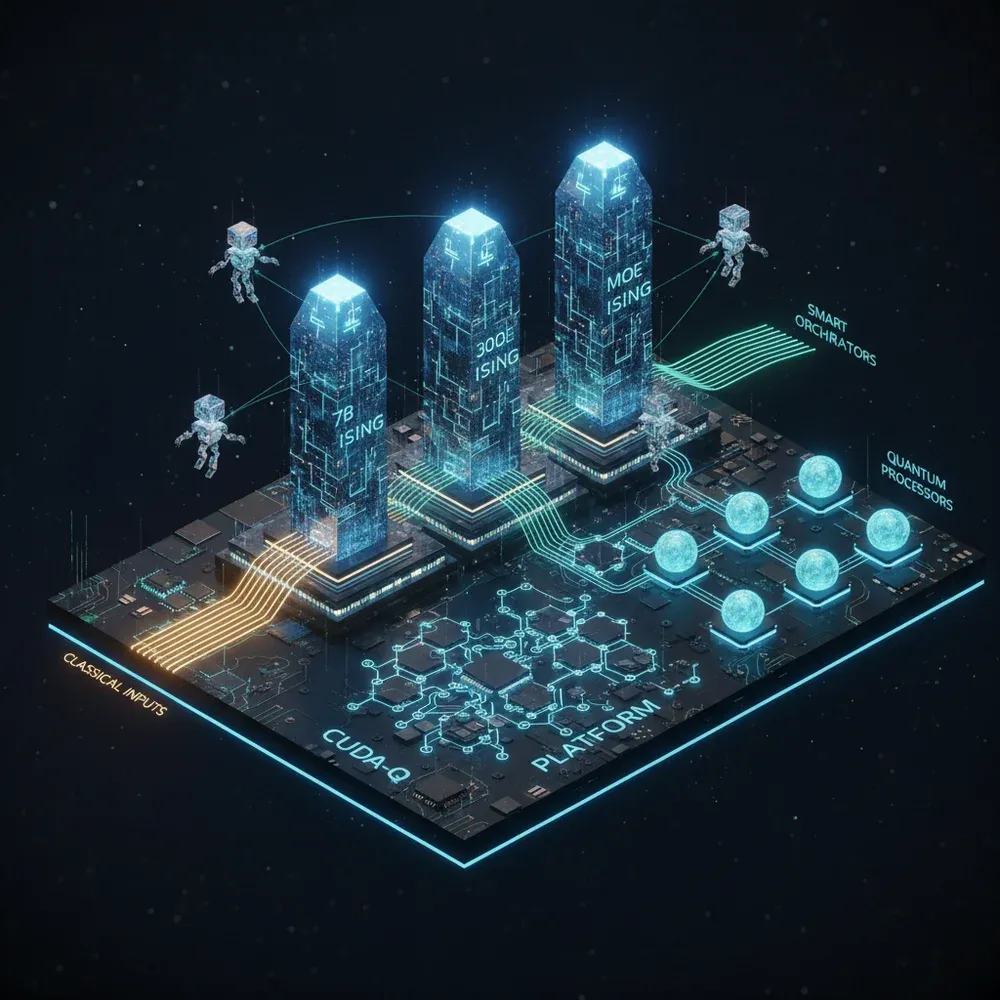
The Ising-7B is an extremely fast, low-latency model optimized for edge-computing environments and control electronics placed directly next to the QPU. Its task is rapid, real-time decision-making in quantum error correction loops. In contrast, the Ising-30B is responsible for deeper, more complex data analysis tasks, such as quantum state tomography and noise modeling.
The most exciting development, however, is the Ising-MoE (Mixture of Experts) model. This architecture contains multiple specialized neural networks (experts) controlled by a gating network. During the processing of quantum data, the model dynamically selects the expert most knowledgeable about the given noise type or algorithm. This drastically reduces computational costs while increasing accuracy, which is critical for achieving fault-tolerant quantum computing.
Key Technology: CUDA-Q Integration
CUDA-Q (formerly cuQuantum) is NVIDIA's open-source platform for hybrid quantum-classical programming. The Ising models integrate natively into this environment, allowing developers to call AI agents directly from their C++ or Python code. This tight integration minimizes latency arising from data movement between the CPU, GPU, and QPU.
During the training of the Ising models, NVIDIA utilized massive amounts of simulated quantum noise data generated on its own DGX Quantum systems. This proactive approach ensures that the AI agents are capable of handling the anomalies of real physical quantum processors from day one. As future enterprise systems become increasingly hybrid, the Ising models will serve as the bridge between classical data centers and quantum coprocessors.
Quantum-Classical Hybrid Computing: Theory, Practice, and the Role of Agents
Quantum-classical hybrid computing is not just a transitional phase until the advent of fully fault-tolerant quantum computers; many experts believe it is the final, most optimal architecture. The reason is that quantum processors excel at certain specific tasks (e.g., exploiting superposition and entanglement), but are extremely poor at traditional data movement, I/O operations, and simple arithmetic. Classical processors (CPUs, GPUs) excel precisely in these tasks.
The essence of the hybrid model is the intelligent delegation of tasks. A complex problem, such as the simulation of a new drug molecule, is broken down into classical and quantum parts. The classical machine prepares the data, sets the parameters of the quantum circuit, and sends the task to the QPU. The QPU executes the quantum operations, then sends the measurement results back to the classical machine, which updates the parameters and starts a new iteration.
In this process, data processing AI agents play the role of the conductor. They are the intelligent software components that oversee the entire architecture. The agents decide whether a given computational task is worth sending to the noisy quantum hardware, or if it is faster and cheaper to emulate it on a classical GPU. This decision is made in real time based on available resources, network load, and the current noise level of the quantum machine.
Furthermore, agents are also responsible for interpreting the results. The output of quantum measurements often appears in the form of probability distributions. AI agents use statistical models and machine learning algorithms to analyze these distributions, filtering out noise and extracting useful information. This process is essential for quantum computing to create real business value for enterprises.
Reinforcement Learning (RL) in Quantum Error Correction: The Intelligence of Agents
Quantum Error Correction (QEC) is the Holy Grail of quantum computing. Physical qubits are extremely sensitive to environmental effects, such as temperature fluctuations or electromagnetic radiation. QEC protocols, such as the Surface Code, create logical qubits by entangling multiple physical qubits, thus protecting the information. However, detecting and correcting errors in real time, within the decoherence time (which is often only a few microseconds), is a massive computational challenge.
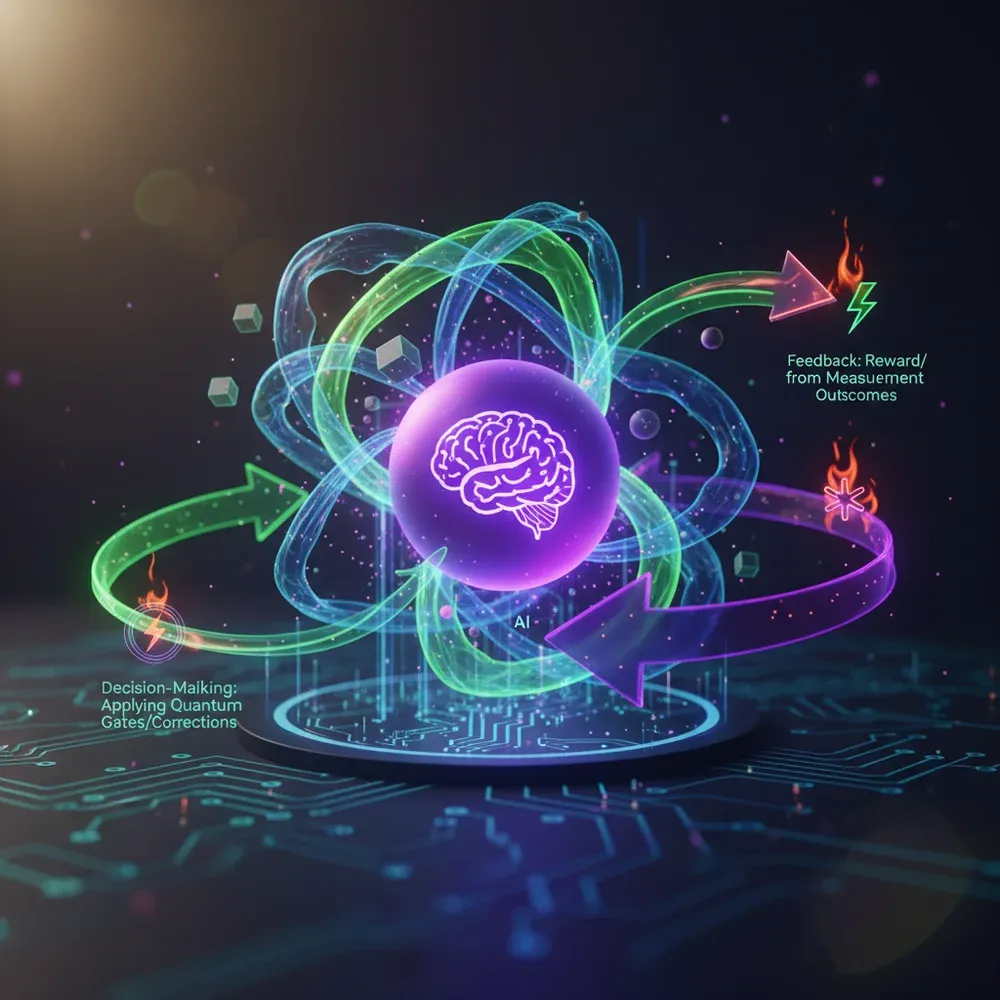
This is where Reinforcement Learning (RL) comes into play. NVIDIA's Ising models use RL algorithms to autonomously master QEC strategies. The AI agent acts as a 'player' whose goal is to maximize the stability of the quantum state. The environment is the noisy quantum processor, the state is the result of syndrome measurements, and the action is the application of correction gates.
The agent continuously interacts with the environment and receives a reward if it successfully preserves the quantum state, and a penalty if the information is lost. Over time, the agent discovers complex, non-linear error correction strategies that human researchers would be unable to design manually. Particularly in handling correlated errors (where a single noise source affects multiple qubits), RL-based agents show a drastic performance increase compared to traditional decoding algorithms (e.g., Minimum Weight Perfect Matching).
This autonomous learning capability makes data processing AI agents indispensable in building scalable quantum computers. If your company also wants to exploit the benefits of AI-driven optimization, it is worth considering the possibilities of custom automation, which are already available in classical systems today.
Extreme Complexity Logistics Optimization: Case Studies and Opportunities
One of the most promising application areas for quantum-classical hybrid systems and the AI agents that orchestrate them is combinatorial optimization. Global logistics chains, fleet management, and warehousing processes have reached a level of complexity that classical algorithms (such as the simplex method or heuristics) can only handle with compromises. The Traveling Salesperson Problem (TSP) or the Vehicle Routing Problem (VRP) becomes exponentially more difficult as the number of variables increases.
Data processing AI agents are capable of translating these logistics challenges into QUBO format, and then finding near-optimal solutions in seconds using quantum coprocessors. For a global shipping company, for example, the agent analyzes weather data, traffic information, port capacities, and the fuel consumption of ships in real time. The hybrid system can dynamically reroute thousands of containers in the event of an unexpected incident (e.g., the closure of the Suez Canal), minimizing delays and costs.
In the financial sector, these technologies can bring breakthroughs in portfolio optimization and risk analysis (e.g., Monte Carlo simulations). AI agents, with the help of quantum algorithms, can model market volatility and correlations between different asset classes much more accurately. In the pharmaceutical industry, the simulation of molecular docking and protein folding can accelerate drastically, shortening the time to market for new drugs.
These case studies clearly show that quantum AI is not just a theoretical research area, but the most important business weapon of the near future. Companies that integrate advanced data processing AI agents in time will gain an insurmountable competitive advantage in the market.
The Depths of Data Processing: What Data Do AI Agents Work With?
The data processing tasks of AI agents operating in quantum-classical hybrid systems are extremely diverse and complex. They must cope not only with traditional, structured relational databases, but also with data types that are completely alien to classical IT infrastructures. The foundation of successful operation is the construction of a robust, extremely low-latency data pipeline.
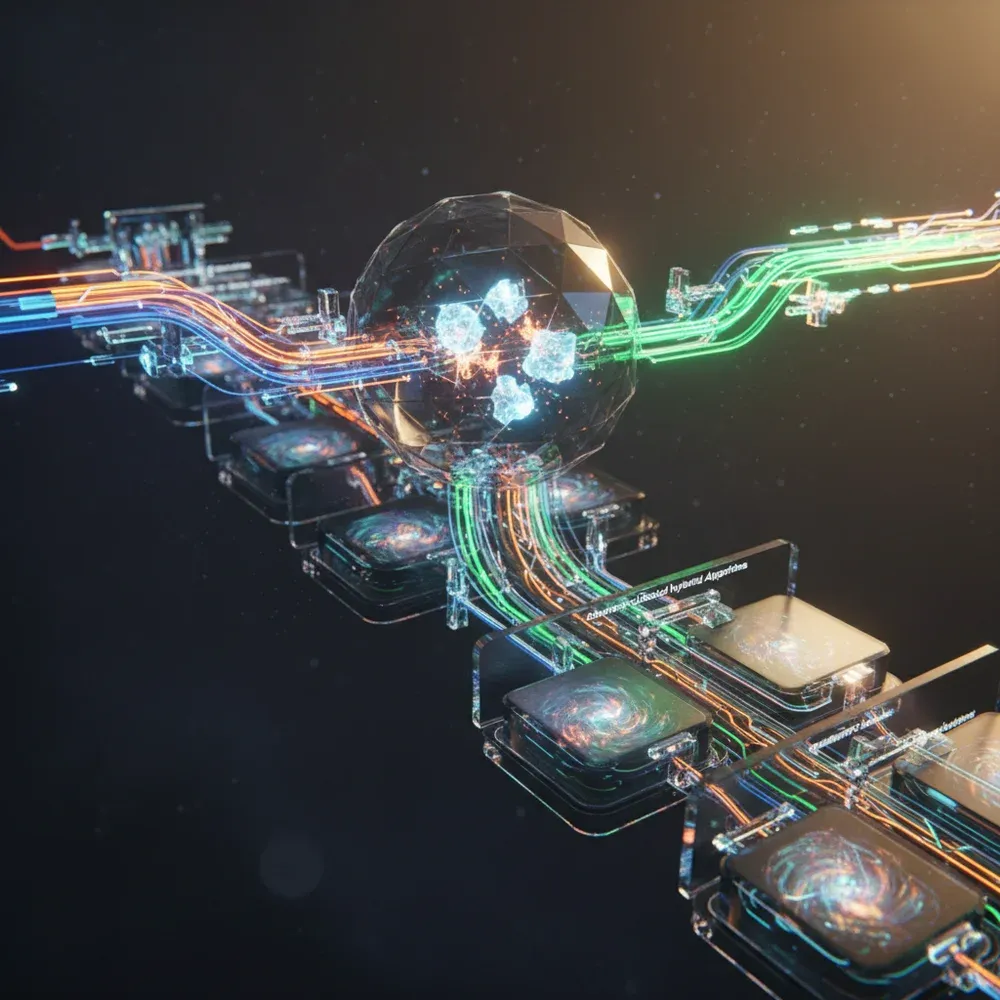
First, agents must handle classical enterprise data: logistics information from ERP systems, financial transactions, or real-time telemetry data from IoT sensors. The agents clean, normalize, and cast this data into a format suitable for parameterizing quantum algorithms. This process itself requires advanced machine learning models to filter out anomalies and impute missing data.
The second, much more critical data type is measurement data from quantum hardware. The results obtained during the measurement of quantum states are noisy and statistical in nature. AI agents must process massive amounts (often in the order of gigabytes/second) of syndrome data for error correction. This data cannot be stored on traditional hard drives; processing must occur directly in the GPU memory (VRAM), or even on network cards (DPUs) to minimize latency.
Finally, agents also work with simulation data. Before running quantum algorithms, parameters are often tested on classical emulators (like CUDA-Q). The AI agent compares the simulated results with the output of the real quantum hardware, and fine-tunes the noise models based on this. This continuous learning loop ensures that the system becomes increasingly accurate and reliable over time.
Challenges and Future Directions: The Path of Data Processing AI Agents Towards Full Potential
Although NVIDIA's Ising models and the CUDA-Q platform represent a massive leap, deploying data processing AI agents in a quantum-hybrid environment still faces several challenges. The most significant obstacle remains hardware limitations. The qubit count and coherence time of current quantum processors are still too low to solve real, large-scale industrial problems. While AI agents can mitigate these shortcomings with advanced error correction, they cannot completely overcome physical limits.
Another major challenge is data transfer bandwidth and latency. Quantum processors typically operate in cryogenic environments (at milliKelvin temperatures), while classical GPUs operate at room temperature. The cabling and signal processing between the two systems cause microsecond latencies, which can be critical during real-time error correction. Future directions include the development of photonic interconnects and classical control chips operating in cryogenic environments.
The interpretability (explainability) of AI models is also a critical issue, especially in regulated industries like finance or healthcare. If an AI agent makes an optimization decision based on a complex RL algorithm, companies need to know why that particular result was reached. The acceptance of 'black box' models is low, so researchers are working vigorously to integrate Explainable AI (XAI) techniques into quantum-hybrid systems.
Finally, the shortage of professionals is a significant inhibiting factor. Engineers are needed who understand quantum physics, machine learning, and High-Performance Computing (HPC) equally. Educational systems and corporate training programs must quickly adapt to this new interdisciplinary field to ensure the talent needed for future innovation.
Implementation Strategies in an Enterprise Environment: How to Get Started?
For CTOs and enterprise architects, the most important question is not whether quantum-hybrid technology will change the industry, but when and how to start integration. A wait-and-see strategy is risky; companies that wait only for fully mature, fault-tolerant quantum machines may fall into an insurmountable disadvantage compared to early adopters. The key is gradual, value-driven implementation.
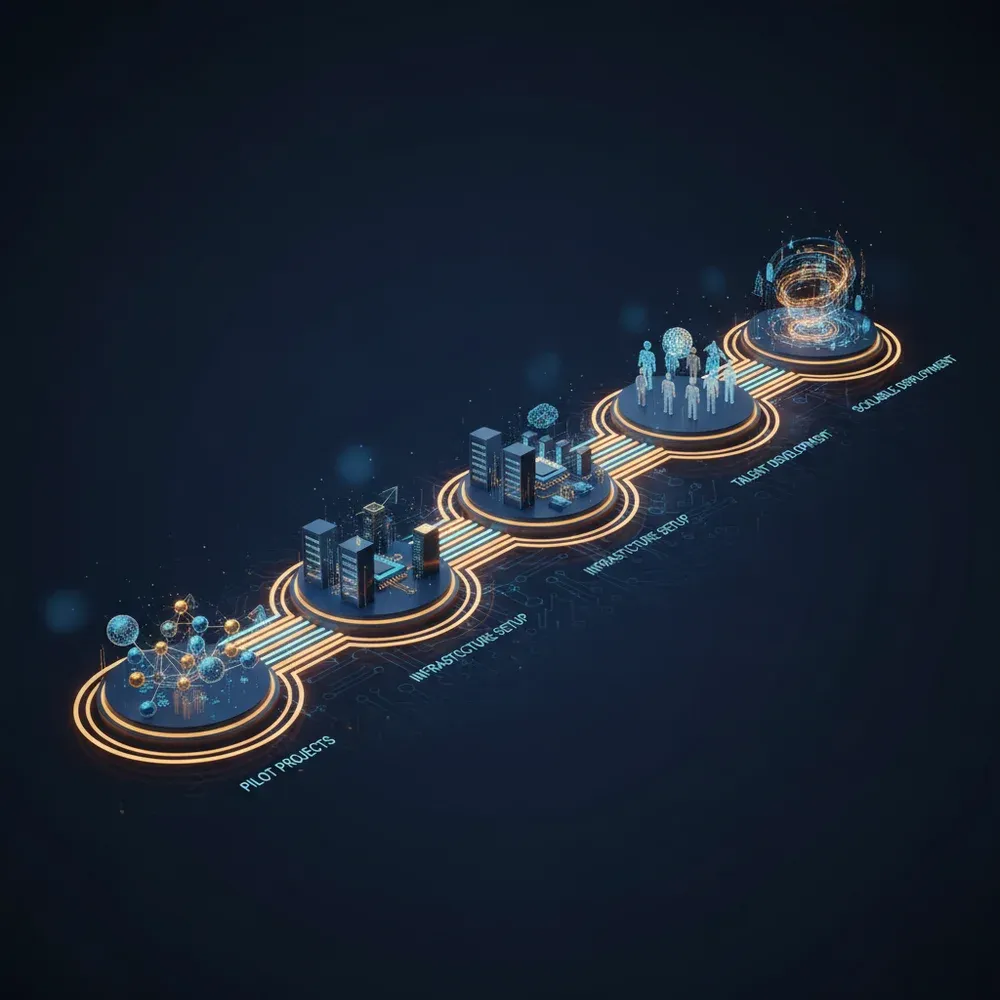
The first step is assessing quantum readiness. Companies must identify the bottlenecks in their current data processing and optimization workflows that classical systems can no longer handle efficiently. These will be the targets for potential 'Proof of Concept' (PoC) projects. It is worth choosing problems whose mathematical structure (e.g., QUBO) fits well with quantum-hybrid solutions.
The second step is establishing the appropriate infrastructure and software environment. It is not necessary to purchase proprietary quantum hardware immediately; cloud providers (AWS Braket, Azure Quantum) and NVIDIA's CUDA-Q platform provide excellent opportunities for simulation and the development of hybrid codes. Companies can begin training their own data processing AI agents on these simulated environments, preparing them for future interaction with real quantum hardware.
Third, talent development and building partnerships are essential. Companies should collaborate with research institutes, quantum startups, and specialized AI integrators like AiSolve. If you want to take the first steps towards intelligent systems, an AI Chatbot or a custom automation project can be an excellent starting point for establishing an enterprise AI culture.
The Future of Quantum AI: What Do Experts and NVIDIA Say?
The convergence of quantum-classical hybrid systems and AI agents will become the defining trend of the technology industry by the end of the 2020s. NVIDIA CEO Jensen Huang has repeatedly emphasized that artificial intelligence and quantum computing are not two separate fields, but two sides of the same coin. The introduction of the Ising models also supports this vision: AI is needed to operate quantum machines, and quantum machines are needed to train the next generation of AI.
Experts, including quantum informatics researchers from leading universities (MIT, Stanford), agree that the hybrid approach is the only viable path in the foreseeable future. The quantum AI breakthroughs show that machine learning can bridge the physical limits that hardware engineers could only solve decades from now. The role of autonomous data processing agents will appreciate as the complexity of systems exceeds the limits of human understanding.
In the future, we can expect quantum coprocessors to become as ubiquitous in data centers as GPUs are today. For software developers, quantum-classical hybrid programming will become a fundamental skill, and CUDA-Q and similar frameworks will be part of the everyday toolkit. Companies that invest in these technologies today will become the industry leaders of tomorrow.
Conclusion: Is Your Company Ready for the Quantum-Hybrid Revolution?
In conclusion, the emergence of NVIDIA's Ising models and the CUDA-Q platform is not just another technological milestone, but the beginning of a new era in data processing. Quantum-classical hybrid systems and the autonomous AI agents that orchestrate them offer unprecedented opportunities to solve complex problems, from logistics to drug discovery. These systems can manage quantum error correction in real time, optimize resources, and build a bridge between classical enterprise IT and the quantum hardware of the future.
The paradigm shift has already begun. The data explosion and the limitations of classical computing are forcing innovation. For enterprises, the question is not whether to adopt these technologies, but when. Early preparation, building the right infrastructure, and implementing AI-driven automation are critical for future competitiveness.
Don't wait until your competitors gain a head start. Start preparing today! Discover how you can transform your company's processes with the help of custom automation and advanced data processing AI agents. Contact the experts at AiSolve, and let's build your future-proof, intelligent enterprise architecture together!
Frequently Asked Questions (FAQ)
Which industries can benefit most from data processing AI agents in quantum-classical systems?
The most affected industries are logistics and transportation (route optimization), the financial sector (risk analysis and portfolio optimization), the pharmaceutical industry (molecular simulations and drug discovery), and materials science (development of new, lighter, and stronger alloys). These areas all struggle with combinatorial problems of extreme complexity that classical systems can no longer solve efficiently.
How secure are data processing AI agents in handling critical enterprise data?
Data security is a primary consideration. Modern AI agents, especially solutions integrated into enterprise environments, are built on a Zero Trust architecture. In quantum-hybrid systems, classical data remains encrypted, and only the necessary parameters are transferred to the quantum processor. In addition, on-premise deployment options and edge computing ensure that sensitive data never leaves the company's internal network.
What expertise is required to implement and manage a data processing AI agent system?
Successful implementation requires an interdisciplinary team. Data Scientists who understand machine learning and RL models are needed; quantum engineers who know the basics of quantum algorithms; and DevOps and MLOps professionals to maintain a scalable infrastructure. However, platforms like CUDA-Q are increasingly abstracting complexity, allowing classical software developers to enter the field as well.
How does the CUDA-Q platform facilitate the development of AI agents powered by NVIDIA Ising models?
CUDA-Q provides a unified programming model that seamlessly connects CPUs, GPUs, and QPUs. It allows developers to write standard C++ or Python code, which the platform automatically optimizes and distributes among the appropriate hardware components. The Ising models are natively integrated into this ecosystem, so AI agents can directly access quantum simulators and physical hardware with minimal latency.
What are the main challenges in the large-scale deployment of data processing AI agents?
The main challenges include the current immaturity of physical quantum hardware (noise levels and low qubit counts), the data transfer latency between classical and quantum systems, and the shortage of skilled professionals. In addition, companies must grapple with the problem of AI model interpretability (XAI) to be able to prove the transparency of decision-making processes in regulated industries.
How do quantum AI agents compare to traditional machine learning models in data processing?
While traditional ML models (e.g., random forests, deep neural networks) excel at pattern recognition on static data, quantum AI agents are autonomous, goal-oriented entities. They are capable of interacting with the quantum environment in real time, using reinforcement learning (RL) for error correction, and solving high-dimensional optimization problems that would be computationally intractable for traditional models.
What are the infrastructure requirements for a quantum-classical hybrid AI agent system?
Building such a system requires a high-level HPC (High-Performance Computing) infrastructure. High-end GPUs (e.g., NVIDIA H100 or B200) are needed for classical data processing and running AI agents, along with high-bandwidth, low-latency network connections (e.g., NVLink, InfiniBand), and access to quantum processors (either via the cloud, like AWS Braket, or local simulators, like DGX Quantum).
Készen állsz a saját weboldaladra?
Ingyenes konzultáció során átbeszéljük, hogyan segíthetünk vállalkozásodnak növekedni egy modern, gyors és konverzióoptimalizált weboldallal. 14 nap alatt kész, 0 Ft induló költséggel.