
Microsoft's $10 billion investment in Japan and the new Cyber Defense Center have made it clear: the future of AI is local and sovereign. For enterprises, using public cloud models poses an increasing security risk. The solution is custom automation built on Sovereign AI infrastructure, guaranteeing complete control over data, strict regulatory compliance (GDPR, HIPAA), and maximum operational efficiency. This article explores how companies can build secure, proprietary data-driven automation systems with the highest level of protection.
Introduction: The Era of Secure, Localized Automation in the AI Age
Global technological geopolitics has reached a turning point. Microsoft's recently announced $10 billion investment in Japan and the associated establishment of a Cyber Defense Center carry a clear message. Data sovereignty is no longer just an abstract legal category, but the absolute cornerstone of national security and corporate competitiveness.
This gigantic infrastructural move not only doubles the island nation's artificial intelligence capacity but also creates a new global standard. The era of Sovereign AI has officially begun, where minimizing cross-border data movement is the primary goal.
In this new era, blind trust in the public cloud and shared language models is no longer sufficient for enterprises. Building local, secure, and fully controlled custom automation systems has become the key to long-term survival and market dominance.
The Problem: Data Security in the Public Cloud
Enterprises take on increasing risks when they entrust their sensitive business data to third-party, cross-border public LLMs (Large Language Models). Data leaks, loss of intellectual property, and regulatory non-compliance (e.g., GDPR) pose a critical, even existential threat to the company.
Understanding Sovereign AI: More Than Just Data Residency
It is a common misconception that sovereign AI is limited to storing data physically on servers located within the borders of a given country. While data residency is an important component, Sovereign AI is a much more comprehensive, multi-layered concept.
True sovereignty also includes operational sovereignty. This means that the enterprise or state has complete control over the hardware, software infrastructure, training datasets, and model weights. There is no hidden telemetry and no external, unverifiable API calls.
Furthermore, exclusive ownership of security controls is a critical element. Encryption Key Management must be handled by the organization itself, ensuring that not even the cloud provider providing the physical infrastructure (such as Azure or AWS) can access the raw data or model outputs.
Definition: Sovereign AI
Sovereign AI refers to an artificial intelligence ecosystem that a given nation, region, or enterprise builds, trains, and operates within its own borders, in accordance with local laws, cultural values, and strict data protection regulations, guaranteeing complete technological independence.
Microsoft's Strategic Investment in Japan: A Blueprint for Global Sovereign AI
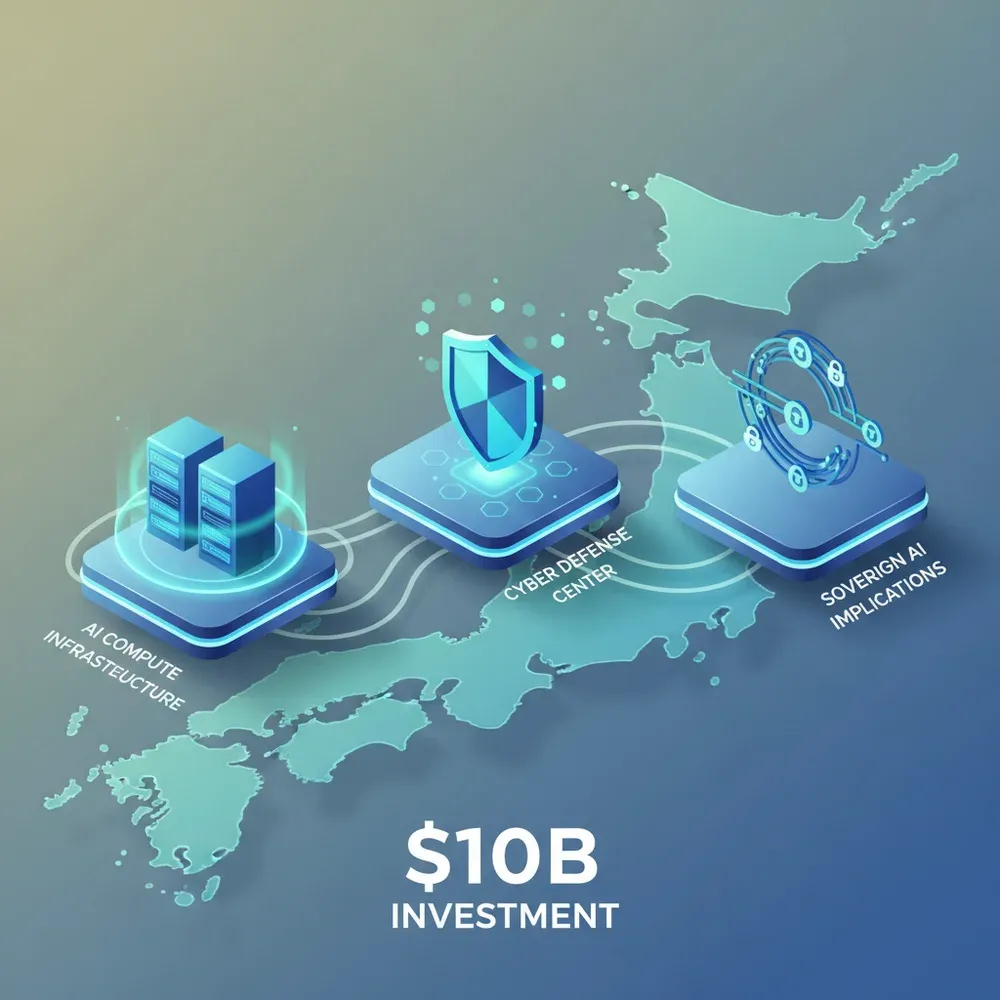
When Microsoft announced its $10 billion investment in Japan, the tech world immediately recognized the gravity of the move. This is the largest investment ever made by the company in the island nation, fundamentally redrawing the digital map of the Asia-Pacific region.
The backbone of the investment is a drastic increase in compute capacity. The local deployment of next-generation GPUs (like NVIDIA H100 and B200 architectures) allows Japanese companies to train massive AI models without a single bit of their data leaving the country.
The Role of the Cyber Defense Center
Alongside hardware expansion, the most important strategic element is the establishment of the new Cyber Defense Center. This center is dedicated to countering nation-state level cyber threats (APTs) and sophisticated, AI-driven attacks.
Protecting modern AI infrastructure today requires proactive, intelligent systems. The center works closely with the Japanese government, sharing real-time threat intelligence, which is a critical trust (E-E-A-T) signal for large enterprises.
This move serves as a clear blueprint for the rest of the world. It demonstrates how hyperscaler cloud providers can meet national sovereignty demands without compromising on performance or innovation.
From Infrastructure to Innovation: How Sovereign AI Powers Custom Automation
Robust, local infrastructure is just an empty server room on its own. The real business value lies in the software solutions running on this foundation, especially artificial intelligence-driven custom automation systems.
The sovereign AI framework eliminates one of the biggest fears of developers and system architects: security risk. When it is guaranteed that data remains within a closed, controlled network, companies can much more boldly integrate AI into their most critical processes.
For example, a data processing AI agent reading sensitive data from a company's financial ERP system can perform complex predictive analytics in a sovereign environment without violating internal compliance policies.
This isolated, yet infinitely scalable environment allows AI-driven custom automation to flourish. Instead of off-the-shelf software, companies can develop their own autonomous agents perfectly tailored to their internal processes.
The Unrivaled Advantages of Custom Automation in a Sovereign AI Framework
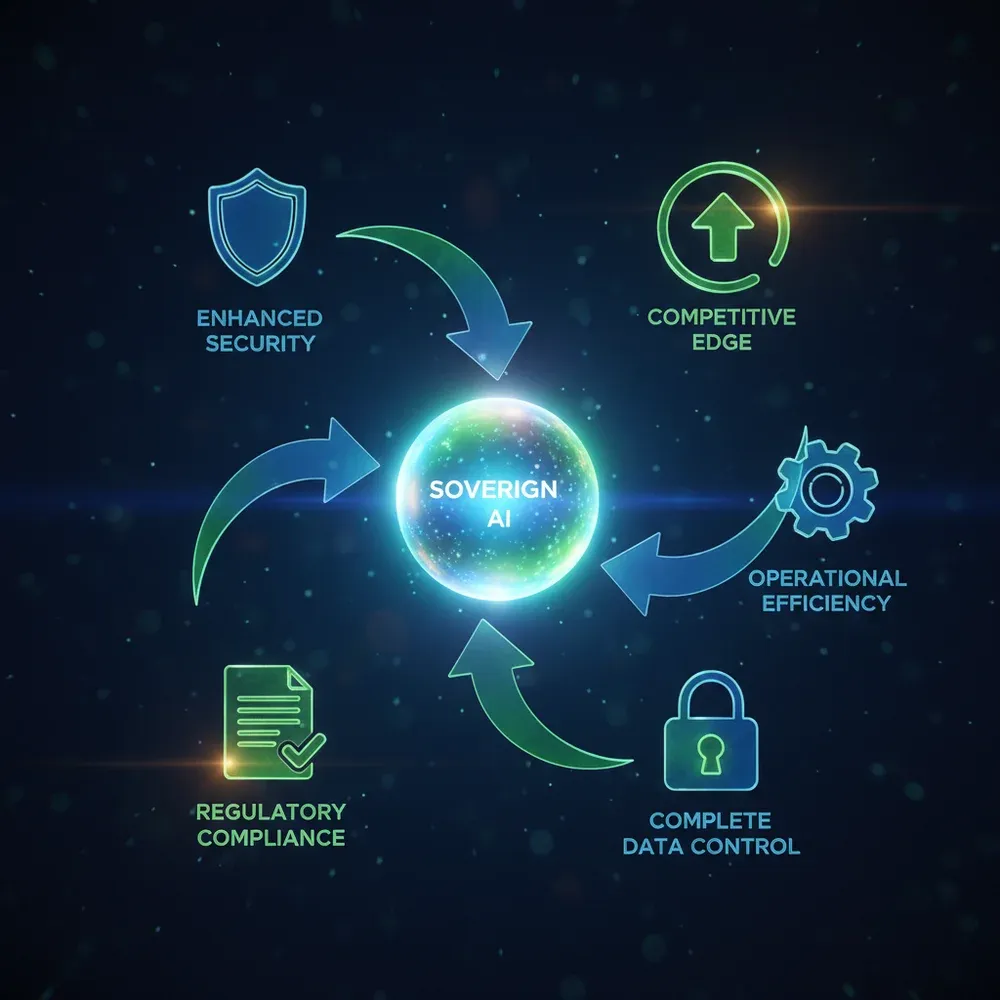
When custom automation meets sovereign AI infrastructure, the synergy creates a competitive advantage that is impossible to reproduce with traditional SaaS-based solutions. The first and most important advantage is uncompromising data security.
For industries operating in a strict regulatory environment (such as finance or healthcare), compliance with GDPR, HIPAA, or local directives is not an option, but a mandatory requirement. Local models guarantee 100% auditability and compliance.
Operational Efficiency and Complete Control
The second huge advantage is a drastic increase in operational efficiency. Because the models are fine-tuned on the company's own specific data or supported by a RAG (Retrieval-Augmented Generation) architecture, the accuracy and relevance of the answers are orders of magnitude better than general models.
Furthermore, the company is freed from the worst forms of vendor lock-in. There is no need to fear that OpenAI or Google will suddenly change API pricing, modify terms of use, or degrade the model's performance on a specific task with an update.
Key Benefits: Sovereign Custom Automation
- Zero Data Leakage: Sensitive data and prompts never leave the protected corporate network (VPC).
- Guaranteed Compliance: Built-in, transparent adherence to GDPR, HIPAA, NIS2, and local industry regulations.
- Independence: No exposure to global cloud provider outages, API limits, or unexpected policy changes.
- Competitive Edge: Unique AI systems trained exclusively on proprietary know-how, impossible for competitors to copy.
Ready for secure, localized automation?
Don't trust your most sensitive corporate data to public models. Let's build your own sovereign AI-driven automation system together, guaranteeing security and efficiency.
Request a Free ConsultationArchitecting for Trust: Key Pillars of Secure Custom Automation
Designing a sovereign automation system requires deep technical expertise and a security-first approach. The foundation is robust Data Governance, which precisely defines what data AI models can access, when, and how.
The second pillar is strict Identity and Access Management (IAM). In a modern system, Zero Trust Architecture (ZTA) is the guiding principle: no single API call or database query enjoys automatic trust. Every interaction must be authenticated and authorized at a micro-level.
Proactive Defense and Secure SDLC
It is especially important to consider the security risks of data processing AI agents. Autonomous agents endowed with excessive privileges can perform lateral movement in the network in the event of a compromise. To avoid this, Role-Based Access Control (RBAC) and continuous, AI-driven anomaly detection are essential.
Finally, integrating a secure Software Development Life Cycle (SDLC) is inevitable. As the traditional software development lifecycle (SDLC) transforms, security screening (SAST/DAST) of code-generating AIs and automated testing pipelines (CI/CD) becomes the guarantee of the sovereign environment's integrity.
Implementing Custom Automation: A Strategic Roadmap for Enterprises
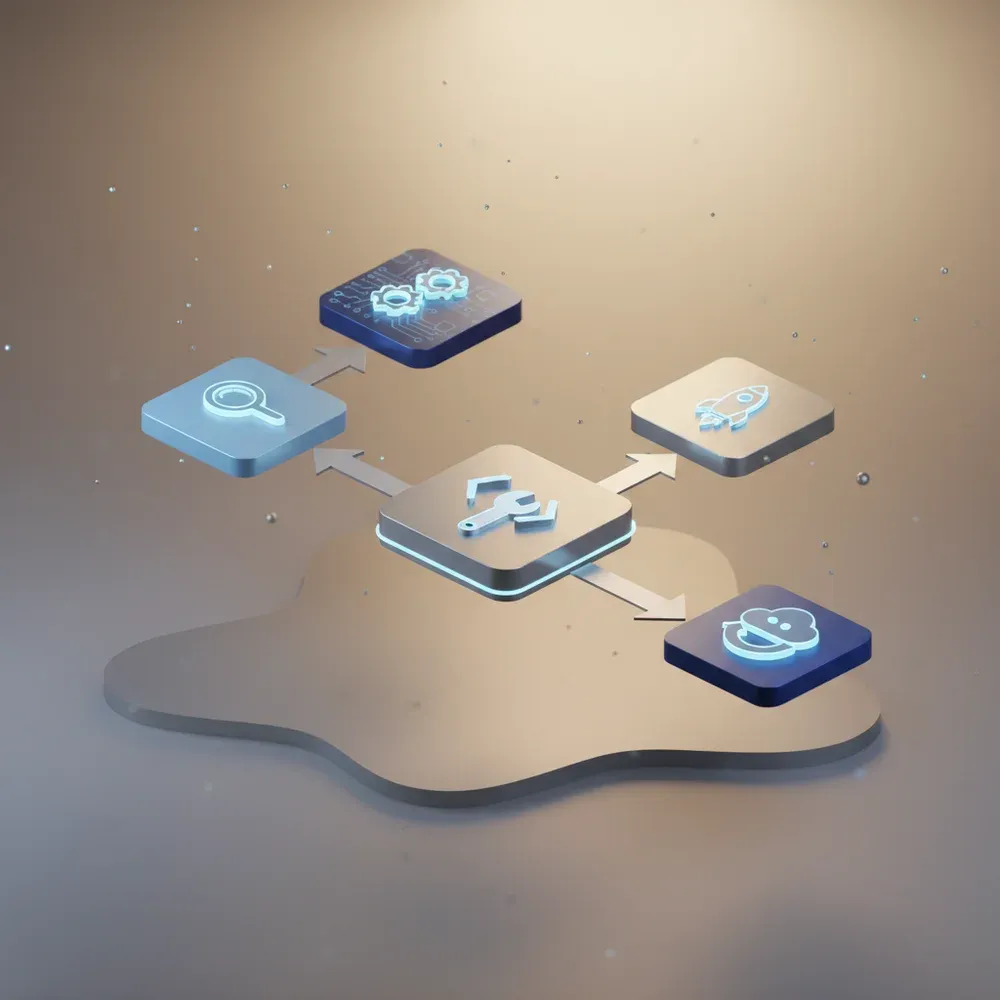
Implementing a sovereign custom automation project is not just an IT task, but a comprehensive business transformation. The process begins with a thorough Needs Assessment and Audit. This is where bottlenecks must be identified where manual data processing consumes the most time and resources.
The second step is selecting the Technology Stack. In an enterprise environment, Microsoft Azure's sovereign cloud solutions (Azure AI Studio, local data centers) provide an excellent foundation. A decision must be made between hosting open-source models (e.g., Llama 3, Mistral) locally or using closed services running in a sovereign region.
Development, Integration, and Continuous Optimization
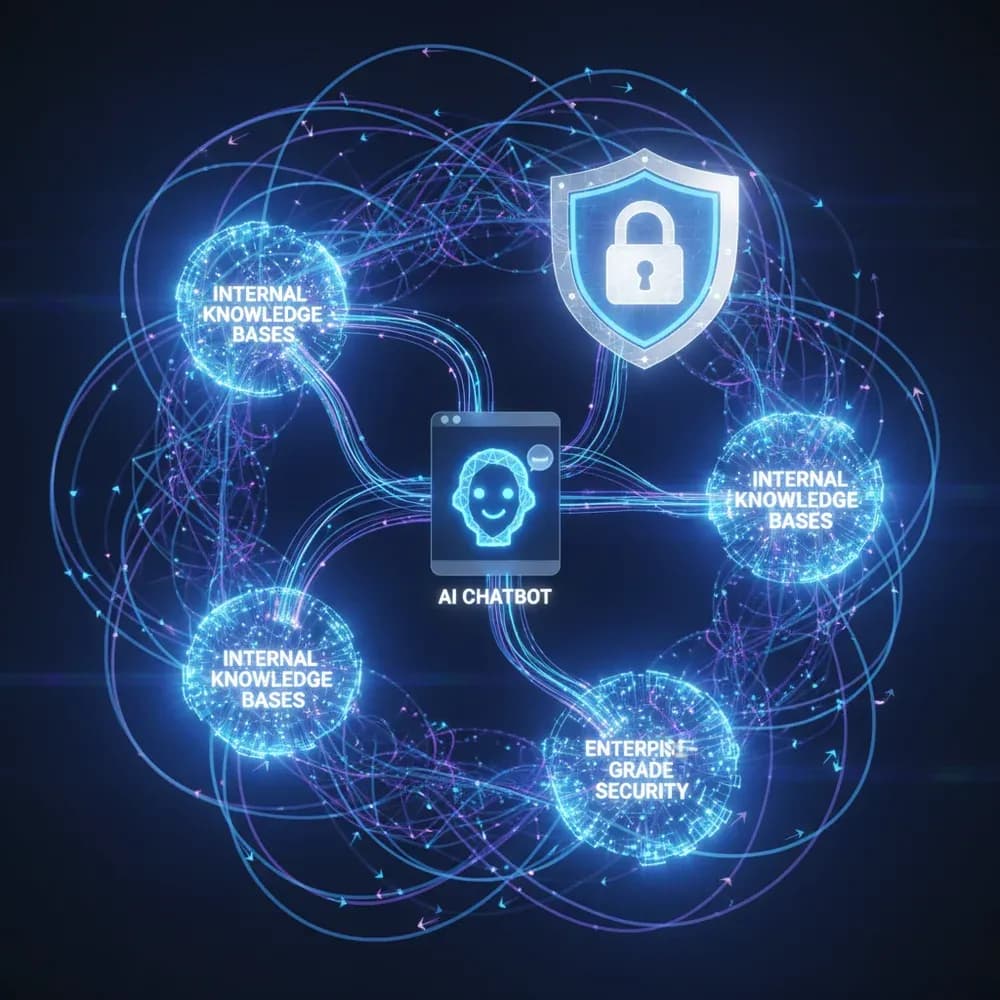
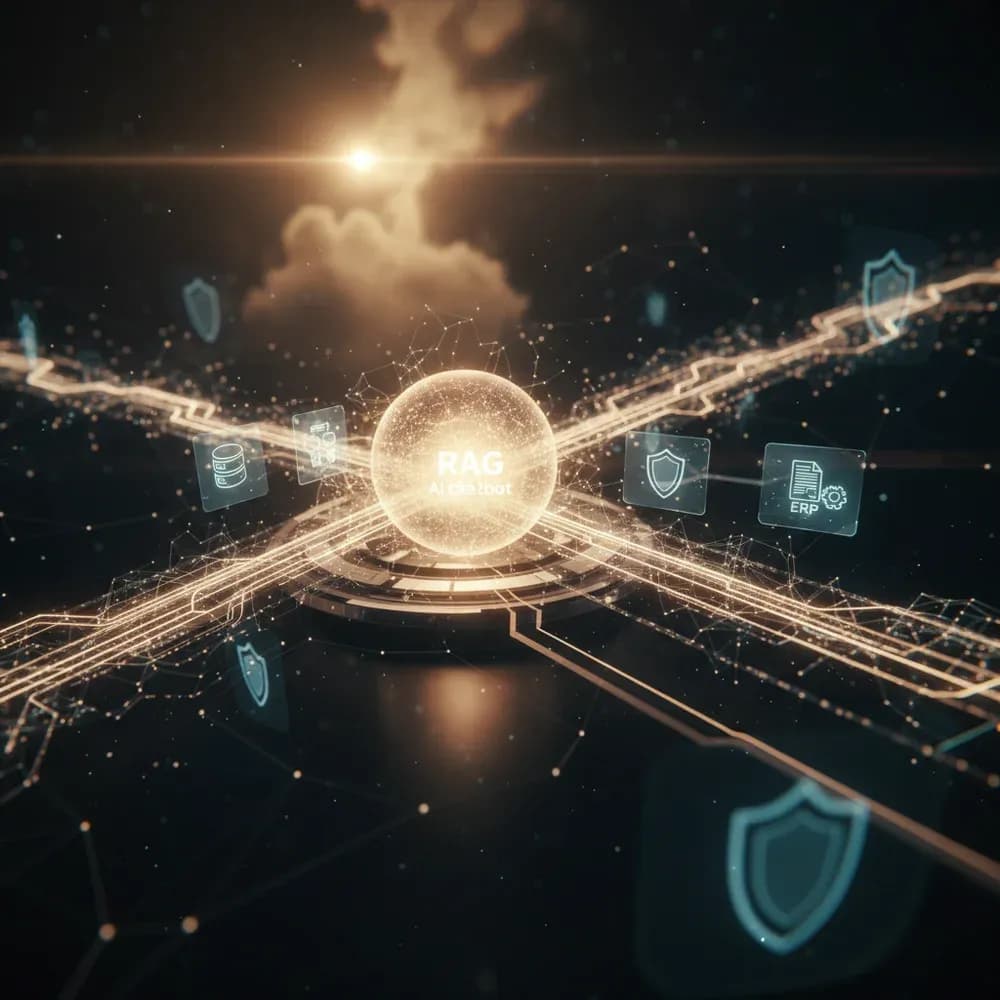
During the development phase, the most common and effective approach is building a RAG (Retrieval-Augmented Generation) architecture. This ensures the model works from the company's own knowledge base, minimizing hallucinations. Secure RAG AI chatbots and internal assistants can generate immediate ROI.
After Deployment, the work is not over. Continuous monitoring, measuring model performance, drift detection (when model responses degrade over time), and establishing Feedback Loops guarantee the long-term sustainability and accuracy of the system.
Real-World Impact: Use Cases for Sovereign Custom Automation
The theoretical advantages of sovereign AI produce impressive results in practice. In the Financial Sector, for example, banks use local LLMs for real-time analysis of SWIFT transactions and Fraud Detection. Since the data does not leave the bank's closed network, banking secrecy and PSD2 directives are fully met.
In Healthcare, hospitals employ sovereign AI chatbot (RAG) solutions to quickly summarize patient medical histories and support diagnostics. The system runs on the institution's own on-premise servers, so sensitive health data (HIPAA/GDPR) remains completely secure, while doctors' administrative burden is reduced by 40%.
In the Government sector and Critical Infrastructure (e.g., energy providers), custom automation accelerates cybersecurity log analysis and Incident Response. Local systems similar to Microsoft's Cyber Defense Center can identify network anomalies in fractions of a second, isolating threats without human intervention.
Navigating the Landscape: Challenges and Best Practices in Sovereign Automation

While the benefits are undeniable, implementing sovereign automation also comes with serious challenges. One of the biggest hurdles is the global Skill Gap. There are few engineers on the market who simultaneously understand Deep Learning fine-tuning, vector databases, and enterprise network security.
Another major challenge is integration with existing Legacy systems. Decades-old, monolithic architectures struggle to communicate with modern, API-driven AI agents. The solution is often developing Middleware or initiating a Refactoring process.
Risk Mitigation and Avoiding Vendor Lock-in
Companies often fear Vendor Lock-in regarding hardware or cloud providers. Best practice involves using containerized architectures (Docker, Kubernetes) and open-source frameworks (LangChain, LlamaIndex), which ensure system portability across different sovereign clouds.
Cost management is also a critical point. Building or renting local GPU capacity requires significant capital expenditure (CAPEX). To mitigate this, it is worth using smaller, quantized models (e.g., 8B or 14B parameter LLMs), which require fewer hardware resources but perform excellently on specific tasks.
Struggling with Legacy System Integration?
Our expert team helps bridge the gap between old systems and the latest AI technologies. We build secure, scalable solutions.
Request a Technical AuditMeasuring Success: Quantifying the ROI of Secure Custom Automation
Technological investments are ultimately about business Return on Investment (ROI). Measuring the success of a sovereign automation project happens across multiple dimensions. The first and most easily measurable metric is direct cost savings resulting from replacing manual, repetitive tasks.
However, for sovereign systems, the value of risk reduction must be included in the ROI calculation. How much would a data leak scandal cost? What would the GDPR fine be if sensitive customer data ended up in a public LLM training dataset? Reducing these risks to zero represents massive financial value.
ROI Metrics (KPIs) in Sovereign Automation
- Operational Cost Reduction (OPEX): Drastic savings in man-hours spent on manual data processing and administration.
- Risk Mitigation Value: Avoiding potential data protection fines (e.g., GDPR 4% of global revenue) and reputational damage.
- Processing Speed (SLA): Up to 80-90% reduction in turnaround time for critical business processes.
- Infrastructure Payback: The payback period for local hardware or sovereign cloud investment (typically 12-18 months).
The Future is Local and Automated: Preparing for the Next Wave
Microsoft's investment in Japan and the establishment of the Cyber Defense Center are not isolated incidents, but the first visible signs of a global paradigm shift. The artificial intelligence of the future will not run in a distant, opaque server center, but within the strictly guarded digital borders of enterprises themselves.
Companies that recognize the importance of sovereign AI and custom automation in time will not only guarantee their security but also gain an insurmountable competitive advantage. They will be able to use their own data as a weapon in the market without exposing it to competitors or tech giants.
The transition cannot wait. The technology is ready, regulatory pressure is increasing, and competitors have already made their move. The question is not whether to implement sovereign automation, but how quickly your company can adapt to this new, security-driven era.
Step onto the Path of Secure Innovation
AiSolve's expert team helps design and implement your company's own sovereign AI automation system. Protect your data and maximize efficiency.
Let's Start Working TogetherFrequently Asked Questions (FAQ)
What is Sovereign AI, and why is it critical for large enterprises?
Sovereign AI refers to artificial intelligence infrastructure and models operated within the borders of a given organization or country, with complete data control. For large enterprises, this is critical for complying with strict data protection regulations (e.g., GDPR, HIPAA), protecting intellectual property, and establishing independence from public cloud providers.
How does Microsoft's Japan investment impact global AI security and custom automation?
Microsoft's $10 billion investment and the creation of the Cyber Defense Center created a new global standard, a 'blueprint'. It proved that hyperscaler providers can also provide local, sovereign infrastructure, allowing companies to develop custom automation solutions without compromise, with maximum security.
What are the key security considerations for custom automation solutions?
Key considerations include applying Zero Trust Architecture (ZTA), strict Identity and Access Management (IAM), Role-Based Access Control (RBAC) for AI agents, data encryption (at rest and in transit), and integrating a secure Software Development Life Cycle (SDLC) with continuous vulnerability scanning.
Can custom automation integrate with existing legacy systems?
Yes, although this can be a technical challenge. Modern AI agents can communicate with decades-old, monolithic legacy systems via APIs, custom middleware layers, or even RPA (Robotic Process Automation) technologies, bridging the technological gap without sacrificing security.
Which industries benefit most from sovereign AI-powered custom automation?
The most affected sectors are strictly regulated industries: financial services (banks, insurance companies), healthcare (hospitals, pharmaceuticals), the government and defense sector, and companies operating critical infrastructure (e.g., energy, telecommunications), where data security and compliance are paramount.
How can the Return on Investment (ROI) of a sovereign custom automation project be measured?
ROI is measured across multiple dimensions: direct operational cost reduction (saved man-hours), process acceleration (SLA improvement), and the value of risk mitigation (avoided data protection fines and reputational damage). Furthermore, new business opportunities generated by models trained on proprietary data also increase returns.
What role does a Cyber Defense Center play in the security of enterprise automation?
A Cyber Defense Center provides proactive, real-time threat intelligence. It continuously monitors the network against nation-state level attacks (APTs) and AI-driven cyber threats, ensuring that enterprise automation systems and the infrastructure supporting them remain protected against even the most sophisticated attacks.
Készen állsz a saját weboldaladra?
Ingyenes konzultáció során átbeszéljük, hogyan segíthetünk vállalkozásodnak növekedni egy modern, gyors és konverzióoptimalizált weboldallal. 14 nap alatt kész, 0 Ft induló költséggel.