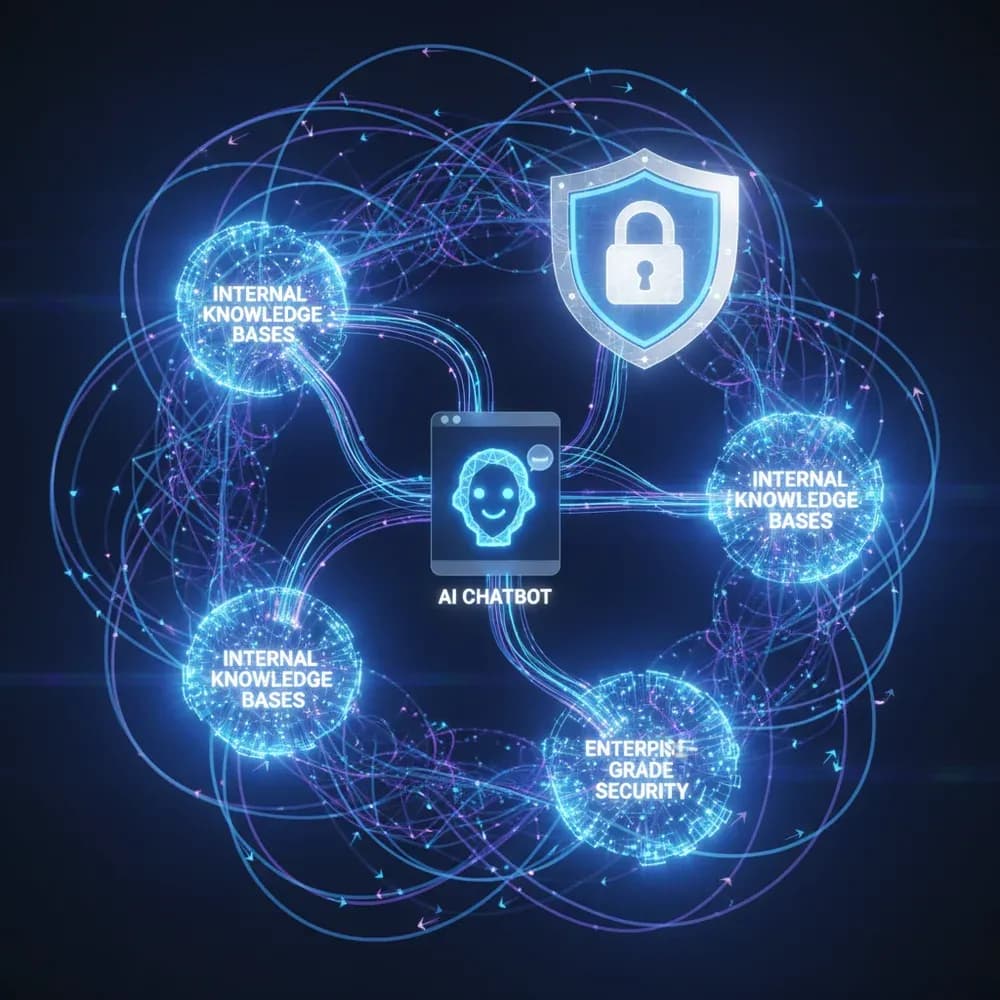
The corporate adoption of artificial intelligence has reached a new milestone. While Large Language Models (LLMs) like the GPT series have demonstrated impressive capabilities, their application in an enterprise context has faced significant challenges. Inaccurate information, outdated knowledge, and data security concerns have hindered widespread adoption. The answer to this problem is Retrieval-Augmented Generation (RAG) technology, which is increasingly becoming the cornerstone of enterprise AI strategies. This trend is reinforced by the recently announced partnership between ServiceNow and Anthropic, which aims to integrate Anthropic's Claude models into the ServiceNow platform, prioritizing trustworthy and secure AI solutions.
This article provides an in-depth analysis of why RAG AI chatbots represent a revolutionary breakthrough for businesses. We will explore how the technology works, its business advantages, and provide a step-by-step guide to implementation, so you too can unlock its immense potential.
Introduction: Moving Beyond LLM Limitations in Enterprise AI
The explosion of Large Language Models (LLMs) into public consciousness brought immense promise for corporate automation and efficiency gains. The idea of an intelligent assistant that could instantly answer complex questions, summarize documents, or even write code captured the imagination of many leaders. However, the initial enthusiasm was soon followed by sobering realities.
Traditional LLMs, while incredibly versatile, have a fundamental limitation: their knowledge is static. Their training database is frozen at a specific point in time, so they are unaware of the latest events, market changes, or a company's internal, private data. This raises several critical issues:
- Hallucinations: When an LLM lacks the necessary information, it tends to 'invent' an answer, which can lead to serious business errors and a loss of trust.
- Outdated Data: A model whose knowledge ends in 2023 cannot provide relevant advice on 2026 market trends or the latest internal policies.
- Data Security Risks: Using public LLMs can expose a company's sensitive data to external servers, raising significant privacy and compliance concerns.
The Problem and The Solution
The Problem: Standard LLMs are inaccurate, outdated, and insecure for enterprise data. They cannot access internal knowledge bases, making them unreliable for critical business tasks.
The Solution: RAG (Retrieval-Augmented Generation) technology, which connects LLMs to a company's own real-time data sources. This guarantees accuracy, timeliness, and data security, enabling the creation of trustworthy enterprise AI assistants.
RAG addresses these challenges not by replacing LLMs, but by augmenting and enhancing them. RAG enables a kind of 'open-book exam' for artificial intelligence, where it retrieves relevant, verified information from the company's own documents before generating an answer. This paradigm shift allows AI to become a truly reliable and valuable tool in the corporate ecosystem.
What is a RAG (Retrieval-Augmented Generation) AI Chatbot?
Retrieval-Augmented Generation, or RAG, is an artificial intelligence architecture that combines the generative capabilities of Large Language Models (LLMs) with an information retrieval mechanism from an external knowledge base. Simply put, a RAG chatbot doesn't just rely on its pre-trained, general knowledge; for every question, it 'looks up' the relevant information in the company's own trusted data sources.
Imagine the difference between a student writing an essay from memory and another who can use the library, their notes, and the latest research materials. The RAG chatbot is the latter student: its answers are well-founded, backed by facts, and always based on the most current, relevant sources.
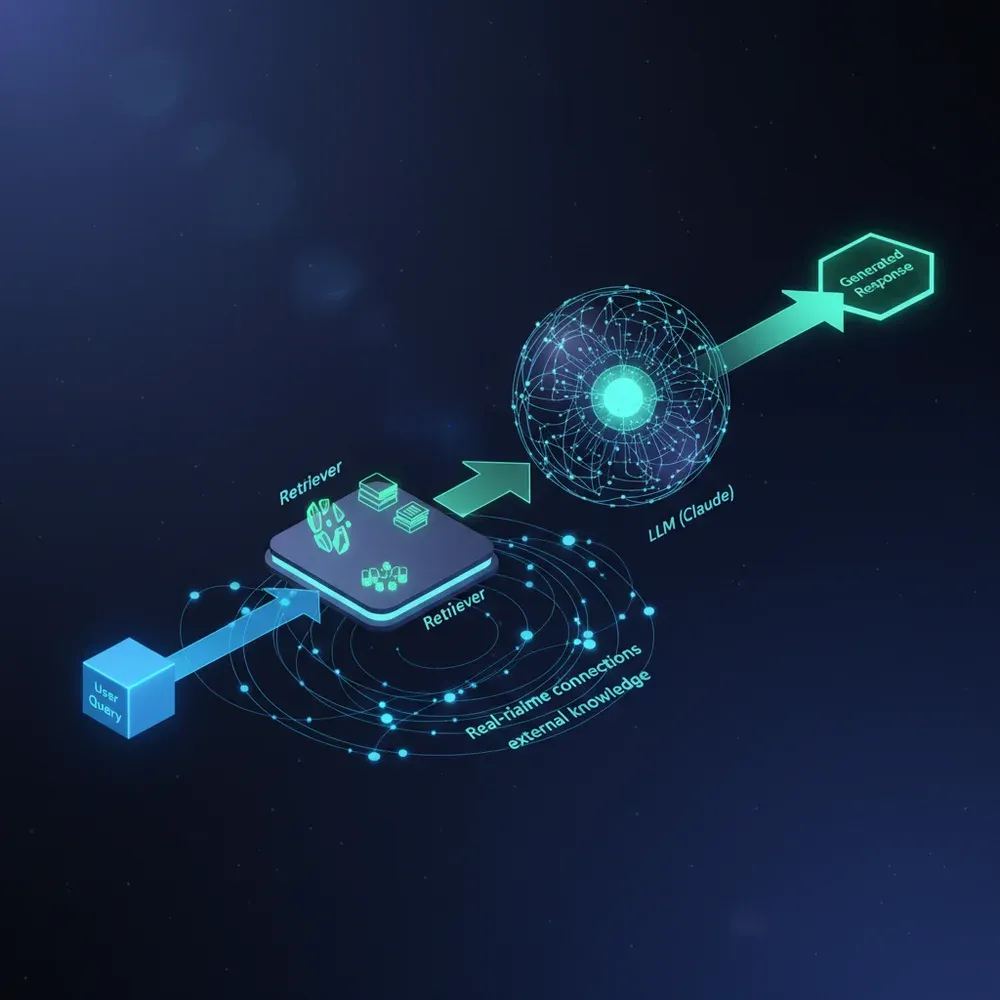
A RAG system consists of two main components:
- The Retriever: This component is responsible for finding the most relevant pieces of information from the company's knowledge base based on the user's query. This knowledge base can be anything: PDF documents, Word files, websites, Confluence pages, database records, or even the results of API calls. The retriever uses a special type of database, called a vector database, for lightning-fast, context-based searching.
- The Generator: This is typically a powerful LLM (like Anthropic's Claude or OpenAI's GPT-4). After the retriever has collected the relevant information (the 'context'), it passes it to the generator along with the user's query. The LLM's task is to generate a coherent, human-readable, and accurate answer based on this context.
Definition: RAG
RAG (Retrieval-Augmented Generation) is an AI method that enhances a language model's response generation by dynamically retrieving relevant information from an external, up-to-date knowledge base. Instead of relying solely on its static training data, RAG allows the model to look up and cite facts, drastically increasing the accuracy and reliability of its answers.
This process ensures that the chatbot's answers are not only grammatically correct but also factually accurate and based on the company's specific knowledge. RAG thus bridges the gap between general-purpose AI models and specific enterprise needs.
Why RAG is Essential for Your Enterprise AI Strategy?
RAG is not just a technical improvement; it's a strategic necessity for any company serious about implementing artificial intelligence. While a general chatbot might suffice for experimentation, in a live business environment, reliability, security, and accuracy are non-negotiable. RAG meets these critical enterprise needs precisely.
Let's look at the key reasons why RAG is essential for a modern enterprise AI strategy:
- Minimizing Hallucinations: This is perhaps the most important benefit. Because the RAG model bases its answers on retrieved, verified company documents, the chance of generating false information is drastically reduced. The model is 'anchored' to facts, which is essential for trustworthy operation.
- Enhanced Data Security and Privacy: The RAG architecture allows a company to have full control over its data flows. The private knowledge base can remain on the company's own infrastructure (on-premise) or in its private cloud, and only relevant snippets of information are passed to the LLM at the time of response generation. This prevents sensitive data leakage and ensures GDPR compliance.
- Access to Real-Time and Proprietary Data: The market is constantly changing, and internal policies are updated. RAG systems can instantly index new information, so the chatbot's knowledge is always up-to-date. Whether it's the latest sales figures, a new HR policy, or the technical specifications of a new product, the chatbot has immediate access.
- Improved Accuracy and Relevance: RAG chatbots provide specific, context-aware answers, not generic ones. They understand corporate jargon, are familiar with internal processes, and know product-specific details, which enhances both user experience and efficiency.
- Transparency and Auditability: A well-implemented RAG system can cite the sources it used to generate an answer. This allows users to verify the information's correctness, which increases trust in the system and is crucial in regulated industries (e.g., finance, healthcare).
These capabilities make RAG the cornerstone of trusted enterprise AI applications. If you'd like to learn how we can build such a secure and effective system for your company, explore our intelligent customer service AI chatbot service.
The ServiceNow and Anthropic Partnership: Claude Models for Enterprise
The maturity of the enterprise AI market is well illustrated by strategic partnerships like the one between ServiceNow and Anthropic. This alliance is not just a collaboration between two tech giants; it's a clear signal that the future of enterprise AI solutions will be built on reliability, security, and customizability—all principles that the RAG architecture embodies.
ServiceNow, the market leader in digital workflows, manages a vast amount of structured and unstructured enterprise data. Anthropic, known for its commitment to safety-focused AI development, offers a powerful yet controllable language model with its Claude family. The essence of the partnership is to natively integrate Anthropic's Claude models into the ServiceNow platform, allowing companies to harness the power of generative AI directly within their workflows.
This partnership highlights the importance of RAG in several ways:
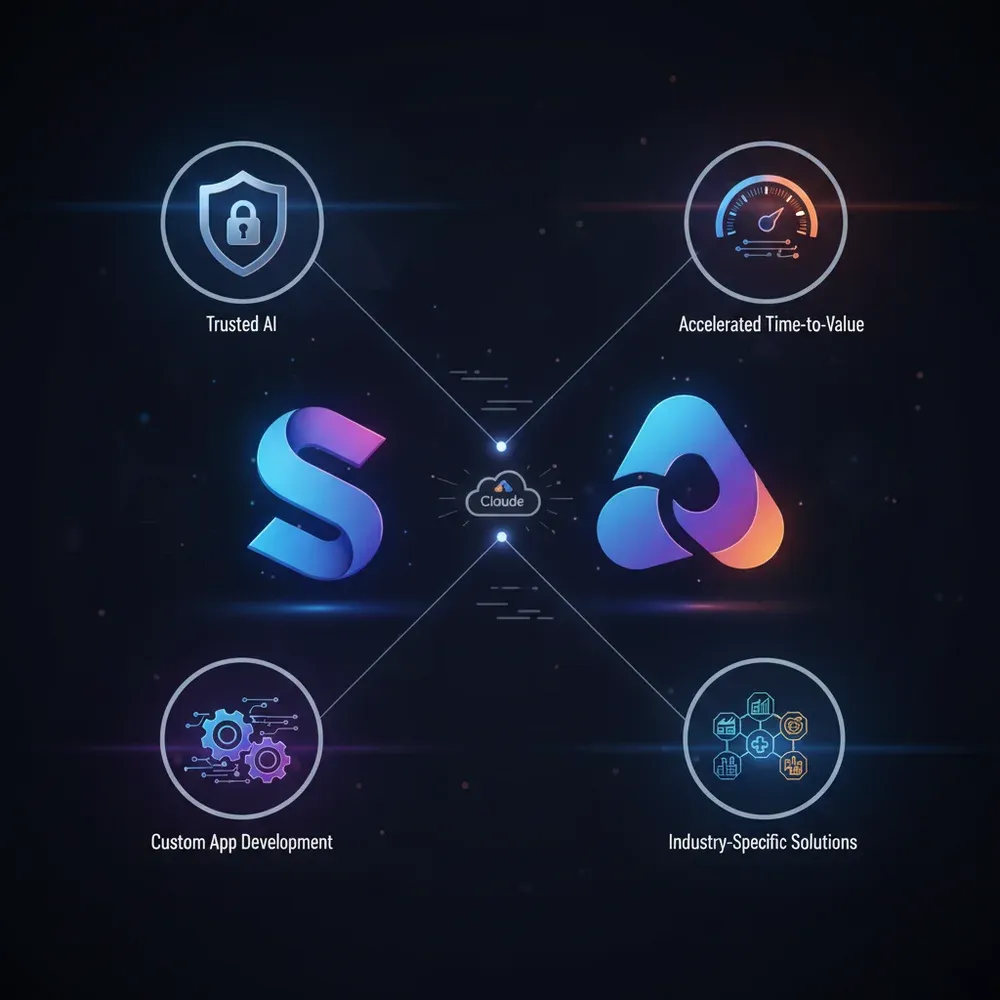
- Focus on Trusted AI: Anthropic has always promoted the concept of 'Constitutional AI,' which aims to make model behavior safe and aligned with human values. This fits perfectly with enterprise needs, where predictability and reliability are key.
- Custom Application Development: The ServiceNow platform enables companies to develop their own custom AI-powered applications. By integrating Claude models, these applications will be able to use the company's own data (the knowledge stored in ServiceNow), which is essentially a built-in RAG capability.
- Accelerated Time-to-Value: Instead of having to build a complex AI infrastructure from scratch, the ServiceNow-Anthropic partnership offers a turnkey solution. This significantly shortens development time and accelerates the return on investment (ROI).
This alliance clearly validates the market demand for securely and effectively connecting generative AI with enterprise data. RAG is no longer just a theoretical concept but a best practice that the biggest players in the market are using to create real business value.
Technical Deep Dive: How a RAG AI Chatbot Works?
To understand the power of RAG systems, it's worth taking a deeper look under the hood. The process consists of several interconnected steps that together ensure accurate and context-aware responses. Let's break down the RAG architecture into its key components.
Data Processing and Indexing (Chunking, Embedding)
Before the chatbot can answer any questions, the knowledge base must be prepared. This is an offline process that typically includes the following steps:
- Data Ingestion: The system loads documents from various sources (PDF, DOCX, HTML, etc.). This step often involves an ETL (Extract, Transform, Load) process, where the data is cleaned and converted to a uniform format.
- Chunking: Long documents are broken down into smaller, logical units called 'chunks.' This is crucial because the search will be performed on these smaller text segments. The size and strategy of chunking (e.g., fixed size, splitting by paragraph) can significantly impact the quality of retrieval.
- Embedding: This is the most magical part of the process. Each text chunk is converted into a numerical representation by a special AI model called an embedding model. This representation is a vector in a high-dimensional space that captures the semantic meaning of the text. Texts with similar meanings will have vectors that are close to each other in this multi-dimensional space.
The resulting vectors, along with their corresponding original text, are stored in a specialized database, the vector database.
Vector Databases and the Retrieval Mechanism
When a user asks a question, the online phase of the RAG system is activated:
- Query Embedding: The user's question is converted into a vector using the same embedding model that was used during indexing.
- Similarity Search: The system compares the query vector to all the text chunk vectors stored in the vector database. The goal is to find the vectors (and their corresponding text chunks) that are closest to the query vector in the high-dimensional space. This process is called 'semantic search' or 'similarity search.'
- Context Assembly: The system collects the most relevant text chunks (e.g., the top 5). This becomes the 'context' that the LLM will use to generate the answer.
Generation Based on Context (LLM Integration)
This is the final step of the process:
- Prompt Engineering: The system constructs a special prompt (instruction) for the LLM. This prompt typically includes the original user query and the retrieved context. For example:
"Based on the following context, answer the user's question. Context: [retrieved text chunks here]. Question: [user's question here]." - Response Generation: The LLM processes the prompt and generates an answer based on the provided context. Because the LLM has specific, relevant information at its disposal, its response will be accurate and well-founded.
This complex yet highly effective process enables RAG chatbots to operate reliably in real business environments. Our data processing AI agents specialize in automating such complex data preparation and processing workflows.
Building a RAG AI Chatbot: A Step-by-Step Guide for Enterprises
Implementing an enterprise-grade RAG AI chatbot is a well-structured project that requires careful planning and expertise. Although the technology is complex, the process can be broken down into logical steps. The following guide outlines the main stages a company will face.
1. Defining Use Cases and Identifying Data Sources
Every successful project starts with 'why.' Before writing a single line of code, the goals must be clear:
- Problem Definition: What specific business problem do we want to solve? (E.g., reducing the workload of the HR department, improving customer service response times, speeding up searches in technical documentation.)
- Target Audience: Who will use the chatbot? (Employees, customers, developers?)
- Success Metrics: How will we measure the project's success? (E.g., 20% fewer HR tickets, 30% faster customer service, etc.)
Next, the relevant knowledge sources must be identified. Where is the information the chatbot will need located? These can be:
- Unstructured data: PDFs, Word documents, presentations, Confluence, SharePoint.
- Structured data: SQL databases, CRM systems (e.g., Salesforce), ERP systems (e.g., SAP).
- Semi-structured data: JSON, CSV files, API endpoints.
2. Selecting the Technology Stack (LLM, Vector DB, Framework)
Choosing the right technology components is crucial for the system's performance and scalability.
- Large Language Model (LLM): The choice depends on the task, budget, and security requirements. Options include Anthropic Claude (safety-focused), OpenAI's GPT series (state-of-the-art performance), or even open-source models (e.g., Llama, Mistral) for full control.
- Vector Database: This component stores the numerical representations of the documents. Popular options include Pinecone, Weaviate, ChromaDB, or cloud providers' own solutions (e.g., PostgreSQL with the pgvector extension).
- Framework: To speed up development, frameworks like LangChain or LlamaIndex can be used. They offer pre-built components for data loading, chunking, and assembling RAG chains.
3. Development, Testing, and Fine-tuning
This stage is about the actual implementation:
- Building the Data Processing Pipeline: An automated process must be created to load, clean, chunk, and embed the data into the vector database.
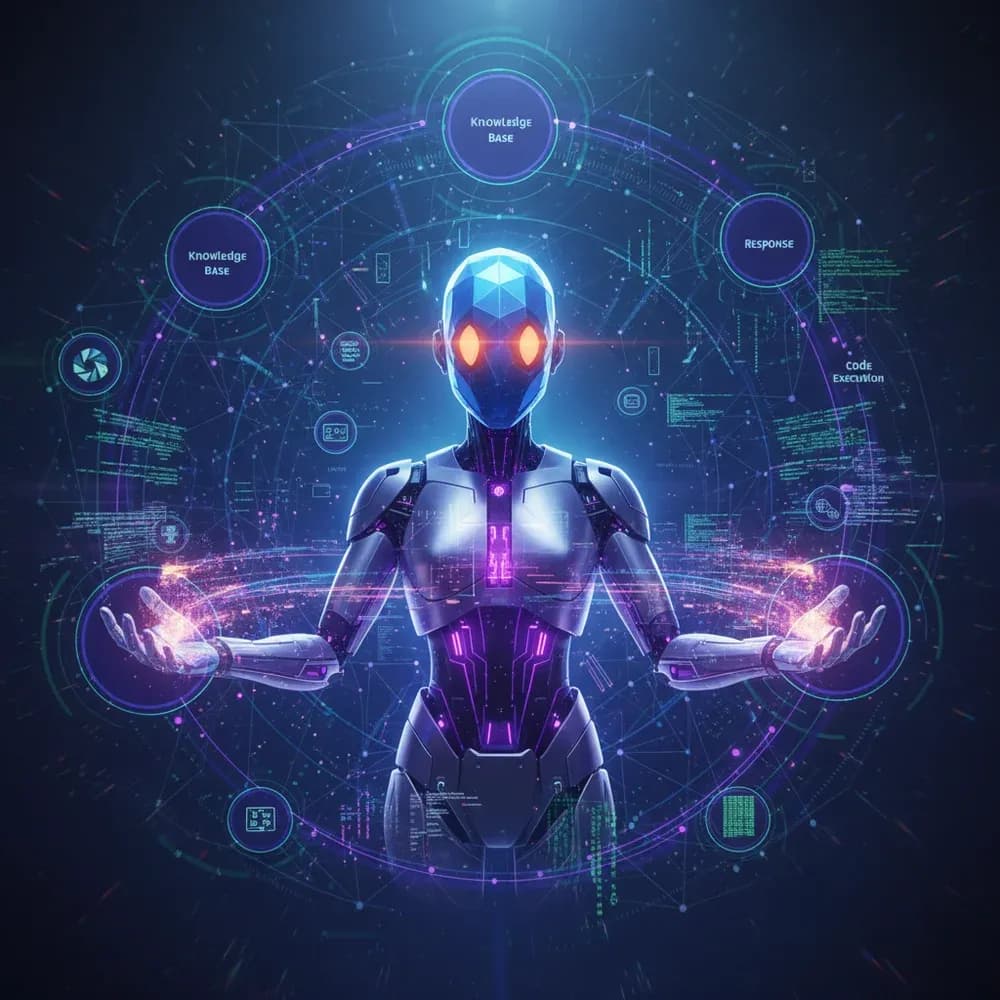
- Implementing the RAG Chain: Using the chosen framework, the components must be connected: receiving the user query, retrieval, prompt engineering, and the LLM call.
- Testing and Evaluation: The system's performance must be measured with objective metrics. Frameworks like RAGAs help evaluate the precision of the retrieval and the faithfulness of the generated answers.
- Fine-tuning: Based on the test results, the system needs to be refined. This might involve changing the chunking strategy, trying a different embedding model, or adjusting the parameters of the retrieval algorithm.
4. Deployment and Continuous Maintenance
The work doesn't end after going live.
- Deployment: The system must be deployed on a scalable and secure infrastructure, whether on-premise or cloud-based. Proper access control and a user interface (e.g., a web chat interface) must be provided.
- Monitoring and Logging: System performance, response times, and any errors must be continuously monitored. Logging user interactions helps identify weak points.
- Continuous Improvement: The knowledge base must be regularly updated with new documents. User feedback can be used to further refine the chatbot's behavior and knowledge.
Due to the complexity of such a project, many companies opt for external expertise. At AiSolve, we offer custom automation solutions to build turnkey RAG systems tailored to enterprise needs.
Key Considerations for RAG Implementation in an Enterprise Environment
There is a huge difference between a prototype and an enterprise-grade RAG system running in a production environment. For the latter, several factors must be considered to ensure reliability, security, and scalability.
- Security: This is the most important aspect. User authentication and authorization must be implemented so that everyone can only access the information they are entitled to. Data must be encrypted both at rest and in transit.
- Scalability: The system must be able to handle growing user load and data volume. This includes horizontal scaling of the vector database, LLM endpoints, and processing services.
- Data Governance: It must be clearly defined which data sources are included in the knowledge base and how often they are updated. Clear processes must be established for removing outdated or sensitive information.
- Cost Optimization: LLM API calls and cloud infrastructure can be expensive. Processes must be optimized, for example, by caching common questions or selecting models of the appropriate size and performance.
- Latency: For a good user experience, it's critical that the chatbot responds quickly. Every component of the system (retrieval, LLM call) must be optimized for speed without compromising quality.
- Integration with Existing Systems: An enterprise chatbot rarely operates in isolation. It needs to be integrated with existing systems like CRM, ERP, or internal authentication solutions (e.g., Active Directory).
Ignoring these aspects can lead to a system that is technically functional but commercially unreliable, expensive, and difficult to maintain. A successful enterprise implementation requires a holistic, engineering-driven approach.
RAG AI Chatbot Use Cases and Industry Applications
The versatility of RAG technology allows it to create value in almost any industry and business function where quick access to accurate and up-to-date information is key. Below are some concrete examples.
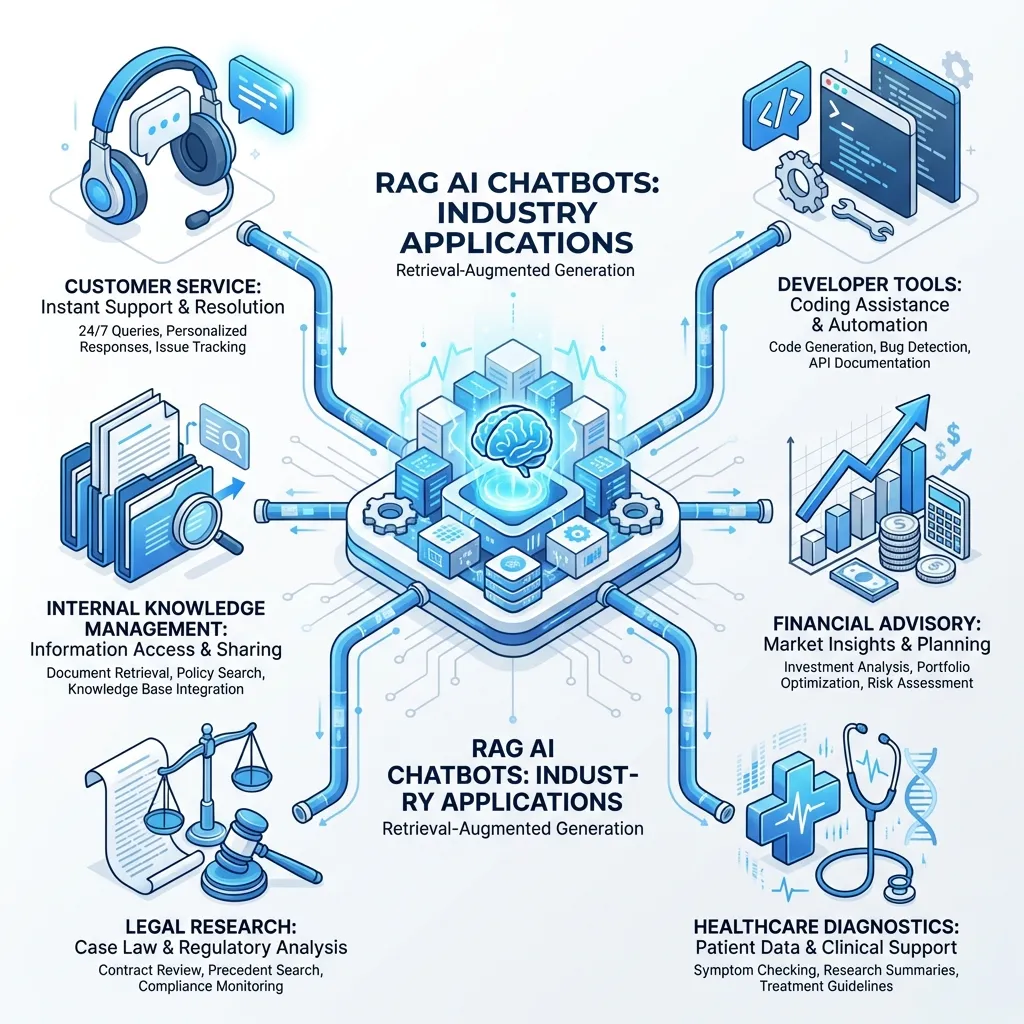
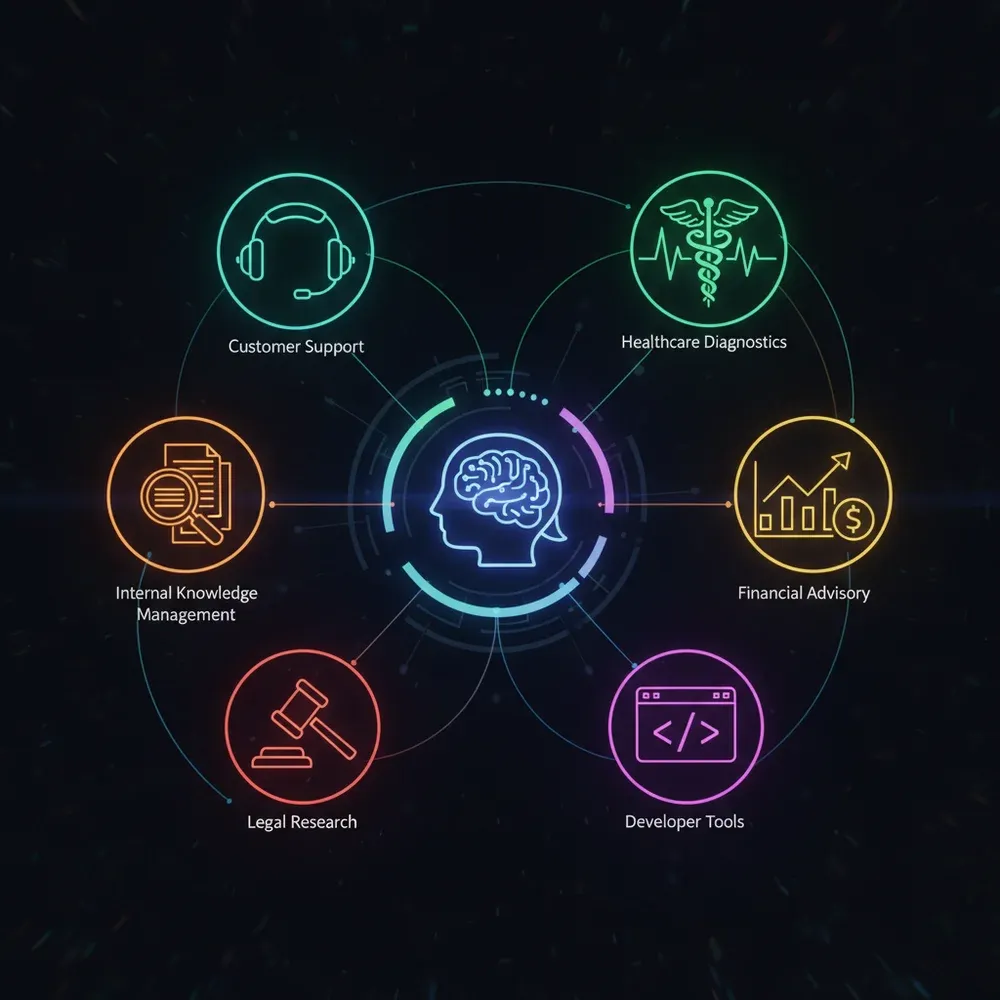
- Intelligent Customer Service: Chatbots can instantly answer customer questions based on product documentation, FAQs, and past support tickets. They can handle complex, multi-step problems and only escalate to a human operator when absolutely necessary. This reduces wait times and increases customer satisfaction.
- Internal Knowledge Management and HR Support: Employees can ask questions about internal policies, HR guidelines, IT issues, or company processes through a simple chat interface. Instead of spending hours searching on Confluence or SharePoint, they get accurate answers in seconds.
- Legal and Compliance Research: Law firms and legal departments can analyze vast amounts of legal documents, contracts, and case studies with RAG. The system helps find relevant precedents and check contracts for compliance with current legislation.
- Healthcare Decision Support: Doctors and researchers can get support for diagnosis or treatment planning based on the latest medical studies, clinical trials, and patient data. The system helps synthesize the vast amount of medical knowledge.
- Financial Advisory and Analysis: Financial advisors can prepare analyses and give investment advice based on market reports, company news, and economic forecasts. The chatbot helps identify trends and risks.
- Developer Tools and Technical Support: Software developers can search for help in technical documentation, API descriptions, and internal codebases. The RAG chatbot helps with debugging, provides code examples, and answers complex architectural questions.
Cost-Effectiveness and ROI of RAG Chatbots
Implementing a RAG AI chatbot can require a significant initial investment, but the long-term return on investment (ROI) can far exceed the costs. The economic benefits are evident in several areas and can often be quantified.
Direct Cost Reduction:
- Operational Efficiency: Automating repetitive, manual tasks frees up human labor. For example, the cost of a ticket handled by a customer service chatbot is a fraction of one handled by a human operator.
- Reduced Training Time: New employees can get up to speed faster with an intelligent assistant that instantly answers their questions about internal processes.
Indirect Benefits and Revenue Growth:
- Improved Decision-Making: When managers and employees have faster access to accurate, data-driven information, they can make better and faster decisions, giving the company a market advantage.
- Increased Employee Satisfaction: Instead of frustrating, time-consuming information searches, employees can focus on value-adding work, which increases productivity and job satisfaction.
- Enhanced Customer Loyalty: Fast, 24/7, and accurate customer service improves the customer experience, which in the long run increases customer loyalty and reduces churn.
Hypothetical ROI Calculation:
Suppose a medium-sized company's customer service handles 5,000 tickets per month. The average cost of a ticket handled by a human operator is $4. After implementing a RAG chatbot, 60% of the tickets (3,000 tickets) are handled by the AI at an average cost of $0.40.
- Cost before RAG: 5,000 tickets * $4/ticket = $20,000/month
- Cost after RAG: (2,000 tickets * $4) + (3,000 tickets * $0.40) = $8,000 + $1,200 = $9,200/month
- Monthly savings: $10,800
- Annual savings: $129,600
This example clearly shows how significant the financial benefits of implementing RAG technology can be in just one area, in addition to the strategic advantages that are harder to measure but at least as important.
The Future of RAG and Enterprise AI: Trends and Innovations
RAG technology is constantly evolving, and we can expect even more sophisticated and effective solutions in the future. Here are some exciting trends that are already shaping the future of enterprise AI:
- Multimodal RAG: Future RAG systems will be able to process and retrieve not only text but also images, diagrams, audio files, and videos. Imagine a chatbot that can answer a question about a part based on a technical drawing.
- Self-Improving RAG Systems: Advanced systems will be able to learn from user interactions. If a response was wrong or the user had to clarify their question, the system will use this to refine its retrieval algorithm.
- Proactive and Agentic RAG: Chatbots will not only reactively answer questions but also act proactively. A RAG-based AI agent could not only tell you how to request leave but also initiate the process in the HR system at the user's request. We wrote about this topic in more detail in our article on the Salesforce Slackbot.
- Deeper Integration with Data Streams: RAG systems will become more tightly integrated with real-time streaming data, such as data from IoT sensors or financial market data, enabling instant, up-to-the-minute analysis.
These innovations will further increase the value of RAG systems, making them an even more central element of corporate digital transformation.
Conclusion: RAG AI Chatbots as the Engine of Enterprise Digital Transformation
Retrieval-Augmented Generation technology bridges the critical gap that has existed between the impressive potential of large language models and the strict requirements of the corporate world. RAG is not just another AI buzzword; it is a robust, practical solution to the problems of accuracy, security, and relevance.
By connecting LLMs to companies' own controlled and up-to-date knowledge bases, RAG enables the creation of intelligent assistants that businesses can trust. These tools reduce operational costs, accelerate decision-making, improve the customer and employee experience, and ultimately provide a sustainable competitive advantage.
Market developments like the ServiceNow and Anthropic partnership show that the industry is moving towards reliable, enterprise-grade AI solutions. The question is no longer whether a company will adopt RAG technology, but when and how.
If you want to leverage the potential of RAG AI chatbots and build a reliable, secure, and effective system that creates real business value, contact us. Discover our custom RAG AI chatbot development services and take the first step towards the future of enterprise intelligence.
Frequently Asked Questions
How much does it cost to implement a RAG AI chatbot in an enterprise?
The costs can vary significantly depending on the project's complexity, the number of data sources, the chosen technology stack (e.g., licensed LLM vs. open-source), and infrastructure requirements. A simpler internal knowledge base chatbot based on a few document types is cheaper, while developing and maintaining a customer service system integrated with multiple complex systems (e.g., SAP, Salesforce) and handling real-time data can be more expensive. Costs include development, infrastructure, LLM API calls, and ongoing maintenance.
What data security measures are required for a RAG system?
Enterprise-grade RAG systems must employ a multi-layered security model. This includes role-based access control (RBAC) to ensure users can only access data they are authorized to see. Data must be encrypted both at-rest and in-transit. It's important to use private network connections (e.g., VPC) between cloud-based components, as well as regular security audits and logging to detect suspicious activities.
What is the difference between RAG and LLM fine-tuning?
They solve different problems. Fine-tuning involves further training a pre-trained LLM on additional, specific data to teach it a particular style, format, or narrow domain. This changes the model's internal weights. RAG, on the other hand, does not change the LLM but supplements it with external, dynamically updated knowledge at the time of the query. The advantage of RAG is that the knowledge base can be easily updated without having to re-run the expensive and time-consuming fine-tuning process, and it reduces the chance of hallucinations.
Which is the best vector database for RAG AI chatbots?
There is no single 'best' answer; the choice depends on specific needs. Pinecone and Weaviate are popular managed services that offer excellent scalability and performance. ChromaDB is an easy-to-use, open-source option that can be ideal for smaller projects or development. Major cloud providers like AWS, GCP, and Azure also offer their own vector database solutions. The PostgreSQL database with the pgvector extension is becoming increasingly popular, allowing existing relational databases to be augmented with vector search capabilities.
Can a RAG AI chatbot integrate with existing enterprise systems (e.g., CRM, ERP)?
Yes, and this is one of its greatest strengths. Advanced RAG systems can use not only static documents but also dynamic data sources. They can query data in real-time from systems like Salesforce (CRM) or SAP (ERP) via API calls. This allows the chatbot to answer questions like 'What is the status of Mr. Smith's latest order?' or 'What is the stock level of product #123 in the Budapest warehouse?'.
What are the maintenance and optimization requirements for a RAG system?
Continuous maintenance is key. This includes regularly updating the knowledge base with new data and archiving old data (data lifecycle management). The system must be monitored for performance degradation and errors. Optimization may involve periodically updating the embedding model to a newer, better-performing version, refining the chunking strategy based on user feedback, and optimizing prompts for better responses.
How can the performance and ROI of a RAG AI chatbot be measured?
Performance is measured on two levels. Technical metrics: Frameworks like RAGAs measure context precision, faithfulness, and context recall. Business metrics (KPIs): These measure the real business impact. This could be a reduction in average handling time (AHT) in customer service, the percentage of tickets resolved automatically, an increase in customer satisfaction scores (CSAT), or a reduction in internal knowledge base search time. The ROI is calculated by comparing the financial value of these KPIs to the system's total cost of ownership (TCO).
Készen állsz a saját weboldaladra?
Ingyenes konzultáció során átbeszéljük, hogyan segíthetünk vállalkozásodnak növekedni egy modern, gyors és konverzióoptimalizált weboldallal. 14 nap alatt kész, 0 Ft induló költséggel.