The advancement of artificial intelligence is now measured in weeks, not years. The latest versions of models like Google's Gemini, which natively feature agentic vision and code execution capabilities, signal a fundamental paradigm shift. We are moving away from static, text-based interactions toward dynamic, action-capable AI agents. This evolution is radically transforming the world of Retrieval-Augmented Generation (RAG) AI chatbots, opening up possibilities that were previously in the realm of science fiction.
This article is not just another overview of chatbots. It is a deep technical analysis of how RAG is evolving from a passive information retrieval tool into a proactive, context-aware problem-solving partner. We will explore what it means when a chatbot can not only read documents but also 'see' uploaded images, interpret graphs, and run code to validate answers or even execute system operations. This leap is the future of intelligent customer service and enterprise knowledge management.
Introduction: Navigating the New Frontier of Conversational AI
Conversational AI has undergone explosive growth in recent years. With the advent of large language models (LLMs), the capabilities of chatbots have dramatically increased, enabling more natural, human-like dialogues. However, LLMs have an inherent limitation: their knowledge is static, 'frozen' at the time of their last training data update. They are also prone to 'hallucination,' confidently stating falsehoods.
Retrieval-Augmented Generation (RAG) technology was developed to address these problems, connecting LLMs to an external, up-to-date knowledge base. This approach has revolutionized enterprise chatbots, allowing them to provide answers based on reliable, company-specific information. But what happens when knowledge exists in forms other than text? What about diagrams, product photos, technical drawings, or real-time system data?
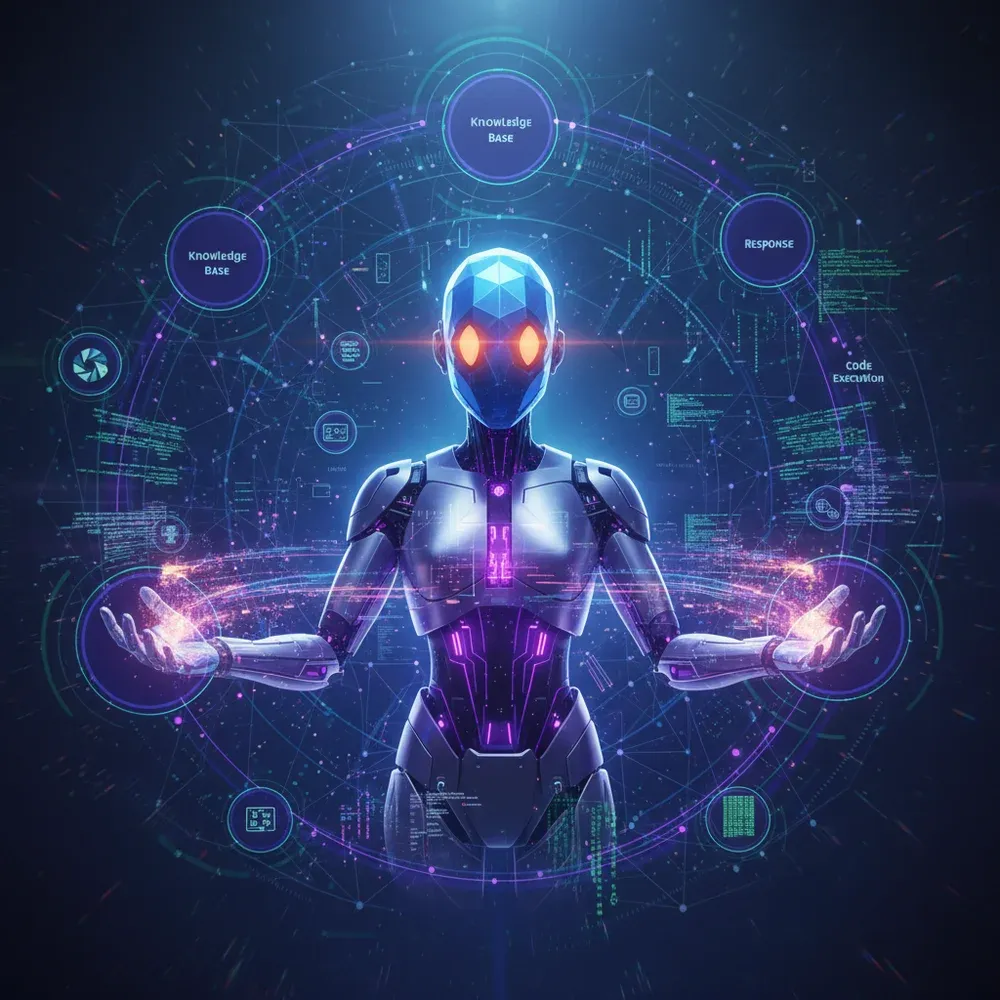
This is where the latest generation of agentic models comes in. 'Agentic vision' and the ability to execute code are not just new features; they are a fundamental leap that allows AI to perceive and interpret the visual world and to act in the digital space. This article will show how these technologies are converging to create the next, more powerful generation of RAG chatbots.
Understanding RAG AI Chatbots: The Foundation of Grounded AI
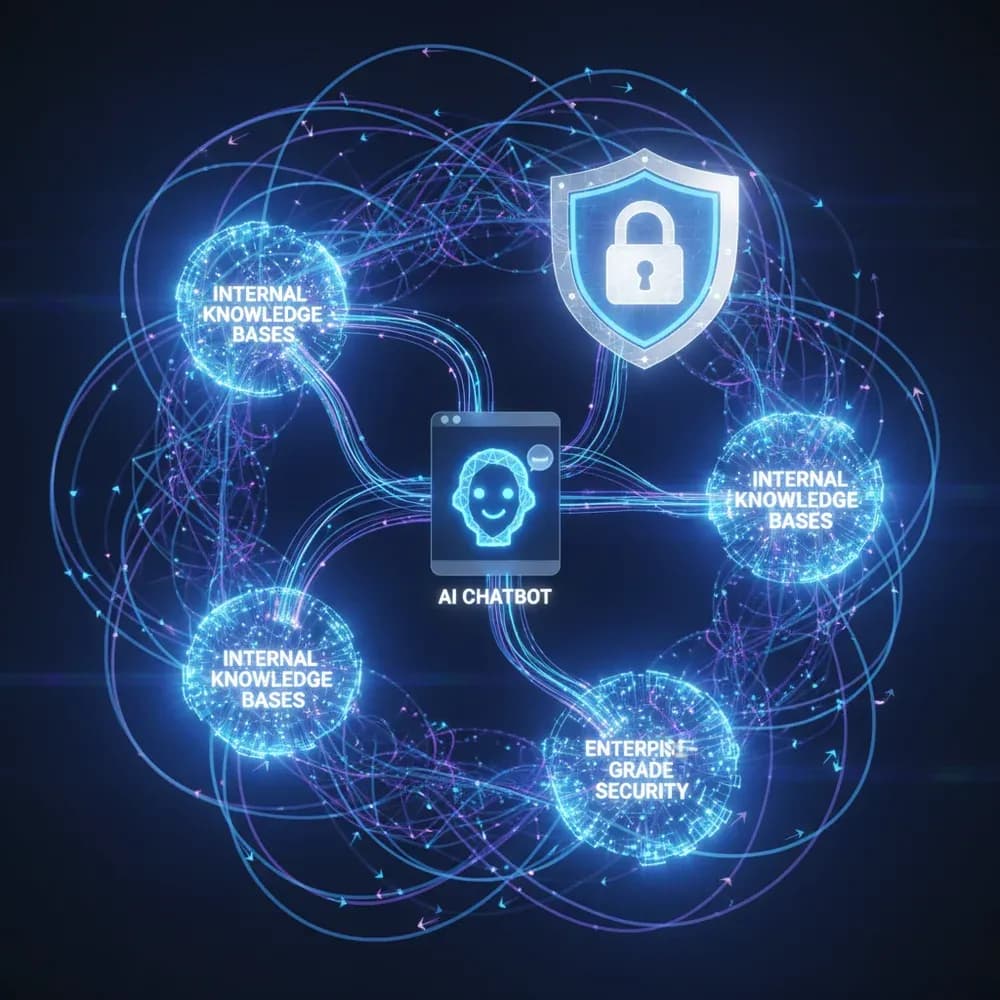
Before diving into the latest advancements, it's essential to understand how traditional RAG AI chatbots work. RAG is an architecture that supplements the generative capabilities of large language models with relevant information from an external knowledge base. The goal is to 'ground' the answers in real, verifiable data, drastically reducing the chance of hallucinations.
Definition: Retrieval-Augmented Generation (RAG)
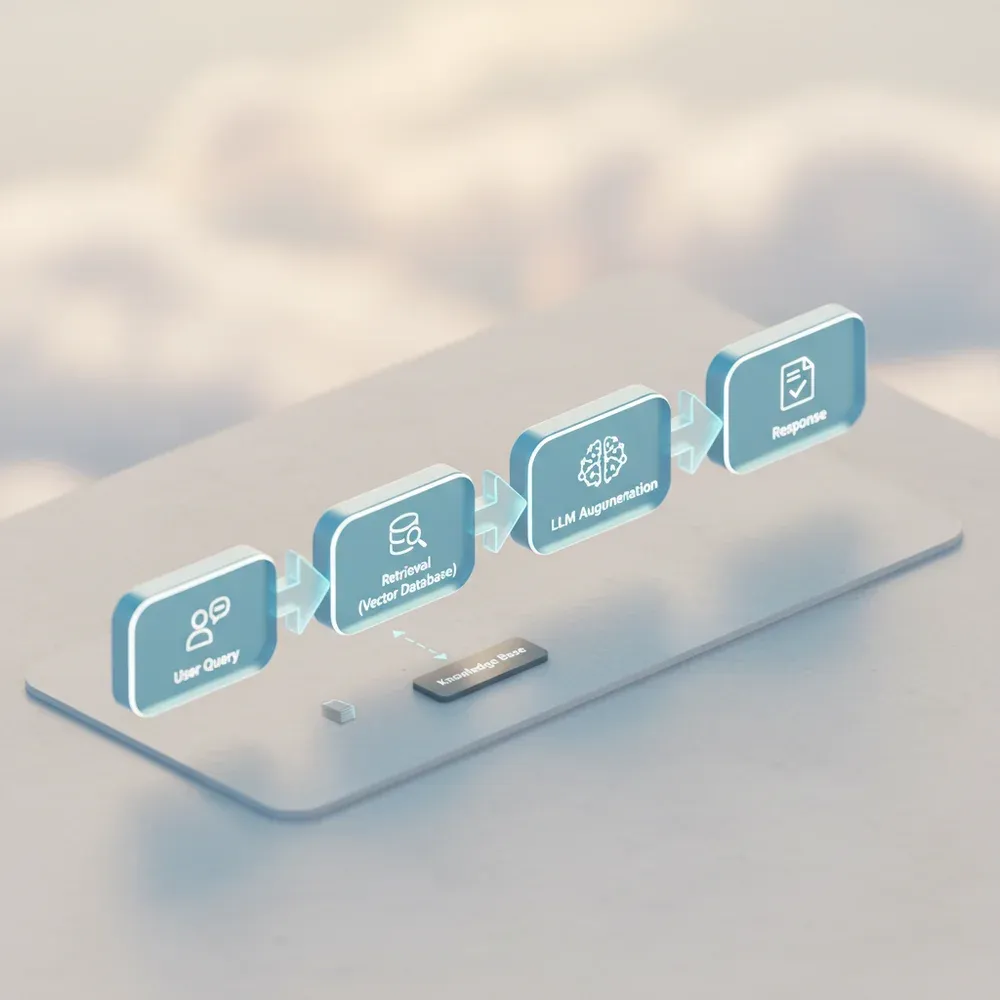
RAG is an AI framework that dynamically retrieves information from an external knowledge source (e.g., company documents, databases) and uses this context to instruct a large language model (LLM) to generate an accurate and relevant response. It's essentially an 'open-book exam' for the AI.
The process can be broken down into two main phases:
The Retrieval Phase: Accessing External Knowledge
When a user asks a question, the RAG system does not immediately turn to the LLM. Instead, it first converts the question into a dense numerical representation called an embedding. It then searches a specialized system called a vector database for the most similar, relevant chunks of information.
Think of the vector database as a super-intelligent library. It doesn't search by keywords but by the semantic similarity of meaning. It can find the paragraph in a 500-page manual that most accurately answers the user's question, even if the words don't match exactly.
The Generation Phase: Crafting Contextual Responses
Once the system has found the most relevant document snippets, it inserts them into the prompt given to the LLM, alongside the original question. This additional context serves as a 'cheat sheet' for the LLM. The instruction looks something like this: 'Based on the following information, answer the user's question. The question is: [...]. The relevant information is: [...].'
As a result, the LLM does not rely on its own general knowledge but on the fresh, specific, and verifiable data provided by the RAG system. This ensures that the answers are accurate, up-to-date, and based on the company's own knowledge base.
Beyond Basic RAG: Addressing the Limitations of Static Knowledge
Although traditional RAG is a significant improvement over basic LLMs, it has its limitations. These limitations primarily stem from its reliance on a pre-processed, static knowledge base and its inability to handle anything other than textual information.
- Dependence on pre-indexed data: RAG can only find information that has been previously processed and indexed into the vector database. If a new product documentation was uploaded yesterday but the indexing hasn't run yet, the chatbot will be 'blind' to it.
- Lack of real-time information: The system cannot query the current state of a live database, such as warehouse inventory or a user account status. Its knowledge is only as fresh as the last indexing.
- Absence of visual context: The biggest limitation. A user can send a traditional RAG chatbot a picture of a faulty part, a screenshot of an error message, or a graph of quarterly data, but it's useless. The system cannot interpret visual information, losing essential context for problem-solving.
- Inability to act: RAG answers, but it doesn't act. It can't create a ticket in Jira, reset a password in Active Directory, or run a diagnostic script to find the cause of an error.
These limitations create a glass ceiling for the capabilities of conversational AI. To create truly autonomous, intelligent assistants, AI must move beyond the passive processing of text. It needs to see, understand, and act.
The Dawn of Agentic AI: Google Gemini 3 Flash and Agentic Vision
The difference between generative AI and agentic AI is becoming increasingly prominent with the latest model announcements. The newest members of Google's Gemini family are not just language models but multimodal systems with agentic capabilities. Two key innovations set them apart from previous generations: agentic vision and native code execution.
Key Concept: Agentic AI
Agentic AI refers to systems that do not just passively respond to inputs but can independently set goals, make plans, use tools, and execute actions in the digital or physical world to achieve those goals. An agent is proactive, while a traditional chatbot is reactive.
What is Agentic Vision? Visual Reasoning Explained
Agentic Vision goes far beyond simple image recognition. It's not about the AI saying 'this is a cat.' Visual reasoning means the model can:
- Interpret complex scenes: It recognizes the relationships between objects, spatial arrangement, and context. For example, it not only recognizes the car and the red light but understands that the car must stop.
- Extract data from images: It can read text from a scanned document (OCR), interpret the axes and trends of a line graph, or read a product's serial number from a photo.
- Understand abstract concepts: It can interpret a flowchart, an architectural blueprint, or a user interface wireframe.
This capability allows the AI to 'see' the user's problem instead of just reading about it. This contextual understanding fundamentally changes the quality of possible interactions.
The Power of Code Execution for AI Agents
The other revolutionary innovation is native code execution. This means the AI model can generate Python code and run it in a secure, sandboxed environment. This capability dramatically expands the AI's problem-solving toolkit.
Code execution allows the agent to:
- Perform mathematical calculations and data analysis: It can run complex statistical analyses, create financial models, or visualize data without needing an external calculator or software.
- Validate its own conclusions: When faced with a complex logical problem, it can write a short script to test the solution before responding to the user, increasing reliability.
- Interact with APIs: It can make API calls to external systems, such as querying a database, updating a CRM record, or starting a workflow on a custom automation platform.
The combination of agentic vision and code execution results in an AI that can perceive, reason, and act. This is the perfect foundation for revolutionizing RAG technology.
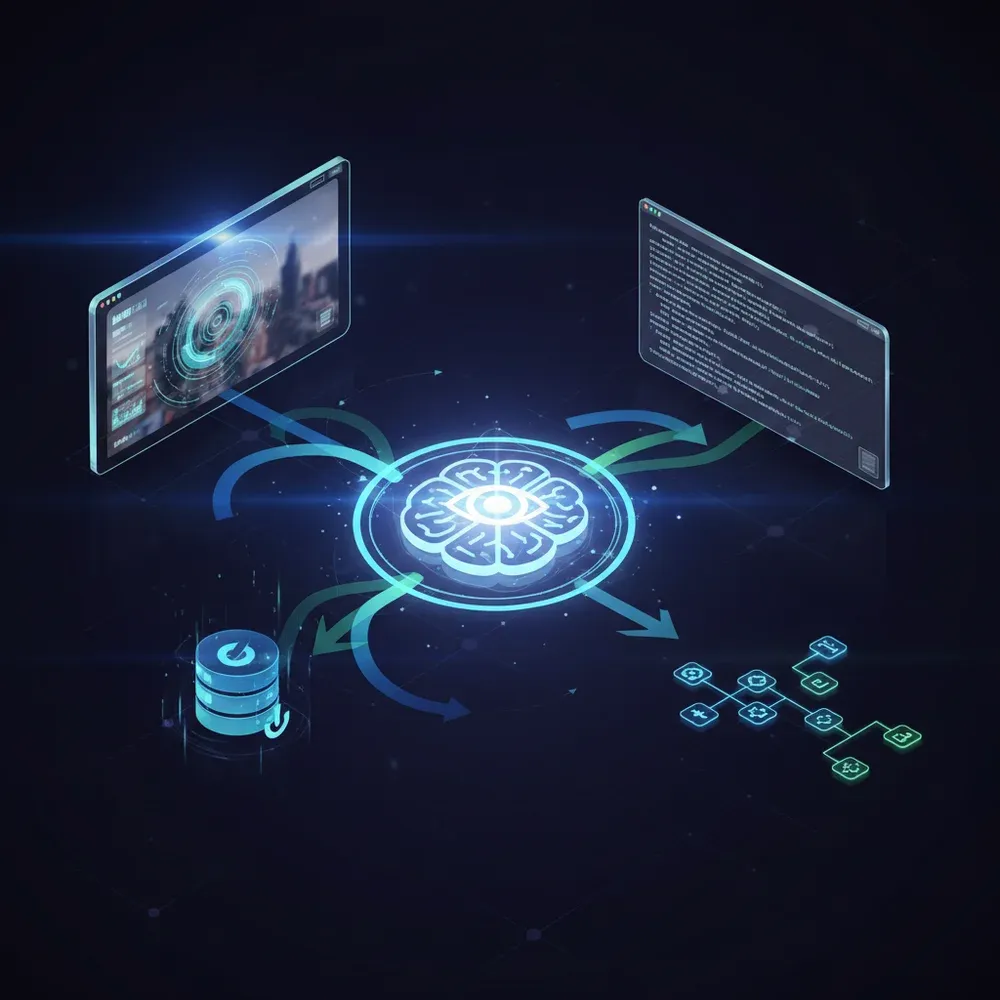
Revolutionizing RAG: Integrating Agentic Vision and Autonomous Behaviors
When we integrate agentic capabilities into the RAG architecture, the system moves beyond querying static documents and becomes a dynamic, multimodal information retrieval and processing machine. RAG is no longer just a 'reader' but a 'seer' and 'doer'.
Visual Grounding: RAG with 'Eyes'
Imagine the following scenario: a maintenance technician takes a photo of a faulty machine part and uploads it to the company chatbot with the question, 'What is this, and how do I replace it?'
A traditional RAG would fail here. An agentic RAG, however:
- Visually analyzes the image: Using agentic vision, it identifies the part, reads the serial number on it, and recognizes the nature of the damage.
- Initiates a multimodal query: It converts the visual information (e.g., 'bearing, model 7A-32, cracked outer ring') into a textual description and uses this to search the vector database.
- Finds relevant documents: The system searches not only for text matches but also for visual context, finding the exact technical drawing, the relevant chapter of the replacement manual, and the latest maintenance log.
- Generates a contextual response: The response not only describes the steps but may also include relevant diagrams from the manual and even a link to a video tutorial.
This 'visual grounding' ensures that the answer pertains to the real, physical problem, not a misinterpretation of a textual description.
Dynamic Retrieval: Agents That Act and Learn
An agentic RAG is not satisfied with the existing knowledge base. If it can't find the answer, it can act to obtain it. For example, if a user asks about 'current stock levels,' the agent can use code execution to:
- Generate an SQL query: It writes the appropriate code to query the company's ERP system database.
- Run the code: It executes the query in a secure environment and gets the real-time data.
- Incorporate the information into the response: It uses the fresh data to generate the answer for the user.
This dynamic retrieval capability means the RAG's knowledge base is no longer static. It extends to all of the company's live systems and always works with the latest information. The system can learn and evolve through interactions, continuously expanding its knowledge.
Multi-Modal RAG: Beyond Textual Information
With agentic capabilities, RAG becomes a true multimodal system. The knowledge base can now consist not only of text documents but also images, PDFs, videos, audio files, and structured data. The system can interpret these different formats together and compile complex answers from multiple sources.
This approach allows companies to leverage their entire data repository and develop a custom RAG chatbot that truly understands all aspects of their business processes, from text reports to visual inspections.
Ready to Revolutionize Your Enterprise AI?
Discover how RAG AI chatbots, armed with agentic vision and code execution, can transform your customer service and knowledge management. Move beyond static answers and build intelligent solutions that act.
Learn More About Our RAG SolutionsAdvanced RAG Architectures for Enterprise Solutions
Introducing agentic capabilities into RAG systems requires new architectural considerations. CTOs and AI engineers must design robust, scalable, and secure systems that can handle the increased complexity.
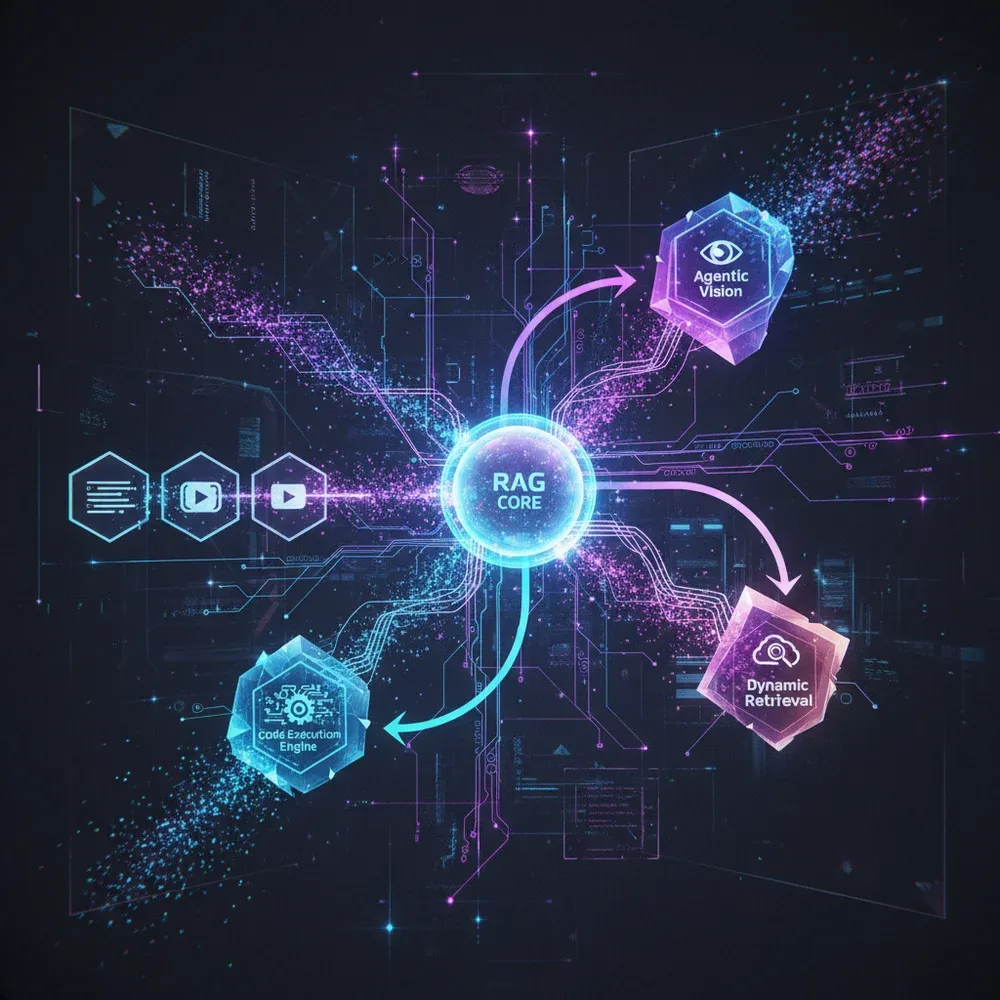
Self-Correcting and Self-Improving RAG Systems
Advanced RAG systems are no longer static. They include a 'critic' module that evaluates the results of the retrieval phase. If the found documents do not seem relevant, the system can regenerate the search keywords or even turn to a different data source. This is a kind of internal quality control loop.
Additionally, code execution enables self-correction. The agent can run a test to check the correctness of its answer. If it finds an error, it can backtrack, change its line of thought, and look for a new solution. This capability dramatically increases the system's reliability and accuracy.
Hybrid RAG: Combining Traditional and Agentic Approaches
Not every question requires complex agentic intervention. The most effective architectures use a 'router' or 'dispatcher' component that decides which strategy to use based on the incoming question. For a simple, fact-based question ('What is the company's headquarters?'), a quick, traditional RAG query is sufficient. A complex, multimodal question ('Based on the graphs in the latest report, which of our products performed the worst, and why?'), however, triggers the full agentic workflow.
This hybrid approach optimizes resource usage and response time while ensuring the system can handle the most complex tasks. Deploying specialized AI agents is key to efficiency.
Security and Data Governance in Advanced RAG Deployments
The ability to act (code execution, API calls) raises serious security questions. It is essential that agents operate in a strictly controlled environment:
- Sandboxing: Code execution must take place in isolated containers that cannot access the host system or the internal network.
- Role-Based Access Control (RBAC): The agent should only have access to the APIs and databases that are essential for its task. Permissions should be minimized.
- Logging and Monitoring: Every agentic action must be logged in detail so that any anomalies or errors can be traced and analyzed.
- Human-in-the-loop: For particularly critical operations (e.g., deleting a database record), the system must request human approval.
Building the right security architecture is a prerequisite for safely deploying agentic RAG systems in an enterprise environment.
Real-World Impact: Use Cases for Agentic RAG Chatbots
Beyond the theory, what does agentic RAG look like in practice? Let's examine some specific enterprise use cases where this technology can bring about revolutionary change.
Enhanced Customer Support and Service Automation
A customer is having a problem with their newly purchased smart thermostat. Instead of describing the problem at length, they take a photo of the error message on the device's display and send it to the manufacturer's chatbot.
The agentic RAG chatbot analyzes the image, identifies the error code (e.g., 'E-24'), and then queries the knowledge base for the meaning of the code ('Communication error with the Wi-Fi module'). It then doesn't just send a generic troubleshooting list but starts an interactive diagnostic process. It asks questions and, based on the user's answers, uses API calls to test the user's network. Finally, if the problem is software-related, it can remotely install an update on the device, resolving the issue without human intervention.
Intelligent Knowledge Management and Research
A pharmaceutical researcher is studying the effects of a new compound. Instead of reading through dozens of research papers and internal reports, they ask the agentic RAG system a question and upload a graph of preliminary results from a clinical trial.
The agent analyzes the graph, interprets the trends, and then scours internal and external knowledge bases (research articles, patents, clinical data). It creates a summary of relevant research, highlights any contradictions, and, based on the uploaded graph, formulates hypotheses about the compound's potential side effects. This condenses weeks of work into minutes, accelerating scientific discovery.
Autonomous Business Process Automation
The procurement department receives a request for a new part in a PDF document that also includes a technical drawing. They simply forward the document to the agentic RAG assistant.
The assistant processes the PDF, extracts the textual data (quantity, delivery deadline), and uses agentic vision to analyze the technical drawing to understand the part's specifications. It then connects to the supplier database via APIs, checks which partners can manufacture the part to specification, and automatically sends out requests for quotes. It analyzes the incoming quotes and recommends the most favorable option. This kind of autonomous business process automation significantly reduces administrative burdens and the potential for errors.
Implementing Agentic RAG: Key Considerations and Best Practices
Implementing an advanced, agentic RAG system requires careful planning and expertise. It's not enough to just connect a model and a vector database. Here are some key considerations for developers and AI engineers.
Data Preparation and Vector Database Selection
The heart of the system is the knowledge base. For multimodal RAG, data preparation and processing become even more critical. Documents must be properly 'chunked,' and images must be tagged with metadata. The chosen vector database (e.g., Weaviate, Pinecone, ChromaDB) must support multimodal embeddings, meaning it must be able to store and search for images and texts together in the same vector space.
An effective chunking strategy (e.g., recursive, semantic) and the right metadata structure are fundamental to the accuracy of the retrievals.
Model Selection and Fine-Tuning Strategies
Choosing the right base model is crucial. You need a model that natively supports multimodal inputs, tool use, and code execution. Google's Gemini, OpenAI's GPT-4o, or Anthropic's Claude 3.5 Sonnet are all good starting points.
Although these models are powerful on their own, fine-tuning is often necessary for the best results. This may involve training the model on the company's specific language or on special tool use patterns to make the agent more effective and accurate in performing its tasks.
Monitoring, Evaluation, and Continuous Improvement
Implementing an agentic RAG system is not a one-time project. It requires continuous monitoring and evaluation. Frameworks like RAGAs or TruLens should be used to measure the system's performance along metrics such as answer relevance, context accuracy, and grounding quality.
Logging and analyzing user interactions are essential for identifying the system's weak points and for continuous improvement. The collected data can be used to refine retrieval strategies, expand the knowledge base, and further tune the base model, creating a self-improving cycle.
Realize the Future of AI Solutions!
Our expert team can help you design, develop, and deploy state-of-the-art RAG AI chatbots with agentic capabilities. Unlock their full potential and gain a competitive edge in the market.
Request a ConsultationThe Future Landscape: RAG, Agents, and the Path to AGI
The development of agentic RAG systems goes beyond increasing enterprise efficiency. It is an important step on the path to Artificial General Intelligence (AGI). We are creating systems that can perceive their environment, understand goals, and act autonomously to achieve them.
In the future, these agents will be able to solve increasingly complex, multi-step tasks. They will be able to collaborate with each other, delegate, and optimize complex business processes without human intervention. This development, of course, also raises serious ethical and security questions that society and regulators will have to address.
Research is currently focused on areas such as long-term memory, proactive goal-setting, and even more sophisticated multimodal reasoning. As these technologies mature, AI agents will increasingly become indispensable partners for knowledge workers, freeing up human creativity for strategic and innovative tasks.
Conclusion: Unlock the Full Potential of Your Data with Agentic RAG
Conversational AI has entered a new era. Traditional, text-based RAG chatbots, while useful, have only scratched the surface of what's possible. By integrating agentic vision and code execution, we can create systems that truly understand users' problems in their full context and can act proactively to solve them.
These advanced RAG systems are no longer just information desks but active problem-solving partners. They can interpret visual data, interact with live systems, and independently execute complex tasks. For companies, this creates an unprecedented opportunity to increase efficiency, improve the customer experience, and accelerate innovation.
The transition is not trivial, but the investment will pay off. The organizations that recognize the potential of agentic AI now and begin to build the right infrastructure and expertise will be the winners of the future. Don't settle for a chatbot that just answers. Build one that acts.
Frequently Asked Questions
How does agentic vision improve the accuracy and relevance of RAG AI chatbots?
Agentic vision allows the chatbot to understand visual context beyond text. For example, an error message read from a user-uploaded screenshot or a part identified from a product photo provides much more accurate and relevant information for the retrieval phase than an inaccurate or incomplete text description. This 'visual grounding' drastically reduces misunderstandings and makes the context found by the RAG system more precise, ultimately resulting in a more relevant answer.
What are the security and data privacy concerns when using RAG systems with code execution?
Code execution is the biggest security risk. The main concerns are: 1) Unauthorized access: The agent could run malicious code that attempts to access sensitive data or systems. 2) Data leakage: The executed code could accidentally or intentionally leak data. 3) System damage: A faulty or malicious script could damage systems. To minimize these risks, it is essential to use strict sandboxing, the principle of least privilege, detailed logging, and human-in-the-loop approval processes for critical operations.
Can RAG AI chatbots with agentic capabilities be integrated with existing enterprise systems?
Yes, in fact, integration is their greatest strength. Agentic RAG systems are designed to communicate with other software via APIs (Application Programming Interfaces). This allows them to connect to existing ERP, CRM, HR, or any other custom enterprise system. Through their code execution capabilities, they can query data from these systems, update them, or even trigger workflows within them, making the chatbot an active, acting part of the corporate ecosystem.
What is the primary difference between traditional RAG and agentic RAG approaches?
The main difference lies in passive versus active operation. Traditional RAG is a passive, reactive system: it queries a static, text-based knowledge base and answers based on the information found there. In contrast, agentic RAG is an active, proactive system: it can interpret multimodal inputs (images, data), and if it doesn't find the answer in the existing knowledge base, it can act (e.g., run code, call an API) to obtain the information. In essence, traditional RAG 'reads,' while agentic RAG 'reads, sees, and does'.
Which industries stand to benefit most from implementing agentic RAG solutions?
Virtually any industry where workflows are complex and involve multimodal data (text, images, sensor data) can benefit. It can be particularly beneficial in manufacturing (visual diagnostics of machinery, maintenance), healthcare (analysis of medical images and reports), the financial sector (automatic analysis of reports, graphs), logistics (visual inspection of shipping documents, inventory), and software development (analysis of error message screenshots, automated testing).
What is the cost associated with developing and maintaining an advanced RAG AI chatbot with agentic capabilities?
The costs vary greatly depending on the complexity of the project. The main factors are: 1) The number and complexity of the systems to be integrated. 2) The size of the knowledge base and the types of data it contains (text, images, etc.). 3) The number of required agentic capabilities and custom workflows. 4) The API costs of the chosen AI model. 5) Maintenance costs cover continuous monitoring, fine-tuning, and updating the knowledge base. A simpler pilot project can start from a few thousand dollars, while a complex, enterprise-level system can cost tens of thousands or more.
What steps are involved in successfully deploying an agentic RAG chatbot in an enterprise environment?
The key to successful deployment is a phased approach and strategic planning. The recommended steps are: 1) Start with a well-defined use case with high business value (pilot project). 2) Conduct thorough data discovery and prepare the knowledge base. 3) Design a secure architecture (RBAC, sandboxing). 4) Develop the core RAG and agentic functionalities. 5) Test thoroughly with a closed user group. 6) Gather feedback and refine the system. 7) Gradually expand the user base and the agent's capabilities. Continuous monitoring and iteration are essential for long-term success.
Készen állsz a saját weboldaladra?
Ingyenes konzultáció során átbeszéljük, hogyan segíthetünk vállalkozásodnak növekedni egy modern, gyors és konverzióoptimalizált weboldallal. 14 nap alatt kész, 0 Ft induló költséggel.