
The New Frontier of AI: The Era of Multimodal Agents
Artificial intelligence development reached a critical turning point this week when Moonshot AI unveiled the Kimi K2.5 model. This announcement is not just about increasing parameter counts but about a fundamental architectural shift: from static chatbots to autonomous, collaborative Agent Swarms.
Traditional Large Language Models (LLMs), like the early GPT series, were impressive at text generation but often stumbled when tasked with solving complex, multi-step problems. A software development project, legal due diligence, or scientific research cannot be solved with a single "prompt-response" cycle. This is where multimodal AI agents come into play.
Definition: Multimodal AI Agent
An artificial intelligence system that not only processes various types of inputs (text, image, audio, video) but is also capable of acting: using tools, creating plans, and autonomously executing tasks within a digital environment.
The industry is now realizing that the real breakthrough will not come from a single "supermodel" but from the collaboration of specialized models. As we have written before, multi-agent workflows represent the future of enterprise automation, and Kimi K2.5 elevates this concept to an industrial level.
What is a Multimodal AI Agent? From Perception to Action
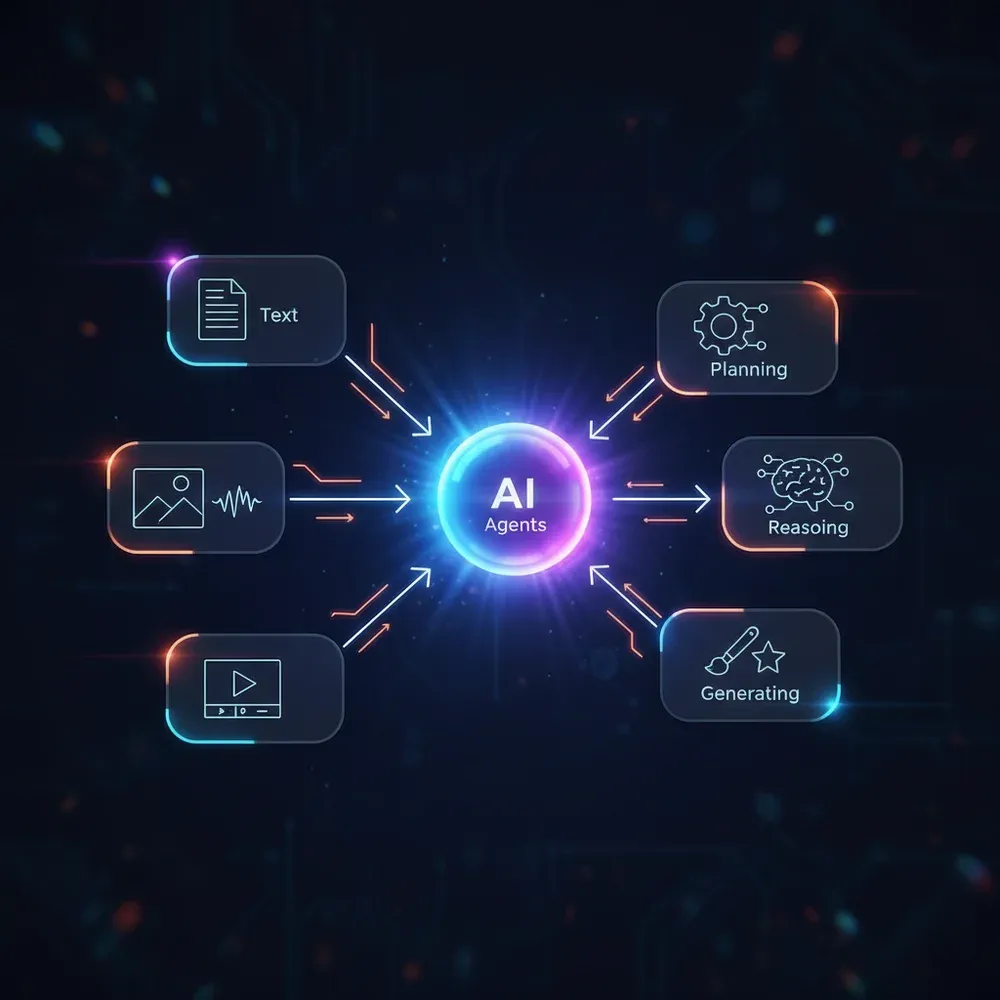
The term "multimodal" implies that the AI is not blind to the world. While old models only saw text, a modern agent—like Kimi K2.5 or Gemini 1.5 Pro—can interpret an architecture diagram, listen to a meeting recording, or analyze a video from a production line.
But the real difference lies in agentic behavior. A traditional chatbot is passive: it waits for a question, then answers. In contrast, an agent:
- Plans: Breaks down the goal into steps (e.g., "Analyze bug report" -> "Locate error in code" -> "Write fix").
- Uses Tools: Accesses databases, runs code, or browses the internet.
- Remembers: Maintains context over the long term.
- Corrects: If a step fails, it replans rather than hallucinating an answer.
This capability allows AI not just to talk about work but to actually perform it. This is particularly important in the field of agentic vision, where decisions must be made based on visual information.
Kimi K2.5 and the Agent Swarm Concept
Moonshot AI's latest release, Kimi K2.5, stands out not for its parameter count but for its parallel processing capability. The model introduces the "Agent Swarm" feature, which allows the system to dynamically create and coordinate multiple sub-agents to solve a single task.
Imagine a project manager who doesn't try to build a house alone but immediately hires an architect, a structural engineer, an electrician, and a mason, and then coordinates their work. Kimi K2.5 does exactly this in the digital space.
When a user submits a complex request (e.g., "Analyze these 10 competitor websites and create a comparative report with pricing and features"), Kimi does not proceed sequentially (one after another). Instead:
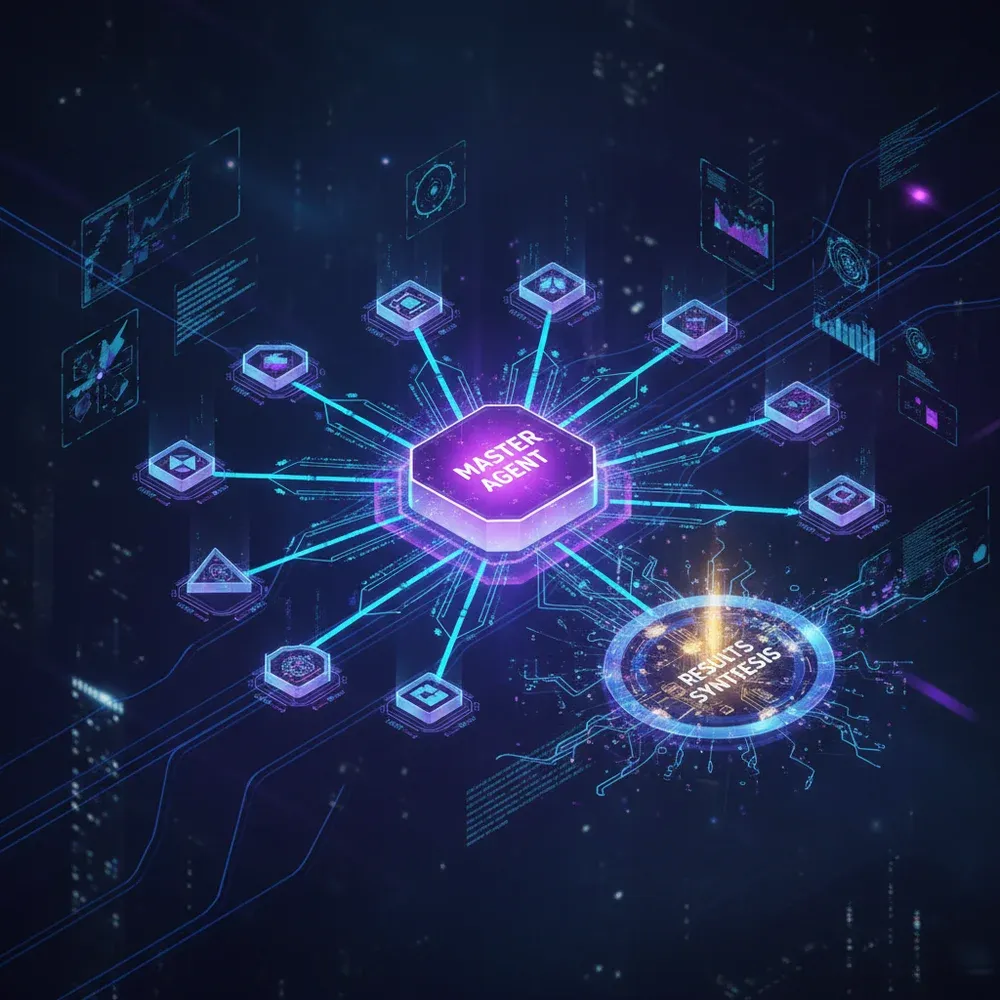
- The "Master Agent" interprets the request.
- It creates 10 "Research Agents," assigning one website to each.
- These agents work in parallel.
- Finally, an "Analyst Agent" synthesizes the data into a single report.
How Does an Agent Swarm Work? Parallel Workflows and Coordination
Deep within the technology lies a sophisticated orchestration layer. This system distinguishes Kimi K2.5 from traditional RAG chatbots, which typically think linearly.
Task Decomposition
The process begins with decomposition. The main model (Master Node) breaks the problem down into a graph-based structure. It recognizes dependencies: which tasks can be done simultaneously and which must wait for the results of others. This step is critical for efficiency.
Inter-Agent Communication
Sub-agents do not operate in isolation. They use shared memory or communicate via messaging protocols. If a "Coding Agent" finds an error in API documentation, it can signal the "Research Agent" to look for a newer version without stopping the main process.
Technical Insight: The Map-Reduce Pattern
The operation of agent swarms often resembles the Map-Reduce programming model known from the Big Data world. In the "Map" phase, the task is distributed (e.g., reviewing 50 files with 50 agents), and in the "Reduce" phase, the results are aggregated (e.g., concatenating relevant information). Kimi K2.5 applies this logic to natural language processing.
The Revolutionary Potential of Agent Swarms in Coding
Software development is one of the most promising areas for agent swarms. The future of software development is no longer about the solitary programmer but about AI-assisted teamwork.
According to Kimi K2.5 demonstrations, the system can handle "repo-level" context. This means it doesn't just see one file but the entire project. During a bug fix, the swarm might operate like this:
- Agent 1: Reproduces the bug in a test environment.
- Agent 2: Analyzes the stack trace and related code snippets.
- Agent 3: Writes the fix.
- Agent 4: Runs tests (including regression tests) to ensure the fix hasn't broken anything else.
This parallelization drastically reduces the development cycle time. While it might take a human hours to context-switch between testing and coding, the agent swarm does this in seconds, simultaneously.
Want to automate your development processes?
Integrate the latest AI agents into your CI/CD pipeline with AiSolve's custom automation solutions.
Custom Automation ConsultationBeyond Coding: Applications of Multimodal Agents
Although coding is a spectacular example, the impact of multimodal agents extends to every industry. Specialized AI agents are capable of transforming traditional business processes.
Financial Analysis and Audit
An agent swarm can simultaneously process thousands of invoices (in image format), cross-reference them with contracts (PDF), and verify transactions in the database. Due to parallel processing, a monthly closing can be completed in hours instead of days.
Customer Service and Sales
Modern AI phone systems no longer just transmit voice. A multimodal agent can analyze a user-submitted photo of a defective product during a call, check inventory, and immediately arrange for a replacement—all in real-time.
Research and Development (R&D)
In the pharmaceutical industry or materials science, agents can read literature, analyze experimental data, and run simulations in parallel, accelerating the pace of discovery.
Benefits and Challenges: Implementing Agent Swarms in Enterprises
Implementing agent swarms is not without risks. Enterprise leaders must weigh ROI against technical requirements.
Benefits:
- Scalability: Capable of performing exponentially more tasks without a linear increase in workforce.
- Flexibility: Agents work 24/7 and do not get tired.
- Accuracy: Multiple rounds of verification (where one agent checks another) reduce the error rate.
Challenges:
- Costs: Many models running in parallel can generate high inference costs (token usage).
- Oversight: It is difficult to track exactly how the swarm arrived at a specific decision (black box problem).
- Integration: Connecting with existing legacy systems requires expertise.
Kimi K2.5 vs. GPT-5 and Gemini: Comparing High-End AI Models
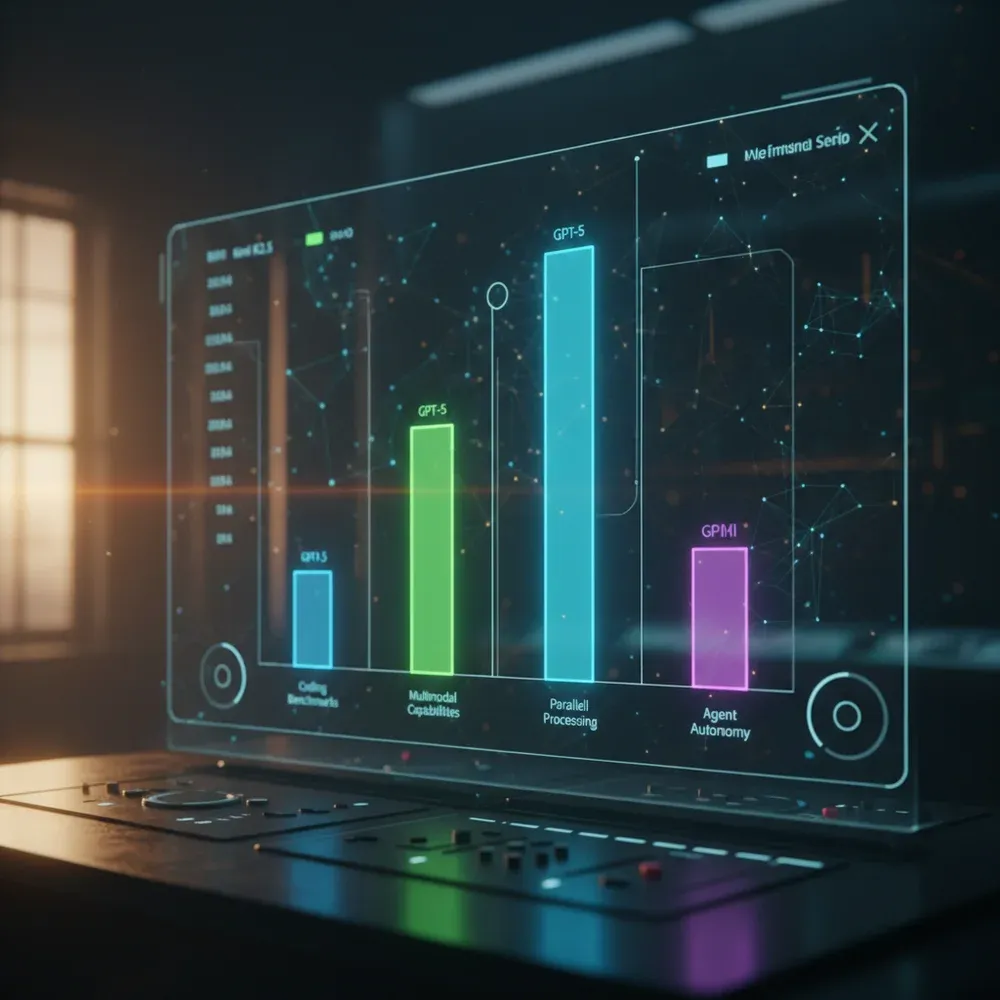
The competition is heating up. While Google aims for deeper, sequential thinking with Gemini 3 Deep Think mode, Kimi K2.5 emphasizes horizontal scaling (swarms).
| Feature | Kimi K2.5 | GPT-4o / GPT-5 (Preview) | Google Gemini 1.5 Pro |
|---|---|---|---|
| Main Strength | Agent Swarm (Parallelization) | General Reasoning & Creativity | Massive Context Window |
| Coding | Excellent (Repo-level) | Very Good | Excellent |
| Multimodality | Native (Image, Video) | Native (Omni) | Native (Long videos) |
| Autonomy | High (Autonomous decomposition) | Medium (Prompt-dependent) | Medium |
The Future of Multimodal AI Agents and the Era of Autonomous Systems
The emergence of Kimi K2.5 is a clear signal: the direction of AI development is autonomy. In future enterprises, humans will not manually copy data from one Excel sheet to another. Instead, "AI Managers" will oversee specialized "AI Workers" performing data processing.
This vision is not distant sci-fi but the reality of the next 1-2 years. Companies that start integrating agent-based systems now can gain an insurmountable competitive advantage in efficiency and response time.
Frequently Asked Questions
How does a multimodal AI agent differ from a traditional large language model (LLM)?
While a traditional LLM (e.g., basic ChatGPT) passively waits for a question and generates text, a multimodal AI agent can act autonomously (tool use), create plans, and execute complex sequences of tasks. Additionally, it can process and interpret not just text but also images, audio, and video as input.
How does Kimi K2.5 Agent Swarm help with complex software development projects?
Kimi K2.5 can break down development tasks (e.g., debugging, writing tests, refactoring) into parallel threads. Different sub-agents can work on different parts of the code simultaneously, while a coordinator agent ensures coherence. This drastically reduces development time and increases code quality.
What security and privacy considerations should be taken into account when implementing an agent swarm system?
Autonomous agents may have access to sensitive corporate data and systems. It is critical to apply the principle of "least privilege," log agent activity, and incorporate human-in-the-loop checkpoints for critical decisions to avoid data leaks or unwanted modifications.
Can multimodal AI agents be integrated with existing enterprise infrastructure and systems?
Yes, modern AI agents can communicate with existing ERP, CRM, and database systems via APIs. During integration, custom middleware layers or platforms like n8n can help ensure the secure flow of data between legacy systems and the AI.
Which industries can benefit most from the application of multimodal AI agents and agent swarms?
Virtually every data-intensive industry can benefit. Standouts include software development (code generation), finance (analysis and audit), healthcare (diagnostic support and research), logistics (route planning and inventory management), and customer service (complex troubleshooting).
How autonomous are multimodal AI agents in decision-making and task execution?
The level of autonomy is configurable. Modern agents can autonomously create plans and execute them (e.g., "find information and summarize"), but in critical systems, their authority is usually limited (e.g., they cannot transfer money without approval). The goal is "guided autonomy."
What ethical considerations arise regarding the use of highly autonomous agent swarms?
Key issues include accountability (who is at fault if the AI errs?), labor market impacts (automation), amplification of bias, and lack of transparency. It is important for companies to develop ethical frameworks before deploying agents.
Is Your Company Ready for Next-Generation AI? Contact Us!
AI technology development never stops. The emergence of Kimi K2.5 and agent swarms shows that we have reached a new level of automation. Don't get left behind! The AiSolve expert team can help you map out how to integrate these revolutionary technologies into your corporate strategy.
Whether it's custom web solutions, intelligent chatbots, or complex data processing systems, we are ready to implement them.
Készen állsz a saját weboldaladra?
Ingyenes konzultáció során átbeszéljük, hogyan segíthetünk vállalkozásodnak növekedni egy modern, gyors és konverzióoptimalizált weboldallal. 14 nap alatt kész, 0 Ft induló költséggel.