

TL;DR: The New Era of Enterprise AI Agents
For modern enterprise leaders, the biggest challenge in recent years hasn't been the lack of AI capabilities, but integrating them securely. Traditional solutions based on language models often failed when they had to connect to real, critical systems.
OpenAI's new native sandbox technology brings a paradigm shift. It allows AI agents to execute code, analyze data, and run complex workflows in a strictly controlled, isolated environment.
This development drastically reduces security risks while exponentially increasing development speed. Enterprises can now build autonomous systems without compromising the integrity of their existing IT infrastructure.
Key Takeaways
- Secure Execution: The native sandbox isolates AI operations from critical systems.
- Scalability: The model-native harness enables long-running, stateful processes.
- Faster ROI: Reduced DevOps overhead and faster iteration create immediate business value.
- Full Integration: Seamless connection with existing enterprise architectures.
Introduction: The Promise and Perils of AI Agents in the Enterprise
The enterprise application of artificial intelligence has reached a turning point. Moving beyond mere text generation, the market has shifted towards autonomous action. The promise is massive: systems that solve problems independently.
However, technology leaders quickly faced reality. When an AI model was directly connected to enterprise databases or APIs, the system became fragile and unpredictable. Hallucinations resulted not just in bad text, but in faulty database queries.
This security and stability deficit hindered widespread adoption. Development teams spent more time building guardrails and handling errors than developing the actual business logic.
The Vision: Truly Autonomous Workflows
Imagine an IT environment where data processing AI agents autonomously detect anomalies, write the necessary correction scripts, test them, and deploy them after human approval.
This vision is the foundation of true custom automation. We are not talking about pre-written, rigid rule sets, but context-aware, dynamically adapting software entities. These agents can understand complex business processes.
The goal is to reduce the cognitive load on the human workforce. If routine but highly complex tasks—such as log analysis or data reconciliation—are handled by AI, engineers can focus on innovation.
The Reality: Current Challenges with AI Agent Deployment
In practice, however, most attempts failed. Language models (LLMs) are non-deterministic. If an agent needs to generate and run Python code in a local environment, missing dependencies or syntax errors cause immediate crashes.
Furthermore, the security risk is enormous. An improperly isolated agent with access to the file system can cause catastrophic damage, either accidentally or due to a prompt injection attack.
Maintaining these environments was a nightmare for DevOps teams. Separate containers, permission management, and network rules had to be manually configured for each agent, making scaling impossible.
What is Custom Automation in the Age of AI?
Definition
AI-powered custom automation involves designing and implementing software solutions where autonomous AI agents dynamically generate, test, and execute logic to solve specific enterprise business problems, moving beyond the limitations of static rule-based systems.
In traditional software development, processes are cast into rigid code. If the input data format changes, the system breaks, and developer intervention is required. In the age of AI, this approach is obsolete.
The new generation of custom automation is flexible. The AI agent can recognize the changed data structure, rewrite its own data processing script, and continue working without human intervention.
This capability provides a strategic advantage. Companies can react to market changes in hours instead of weeks, build new integrations, or optimize their internal processes with an intelligent layer.
Beyond RPA: The Shift to Intelligent Automation
Robotic Process Automation (RPA) was great for automating repetitive, click-based tasks. But RPA is blind and dumb. It can only execute exactly what it was trained to do, and it crashes at the slightest UI change.
AI agents, on the other hand, possess cognitive capabilities. They can interpret unstructured data (like emails or PDF contracts), make decisions based on context, and handle exceptions.
While RPA is a digital assembly line, AI-driven automation is a digital knowledge worker. It can understand the "why" behind the task and proactively seek the best solution path.
Key Characteristics of AI-Powered Custom Automation
The primary characteristic is adaptability. An advanced AI agent can read API documentation in real-time and autonomously build the necessary HTTP requests to integrate a new software.
The second is context-awareness. Combined with RAG (Retrieval-Augmented Generation) technology, agents have access to the company's entire internal knowledge base, ensuring their decisions are always relevant and accurate.
Finally, multi-step reasoning. Agents can break down a complex problem into smaller subtasks, execute them in sequence, and adjust the strategy based on intermediate results.
The Core Problem: Fragile Agents and DevOps Nightmares

To understand the magnitude of OpenAI's new announcement, we must examine the flaws of previous architectures. The "fragile agent" phenomenon was the developers' biggest enemy.
When we ask an LLM to write and run code, the environment must be perfect. If a Python package is missing, or a network port is blocked, the agent gets stuck. The LLM tries to fix the error but often enters an infinite loop.
This fragility meant that AI agents could only be used in strictly controlled, laboratory conditions. In live, critical enterprise environments, their unreliability posed an unacceptable risk.
Security Vulnerabilities in Unsandboxed Environments
The most critical problem is security. If an AI agent gains direct access to the host operating system, a malicious prompt (prompt injection) can coerce it into exfiltrating sensitive data or shutting down systems.
Traditional Docker containers did not provide enough protection. Through kernel-level vulnerabilities, the code could break out of the container. Companies had to build complex, expensive security layers around the agents.
Network access posed an additional risk. A compromised agent could perform internal port scanning on the corporate intranet, mapping vulnerable endpoints. Implementing a Zero Trust architecture for AI agents was extremely complex.
Managing Dependencies and Execution Contexts
AI agents often use external libraries (e.g., Pandas for data analysis, Requests for API calls). Dynamically installing and managing these dependencies at runtime is a major challenge.
If the agent installs an incompatible package version, the entire workflow crashes. Preserving the execution context (state, memory variables) between different steps was also unstable in previous systems.
Developers had to write massive "wrapper" codes that checked syntax, managed package managers, and tried to restore context upon failure. This DevOps overhead consumed the efficiency gains promised by AI.
The Cost of Iteration and Debugging
In fragile environments, debugging is a nightmare. Because the AI-generated code and the execution environment are constantly changing, traditional monitoring tools often fail.
Developers spent hours analyzing logs to figure out why the agent got stuck at step 14 in a 20-step process. This drastically slowed down iteration cycles and increased development costs.
For enterprises, the ROI of custom automation became questionable when maintenance costs exceeded the value of saved human labor hours.
OpenAI's Breakthrough: Native Sandbox Execution for Secure AI Agents

OpenAI's latest innovation, native sandbox execution, directly targets these critical problems. This is not just a software update, but a completely new architectural approach to implementing custom automation with AI.
The essence of the technology is that OpenAI integrated a secure, isolated code execution environment directly into the model's infrastructure. Agents now run generated codes in an ephemeral, strictly limited virtual space.
This eliminates the infrastructural burden on developers. There is no need for complex Docker configurations or custom security layers; the sandbox natively provides protection and stability out of the box.
How Sandbox Technology Elevates Agent Security
The native sandbox uses kernel-level isolation (similar to gVisor technology). This means that even if the AI agent generates malicious code, it is unable to break out of the sandbox and access host resources.
Network access is strictly regulated. By default, the sandbox is cut off from the internal network and can only communicate with explicitly allowed API endpoints. This minimizes the risk of data leaks.
Every session starts with a clean slate. When the task is completed, the sandbox is destroyed, wiping out all temporary files and memory garbage. This guarantees that agents leave no vulnerabilities behind.
Model-Native Harness: Bridging AI and System Operations
The sandbox alone is just a cage. The real breakthrough is the model-native "Harness". This layer is responsible for seamless communication between the LLM's cognitive processes and the code running in the sandbox.
The Harness automatically manages dependencies. If the agent writes code that requires the 'matplotlib' package, the Harness detects this, installs the package in the sandbox, and only then runs the code, preventing a crash.
Furthermore, the Harness returns the code execution results or error messages to the LLM in a structured format (JSON). This allows the agent to understand the error, fix the code, and retry, achieving true autonomous iteration.
Enabling Long-Running, Stateful Agent Workflows
Previous systems often forgot context during long processes. The new architecture allows for "stateful" execution. The sandbox can preserve memory and files between steps.
This is critical for complex enterprise tasks. For example, an agent can download a 100-page financial report, process it, save intermediate data to a local SQLite database within the sandbox, and generate a chart from it hours later.
This stability makes it possible to safely deploy AI agents not just for quick Q&A tasks, but for asynchronous background processes lasting for days.
Architecting Enterprise-Grade Custom Automation with OpenAI Agents
Best Practices
- Start Small: Choose well-defined, low-risk processes as a first step.
- API-First Approach: Ensure your internal systems have robust APIs for agents.
- Human-in-the-Loop: Always tie critical decisions to human approval.
- Continuous Monitoring: Implement detailed logging of every step the agents take.
The technology is available, but successful implementation requires strategic planning. CTOs and IT architects must rethink how they integrate these autonomous entities into the existing enterprise ecosystem.
During design, security and scalability must be the two main pillars. OpenAI's native sandbox provides an excellent foundation, but compliance with corporate data protection policies (GDPR, HIPAA) remains the responsibility of the designers.
The goal is to create an architecture where AI agents operate as modular microservices, easily replaceable, updatable, and scalable depending on the load.
Identifying High-Impact Automation Opportunities
Not every process requires an AI agent. For traditional, deterministic tasks, classic scripts are still best. AI shines where cognitive flexibility is needed.
Look for bottlenecks where employees spend a lot of time processing unstructured data, reconciling data between different systems, or performing complex debugging.
For example, categorizing incoming customer complaints, extracting relevant data from the CRM, and preparing a personalized draft response is a perfect task for a secure, sandboxed AI agent.
Designing for Resilience and Scalability
Enterprise systems must withstand sudden load increases. Design the system so that multiple AI agent instances can run in parallel, coordinating tasks using asynchronous message queues (e.g., RabbitMQ, Kafka).
For resilience, implement robust error-handling logic. If an agent gets stuck in the sandbox, the system must automatically stop the process, log the error, and restart the task in a clean environment.
Use API Gateways between agents and internal systems to control traffic (rate limiting) and prevent overload.
Integration Strategies with Existing Enterprise Systems
AI agents rarely operate in a vacuum. They need to connect to ERP, CRM, and legacy systems. The safest method is creating dedicated, least-privilege API endpoints for the agents.
Never give direct database access (SQL) to the agent. Instead, build GraphQL or REST API layers that validate the parameters sent by the agent before execution.
For legacy systems without APIs, agents can run secure headless browsers (e.g., Puppeteer) within the sandbox to automate the interface, but this should always be done with strict network isolation.
Use Cases and Real-World Applications of Secure Custom Automation
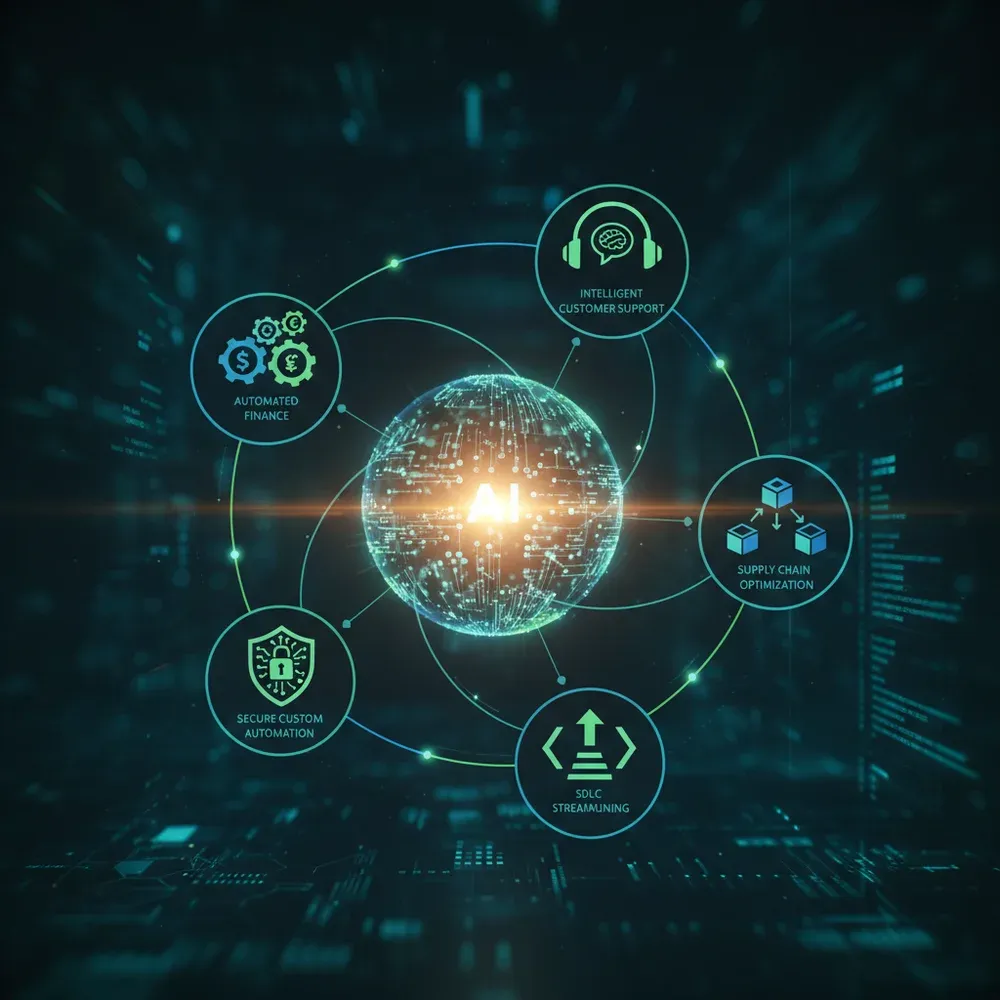
After the theory, let's look at how secure sandbox technology transforms enterprise operations in practice. The possibilities are almost limitless, but in certain industries, the ROI is already outstanding.
The key is managing complexity. Where human workers spend hours data mining and synthesizing, an autonomous agent finishes in minutes, without errors.
Each of the following use cases relies on the isolated execution environment, guaranteeing that sensitive corporate data is never compromised during the process.
Automated Data Analysis and Reporting
Finance and controlling departments spend days each month consolidating data from various sources. Dedicated data processing AI agents can automatically download CSV files, clean the data with Pandas scripts running in the sandbox, and generate a comprehensive visual report.
Because the code runs in the sandbox, the company can be sure that financial data won't leak, and the agent won't accidentally modify the original databases.
This process not only saves time but also eliminates human copy-paste errors, increasing the accuracy of executive decision-making.
Intelligent Customer Service Agents
Traditional chatbots are frustrating. An advanced AI chatbot equipped with sandboxed code execution can query a user's shipping status in real-time, calculate the refund amount, and initiate the transaction via the internal API.
The same technology powers modern AI phone customer service systems, where the voice agent runs database queries in the background within the sandbox during the conversation to provide an immediate, accurate answer to the caller.
Security isolation is critical here too: the customer's personal data remains strictly protected throughout the process.
Streamlining Software Development Lifecycle (SDLC)
For IT teams, AI agents are revolutionizing the website development and software engineering process. Agents can conduct automatic code reviews, identify security flaws, and test proposed patches right in the sandbox.
An autonomous testing agent can generate and run thousands of edge-case scenarios overnight, relieving QA engineers.
The sandbox guarantees that any malicious code or infinite loops generated during testing won't crash the CI/CD pipeline.
Supply Chain Optimization and Predictive Maintenance
In logistics, agents can continuously analyze weather data, traffic reports, and supplier inventories. If a storm delays a shipment, the agent models the costs of alternative routes in the sandbox and suggests the optimal solution.
In manufacturing, agents processing sensor data can run predictive maintenance models. If a machine's vibration pattern changes, the agent immediately sends an alert and prepares a service request.
These complex, data-intensive operations would be unimaginable without a secure, scalable code execution environment.
Overcoming Implementation Hurdles: Best Practices for AI Agent Development
Although the technology is mature, numerous pitfalls await companies during implementation. AI agent security and automation require rethinking traditional development paradigms.
The most common mistake is companies giving too much autonomy to agents from day one. Trust must be built gradually, inserting strict checkpoints.
The key to successful implementation is transparency. Developers and business decision-makers must see exactly why an AI agent made a particular decision.
Data Privacy and Compliance Considerations
GDPR and other data protection regulations impose strict requirements. Before data enters the sandbox or the LLM, a data anonymization layer (PII masking) must be implemented.
It must be ensured that AI agents do not use corporate data to train public models. OpenAI's Enterprise solutions and private sandbox environments guarantee this separation by default.
Regular security audits of agent access rights must be conducted, following Zero Trust principles.
Monitoring, Logging, and Observability for Autonomous Agents
With autonomous systems, the "black box" effect is unacceptable. Every API call, every line of code executed in the sandbox, and every reasoning trace of the LLM must be logged.
Use modern observability tools (e.g., Datadog, LangSmith) that visually display the execution graphs of the agents. This drastically speeds up debugging.
Set up alerts for anomalies: if an agent runs a script in the sandbox for 5 minutes instead of the usual 5 seconds, the system must intervene automatically.
Human-in-the-Loop Strategies for Critical Tasks
For financial transactions, live system configurations, or customer communication, human oversight is essential. Design workflows so that the agent prepares the work, but a human pushes the final button.
Sandbox technology facilitates this too: the agent can generate a "dry-run" report in the sandbox, showing exactly what would happen after approval.
This approach reduces risk, while 90% of the time-consuming manual work is still done by AI.
The Future of Work: Scaling Autonomous Workflows with Confidence

Secure, native sandbox execution is not just a technical feature; it is the key that opens the door to the era of truly autonomous enterprises. Technological barriers have fallen.
In the future, companies won't buy software; they will rent a digital workforce (AI agents) and train them on their specific processes. This is the ultimate form of custom automation.
However, trust is essential for success. Leaders must trust that these systems are secure, reliable, and serve business goals. Robust infrastructure builds this trust.
The Strategic Advantage of Secure Custom Automation
Companies that are the first to integrate secure AI agents will gain an insurmountable competitive advantage. They will be able to scale their operations for a fraction of the cost.
Innovation cycles will shorten. If a new market opportunity arises, AI agents can develop and test the necessary data connections and processes in days.
The efficiency gain won't be 10-20%, but exponential. The human workforce will be freed from monotonous tasks and can focus on creative, strategic problem-solving.
Preparing Your Organization for the AI Agent Revolution
Technological change also requires cultural change. Employees must be trained on how to work alongside AI agents, how to delegate tasks, and how to verify results.
The role of IT departments will also change: from code writers, they will become supervisors and architects of AI systems. The focus will shift to building security frameworks (guardrails) and maintaining data infrastructure.
Start preparing by cleaning up your data assets. AI agents are only as good as the data they have access to. Build clean, well-structured databases and APIs.
Industry Perspective: What Experts Say About Agent Security and Scalability
Leading analysts in the tech industry agree that 2025-2026 are the years of "Agentic AI". Reports from Gartner and Forrester all highlight the critical importance of autonomous system security.
Experts emphasize that sheer intelligence (model size) is no longer a sufficient differentiator. True value is provided by reliable execution environments.
OpenAI's move towards the native sandbox aligns perfectly with the demands of enterprise CTOs: they want less hype and more enterprise-grade stability.
The Growing Need for Robust Agent Infrastructure
Cybersecurity experts have long warned about the dangers of direct LLM system integration. Robust infrastructure, including isolation, permission management, and logging, is now a basic requirement.
Companies cannot afford to run experimental, unstable codes in their production systems. The infrastructure must guarantee 99.99% uptime and zero data leakage.
Platform-level solutions that offer these defense lines built-in drastically accelerate the Time-to-Market for enterprise AI projects.
The Role of Platforms like OpenAI in Advancing AI Agent Adoption
The role of platform providers (PaaS) is crucial in democratization. By taking on the complexity of sandbox technology, OpenAI makes advanced custom automation accessible to smaller companies and SMEs as well.
This standardization fosters the development of a broader ecosystem. Developers can build tools and modules that are guaranteed to work in the secure environment.
In the future, other major cloud providers (AWS, Google Cloud) are expected to offer similar native integrations, further strengthening the rise of autonomous agents.
Ready to Transform Your Enterprise? Partner with Us for Custom AI Automation
The era of autonomous AI agents has arrived, and the secure technological foundations (like OpenAI's native sandbox) are already available. The question is not whether to start, but when and with whom.
The expert team at AiSolve has deep experience in designing and implementing enterprise-grade, secure custom automation. We help identify processes with the highest ROI and build the necessary robust architecture.
Don't let technological complexity or security concerns hold back your growth. Contact us today, and let's transform the future of your enterprise together with intelligent, autonomous solutions!
Frequently Asked Questions (FAQ)
How does OpenAI's native sandbox technology enhance AI agent security for enterprises?
The native sandbox uses kernel-level isolation (similar to gVisor) and strict network restrictions. This means that the code generated and executed by the AI agent runs in a closed, ephemeral environment. Even if the agent generates faulty or malicious code, it cannot break out of the sandbox, so it cannot access host resources, the internal network, or sensitive corporate data. At the end of the process, the environment is destroyed, guaranteeing zero residual vulnerability.
What are the key differences between traditional RPA and AI-powered custom automation?
Traditional RPA (Robotic Process Automation) is static, rule-based, and extremely fragile; if the user interface or data structure changes even slightly, the process crashes. In contrast, AI-powered custom automation has cognitive capabilities. AI agents can interpret unstructured data, adapt to changing environments (e.g., by reading API docs in real-time), and autonomously rewrite execution scripts in the sandbox to solve the problem, without human intervention.
Can custom AI agents integrate with existing enterprise systems and legacy infrastructure?
Yes, absolutely. The key to secure integration is an API-driven approach. AI agents communicate with existing ERP or CRM systems through dedicated, least-privilege REST or GraphQL endpoints. For legacy systems without modern APIs, agents can run headless browsers (e.g., Puppeteer) within the secure sandbox to automate the interface, under strict network isolation and Human-in-the-Loop supervision.
What are the typical challenges in deploying long-running AI agents, and how does the new SDK address them?
The main challenges for long-running agents were context loss, dependency inconsistencies (e.g., Python packages), and memory leaks. The new model-native Harness and sandbox SDK handle this by supporting "stateful" execution. It automatically manages package installations at runtime, preserves intermediate files and memory variables between steps, and maintains contact with the LLM in a structured JSON format, enabling stable, multi-day asynchronous workflows.
How can data privacy and compliance be ensured when implementing custom AI automation?
Ensuring data privacy (GDPR, HIPAA) requires a multi-layered approach. First, data must be anonymized (PII masking) before reaching the agent. Second, Enterprise-level AI providers (like OpenAI) contractually guarantee that corporate data is not used to train public models. Third, sandbox technology ensures that data processing occurs in an isolated space, preventing unauthorized data exfiltration.
What is the Return on Investment (ROI) for investing in secure, enterprise-grade custom AI automation?
The ROI is extremely high, often measurable in months. The return comes from three main sources: 1) A drastic reduction (up to 80-90%) in manual, repetitive data processing and administrative hours. 2) Minimizing DevOps and maintenance costs, as the native sandbox eliminates the need to constantly fix fragile scripts. 3) Faster Time-to-Market, as AI agents can develop new processes and integrations in days instead of traditional months-long development cycles.
How do you monitor and manage the performance of autonomous AI agents in production?
Monitoring in production requires advanced observability tools (e.g., LangSmith, Datadog). Every API call, line of code executed in the sandbox, and the LLM's reasoning trace must be logged in detail. Alerts must be set up for execution time anomalies or increased error rates. For critical processes, applying a "Human-in-the-Loop" strategy is mandatory, where the agent only prepares the decision, but the execution is approved by a human operator.
Készen állsz a saját weboldaladra?
Ingyenes konzultáció során átbeszéljük, hogyan segíthetünk vállalkozásodnak növekedni egy modern, gyors és konverzióoptimalizált weboldallal. 14 nap alatt kész, 0 Ft induló költséggel.