OpenAI recently made a quiet but earth-shattering announcement: a significant portion of their internal development processes is no longer handled by humans, but by Codex agents built on the so-called "Harness Engineering" methodology. This is not just another tech news story; it is proof that we have reached a turning point in software development and business automation where complexity is no longer a barrier to growth, but a baseline handled by AI.
Modern enterprises have struggled with the same problem for decades: as systems grow, maintaining them becomes slower and more expensive. Technical debt accumulates, and developers' time is spent firefighting instead of innovating. However, the new era of custom automation breaks this paradigm. We are not talking about simple scripts that copy data from A to B, but intelligent, context-aware agents capable of understanding, testing, and fixing their own code.
In this article, we dive deep into the technology that enables this level of autonomy. We examine how companies can apply the methods pioneered by OpenAI to optimize their own processes and why this is essential for maintaining competitiveness in the next five years.

What is Custom Automation in the Age of AI? More Than Just Scripts
Traditional automation (RPA - Robotic Process Automation) was based on rigid rules: "If this happens, do that". This worked excellently with structured data and linear processes but collapsed immediately when an unexpected error or variable occurred. AI-driven custom automation, by contrast, is probabilistic and adaptive.
Definition: AI-Driven Custom Automation
The design and implementation of software systems that use Large Language Models (LLMs) and agent-based architectures to execute complex, non-deterministic tasks. These systems are capable of semantic understanding, decision-making, and self-correction, thus dynamically adapting to the changing business environment.
This technology allows us to automate processes that previously required human cognitive abilities. Consider, for example, a RAG (Retrieval-Augmented Generation) based system that not only retrieves a document but interprets its legal content, compares it with corporate policy, and suggests necessary amendments. Or a developer agent that not only runs tests but analyzes the error message and writes the fix in the codebase.
Implementing custom AI agents is not just about increasing efficiency; it is about liberating the workforce from monotonous, cognitively draining tasks, enabling strategic thinking and creative creation.
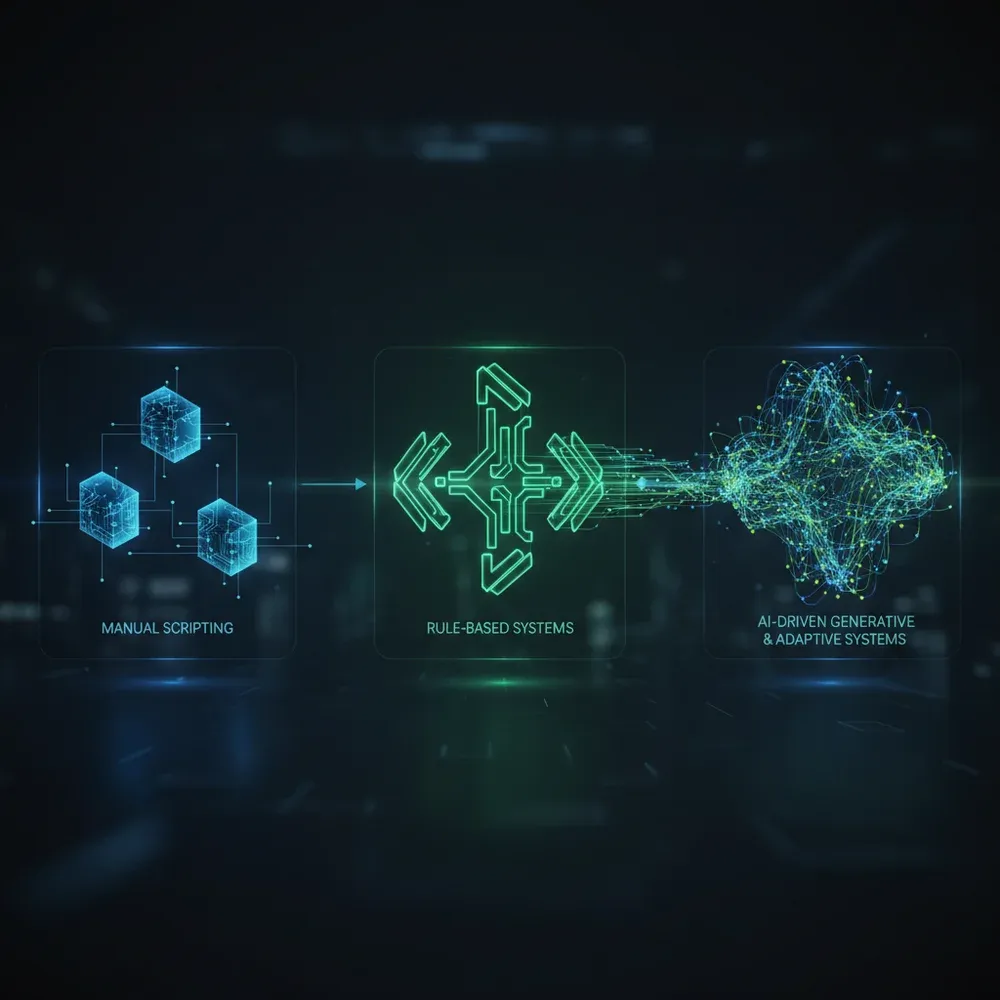
Case Study: OpenAI's Harness Engineering – Codex Agents Behind Million-Line Systems
OpenAI's "Harness Engineering" approach is the prime example of how AI can be applied at the deepest levels of software development. Instead of humans writing test cases and boilerplate code, OpenAI uses Codex-based agents for this purpose. But how does this work in practice?
How Codex Agents Work and Their Capabilities
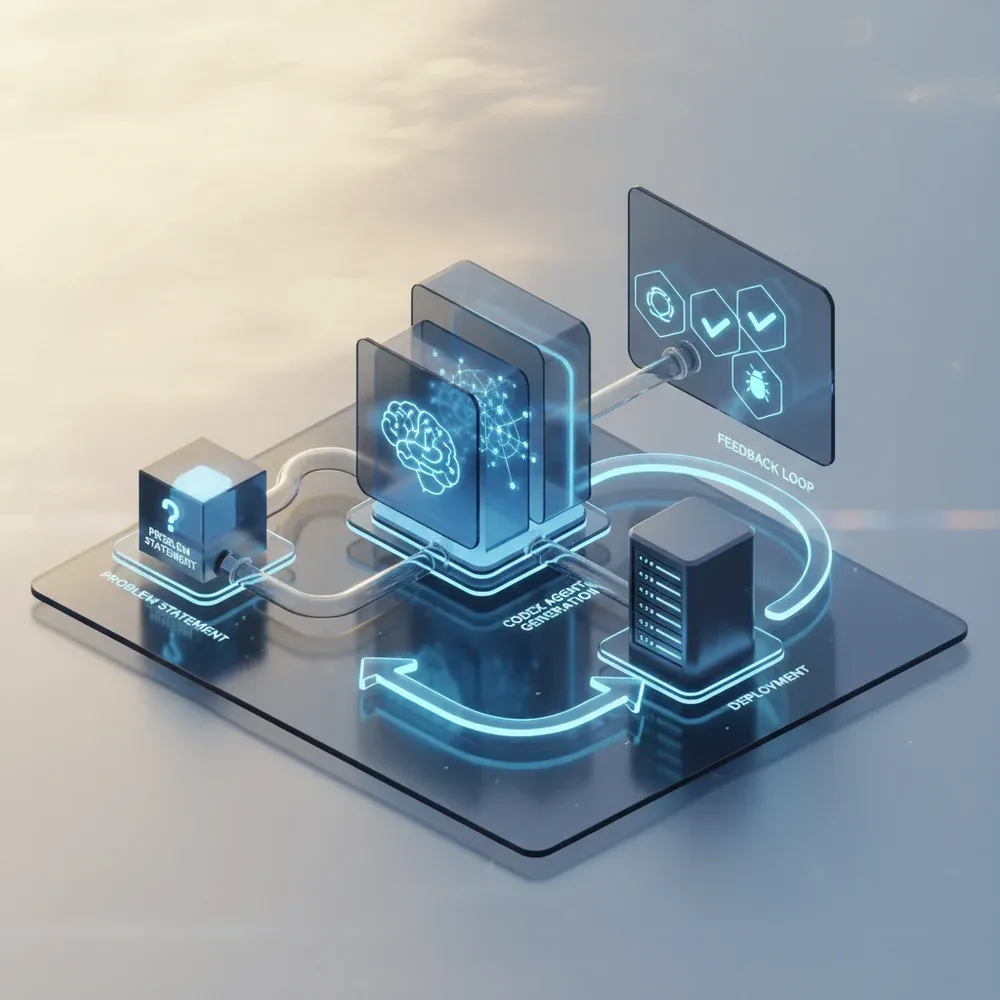
The system is based on an LLM specifically fine-tuned for code interpretation and generation. When a developer specifies a new feature (even in natural language), the agent:
- Analyzes Context: Maps the affected codebase and dependencies.
- Generates Tests: Before writing a single line of production code, it creates test cases that define successful operation (Test-Driven Development - TDD).
- Implements: Writes the feature.
- Validates and Fixes: Runs the tests. If an error occurs, the agent "reads" the error message and iterates on the code until it passes the tests.
This process drastically reduces the burden on human developers, who now only need to deal with high-level architecture and specification accuracy. We apply similar principles when building OpenAI Codex App Servers for our clients.
Key Components of the Harness Engineering Architecture
The key to success lies not only in the model but in the infrastructure around it. The "Harness" ensures that the AI does not "hallucinate" non-functional code. This includes strict sandbox environments where code can be safely executed, as well as modern SDLC (Software Development Life Cycle) integration that automatically handles version control and deployment.
Results and Lessons from OpenAI's Experience
According to OpenAI reports, since the introduction of Harness Engineering, test coverage has increased dramatically while development cycle times have decreased. The most important lesson for companies: AI does not replace the engineer, but multiplies their capabilities. A single senior engineer capable of directing an army of Codex agents can now create as much value as a full development team previously could.
Why AI-Driven Custom Automation is Critical for Modern Enterprises?
The technological gap is widening. Companies that continue to rely solely on manual processes and off-the-shelf software will soon be at an insurmountable disadvantage. The strategic benefits of custom automation are indisputable:
- Speed: Time-to-Market can decrease from weeks to days, or even hours.
- Scalability: AI agents do not get tired and can handle thousands of processes in parallel.
- Cost Efficiency: Although the initial investment may be higher, operational costs (OPEX) fall to a fraction in the long run.
- Quality Assurance: Automated testing and validation eliminate errors resulting from human inattention.
This is particularly true in data-intensive industries, where data processing AI agents can analyze and structure incoming information in real-time, whether it be financial transactions or production line sensor data.
Key Pillars and Technological Foundations of AI-Driven Custom Automation
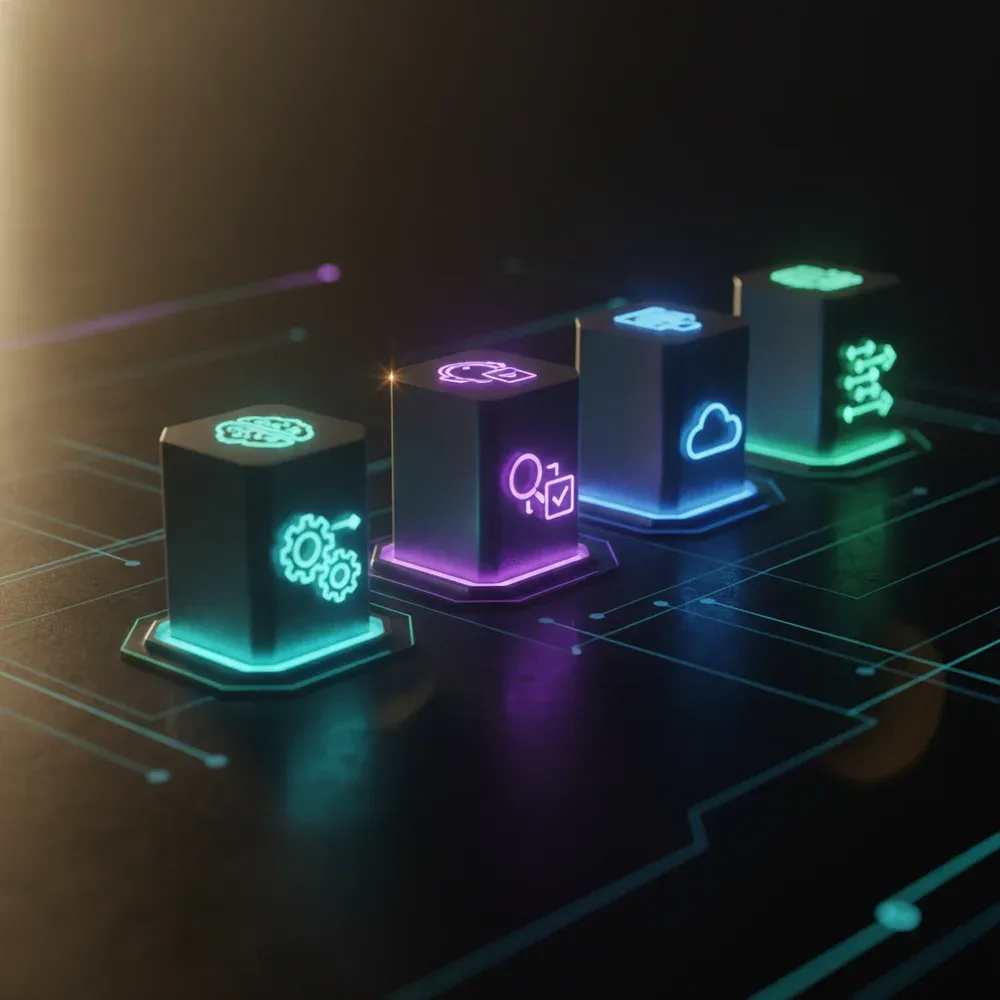
To successfully implement these systems, a company must build on three main technological pillars. These elements form the stable foundation upon which complex automation solutions can be built.
Generative AI and Large Language Models (LLMs)
LLMs (like GPT-4, Claude 3.5 Sonnet, or Llama 3) form the "brain" of the system. They are capable of understanding unstructured data (emails, images, PDFs) and converting it into structured formats (JSON, SQL, Python code). The future of software development is unimaginable without the integration of these models.
MLOps and Automated Workflows
AI models alone are not enough; a framework is needed to manage them. MLOps (Machine Learning Operations) ensures continuous training, versioning, and monitoring of models. This guarantees that automation does not "dumb down" over time but adapts to new data.
Intelligent Testing and Validation
As the OpenAI example showed, validating generated code or content is critical. This is where automated test frameworks come in, checking probabilistic AI outputs with deterministic rules. This hybrid approach ensures enterprise-level reliability.
Implementing AI-Powered Custom Automation: A Strategic Roadmap
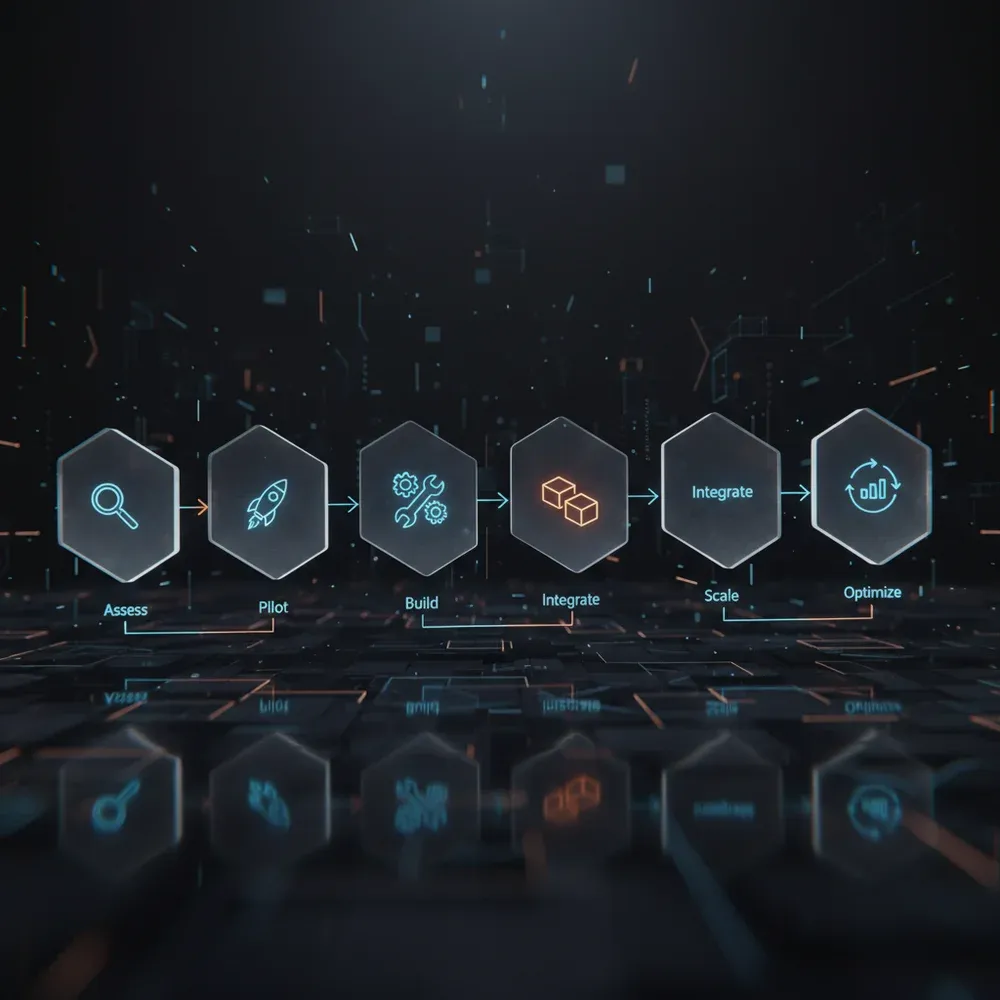
The transition cannot happen overnight. In our experience, the following stepped approach leads to the most certain success:
Assessing Current State and Defining Objectives
Before choosing technology, bottlenecks must be identified. Where does the team lose the most time? What are the repetitive tasks with the highest error rates? A thorough audit is essential.
Pilot Projects and Proof-of-Concept (PoC) Phases
Do not try to automate the entire company immediately. Choose a well-isolatable process (e.g., pre-screening customer service tickets or automatic invoice processing) and build a PoC for it. This helps validate the technology and convince decision-makers of the ROI.
Selecting Technology Stack and Integration
This is where the choice of tools is made: LangChain, Semantic Kernel, custom Python scripts, or Claude Code based workflows. The goal is seamless integration with existing systems (ERP, CRM).
Team Training and Organizational Adaptation
Automation is not about replacing people, but about transforming roles. Employees must be taught to collaborate with AI tools ("AI literacy") so they can evolve from operators to AI supervisors.
Challenges and Considerations in AI-Driven Automation
While the benefits are huge, risks must not be ignored. The most common challenge is "hallucination", when AI confidently asserts falsehoods. To manage this, strict "Human-in-the-loop" processes and fact-checking algorithms must be incorporated.
Data security is also critical. Corporate data should never be sent to public models without anonymization. This is why we prefer custom solutions running in private environments, where data never leaves the company infrastructure.
How secure is AI-generated code?
The security of AI-generated code largely depends on validation processes. On its own, AI can generate vulnerable code, so it is essential to use Static Application Security Testing (SAST), dynamic tests, and security sandboxes before deployment. OpenAI's Harness Engineering methodology is also built on this multi-layered verification.
What ROI can be expected from AI-driven custom automation?
Return on investment typically appears within 6-12 months. In addition to direct cost reduction (replacing man-hours), the greatest value comes from scalability and reduced error rates. We often see 40-60% efficiency gains in automated processes at our clients.
The Future of AI-Driven Custom Automation: Trends and Opportunities
The future belongs to autonomous agents. While most of today's systems still require human supervision, next-generation agents will be able to independently set goals, create plans, and execute them. "Self-healing" software will appear, detecting its own errors and patching them before users notice anything.
Measuring the ROI of AI-Driven Custom Automation
Measuring success is essential. Key KPIs include:
- Process Execution Time: How much faster did the task become?
- Error Rate Reduction: How many manual corrections were needed?
- Freed-up Man-hours: How much time can the team spend on higher value-added work?
- System Availability: How much more stable is the automated system?
Choosing the Right Partner for Your Custom Automation Journey
AI-driven automation is a complex field requiring deep technical knowledge in both software development and artificial intelligence. The AiSolve team is expert in designing and executing enterprise-level, custom AI solutions.
Whether it is custom automation, intelligent chatbots, or data processing systems, we help find and implement the most effective solution.
Conclusion: Prepare for the Software Development Revolution
OpenAI's Harness Engineering is not a unique case, but a harbinger of the future. Companies that act now and integrate AI into their development and business processes can gain a decade-long advantage. The question is not whether to automate, but how quickly we can adapt to this new, intelligent era.
Készen állsz a saját weboldaladra?
Ingyenes konzultáció során átbeszéljük, hogyan segíthetünk vállalkozásodnak növekedni egy modern, gyors és konverzióoptimalizált weboldallal. 14 nap alatt kész, 0 Ft induló költséggel.