

OpenAI and the U.S. Department of Energy's Pacific Northwest National Laboratory (PNNL) recently made a landmark announcement: through the DraftNEPABench project, they demonstrated that specialized data processing AI agents can drastically accelerate federal environmental permitting processes. The research highlighted that modern language models do not just generate text but can structure thousands of pages of regulatory documentation, potentially reducing the permitting time for critical infrastructure projects—such as clean energy plants or semiconductor factories—by 15%.
This breakthrough isn't just for the government sector. It signals that we have entered the era of agentic data processing, where AI is no longer just a passive chatbot but an active collaborator capable of understanding, analyzing, and managing the most complex corporate and legal data.
Introduction: The Complexity of Regulatory Data Processing and AI's Potential
Regulatory compliance and permitting processes are traditionally black holes of corporate efficiency. A single Environmental Impact Statement (EIS) for a major investment often exceeds thousands of pages, taking years to complete and requiring the manual effort of dozens of experts. Data is fragmented: lying in PDFs, Excel spreadsheets, legacy databases, and emails.
Manual processing is not only slow but error-prone. A single overlooked data point or incorrect citation can result in months of delays. This is where data processing AI agents step in. These systems do not get tired, can interpret legal texts in context, and most importantly: they can extract structured data from unstructured chaos.
What Are Data Processing AI Agents?
Data Processing AI Agents are software entities that use Large Language Models (LLMs) and other machine learning technologies to autonomously perform complex data management tasks. Unlike traditional automation (RPA), which follows pre-programmed rules, AI agents can adapt, make decisions, and "understand" the meaning of content.
Definition: Data Processing AI Agent
An autonomous system capable of ingesting, interpreting, and analyzing unstructured (text, image) and structured data, and generating new content (e.g., reports, code) with minimal human intervention, while continuously learning from feedback.
These agents often use RAG (Retrieval-Augmented Generation) technology to retrieve information from the corporate knowledge base in real-time, ensuring hallucination-free, fact-based operation. They don't just read data; they act: updating databases, drafting emails, or requesting missing information.

Challenges of Federal Permitting Through the Lens of NEPA
In the United States, the National Environmental Policy Act (NEPA) mandates that environmental impacts be assessed before any major federal project. This process is notoriously slow. The average preparation time for an EIS is 4.5 years, and documents often exceed 600 pages (excluding appendices). This bureaucratic burden has a direct impact on the economy: delaying the green energy transition and increasing investment costs.
The root of the problem is the "blank page" syndrome and data fragmentation. Engineers and lawyers must review hundreds of previous documents to ensure consistency and legal compliance. This manual research consumes most of the time, and this is where AI offers a solution.
AI Agents in Action: Revolutionizing Permitting Processes (DraftNEPABench)
DraftNEPABench, created through the collaboration of OpenAI and PNNL, is a benchmark designed specifically to measure the ability of AI models to draft NEPA documents. The experiment did not use simple text generators but employed a "coding agents" approach.
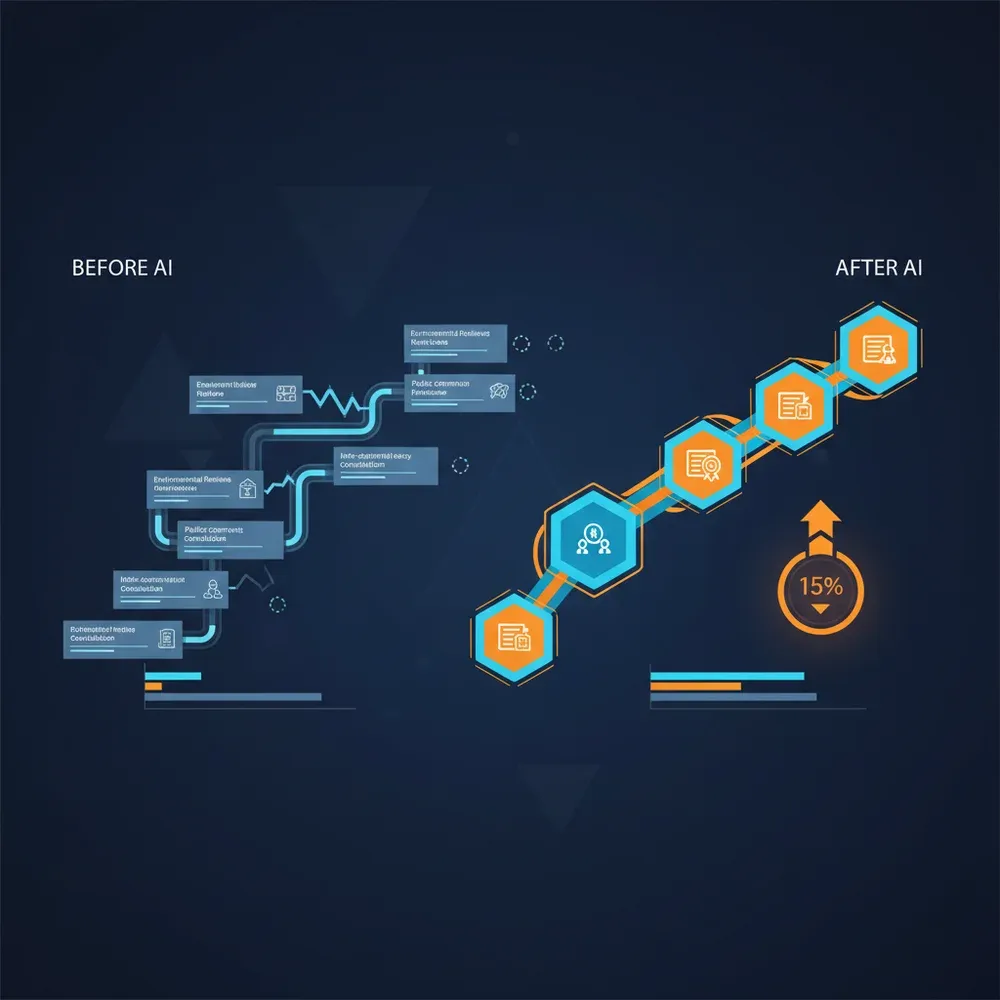
These agents do not just write text; they can execute Python code to analyze data, extract statistics, and verify sources. The results are impressive: the models were able to quickly retrieve relevant information and write coherent, professionally accurate text sections, which researchers estimate could reduce the total drafting process by approximately 15%.
This 15% might seem small at first, but in a 4-5 year process, it translates to months or even a year, saving investors millions of dollars. The ability of autonomous AI agents to handle legal texts in a structured way could revolutionize not only environmental protection but also financial and healthcare audits.
Benefits of Applying Data Processing AI Agents
Implementing AI agents isn't just about speed. The technology fundamentally changes quality assurance and cost structures.
- Scalability: While a human expert's capacity is finite, AI agents can process thousands of documents in parallel, 24/7.
- Consistency: Agents don't "forget" rules. They review every single document against the same strict criteria, reducing the chance of subjective errors.
- Cost Reduction: By automating routine data collection and pre-screening, expensive expert hours can be redirected to true decision-making and strategic planning.
- Improved Compliance: Agents can be continuously updated with the latest regulations, immediately flagging if a draft does not meet new requirements.
Want to know how these benefits apply to your industry? Through our custom automation service, we assess your processes and design the most suitable agent architecture.
Technical Deep Dive: How Do Data Processing AI Agents Work?
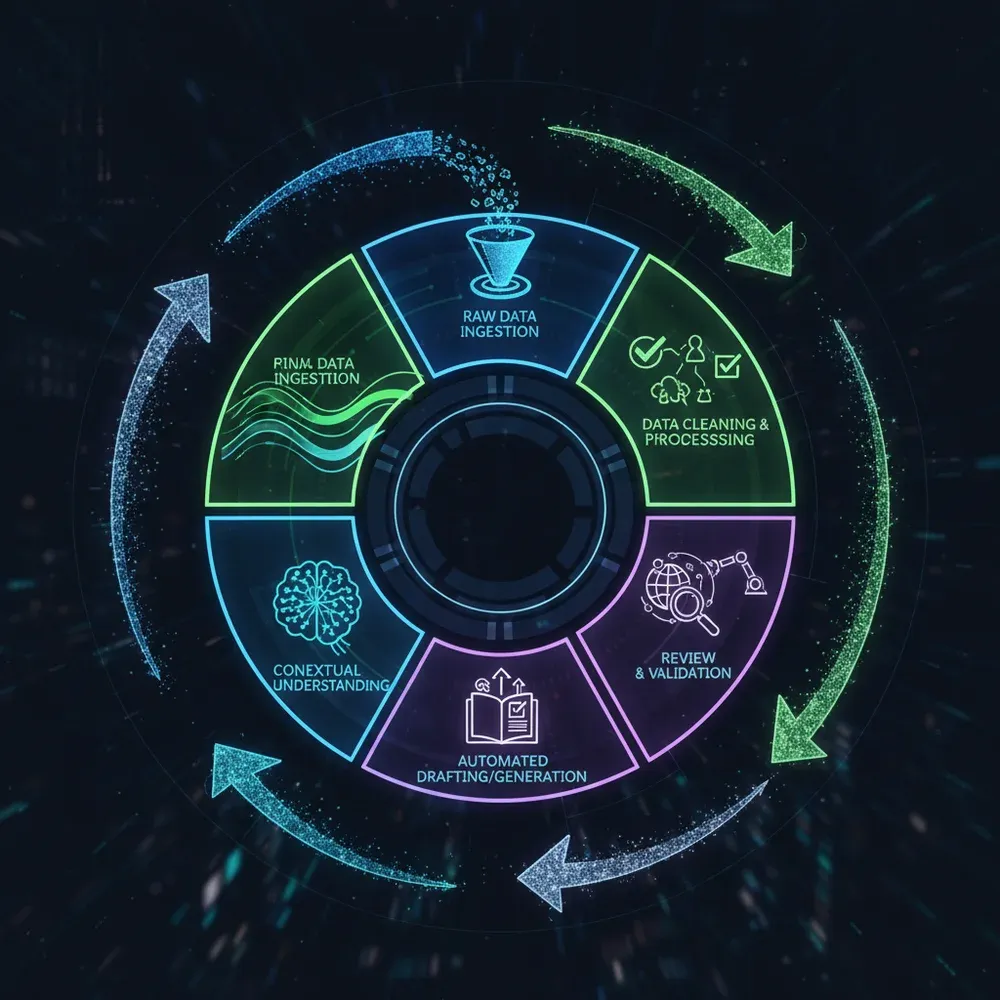
How does a pile of PDFs become structured knowledge? The process involves several steps orchestrated by the agents.
- Ingestion: The agent connects to source systems (APIs, file systems, websites) and collects raw data. OCR (Optical Character Recognition) technology may be used here for scanned documents.
- Chunking and Embedding: Texts are broken down into smaller units (chunks) and then converted into vector format (embedding). This allows the machine to search for meaning, not just keywords.
- Semantic Search and RAG: When the agent needs to answer a question or write a chapter, it retrieves the most relevant information from the vector database.
- Generation and Validation: The LLM writes the response based on the extracted data. Advanced systems, like the ones we build, include a "critic" sub-agent that checks the factual accuracy of the generated text against the original source.
This multi-step process ensures that the result is not only well-written but professionally accurate. The foundation of such systems is often a robust enterprise data platform, like the one offered by the Snowflake and OpenAI partnership.
Implementation Guide: Introducing AI Agents in Organizations
Implementing AI agents is not a "plug-and-play" process but a strategic project. Here are the steps we recommend:
- Data Asset Assessment: Where is the data? What is its quality? AI is only as good as the data it works from.
- Pilot Project Selection: Don't try to automate the entire company at once. Choose a well-defined, data-intensive process (e.g., incoming invoice processing or contract preparation).
- Digital Infrastructure: Ensure proper API connections and a cloud-based environment. Modern website development and backend development can help create the necessary technical foundation for agents.
- Human-in-the-Loop: Design the process so that human approval is required at critical decision points. AI prepares, humans decide.
If you need help taking the first steps or are unsure about the technical requirements, contact us for a consultation.
Challenges and Considerations in AI Agent Adoption
While the technology is promising, it is not without risks. The most critical challenge is hallucination, where the AI confidently states falsehoods. This is why RAG technology and strict citation are critical.
Another consideration is data security. When handling sensitive business or personal data, you must ensure that information does not leave the corporate network and is not used to train public models. Custom automation with AI allows for running closed, private models that guarantee data sovereignty.

The Future: Data Processing with AI Agents and Human Collaboration
The future is not about offices without humans, but about experts empowered with "superpowers". AI agents take over the grunt work—searching for data, organizing it, writing first drafts—allowing humans to focus on what they do best: strategic thinking, empathy, and complex problem-solving.
We can also expect the emergence of multimodal agents capable of processing not just text but audio and video. Imagine an AI phone customer service that analyzes customer data in real-time during a conversation and immediately suggests solutions to the operator.
E-E-A-T: What Do Experts and Research Say? (OpenAI, PNNL)
The claims presented in our article are supported by the latest industry research. OpenAI and PNNL's "DraftNEPABench" study scientifically proved that coding agents perform significantly better in structured data extraction than traditional language models. Researchers emphasize that the key to success is domain-specific knowledge and the existence of a proper testing framework (benchmark).
How do data processing AI agents differ from traditional automation?
Traditional automation (RPA) follows rigid rules (e.g., "if X happens, do Y"). In contrast, AI agents can interpret unstructured data (e.g., the tone of an email or the content of a legal text) and make adaptive decisions even in unexpected situations.
What is DraftNEPABench, and why is it important for federal permitting?
DraftNEPABench is a benchmark environment developed by OpenAI and PNNL that measures how effectively AI models can draft environmental permitting documents (NEPA). Its importance lies in proving that AI can accelerate critical infrastructure permitting, potentially reducing administrative time by 15%.
Can data processing AI agents be customized for specific industry regulations?
Yes, this is one of their biggest advantages. Using RAG technology, agents can be loaded with specific laws, internal policies, and industry standards (e.g., GDPR, HIPAA, ISO), so they operate exactly according to the expectations of that environment.
What are the main security concerns when using AI agents for sensitive data?
The main concerns are data leakage, model hallucination, and unauthorized access. Solutions include using models running in a private cloud, strict access control (RBAC), and anonymizing data before processing.
How long does it take to implement a data processing AI agent system?
This depends on complexity. A simpler, internal document search agent (MVP) can be ready in 2-4 weeks, while developing a complex decision support system integrated with multiple systems can take 3-6 months.
Conclusion: The Transformative Power of Data Processing AI Agents
Data processing AI agents are not a promise of the distant future but a present reality. As the DraftNEPABench example shows, they are already capable of achieving measurable, tangible efficiency gains in the most complex regulatory environments. The question is not whether to use them, but who will move first and gain an insurmountable competitive advantage through faster, more accurate, and cost-effective operations.
Don't let paperwork and data chaos slow down your business. Discover how AiSolve's custom automation solutions can help modernize your processes.
Készen állsz a saját weboldaladra?
Ingyenes konzultáció során átbeszéljük, hogyan segíthetünk vállalkozásodnak növekedni egy modern, gyors és konverzióoptimalizált weboldallal. 14 nap alatt kész, 0 Ft induló költséggel.