
Introduction: Moving Beyond the Limitations of Cloud-Based AI
This month's announcements regarding Google's latest open-weights Gemma 4 model and NVIDIA's newest RTX AI PC platforms have fundamentally shaken enterprise IT strategies. The message is clear: the future is not exclusively in the cloud.
Until now, companies were forced to send their sensitive data to third-party servers to access the most advanced language models. However, this model is becoming increasingly unsustainable in the modern business environment.
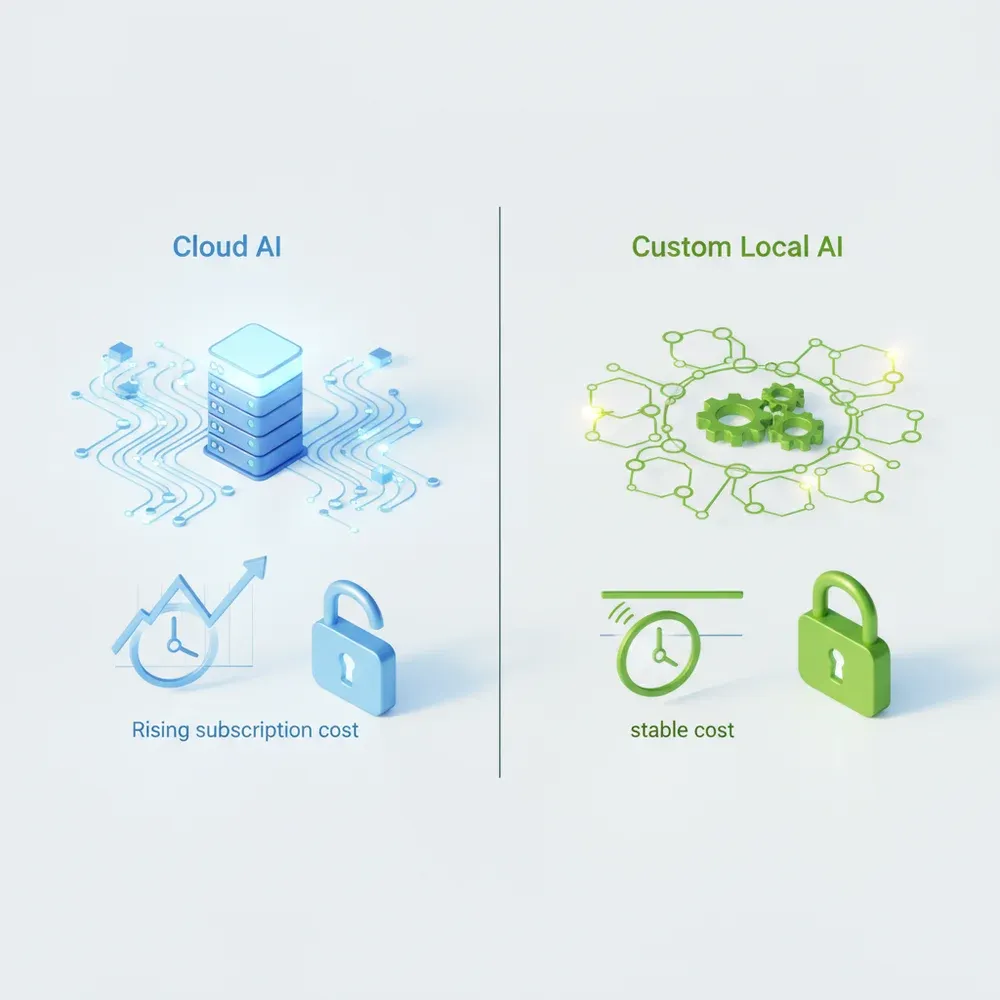
Cloud-based solutions struggle with three main problems: unpredictable network latency, difficulties in complying with tightening data protection regulations (GDPR, HIPAA), and skyrocketing API costs.
When a company processes millions of tokens a day, the fees for cloud subscriptions and API calls grow exponentially. This is where custom AI automation running on local hardware comes into play, bringing a paradigm shift.
Problem Statement: The Vulnerability of the Cloud
An average large enterprise can spend up to a hundred thousand dollars annually on cloud LLM API calls. Furthermore, every single request that leaves the corporate firewall represents a potential security risk. Network outages or slowdowns on the provider's side can directly paralyze critical business processes. The solution is to bring data and computational capacity back into the corporate infrastructure.
What is Custom AI Automation and Why is it Critical Now?
Custom AI automation does not mean buying off-the-shelf software. It is the construction of a tailored ecosystem that fits perfectly into the company's unique workflows and data structure.
Instead of using general-purpose chatbots, we train or fine-tune specialized AI models on the company's own internal knowledge base. These models integrate deeply into existing ERP, CRM, and database systems.
Why is now the time for this? The answer lies in the convergence of hardware and software. The performance of open-source models has caught up with closed, cloud-based systems.
As we demonstrated in our analysis on hardware innovation in custom automation, the time for standard solutions is over. Companies need their own dedicated infrastructure to maintain a competitive edge.
Custom automation allows artificial intelligence to be more than just a "smart search engine"; it becomes an active, decision-making, and executing entity within the corporate network.
Gemma 4 and NVIDIA RTX: The Engines of the Local AI Revolution
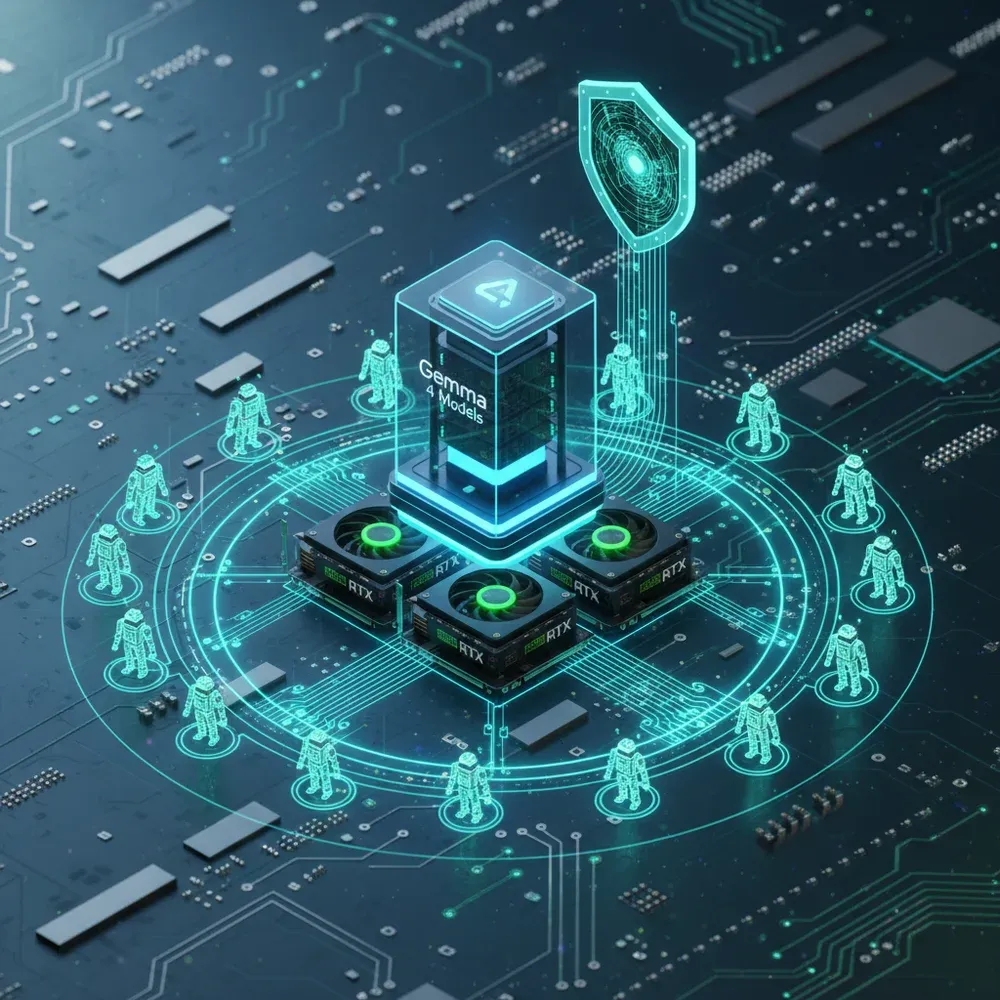
Google's Gemma 4 architecture is a milestone in the history of open-weights models. It was designed to provide maximum efficiency even in local, resource-constrained environments.
With the advancement of quantization techniques (like AWQ or GPTQ), a 27-billion parameter model can now comfortably fit into the memory of a single high-end GPU. This was previously unimaginable.
The NVIDIA RTX series, especially the Ada Lovelace and newer architectures, provide brutal computational power for local inference with their fourth-generation Tensor cores.
Coupled with TensorRT-LLM software optimization, RTX cards can generate hundreds of tokens per second. This speed is essential for complex, multi-step agentic workflows.
Technical Deep Dive: Hardware Inference
An NVIDIA RTX 4090 or 5090 GPU comes with 24GB or more of GDDR6X VRAM. A Gemma 4 model that has undergone 4-bit quantization requires only 14-16 GB of memory. The remaining VRAM is more than enough to maintain the context window (KV cache), allowing for the instant, local processing of documents up to 128k tokens long, without the data ever leaving the machine.
The Rise of Autonomous Agent Swarms: Reshaping Workflows
The next step in the evolution of artificial intelligence is not a single, omniscient model, but the emergence of networks of specialized agents, known as Agent Swarms.
These autonomous agent swarms operate like a highly trained virtual team. Each agent has its own specific task, toolset, and scope of authority.
For example, in a data processing workflow, one agent collects data, another cleans it, a third analyzes it, and a fourth generates a report. They communicate with each other continuously.
As we detailed in our article on the revolution of multi-agent AI workflows, this decentralized approach drastically reduces the margin of error and increases efficiency.
Running on local hardware, these swarms can exchange messages in milliseconds, which would be impossible in the cloud due to network latency. This is what makes them truly autonomous and fast.
The Advantages of Local Hardware: Latency, Privacy, and Cost-Efficiency
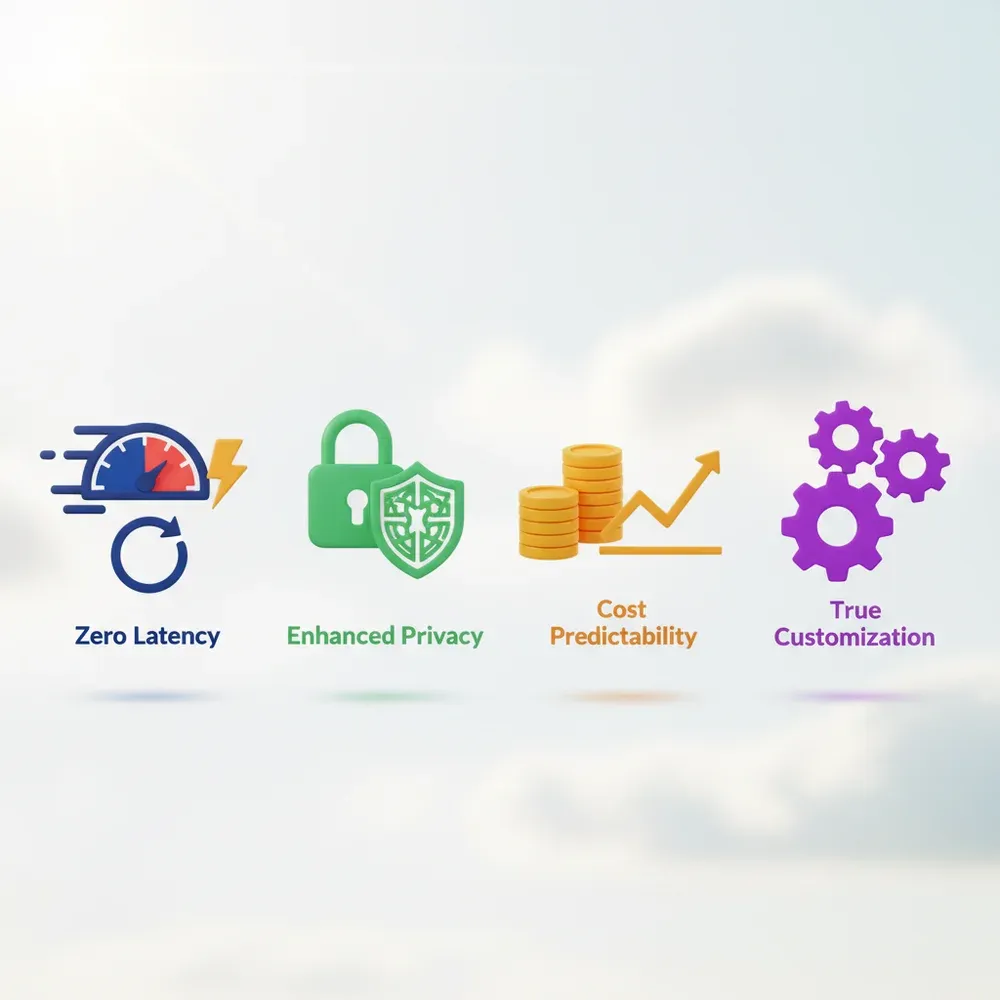
The first and most obvious advantage of transitioning to local hardware is speed. By eliminating network requests (round-trip time), latency is reduced to near zero.
This real-time operation is critical in areas such as manufacturing quality control or high-frequency financial trading, where every millisecond counts.
The second pillar is data privacy. When models run on-premise, behind the corporate firewall, the most sensitive customer data, financial reports, or source codes are never exposed to the internet.
This edge revolution and on-device LLMs providing full privacy is a fundamental requirement in strictly regulated industries like healthcare or banking.
Last but not least, cost-efficiency. Although purchasing hardware requires a significant initial investment (CapEx), the elimination of ongoing cloud subscription fees (OpEx) means the return on investment (ROI) is often less than a year.
If you want to learn how to optimize your company's costs, explore our custom automation services and request a personalized ROI calculation.
Architecture of Custom AI Automation: Planning and Implementation
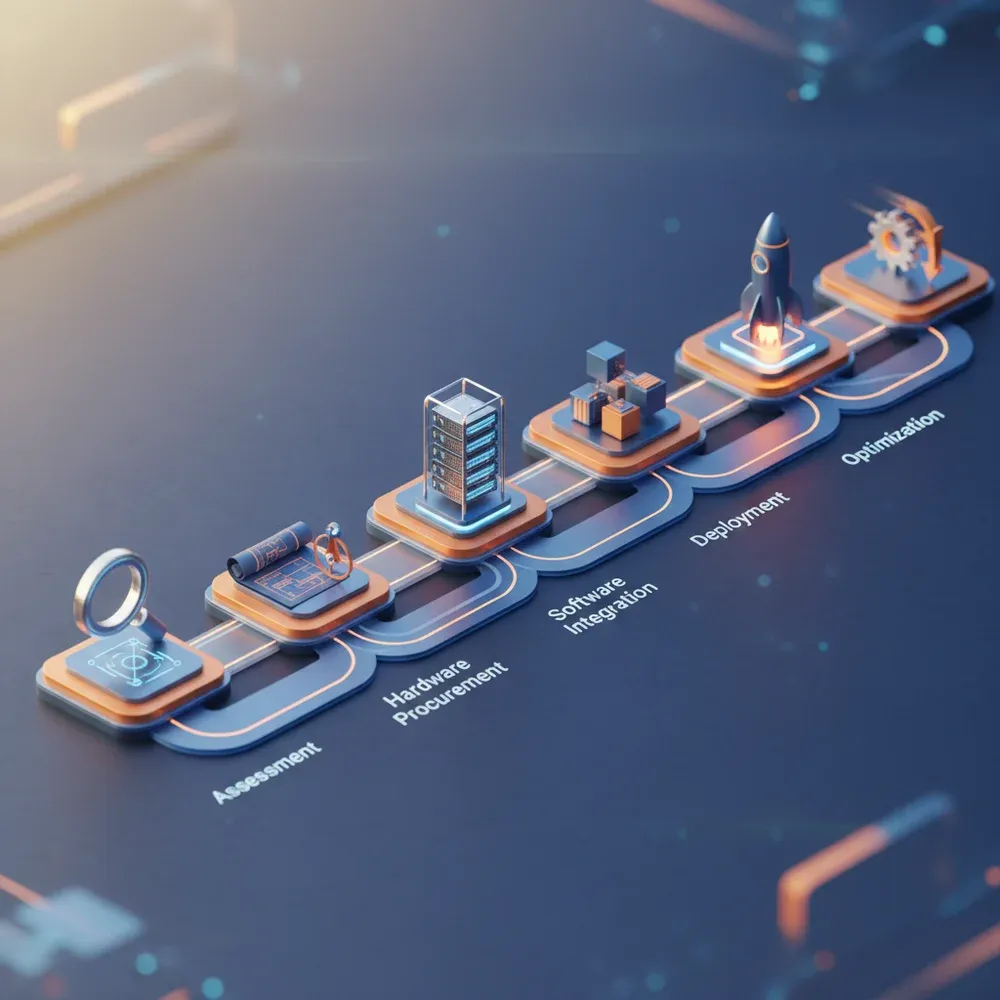
Building a robust local AI infrastructure requires careful planning. The hardware foundation consists of NVIDIA RTX workstations or servers with adequate VRAM capacity.
At the bottom of the software stack are the operating system and CUDA drivers. Built on top of these are high-performance inference engines like vLLM or Ollama.
For data management, a local vector database (e.g., Qdrant or Milvus) is essential, enabling the application of RAG (Retrieval-Augmented Generation) technology on your own documents.
Agent orchestration is handled by frameworks such as LangChain, CrewAI, or Microsoft AutoGen. These ensure communication between agents and the delegation of tasks.
The entire system runs containerized (Docker), which guarantees scalability, easy updatability, and high availability within the corporate network.
Case Studies and Applications: Where Custom AI Automation Shines
In the manufacturing industry, local AI agents are revolutionizing predictive maintenance. Sensor data is analyzed in real-time, right next to the machines (edge computing), intervening immediately before failures occur.
In the financial sector, fraud detection has gained new momentum. Local models can analyze transaction patterns in milliseconds without customer data ever leaving the bank's secure zone.
In healthcare, it is bringing breakthroughs in patient data processing and diagnostic support. Doctors receive instant, AI-supported analyses of medical records, with full HIPAA and GDPR compliance.
In these industries, data processing AI agents are not just a convenience feature, but provide a critical competitive advantage in the market.
In the legal sector, the automated analysis of contracts and precedent research becomes incredibly fast, while attorney-client privilege remains maximally guaranteed thanks to local execution.
Challenges and Solutions During the Transition
Transitioning to a local AI infrastructure is not without its challenges. The most common hurdle is the significant initial capital expenditure (CapEx) required to purchase the appropriate hardware.
This problem can be mitigated through hardware leasing arrangements or by migrating critical processes gradually, in phases, thus spreading out the costs.
Another major challenge is the skills gap. Operating local LLMs, handling quantization, and orchestrating agent swarms require specialized engineering knowledge that is rare in the market.
The solution is to involve external, specialized partners who deliver turnkey systems and train the internal IT team on the daily supervision of the system.
Finally, integration with existing, legacy systems can also cause headaches. This can be overcome by developing robust API bridges and custom middleware software.
Industry Insights: Why This is the Next Big Leap? (E-E-A-T)
Technology industry leaders agree that hybrid and local AI represent the future. Google's open-source strategy with Gemma 4 is a clear message to the market.
NVIDIA CEO Jensen Huang has also repeatedly emphasized that every company must have its own "AI factory" to process and protect its own data.
This trend is not just a passing fad, but a fundamental architectural shift in the IT sector. The issue of data sovereignty is becoming increasingly important in the shadow of geopolitical tensions.
Large enterprises have realized that total control over their AI models and data is the key to long-term survival and sustainable innovation.
Industry Trend: The Era of Data Sovereignty
"The democratization of artificial intelligence does not mean everyone uses the same cloud API. It means companies are able to run their own intelligent systems on their own hardware, according to their own rules." – This thought is currently driving hardware developments in Silicon Valley, and it justifies the explosive spread of NVIDIA RTX AI platforms in the corporate sector.
Is Your Enterprise Ready for Local, Custom AI Automation?
Before embarking on a local AI project, technology leaders (CTOs, CIOs) should conduct a thorough self-assessment. The first question: how sensitive is the company's data?
If the company is subject to strict compliance rules (e.g., finance, healthcare), local AI is not just an option, but a mandatory direction. The second question is network dependency.
Can the company afford potential downtime of cloud services? If the answer is no, local redundancy is essential. The third consideration is the long-term budget.
Calculate your current cloud API spending and project it over the next 3 years. If this amount exceeds the cost of building and operating your own server farm, the transition is financially justified.
If, based on the above, you feel the time has come to make the switch, our expert team is ready to guide you through the entire custom automation process.
Contact Us: Our Experts in Custom AI Solutions
At AiSolve, we believe that the true power of artificial intelligence lies in customizability and security. We don't sell boxed products; we build complex solutions.
Our engineers have deep expertise in fine-tuning Gemma 4 models, optimizing NVIDIA RTX infrastructures, and developing autonomous agent swarms.
We help assess your current processes, design the most optimal hardware and software architecture, and deliver the system turnkey, with comprehensive training.
Don't entrust your sensitive data and critical processes to third parties. Take control with local AI technologies.
Contact us today through our website and request a free, no-obligation technical consultation from our experts!
Frequently Asked Questions (FAQ)
What is the difference between cloud-based and local custom AI automation?
With cloud-based AI (e.g., ChatGPT, Claude API), data is sent to an external server for processing, which involves ongoing subscription fees and privacy risks. In local custom AI automation, models (e.g., Gemma 4) run on the company's own physical hardware (e.g., NVIDIA RTX servers). This ensures complete data sovereignty, near-zero network latency, and more predictable, lower long-term costs.
How do Gemma 4 and NVIDIA RTX contribute to local AI solutions?
Google Gemma 4 is a highly efficient, open-weights language model specifically optimized to deliver top performance even on smaller resources. NVIDIA RTX graphics cards (GPUs) provide the massive parallel computing capacity required to run the model quickly via their Tensor cores. The combination of the two makes it possible to bring data-center-level intelligence into a local office server.
What are the data privacy benefits of on-premise AI agent swarms?
The biggest advantage of on-premise AI agent swarms is the ability to create a "Zero Trust" environment. Since data never leaves the internal corporate network, the system automatically complies with the strictest data protection regulations (GDPR, HIPAA, ISO 27001). There is no risk of sensitive business secrets or customer data ending up in the training datasets of third-party models.
Which industries can benefit most from custom AI automation?
While almost every sector can benefit, data-intensive and strictly regulated industries see the highest ROI. The financial sector (fraud detection, automated credit scoring), healthcare (secure analysis of patient data), manufacturing (real-time quality control, predictive maintenance), and the legal sector (contract analysis) are the primary beneficiaries of fast, private, and customized AI solutions.
What is the typical initial investment for building a local AI system?
The scale of the investment depends heavily on the volume of data to be processed and the required speed. To run a smaller, office-level agent swarm, a workstation equipped with 1-2 NVIDIA RTX 4090/5090 cards might be sufficient, which can be built for a few thousand dollars. For enterprise-scale server farms running dozens of agents in parallel, costs are higher, but due to savings on cloud API fees, the ROI is typically between 8 to 14 months.
Can custom AI automation integrate with existing enterprise systems?
Yes, this is one of the main goals of custom development. AI agents are designed to communicate seamlessly with existing ERP (e.g., SAP), CRM (e.g., Salesforce) systems, or custom internal software via APIs, database connections, or custom middleware. The agents can query data, make modifications, and trigger processes within these systems.
What expertise is needed to manage a local AI infrastructure?
Daily use of the system does not require special knowledge from end-users, as AI agents work in the background or communicate through intuitive chat/voice interfaces. However, maintaining the infrastructure (updating models, managing vector databases, hardware monitoring) requires basic DevOps and AI engineering skills. AiSolve takes this burden off your IT team's shoulders with comprehensive operation and support services.
Készen állsz a saját weboldaladra?
Ingyenes konzultáció során átbeszéljük, hogyan segíthetünk vállalkozásodnak növekedni egy modern, gyors és konverzióoptimalizált weboldallal. 14 nap alatt kész, 0 Ft induló költséggel.