
Traditional prompt engineering is dead. The recent launch of the Agentic AI Foundation and the shift by tech giants towards stateful APIs have made it clear: the future belongs to autonomous agents. Context Engineering is the discipline that allows Large Language Models (LLMs) to remember, plan, and act based on enterprise data. This approach replaces static Q&A systems with dynamic, RAG-based architectures, memory management, and advanced tool use, drastically increasing enterprise ROI and automation reliability.
Introduction: The Evolution of AI – Beyond Prompt Engineering
In recent weeks, the formation of the Agentic AI Foundation, led by OpenAI and Google, clearly signals the latest tectonic shift in the artificial intelligence industry. The focus has definitively moved from static, one-off interactions to continuous, autonomous workflows.
"Prompt Engineering," once hailed as the most critical AI skill, is rapidly losing its significance. While instructing models accurately remains important, solving enterprise-grade problems requires more than a single, well-crafted sentence. The real challenge lies in providing the model with the right information at the right time.
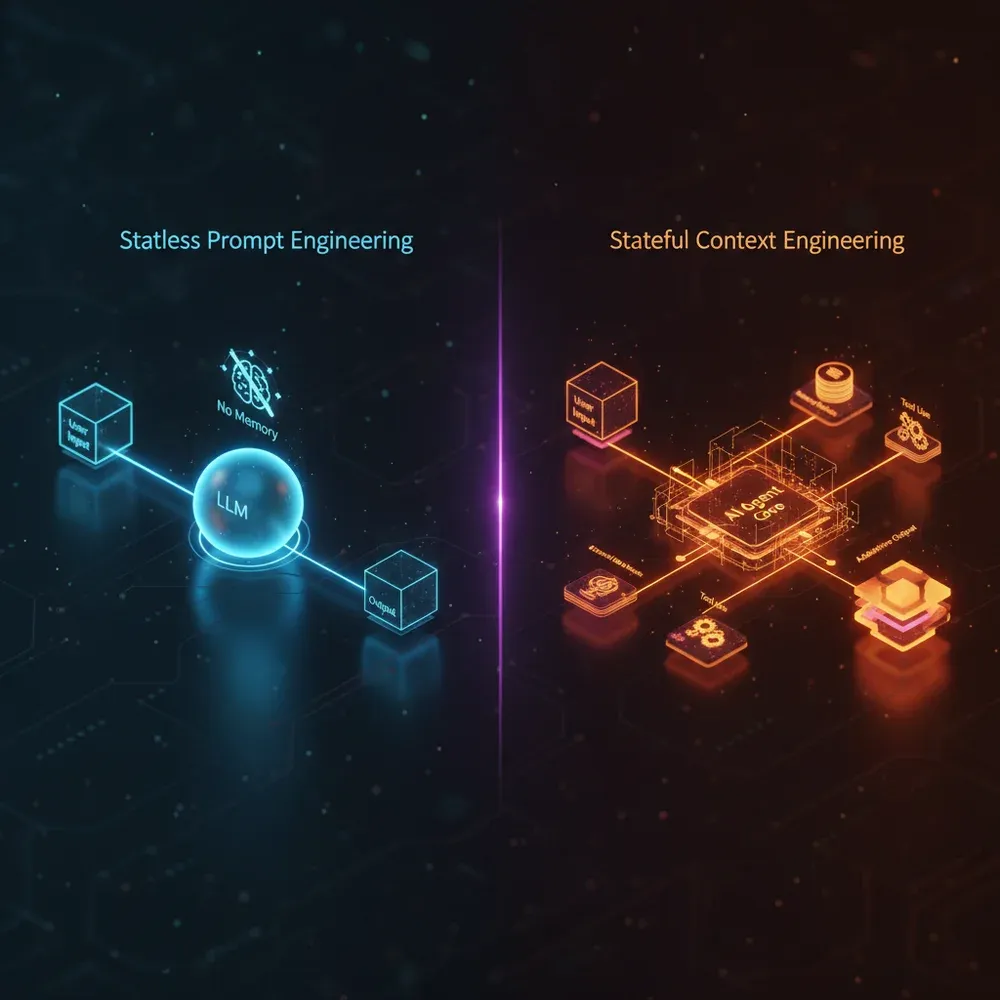
Traditional LLMs are stateless. Every API call starts with a blank slate. This approach is perfect for writing a poem, but entirely inadequate for executing a complex, multi-step custom automation process where the results of previous steps determine the next actions.
This is where Context Engineering enters the picture. This new paradigm is not about altering the internal weights of the model, but about the intelligent information architecture built around it. It's about how we construct a system capable of dynamically managing memory, retrieving relevant enterprise data, and autonomously utilizing external software tools.
The fundamental difference between Generative AI and Agentic AI lies precisely in this context management capability. For modern CTOs, the question is no longer which model to use, but what contextual infrastructure to build around it.
What is Context Engineering? Defining the New Paradigm
Definition: Context Engineering
Context Engineering is a software architectural and data management discipline focused on dynamically assembling, optimizing, and maintaining the information environment around LLMs. Its goal is to transform stateless models into stateful, context-aware agents capable of long-term memory management, real-time data retrieval, and autonomous execution of complex, multi-step tasks.
Context engineering differs fundamentally from prompt engineering. While prompt engineering focuses on the linguistic fine-tuning of the input text (e.g., "act like an expert"), context engineering focuses on the systemic provision of input data.
Imagine a new employee. Prompt engineering is like explaining their task very precisely but denying them access to company documents, emails, or past project files. No matter how smart the employee is, they cannot work without data.
Context engineering, on the other hand, provides the complete work environment. It builds the data pipelines that deliver relevant information into the model's context window in real-time. This includes processing unstructured data, generating vector embeddings, and implementing complex retrieval algorithms.
The most crucial distinction lies in state management. A system designed by a context engineer can maintain the thread of a conversation over hours, days, or even weeks, continuously updating its internal knowledge base based on new interactions.
The Pillars of Context Engineering: Building Stateful LLM Agents
Building a robust, enterprise-grade AI agent does not rely on a single technology. Context engineering rests on three main pillars that, when tightly integrated, create an intelligent, autonomous system. These pillars ensure that the AI doesn't just "speak," but understands, remembers, and acts.
Retrieval-Augmented Generation (RAG): The Foundation of Relevant Context
Retrieval-Augmented Generation, or the technology behind RAG AI chatbots, is the cornerstone of context engineering. RAG solves the biggest problems of LLMs: hallucinations and outdated or missing enterprise knowledge.
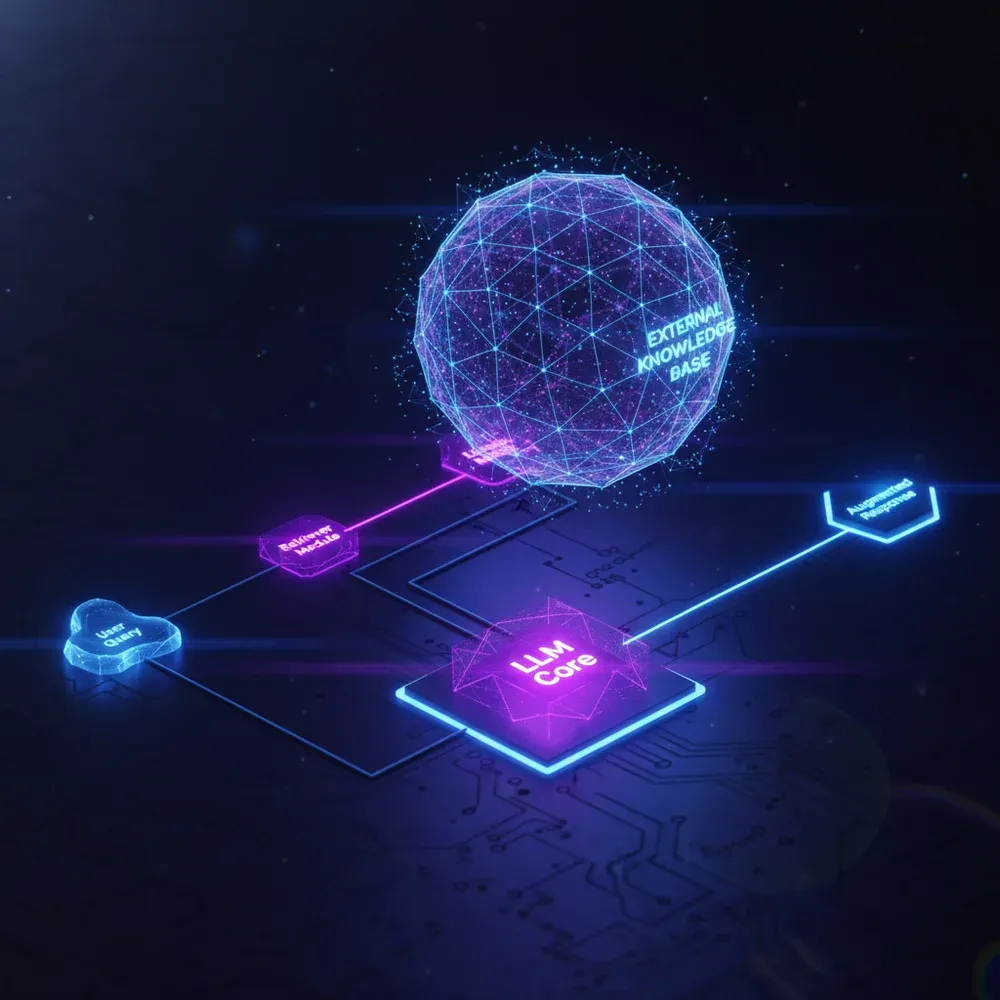
The essence of the RAG architecture is that before the language model answers a question, the system first performs a search in an external knowledge base. This knowledge base is typically a vector database (e.g., Pinecone, Qdrant, Milvus) that stores enterprise documents as mathematical vectors (embeddings).
The process is highly technical. When a user asks a question, an embedding model (e.g., OpenAI text-embedding-3-large) converts the question into a vector. The vector database then calculates the cosine similarity between the question vector and the stored document vectors to find the most relevant text snippets.
However, advanced context engineering doesn't stop at simple semantic search. Modern systems employ Hybrid Search, which combines vector search with traditional keyword search (BM25 algorithm). This ensures that both conceptual matches and exact keywords (e.g., part numbers, names) are found.
Next comes the Re-ranking phase. A specialized model (Cross-Encoder) re-evaluates and reorders the retrieved documents so the most relevant ones appear at the top of the list. Only then are these texts inserted into the LLM's context window as "facts" upon which the model generates the final response.
Memory Management: Enabling Stateful Interactions
While RAG provides access to external, static knowledge, memory management is responsible for preserving the dynamic history of interactions. Without it, the AI agent would forget what it did a second ago at every step, leading to the phenomenon of architectural amnesia.
Context engineers distinguish and implement three levels of memory. The first is Short-term memory, which lives within the context window itself. It contains the last few messages of the current conversation. Since the context window size is limited (though increasing, e.g., 200k tokens for Claude 3.5 Sonnet), this memory must be continuously managed.
Memory management techniques include automatic summarization of older messages or discarding less relevant ones (sliding window). The goal is to ensure the model always sees the thread of the conversation without wasting expensive tokens on unnecessary information.
The second level is Long-term memory. This is usually a state graph stored in a relational database (e.g., PostgreSQL) or NoSQL database. Frameworks like LangGraph allow developers to define the entire agentic workflow as nodes and edges, where the state is persistently saved after each step.
The third level is Semantic memory, which stores facts learned about the user or the environment in vector format. If a user mentions that "the project deadline is Friday," the agent extracts this fact and saves it in its memory so it can be automatically used in future interactions without the user having to repeat it.
Agentic Planning & Tool Use: Bridging LLMs to Action
The third pillar of context engineering is what transforms passive chatbots into active data processing AI agents. This capability allows models to step out of the text-generation box and perform real actions in the digital world.
During the technical implementation of Tool Use (or Function Calling), developers provide the LLM with a JSON schema that describes the available functions (e.g., `get_weather`, `query_database`, `send_email`), their parameters, and types. If the context requires it, the model generates a structured JSON object requesting the invocation of a specific function instead of text.
The system (the orchestrator) intercepts this request, executes the actual code (e.g., calls an external API), and feeds the result back into the LLM's context. This process is iterative. The agent can evaluate the result and, if it detects an error, try again with different parameters.
To solve complex tasks, context engineers use prompting and architectural frameworks like ReAct (Reasoning and Acting). The ReAct framework forces the model to describe its thought process (Thought) before taking action (Act). This internal monologue drastically improves the model's planning capabilities and the reliability of multi-step problem-solving.
In advanced enterprise environments, multiple specialized agents often work together (Multi-Agent Systems). A "Planner" agent breaks down a complex task into subtasks, which it delegates to "Executor" agents, while an "Evaluator" agent checks the quality. The context engineer's job is to ensure flawless information flow and context sharing between these agents.
Why Context Engineering Matters for the Enterprise
Context engineering is not just a technological curiosity; it is the key to enterprise-grade, ROI-positive AI adoption. Traditional, off-the-shelf AI solutions often fail against the complexity of enterprise reality because they lack specific business context.
The first and most important business benefit is a drastic increase in accuracy and reliability. Hallucinations—when AI confidently states falsehoods—are the biggest barrier to enterprise adoption. Context engineering (especially RAG) anchors responses strictly to the company's own verified data, minimizing risk.
Secondly, context-aware agents enable hyper-personalization at scale. A customer service AI that has instant access to a caller's entire purchase history, previous complaints, and current contract terms provides a level of service previously expected only from the best human operators.
Thirdly, advanced tool use and memory management pave the way for automating complex, end-to-end processes. It's not just about the AI answering an email. It's about the AI reading the email, extracting invoice data, checking fulfillment in the ERP system, approving payment, and finally notifying the partner. This level of custom automation radically reduces operational costs.
Key Challenges in Implementing Context Engineering at Scale
While context engineering holds immense potential, enterprise-scale implementation comes with significant technical and organizational challenges. The transition from prototype to production often exposes the fragility of these systems.
One of the biggest technical challenges is managing context window limitations. Although models can ingest more tokens, the "needle in a haystack" problem persists. If we flood the model with too much irrelevant information, the attention mechanism dilutes, and the model tends to ignore critical details. Context engineers must apply precise filtering and ranking algorithms.
Latency and computational costs are also critical factors. Complex RAG pipelines involving multiple database queries, embedding generation, and re-ranking can significantly increase response times. For real-time applications (e.g., voice AI assistants), milliseconds matter. Pipeline optimization and caching are essential.
Finally, data quality and data governance are fundamental. A RAG system is only as good as the data behind it. If the enterprise knowledge base is full of outdated, contradictory, or unstructured documents, context engineering will only amplify the chaos. Data cleansing and continuous maintenance are prerequisites for AI adoption.
Designing Enterprise-Grade LLM Agents with Context Engineering
Designing an enterprise-grade, context-driven AI system goes beyond writing a simple Python script. It requires a robust, scalable, and secure architecture that integrates seamlessly into existing IT infrastructure.
Architectural Considerations: Data Flow and Integration
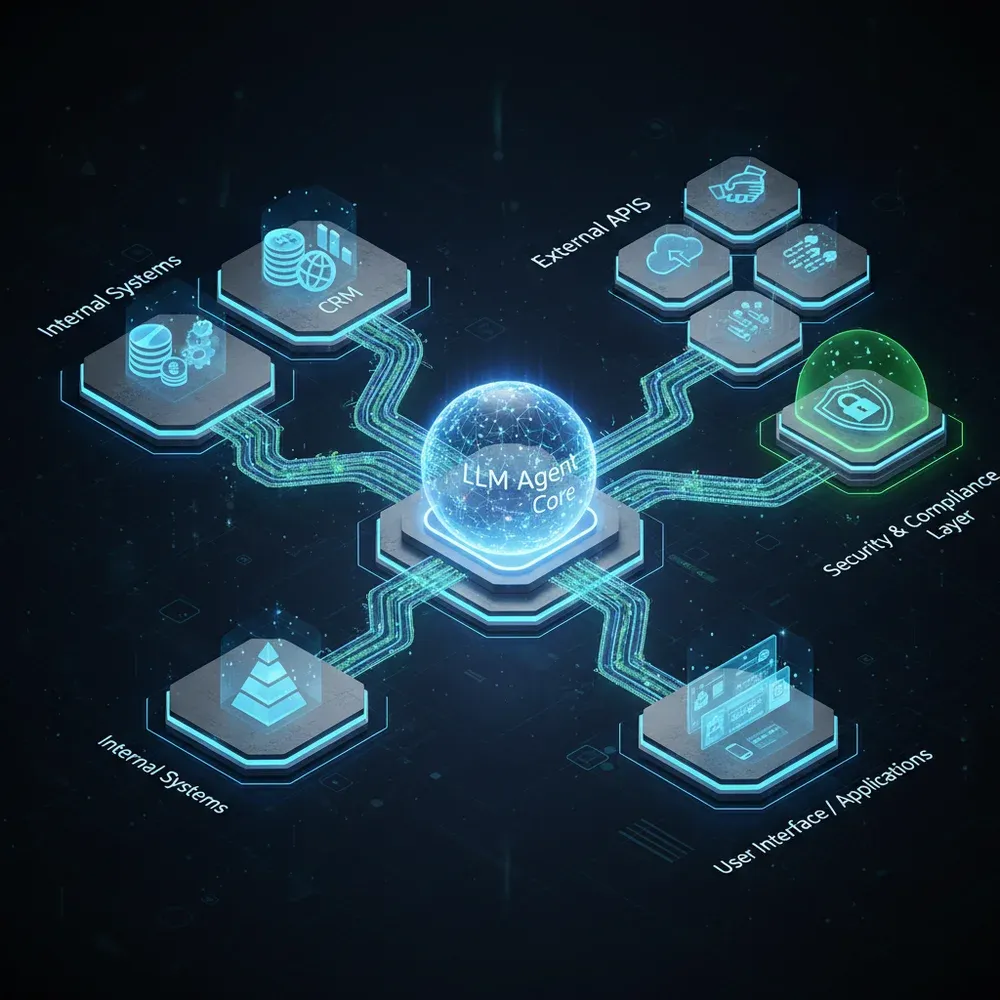
The core of the system is the orchestrator layer (e.g., LangChain, LlamaIndex, or custom microservices). This layer is responsible for receiving user requests, assembling context, calling the LLM, and processing responses. The orchestrator must operate asynchronously to avoid blocking the system during long-running LLM calls.
The data pipeline is a critical component. Enterprise data (SharePoint, Confluence, Jira, ERP systems) changes constantly. ETL (Extract, Transform, Load) processes must be built to extract new data in real-time or on a frequent schedule, chunk it, generate embeddings, and update the vector database. The chunking strategy (e.g., semantic-based vs. fixed character length) fundamentally determines retrieval quality.
During integration, API gateways and event-driven architectures (e.g., Kafka, RabbitMQ) should be used so AI agents can communicate smoothly with internal systems and react to system events (e.g., a new customer registration).
Security and Compliance in Context-Rich Systems
Security is one of the biggest challenges in context engineering. Because the system dynamically pulls data from the enterprise knowledge base, strict Role-Based Access Control (RBAC) must be implemented. The AI agent must not see documents that the querying user does not have permission to access.
This must be solved at the vector database level using metadata filtering. Every document chunk must be assigned appropriate permission tags, and vector searches must be filtered based on these tags before the results reach the LLM.
For compliance (GDPR, HIPAA, SOC2), PII (Personally Identifiable Information) and PHI (Protected Health Information) data must be masked or anonymized before entering the vector database or the LLM's context. This is especially important when using external, cloud-based LLM providers (e.g., OpenAI, Anthropic). Audit logging is essential: it must be possible to track exactly what data the AI used to generate a specific response.
Performance Optimization for Stateful Agents
Performance optimization occurs at multiple levels. The fastest and most cost-effective method is Semantic Caching. If a user asks a question that is semantically very similar to a previously answered question, the system skips the full RAG pipeline and LLM call, serving the answer directly from the cache.
Semantic Routing is another powerful technique. A fast, cheaper model (or a simple classification algorithm) analyzes the incoming request and determines if the task is simple (e.g., password reset) or complex (e.g., financial analysis). It routes simple tasks to cheaper models (e.g., GPT-4o-mini) or traditional code, while directing complex ones to more expensive, intelligent models (e.g., Claude 3.5 Sonnet).
Vector database optimization is also critical. Fine-tuning indexing algorithms (e.g., HNSW - Hierarchical Navigable Small World) can significantly reduce search times for large datasets.
Context Engineering vs. Fine-Tuning: A Strategic Comparison
A common question in enterprise AI strategy is: "Should we fine-tune the model on our own data, or use RAG and context engineering?" The answer is almost always the latter, or a combination of both.
During fine-tuning, we modify the model's internal weights using new training data. This is excellent for teaching the model a specific style, tone of voice, or a new, specialized format (e.g., generating a custom JSON structure). However, fine-tuning is a terrible method for injecting new factual knowledge.
Models tend to forget facts learned during fine-tuning (catastrophic forgetting), and updating knowledge requires a new, expensive training process every time. In contrast, context engineering (RAG) separates knowledge from the model. Updating data simply means updating the vector database, which can be done in real-time at minimal cost.
Comparison Table: Context Engineering vs. Fine-Tuning
| Feature | Context Engineering (RAG) | Fine-Tuning |
|---|---|---|
| Primary Goal | Providing factual knowledge and context | Modifying style, format, and behavior |
| Data Updating | Real-time, simple (DB update) | Slow, expensive (requires retraining) |
| Hallucination Risk | Low (cites sources) | High (model relies on itself) |
| Cost | Low setup, higher runtime (tokens) | High setup, lower runtime |
| Access Control | Easily implemented (at DB level) | Nearly impossible (model knows everything) |
The Future of AI: Autonomous Agents Powered by Context
The evolution of context engineering paves a direct path toward fully autonomous, Multi-Agent Systems. In the enterprises of the future, humans will not write prompts for AI. Instead, they will define high-level business goals, which a network of AI agents will autonomously break down into tasks, plan execution, gather necessary context, and perform actions.
These agents will continuously learn from their environment. With advancements in memory management systems, agents will understand corporate hierarchy, hidden processes, and user preferences. This level of intelligence is unimaginable without the rigorous, engineering foundation of context engineering.

Case Studies: Context Engineering in Practice (Examples)
In the financial sector, context engineering is revolutionizing risk analysis. A RAG-based agent implemented at an investment bank can analyze thousands of pages of financial reports, stock market news, and internal analyses in real-time. The agent doesn't just summarize data; it executes complex queries in the vector database to identify hidden market trends, drastically accelerating decision-making.
In healthcare, stateful agents are providing breakthroughs in patient journey management. A context-aware AI assistant securely accesses a patient's anonymized medical history (long-term memory), integrates with laboratory systems (tool use), and can make preliminary diagnostic suggestions to doctors, while strictly logging every step for HIPAA compliance.
In B2B customer service, context engineering eliminates frustrating, menu-driven chatbots. An intelligent agent that knows a partner company's entire contractual background, previous support tickets, and current orders can resolve complex logistical problems instantly with human-level empathy and accuracy, automatically modifying shipping data in the ERP system.
Choosing the Right Partner for Your Context Engineering Journey
Implementing context engineering is not about installing off-the-shelf software; it's a complex system integration project. You need a partner who not only understands language models but also has deep expertise in data engineering, cloud architectures, and enterprise security.
At AiSolve, this is exactly what we specialize in. Whether it's deploying a secure AI Chatbot (RAG) based on internal knowledge bases or developing complex data processing AI agents, our engineers apply the most advanced context engineering principles. We help transform your static data into dynamic, actionable intelligence.
Conclusion: Embrace the Agentic Future with Context Engineering
The era of prompt engineering is over. The future belongs to context engineering. Companies that recognize that the true power of AI lies not in the size of the models, but in the intelligent, stateful, and data-centric architecture built around them, will gain an insurmountable competitive advantage.
Don't settle for simple chatbots that start every conversation with a blank slate. Build autonomous systems that remember, learn, and act. Contact us today, and let's start designing your company's context-driven AI future.
Frequently Asked Questions (FAQ)
How secure is Context Engineering with sensitive enterprise data?
It is highly secure when implemented correctly. Context engineering allows for strict, document-level Role-Based Access Control (RBAC) within vector databases. Data can be masked before embedding, and the system can run in closed, private cloud environments (VPC) or even on-premise servers, ensuring sensitive data never leaves the corporate network.
Which industries stand to benefit most from Context Engineering?
While every data-driven industry can benefit, the highest ROI is realized in sectors managing complex knowledge bases and strict regulations. This includes finance (risk analysis, compliance), law (contract analysis, precedent research), healthcare (patient data management, diagnostic support), and complex B2B manufacturing or logistics.
How does Context Engineering differ from traditional database integration for AI?
Traditional integration relies on rigid, SQL-based queries that require exact matches. Context engineering uses vector embeddings and semantic search, allowing the AI to understand the meaning and context of data, even if the user doesn't use exact keywords. It also dynamically manages memory and state across interactions.
What kind of investment is required to implement an enterprise-grade Context Engineering system?
The investment depends on project complexity, the number of data sources to integrate, and security requirements. Implementing a basic RAG system for internal documents can start from a few thousand dollars, while a complex, multi-agent autonomous system integrated with an ERP requires a more significant strategic investment. However, ROI is typically realized within 6-12 months through drastic efficiency gains.
Can Context Engineering be integrated with existing LLM solutions?
Yes, absolutely. Context engineering is model-agnostic. The architecture (vector databases, orchestrators, memory management) is independent of whether you ultimately use OpenAI GPT-4o, Anthropic Claude 3.5, or an open-source, locally hosted Llama 3 model. This provides flexibility for companies to swap models in the future.
What metrics should be used to measure the success of Context Engineering initiatives?
Technical metrics include Retrieval Accuracy (e.g., MRR, NDCG), Latency, and Hallucination Rate. Business metrics are even more important: Task Completion Rate (automation percentage), Deflection Rate (reduction in human intervention needed), and the shortening of process Turnaround Time.
Készen állsz a saját weboldaladra?
Ingyenes konzultáció során átbeszéljük, hogyan segíthetünk vállalkozásodnak növekedni egy modern, gyors és konverzióoptimalizált weboldallal. 14 nap alatt kész, 0 Ft induló költséggel.