

| Terület / Area | Kulcsfontosságú Megállapítás / Key Insight |
|---|---|
| Hardware Acceleration | NVIDIA's accelerated release of faster AI chips significantly lowers the barrier to deploying complex, real-time multi-agent systems, moving the focus from hardware scarcity to software optimization and governance. |
| Enterprise Automation | Blueprints for "Intelligent Warehouse" and "Catalog Enrichment" demonstrate the shift towards autonomous, coordinated data processing AI agents that manage entire enterprise workflows rather than simple, siloed tasks, promising vast efficiency gains. |
| Energy & Infrastructure | The need for massive, stable energy is driving Big Tech (Meta, OpenAI) to secure nuclear power deals for multi-gigawatt data center campuses, confirming that current AI expansion models are unsustainable without radical energy solutions. |
| Regulatory Environment | European regulators are balancing the enforcement of digital content laws and data governance with the need to foster innovation, potentially softening rules for large American tech companies to avoid hampering local digital growth. |
| Implementation Strategy | Successful deployment of these complex agent systems requires a professional control interface—making professional website creation a critical, often overlooked step for real-time monitoring and human-in-the-loop governance. |
The NVIDIA Catalyst: Faster Chips and the Autonomous Enterprise
The technological landscape of late 2025 and early 2026 is defined by a singular, powerful acceleration: the pace of AI hardware development. NVIDIA, a critical enabler of the AI boom, has recently detailed the faster-than-anticipated release of their next-generation AI chips, a development that is not merely incremental but catalytic. These advanced processors provide the necessary computational muscle for running increasingly sophisticated and dense AI models, transforming theoretical concepts like full enterprise automation into practical, deployable systems. The implications extend far beyond the data center, directly influencing the speed at which organizations can adopt and scale multi-agent architectures capable of autonomous operation. Recent reports confirmed that NVIDIA is not only pushing the hardware envelope but is also forging strategic partnerships, such as the autonomous car project with Mercedes, underscoring their commitment to applying high-performance computing to complex, real-world systems.
This increased hardware capability fundamentally changes the economic viability of complex AI projects. Previously, the cost and scarcity of high-end GPUs acted as a bottleneck for ambitious automation projects. With faster, more efficient chips entering the market sooner, organizations can now design systems relying on distributed networks of specialized software components—or, more accurately, sophisticated data processing AI agents. These agents require immense, continuous processing power to handle the ingestion, analysis, and execution of tasks across vast datasets. The shift from human-in-the-loop monitoring to truly autonomous, decision-making systems is contingent upon this underlying hardware speed and efficiency. The entire enterprise ecosystem is now accelerating toward a state of autonomy, where interconnected AI agents manage everything from supply chain logistics to customized customer interactions.
The autonomous enterprise is no longer a futuristic vision; it is an emerging reality fueled by this hardware revolution. The challenge for companies is transitioning their siloed data and legacy systems into environments where these powerful agents can operate effectively. This requires a dedicated focus on data governance, security, and a robust deployment platform. The new chips enable not just faster training, but significantly faster inference—the speed at which a model applies its knowledge to make a decision. For data processing AI agents, operating in real-time environments like trading floors or intelligent warehouses, this inference speed is the difference between a minor delay and a massive operational failure. The foundational technological acceleration provided by companies like NVIDIA makes the move towards comprehensive custom automation solutions across enterprise segments not only feasible but strategically necessary for competitive advantage in 2026.
Multi-Agent Systems in Retail: The Intelligent Warehouse Blueprint
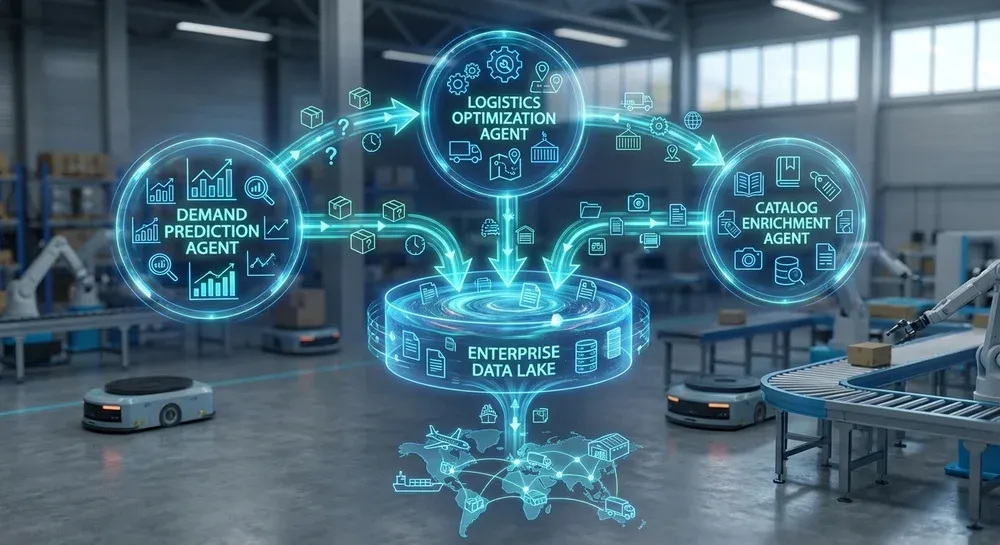
NVIDIA recently unveiled specific AI blueprints aimed at tackling complex industry challenges, most notably for the retail pipeline, focusing on a "Multi-Agent Intelligent Warehouse" and "Catalog Enrichment." This is a significant move because it shifts the conversation from generalized AI tools to highly specific, commercially viable operational systems. The Intelligent Warehouse blueprint is designed around the principle of coordinated automation, where multiple specialized AI agents work in tandem to optimize logistics. One agent might be dedicated to predicting inventory demand based on real-time sales data and weather patterns, another might optimize the physical movement of goods within the warehouse using robot fleet management, and a third could handle supplier communication and dynamic pricing adjustments.
The core value proposition here lies in the synergy between these dedicated data processing AI agents. Unlike previous generations of automation which focused on scripting rigid, singular tasks, the multi-agent system is designed to handle unforeseen variables and adapt. For example, if a sudden supply chain disruption occurs, the demand prediction agent can communicate the risk to the inventory management agent, which automatically prioritizes certain stock and updates the external catalog agent to reflect accurate shipping times, all without human intervention. This kind of dynamic, interconnected decision-making is only possible when agents have access to and can process vast amounts of unstructured and structured data simultaneously, which is exactly where NVIDIA's faster chips become essential.
Strategic Insight: When deploying a multi-agent system, prioritize the central data lake architecture. Agents must access a unified, real-time data source. A common failure point is siloed data that prevents agents from achieving coordinated decision-making. Ensure robust APIs and standardized data formats across all integrated agents.
Implementing such a blueprint requires a strategic overhaul of existing infrastructure, not just plugging in new software. It demands a commitment to treating data as the enterprise's most valuable asset and deploying specialized data processing AI agents to manage its flow and quality. This paradigm promises substantial efficiency gains. According to InfoQ trends reports, firms that fully integrate coordinated AI systems report operational cost reductions that can exceed 30% in logistics and inventory management sectors alone. The era of simple robotic process automation (RPA) is giving way to complex, cognitive agent networks that redefine operational excellence in retail and beyond.
Catalog Enrichment and Dynamic Data Processing: Beyond Simple Automation
One of the less visible yet highly critical components of the retail blueprint is Catalog Enrichment. In large-scale e-commerce operations, product catalogs are often incomplete, inconsistent, or lack rich metadata, leading to poor customer experiences and high return rates. Catalog Enrichment AI agents address this by autonomously ingesting product data (images, descriptions, specifications) and using generative AI and large language models (LLMs) to automatically fill in missing fields, normalize terminology, and even generate multiple localized or specialized product descriptions tailored for different market segments. This process is a prime example of high-volume data processing AI agents at work.
This dynamic data processing goes far beyond simple data entry automation. It involves cognitive tasks such as contextual understanding, image analysis (e.g., confirming a product photo matches the description), and natural language generation. The agents act as digital content curators, ensuring data accuracy and consistency at a scale that is impossible for human teams to maintain. The ability to instantly enrich thousands of product listings upon initial entry or change is a competitive advantage, speeding up time-to-market for new goods. Furthermore, these agents can detect and flag data discrepancies that could lead to regulatory non-compliance or customer dissatisfaction, turning a manual audit process into a continuous, real-time data quality pipeline.
| Data Processing Task | Traditional Method (Manual/Scripted) | Data Processing AI Agent |
|---|---|---|
| Product Metadata Enrichment | Slow, prone to human error, inconsistent terminology across SKUs. | Instant, uses LLMs for context-aware generation, 99%+ consistency rates. |
| Real-Time Inventory Reconciliation | Scheduled batch processes, up to 24-hour lag, prone to stockouts. | Continuous reconciliation, decision-making in milliseconds, dynamic stock allocation. |
| Supply Chain Anomaly Detection | Threshold-based alerts, high false positive rates, requires manual review. | Learns normal patterns, detects subtle deviations, directs resources immediately. |
Successfully deploying these catalog enrichment agents requires not only robust software but also a clear strategy for integrating the output into customer-facing applications. Whether the agent is managing inventory or generating product descriptions, the results must flow seamlessly to the end-user interfaces. The true power of RAG AI chatbot technologies can also be leveraged here, using the newly enriched catalog data as the foundational knowledge base, ensuring customer support is always accurate and up-to-date. This integration demonstrates how specialized data processing AI agents are interconnected, requiring a holistic approach to automation.
The Energy Dilemma: Nuclear Power and the Sustainability of Massive AI
The surging demand for AI computation, driven by faster chips and the deployment of massive data processing AI agents, presents a formidable challenge: energy consumption. The exponential growth in the size of LLMs and the complexity of multi-agent systems necessitates colossal, reliable power sources. This is why major players like Meta and OpenAI are making bold, strategic moves into unconventional energy solutions. Meta recently signed deals with nuclear energy companies, aiming to enhance both its public image regarding environmental leadership and its ability to secure the necessary energy for its vast data centers. Similarly, OpenAI and SoftBank Group have partnered with SB Energy to develop multi-gigawatt AI data center campuses, including a massive 1.2 GW facility in Texas intended to support ambitious initiatives like 'Stargate'.
These partnerships confirm an industrial-scale pivot: the world’s leading AI firms are betting on nuclear power to solve the sustainability and capacity crisis. Traditional renewable sources, while essential, often lack the guaranteed 24/7 baseload power that gigawatt-scale AI data centers require for uninterrupted training and inference. Deploying large networks of data processing AI agents to manage global logistics or highly transactional e-commerce platforms requires absolute uptime. A 1.2 GW campus is a monumental undertaking, signaling that the industry is preparing for a data and computation scale far beyond current models. The implications for regional energy grids and resource allocation are enormous.
Implementation Advice: When scaling your data processing AI agents, factor in the true operational energy cost. Utilize optimization techniques like sparsity and quantization to reduce model size and inference power consumption. Although you won't build a nuclear plant, minimizing your footprint aligns with future enterprise efficiency standards.
For enterprises deploying their own multi-agent systems, this news serves as a crucial metric for planning. While they may not require gigawatts of power, the trend indicates that high-performance data processing AI agents demand reliable, high-density computing resources. Companies must assess their current infrastructure's ability to handle sustained, peak computational loads required by real-time agent coordination. Failure to plan for energy and cooling infrastructure can lead to throttling, system slowdowns, and ultimately, a compromised return on AI investment. The transition to nuclear power by the industry giants is a loud signal: the age of energy-frugal AI is over, and we are entering an era of massive computational hunger.

Figure: Strategic pivot towards nuclear energy for next-generation AI data center operations.
Governing the Agents: Data Security and Regulatory Compliance in the EU
As the deployment of autonomous data processing AI agents accelerates, so does the scrutiny from global regulators, particularly within the European Union. The ability of these agents to ingest, process, and generate vast quantities of sensitive data—from customer profiles in retail blueprints to classified logistics information—introduces significant security and compliance risks. The EU is currently navigating a complex balancing act, attempting to enforce robust data governance laws while simultaneously preventing undue stagnation of technological advancement, especially against the dominant American Big Tech firms. Recent reports suggest the EU might soften its stance in the forthcoming Digital Networks Act, favoring recommendations over strict rules in certain areas, in a move to foster innovation.
However, this potential flexibility does not negate the core responsibility of robust data security, especially concerning synthetic media and content generation. The controversy surrounding the generation of explicit deepfake content by models like Grok highlights the immediate and serious need for guardrails around generative AI components embedded within data processing AI agents. While a catalog enrichment agent's primary function is benign, its underlying LLM foundation carries inherent risks of misuse or biased output if not properly constrained. Organizations must implement a comprehensive Agent Governance Framework (AGF) that monitors the flow of information, ensures compliance with local data residency laws (GDPR), and provides an auditable trail for every decision an agent makes.
| Regulatory Challenge | Risk to AI Agents | Mitigation Strategy |
|---|---|---|
| GDPR Data Residency | Cross-border data processing of EU citizen data by agents. | Use localized cloud instances; implement differential privacy techniques. |
| Bias and Fairness (AI Act) | Agents making discriminatory decisions in pricing or inventory allocation. | Mandatory bias audits and transparent data lineage tracking. |
| Synthetic Media Content | Uncontrolled generative agent output used for harmful or misleading content. | Strong content filters (guardrails) and content provenance tracking (watermarking). |
For European companies, the initial deployment of data processing AI agents must be accompanied by expert legal and technical consultation focused on preemptive compliance. Relying on the EU's potential leniency is a risky strategy. The core principle remains: if the agent processes European data, it must adhere to the highest standards of privacy and security. The design of any multi-agent system should therefore be modular, allowing for easy updates or isolation of components that handle sensitive information, ensuring the entire system is defensible against both cyber threats and regulatory penalties.
Implementation Framework: Building a Foundation with Professional Web Interfaces
The most advanced multi-agent systems, driven by NVIDIA's chips and fueled by gigawatt-scale data centers, remain useless if their performance, status, and control are inaccessible to human operators. This is where the crucial link to high-quality user experience and professional website creation emerges. A complex network of data processing AI agents needs a centralized, highly optimized dashboard or control panel that acts as the "cockpit" for the entire operation. This web interface is not merely a reporting tool; it is the vital human-in-the-loop governance mechanism, essential for debugging, intervention, and auditing.
The design of this interface must prioritize real-time data visualization, clear alerting mechanisms, and intuitive control overrides. For an Intelligent Warehouse, the dashboard must show, in real-time, the performance metrics of the inventory agent, the logistics agent, and the catalog agent simultaneously, allowing managers to spot bottlenecks before they impact the supply chain. This requires enterprise-grade professional website creation that integrates complex backend API data streams with a resilient, high-speed frontend. A poorly designed interface leads to slow decision-making, which negates the speed advantage gained by the underlying AI agents.
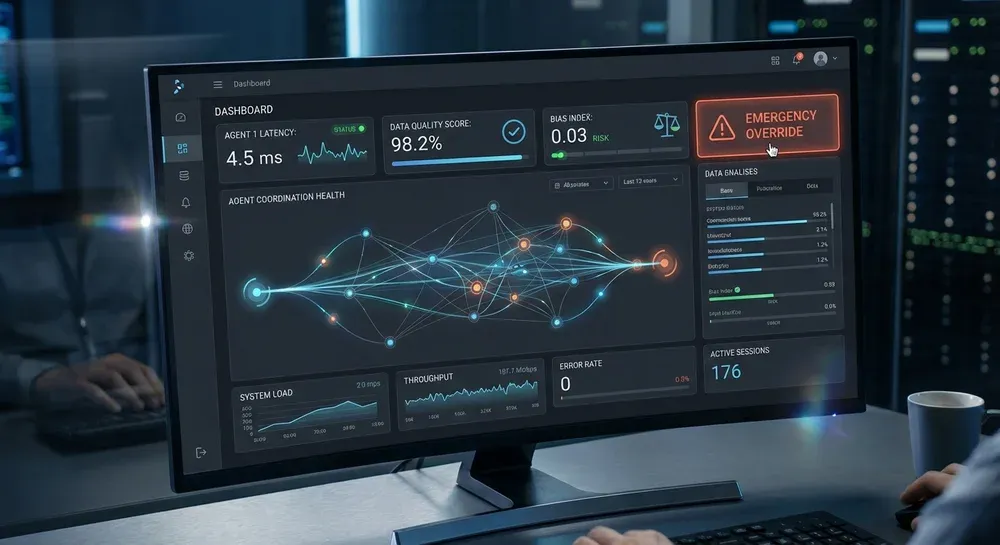
A custom-built interface provides the flexibility required for rapid iteration and adaptation as the agent architecture evolves. While off-the-shelf monitoring tools exist, they rarely provide the depth of customization needed to track specific agent metrics, such as the bias score of a generative agent or the energy efficiency of a particular data processing pipeline. This dedicated professional website creation effort ensures that the immense complexity of the data processing AI agents is distilled into actionable insights for the human oversight team. Furthermore, a secure and professionally built web portal is often required to grant tiered access to different stakeholders—from C-level executives viewing high-level KPIs to technicians debugging specific agent failures.
Pro Tip: When designing the control panel for your data processing AI agents, use a dedicated, secure component for ‘Emergency Override.’ This feature must be front-and-center in the web interface, allowing immediate human intervention to pause or redirect agents in case of unforeseen operational drift or security threats.
Finally, the web interface is the public face for internal teams, validating the investment in AI. A high-quality, reliable interface created through professional website creation instills confidence in the new autonomous systems. This principle applies universally, whether the underlying system is an intelligent warehouse or an AI phone customer service solution. Every complex AI deployment requires a robust UI for management.
Strategic Risks and Operational Pitfalls of Agent Deployment
The promise of coordinated, autonomous data processing AI agents is compelling, yet the path to implementation is fraught with significant strategic and operational risks. The first major pitfall is the "Black Box Coordination Failure." Unlike single-task automation, a multi-agent system introduces an element of emergent behavior, meaning the interaction between agents can lead to unpredictable outcomes. If the demand prediction agent misinterprets market signals, and the pricing agent automatically adjusts rates based on that misinterpretation, the error can cascade across the system rapidly, leading to substantial financial losses before human operators can intervene. Effective governance requires meticulous testing of inter-agent communication protocols.
A second critical risk is "Data Poisoning and Drift." The effectiveness of data processing AI agents is entirely dependent on the quality and integrity of the data they consume. If a malicious actor or a faulty sensor introduces corrupted data into the system, all dependent agents will begin operating on flawed premises. For instance, in catalog enrichment, a data poisoning attack could deliberately introduce incorrect regulatory compliance information, exposing the enterprise to legal risks. Ongoing monitoring of data lineage and the establishment of "data trust scores" are essential to mitigate this risk. Furthermore, AI models naturally experience 'drift' over time as real-world data changes, necessitating continuous retraining—a task that adds complexity to maintenance.
Finally, the "Vendor Lock-in and Integration Burden" presents a long-term strategic threat. While blueprints from major players like NVIDIA offer clear roadmaps, adopting proprietary frameworks can limit an organization's flexibility to integrate best-of-breed components from other providers. The implementation of complex data processing AI agents often requires significant customization to fit legacy enterprise resource planning (ERP) systems. The initial integration can be costly and time-consuming, and if the chosen vendor's technology evolves rapidly (as is the case with AI chips), the enterprise may find itself locked into an expensive and quickly outdated technology stack. Enterprises must demand open API standards and modular architectures that allow for agent components to be swapped out without rebuilding the entire system from scratch.
The Future of Enterprise Data Orchestration: 2026 and Beyond
The confluence of advanced AI hardware, unprecedented energy infrastructure investments, and sophisticated enterprise blueprints signals a clear trajectory for the future of business: autonomous data orchestration. The role of data processing AI agents will expand beyond specialized functions like warehouse management and catalog enrichment to become the foundational layer of enterprise control. We anticipate a future where a CEO's primary interaction with the business is through the governance dashboard of their agent network, where human decision-making becomes focused entirely on strategic direction and ethical oversight, rather than tactical execution.
Key future trends include the rise of meta-agents—AI agents responsible for overseeing and optimizing the performance of other specialized agents. This hierarchical structure will be necessary to manage systems with potentially hundreds of interconnected automation components. Furthermore, the push towards edge computing, driven by highly efficient chips, will allow data processing AI agents to perform complex tasks directly at the point of action—whether on a factory floor sensor or a retail store shelf—reducing reliance on constant centralized cloud communication and improving real-time response capabilities. The integration of advanced AI with robotics, as demonstrated by the NVIDIA-Mercedes autonomous project, will blur the line between digital and physical data processing AI agents.
For businesses planning for this autonomous future, the immediate action must be to invest in the data foundation. Successful deployment of future multi-agent systems depends not on procuring the latest chips, but on having clean, well-governed, and easily accessible data streams. Organizations must start small, piloting specialized data processing AI agents in low-risk, high-return areas, such as automating internal compliance reporting or basic IT support, before attempting to deploy a fully intelligent warehouse. The technological momentum is undeniable; the successful companies of tomorrow will be those who master the governance and integration of their autonomous agent ecosystem today.
Frequently Asked Questions
What is a multi-agent intelligent warehouse system?
A multi-agent intelligent warehouse system, exemplified by the NVIDIA blueprint, is an automated architecture where several specialized <a href="https://aisolve.me/data-processing" class="blog-link blog-link-data">data processing AI agents</a> coordinate to manage different aspects of logistics and inventory. Unlike siloed automation, these agents communicate and adapt in real-time, optimizing demand forecasting, internal logistics, and supply chain adjustments simultaneously to handle unforeseen variables and maximize efficiency.
Why are tech giants turning to nuclear energy for their AI data centers?
Companies like Meta and OpenAI require massive, constant, and highly reliable power sources (baseload power) to operate their enormous AI data center campuses and train the increasingly large language models that power <a href="https://aisolve.me/data-processing" class="blog-link blog-link-data">data processing AI agents</a>. Nuclear power offers guaranteed 24/7 electricity generation at the gigawatt scale, which is difficult to achieve solely with intermittent renewable sources. This strategic pivot addresses both the vast energy consumption of modern AI and sustainability concerns.
What role does <a href="https://aisolve.me/website-development" style="color: #B87EFE;"><strong>professional website creation</strong></a> play in AI deployment?
Professional website creation is essential for building the governance and monitoring interface, or "cockpit," for complex AI systems. Even the most sophisticated <a href="https://aisolve.me/data-processing" class="blog-link blog-link-data">data processing AI agents</a> require human oversight. A custom-built web dashboard provides real-time data visualization, clear alerts, and control overrides, allowing human operators to audit performance, intervene in case of agent drift, and ensure overall system integrity and compliance, transforming raw data into actionable insights.
What are the primary operational risks when using <a href="https://aisolve.me/data-processing" class="blog-link blog-link-data">data processing AI agents</a>?
Key operational risks include Black Box Coordination Failure, where emergent interactions between agents lead to unpredictable outcomes, and Data Poisoning and Drift, where corrupted input data or model decay compromises the entire system's decision-making integrity. Mitigation requires continuous testing, robust data lineage tracking, and establishing secure control mechanisms and dashboards for human oversight and emergency intervention.
Ajánlott / Recommended
- Data Processing AI Agents: Transforming Enterprise Data Pipelines
- Case Study: Achieving 40% Cost Reduction with Custom Automation Solutions
- Meta's Nuclear Strategy and AI Infrastructure
- The Essential Role of Professional Web Design in AI Governance Interfaces
Are you ready to transition from simple automation scripts to autonomous, coordinated data processing AI agents? Leverage the new generation of AI hardware and enterprise blueprints to achieve unprecedented operational efficiency and data quality.
Explore Advanced AI Data Processing Solutions Today[Article generated by AiSolve AI Content System]
Készen állsz a saját weboldaladra?
Ingyenes konzultáció során átbeszéljük, hogyan segíthetünk vállalkozásodnak növekedni egy modern, gyors és konverzióoptimalizált weboldallal. 14 nap alatt kész, 0 Ft induló költséggel.