
| Area | Key Insight |
|---|---|
| SDLC Disruption | AI-generated code is produced at a volume and velocity that makes traditional human-gated processes like pull requests a critical bottleneck, forcing a fundamental rethink of the software development lifecycle. |
| Business Strategy | The tech industry's M&A frenzy, highlighted by Meta's strategic acquisitions, shows that companies are buying entire AI ecosystems and talent pools, not just technology, to secure a competitive future. |
| Developer Workflow | The developer's role is shifting from a "coder" to a "systems orchestrator" who manages, validates, and directs AI agents, requiring new tools and skills focused on high-level architecture and oversight. |
| Core Challenge | The primary challenge is no longer writing code but managing its complexity, quality, and business alignment at scale. This requires sophisticated custom automation solutions to prevent AI-generated technical debt. |
The technological landscape of late 2025 is defined by a powerful paradox. At the micro-level, AI is generating code with such ferocious efficiency that it's shattering decades-old software development workflows. At the macro-level, this very same capability is fueling a multi-billion dollar corporate arms race, with tech giants like Meta acquiring AI startups at a record pace. This isn't a story about two separate trends; it's a single narrative of system-level disruption. As Michael Webster of CircleCI bluntly stated at QCon AI New York, "AI works, pull requests don't." This single observation reveals a deeper truth: the friction point has moved from code creation to human verification, and the entire value chain, from a developer's keyboard to the boardroom's acquisition strategy, is being redrawn in real-time. The challenge is no longer just about adopting AI, but about rebuilding the operational and strategic scaffolding of the entire organization around it. This requires a new way of thinking, centered on holistic, custom automation solutions.
The End of an Era: How AI is Dismantling the Traditional SDLC
The Software Development Lifecycle (SDLC) has long been the bedrock of digital product creation—a structured process encompassing planning, coding, testing, and deployment. Within this framework, Continuous Integration/Continuous Delivery (CI/CD) pipelines and the humble pull request (PR) have served as critical quality gates. The PR, a formal request to merge new code into the main codebase, has been the primary mechanism for peer review, a human-centric checkpoint to catch bugs, enforce standards, and share knowledge. For years, this system worked. But AI has turned the flow from a manageable stream into a firehose. Webster’s analysis from CircleCI's data confirms that a single developer, augmented by AI tools, can now produce the output of a small team, generating thousands of lines of code daily. The result is a PR queue that is impossibly backlogged. Human reviewers, already tasked with complex work, simply cannot keep up with the volume and velocity of AI-generated code. This bottleneck doesn't just slow down deployment; it fundamentally breaks the SDLC's promise of a steady, predictable flow of value. The very process designed to ensure quality has become the single greatest impediment to progress.
The Pull Request Paradox
The paradox is that while the code itself might be functionally correct, the PR process was about more than just correctness. It was about shared ownership, context-building, and mitigating the risk of a single point of failure. When an AI generates the code, who is the "peer" in the peer review? How do you question the logic of a machine that produced a complex algorithm in seconds? The traditional PR workflow is fundamentally incompatible with a world where code is not painstakingly handcrafted but generated instantaneously. Companies are now faced with a stark choice: either artificially throttle their AI-driven productivity to fit an archaic review process or build a new quality assurance paradigm from the ground up. This new system must be automated, intelligent, and capable of analyzing code on a scale that is beyond human capacity. This is where the need for purpose-built custom automation solutions becomes not just an advantage, but a necessity for survival.
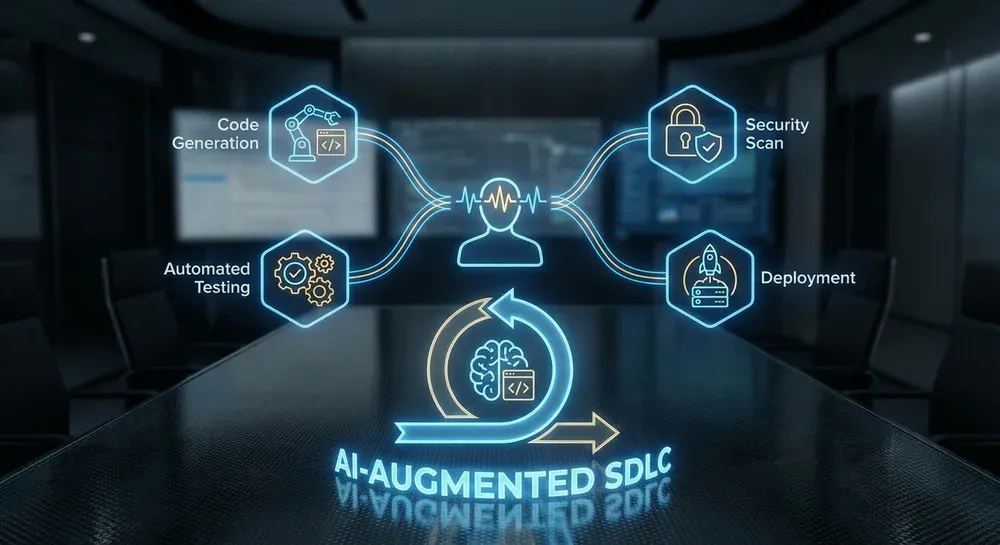
The New Development Paradigm: Augmentation, Not Just Automation
The solution to the broken SDLC is not to remove humans from the loop, but to redefine their role. The new paradigm treats AI as a powerful but junior team member that requires senior oversight. The developer's job is evolving from writing line-by-line code to orchestrating a team of specialized AI agents. In this model, one AI agent might be tasked with generating boilerplate code based on a high-level specification, another might be a security expert that scans for vulnerabilities in real-time, and a third could be a testing specialist that generates a comprehensive suite of unit and integration tests for every new feature. The human developer acts as the architect and the final arbiter of quality, focusing on system design, business logic, and the user experience—tasks that still require human intuition and context. This augmented approach transforms the developer from a craftsperson into a fleet commander, directing AI resources to achieve a strategic objective. It’s a fundamental shift from direct contribution to high-level leverage.
Strategic Insight: Instead of reviewing code line by line, developers should review the AI's intent and the resulting behavior. This means focusing on high-level test results and architectural compliance rather than syntax, a process that can be managed with advanced custom automation solutions.
| Aspect | Traditional SDLC | AI-Augmented SDLC |
|---|---|---|
| Code Creation | Manual, human-driven | AI-generated from high-level prompts |
| Bottleneck | Development speed | Human review and verification (Pull Requests) |
| Developer's Role | Coder, problem-solver | Orchestrator, architect, AI manager |
| Testing | Manually written tests, often lagging | AI-generated, comprehensive test suites |
| Quality Assurance | Human peer review | Automated analysis, formal verification |
Beyond the Code: Visualizing and Managing the AI-Powered Workflow
As AI agents take over low-level implementation, the complexity of managing the development process explodes. When hundreds of micro-features are being developed, tested, and deployed simultaneously by AI, the traditional command-line interface or a simple project board becomes woefully inadequate. A new layer of tooling is required: a sophisticated, visual dashboard that provides a real-time, high-level overview of the entire system. This is where the discipline of professional website creation extends beyond marketing sites and into the core of enterprise operations. We are talking about custom-built, data-rich web applications that serve as the command center for the modern SDLC. These platforms must be able to visualize dependencies between AI-generated components, flag potential integration conflicts before they happen, and provide human overseers with intuitive controls to approve, reject, or modify AI-driven actions. Imagine a dashboard that doesn't just list completed tasks but graphically represents the flow of value through the system, using AI-powered data processing agents to identify bottlenecks and predict future risks. This isn't just a nice-to-have; it's a fundamental requirement for maintaining control and coherence in an AI-first environment. Building these intricate internal systems requires the same level of expertise in UI/UX, data visualization, and robust backend engineering as any world-class external product. Therefore, investing in professional website creation for these internal platforms is as critical as the AI models themselves.
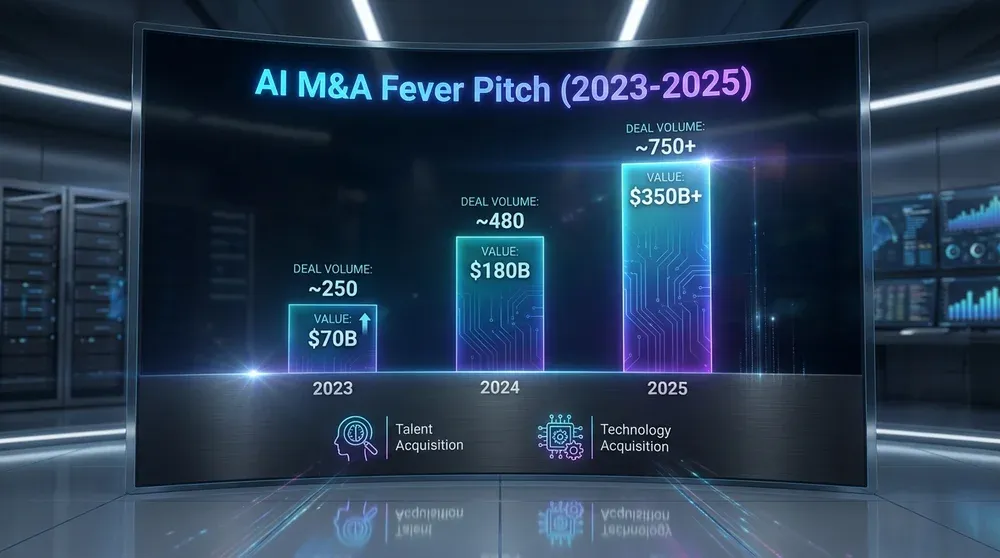
The Macro View: The Fever Pitch of the AI Arms Race
The disruption happening at the code level is a mirror image of the strategic upheaval in the broader market. The recent flurry of AI-related mergers and acquisitions, such as Meta's reported purchase of a promising DeepSeek competitor, is not merely about acquiring technology. It's an aggressive, high-stakes race to acquire talent, proprietary data sets, and entire pre-built research ecosystems. The "build vs. buy" calculation has overwhelmingly shifted toward "buy" because the speed of AI innovation is too rapid to cultivate organically. A competitor can go from non-existent to market leader in a matter of months, not years. This M&A frenzy is a direct response to the technical realities discussed earlier. Large corporations recognize that owning the most efficient development paradigm—the one that can translate ideas into products the fastest—is the ultimate competitive advantage. They are not just buying a chatbot or an image generator; they are buying a "software factory" that operates at 100x the speed of their traditional R&D departments. This makes every promising AI startup a potential acquisition target, creating a hyper-competitive market where valuations are driven by future potential rather than current revenue. The goal is strategic dominance, and the price tag is secondary. This is an existential race for relevance in an industry that is being fundamentally reshaped by automation.
Strategic vs. Tactical Acquisitions
It's crucial to distinguish between two types of acquisitions in this climate. Tactical acquisitions involve buying a smaller company to integrate its specific feature into an existing product—for example, adding an AI-powered editing tool to a software suite. Strategic acquisitions, which we are seeing more of now, are about absorbing an entire team and its underlying research foundation to build a new pillar for the parent company's future. This is about acquiring a new capability, not just a new feature. These strategic moves are far riskier and more expensive, but they offer the potential for market-defining transformation, which is why Big Tech is pursuing them so aggressively. Companies that fail to make these bold strategic moves risk being left behind, saddled with slow, human-centric processes in a world dominated by AI-driven speed.
Navigating the Risks: Technical Debt and Strategic Misalignment
The speed promised by AI comes with significant, often hidden, risks. On the technical side, AI's ability to generate vast amounts of code can also create technical debt at an unprecedented scale. If not properly managed, AI can produce code that is functional but inefficient, difficult to maintain, or insecure. A poorly prompted AI might solve a problem in the moment but create a much larger architectural issue down the line. Without rigorous, automated quality controls, companies could find themselves drowning in a sea of "AI-generated spaghetti code." This reinforces the need for human oversight and robust custom automation solutions designed specifically to audit and validate machine-written code. The goal must be to maintain high standards, not just high velocity.
Implementation Advice: Implement an "AI Code Quality Score" in your CI/CD pipeline. This automated metric should analyze factors like complexity, maintainability, and adherence to security best practices, providing a quantitative measure of the AI's output before it's ever merged.
On the business front, the M&A frenzy carries its own set of dangers. A strategic misalignment between the acquiring company and the startup can lead to a clash of cultures, stifling the very innovation the acquisition was meant to capture. Furthermore, integrating a highly specialized AI research team into a large, bureaucratic corporation can be fraught with friction. If not handled carefully, the most valuable asset—the talent—can walk out the door within a year. A successful acquisition requires more than just capital; it demands a clear strategic vision, a commitment to protecting the startup's agile culture, and a realistic plan for integration that doesn't smother the golden goose.

Strategic Implementation: A Roadmap for the AI Transition
For businesses looking to navigate this transition without being overwhelmed, a phased and strategic approach is essential. Plunging headfirst into a fully automated, AI-driven SDLC is a recipe for disaster. Instead, companies should build a roadmap that incrementally introduces AI and automation, allowing the team to adapt and build the necessary guardrails along the way. This journey requires a partner who understands not just the technology but the process of organizational change. The goal is to evolve, not to break the system overnight.
- Phase 1: Augment the Developer. Start by introducing AI tools that assist, rather than replace, developers. This includes advanced code completion tools, AI-powered linters that suggest fixes, and tools that automatically generate documentation. The goal here is to boost individual productivity and familiarize the team with AI collaboration in a low-risk environment.
- Phase 2: Automate the Pipeline. Once developers are comfortable with AI assistance, focus on the CI/CD pipeline. Implement AI-driven testing that automatically generates test cases based on new code. Introduce automated security scans and performance analysis. This begins to address the PR bottleneck by offloading review tasks from humans to intelligent systems. This is a critical stage where effective custom automation solutions are designed and implemented.
- Phase 3: Introduce Generative Components. In this phase, allow AI to generate non-critical components of the application, such as UI elements from a design file or simple API endpoints from a specification. Human developers still control the core architecture but delegate routine implementation tasks to AI agents, with all output passing through the automated pipeline from Phase 2.
- Phase 4: Orchestrate AI Agents. This is the most advanced stage, where the development process is managed as a system of interacting AI agents overseen by human architects. It requires a sophisticated control plane—the custom dashboard discussed earlier—and a mature set of automated quality gates. This represents a fully transformed, AI-native SDLC.
The disruption of the SDLC and the strategic M&A frenzy are two sides of the same coin—a fundamental shift towards an AI-driven future. Navigating this new landscape requires more than just new tools; it requires a new operational philosophy. At AiSolve, we specialize in crafting the custom automation solutions that form the backbone of this modern, resilient, and highly efficient new paradigm.
Build Your AI-Ready Workflow Today[Article generated by AiSolve AI Content System]
Frequently Asked Questions
What is the SDLC and why is AI "breaking" it?
The Software Development Lifecycle (SDLC) is the structured process for creating software. AI is "breaking" it because it generates code much faster than humans can review it. Traditional quality checks, like manual pull requests, become severe bottlenecks, rendering the old, linear process inefficient in the face of AI's exponential output.
How should a company start implementing an AI-augmented workflow?
Start small and focus on augmentation, not replacement. Begin by equipping developers with AI-powered code assistants and linters to boost productivity. Then, incrementally introduce automation into the CI/CD pipeline for tasks like testing and security analysis. This phased approach allows the team to adapt and build trust in the automated systems.
What's the main risk of using AI to generate code?
The primary risk is creating massive "technical debt" at high speed. AI can generate code that works but is inefficient, hard to maintain, or insecure. Without robust, automated quality checks and skilled human oversight, companies can quickly accumulate unmanageable codebases that are costly to fix in the long run.
Why are tech giants like Meta buying AI startups instead of building their own tech?
It's a race for speed and talent. AI innovation is happening so fast that it's often quicker to acquire a cohesive, high-performing team with a proven research foundation than to build one from scratch. These acquisitions are strategic moves to buy not just technology, but entire ecosystems of talent, data, and future capabilities to secure a competitive edge.
Készen állsz a saját weboldaladra?
Ingyenes konzultáció során átbeszéljük, hogyan segíthetünk vállalkozásodnak növekedni egy modern, gyors és konverzióoptimalizált weboldallal. 14 nap alatt kész, 0 Ft induló költséggel.