

TL;DR: The Era of Agentic OS and the Revolution of Custom Automation
Introduction: The New Horizon of Automation – Beyond Scripts and APIs
The technology world entered a new era with the official announcement of the OpenAI Responses API. This is not just another language model update; it is a paradigm shift.
The introduction of the built-in shell tool, the autonomous execution loop, and the secure, hosted container workspace means that AI has stepped out of the chat windows.
From now on, artificial intelligence can directly interact with operating systems, execute code, and respond to environmental changes in real-time.
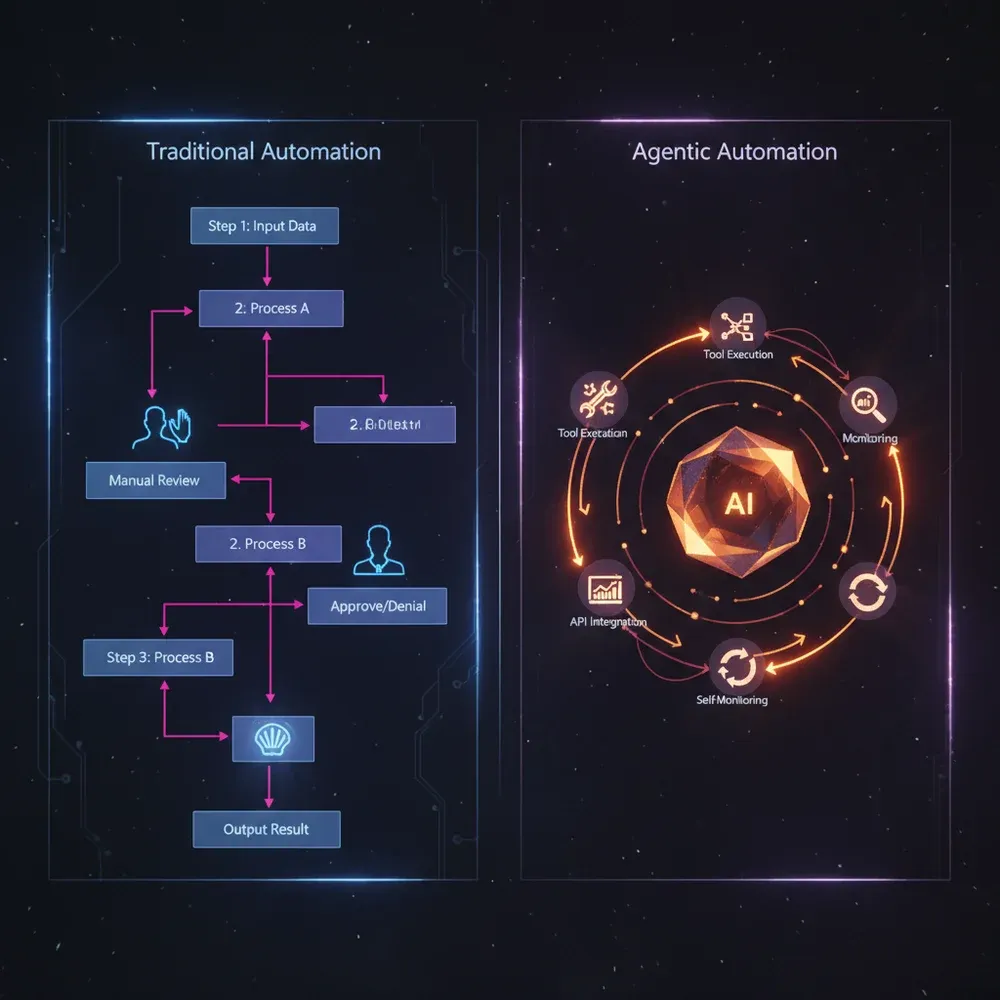
Traditional enterprise automation has historically relied on rigid rules, fragile API connections, and endless amounts of high-maintenance Python or Bash scripts.
When an endpoint changed due to a system update, the entire chain collapsed, requiring immediate human intervention from development teams.
Approaching custom automation with AI eliminates this fragility once and for all.
The essence of the new "Agentic OS" concept is that the system can understand the goal, autonomously plan the steps, write the necessary code, and execute it immediately.
If an error occurs, the built-in execution loop analyzes the error message, fixes the code, and retries, all without human intervention.
What is Custom Automation in the 21st Century? Challenges and Opportunities
Custom automation in the 21st century is no longer synonymous with recording macros or workflows built on simple "if this then that" (IFTTT) logic.
Today, a modern enterprise uses hundreds of different SaaS applications, local databases, and cloud-based infrastructures simultaneously, all of which must communicate.
Integrating these systems is a massive challenge. Traditional integration platforms (iPaaS) are often not flexible enough to map complex, custom business logic.
Scalability and maintenance are the two biggest enemies of growth. Implementing every new software requires months of development work and testing.
Definition: Modern Custom Automation
Modern custom automation is an intelligent, context-aware process control system that uses artificial intelligence agents for dynamic decision-making. It does not follow pre-written, static paths, but adapts in real-time to changing data, systems, and business requirements, autonomously bridging the gaps between software.
However, the opportunities are unprecedented. Companies that recognize the potential of autonomous systems will gain a drastic competitive advantage.
Enterprise AI agents can take over monotonous, repetitive tasks, freeing up engineers' time for true innovation and strategic planning.
The challenge now is no longer the lack of technology, but proper architectural design and cultural adaptation to the new agentic paradigm within organizations.
The Rise of Agentic AI: Language Models as Autonomous Operators
The first wave of generative AI was about content creation and question-answering systems. The models were reactive: they waited for a prompt and then generated an output.
Agentic AI, on the other hand, is proactive. It doesn't just answer; it acts. It can set long-term goals, break them down into subtasks, and execute them.
Imagine a virtual system administrator. If given the task to "optimize database performance," a reactive model would only describe the steps.
An agentic model, however, logs into the server, retrieves the slow query log, analyzes it, and creates indexes on the problematic tables.
This level of autonomy rests on four fundamental pillars: planning, execution, monitoring, and self-correction.
In the planning phase, the agent assesses the available tools and the environment. During execution, it initiates API calls or issues command-line instructions.
During monitoring, it evaluates the output. If the command fails, the self-correction module analyzes the stack trace, modifies the strategy, and retries the task.
This continuous iteration cycle turns language models into true, reliable operators capable of managing even the most complex enterprise infrastructures.
The OpenAI Responses API Revolution: Shell Tool, Execution Loop, and Hosted Container
OpenAI's latest announcement brings exactly this agentic future into the present. The Responses API introduced three critical features that change the rules of the game.
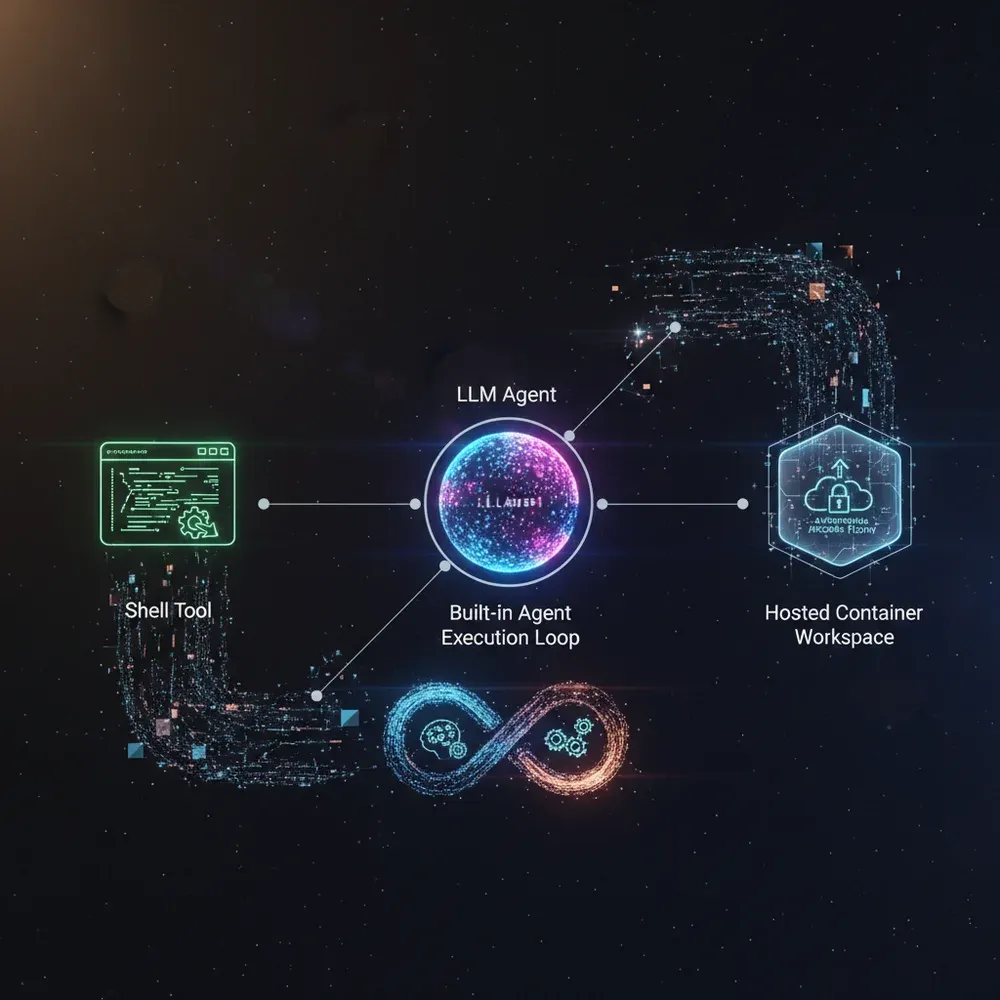
The first is the native Shell Tool. This allows the model to run Bash or PowerShell commands directly in an operating system.
There is no longer a need to write complex middleware for the AI to move files, run network diagnostics, or execute git commands.
The second breakthrough is the Built-in Agent Execution Loop. Previously, developers had to write the "while" loops themselves using LangChain or LlamaIndex.
Now, OpenAI's API handles the iterations itself. The model keeps calling tools, analyzing results, and correcting itself until the final goal is reached or a set limit is hit.
The third, and perhaps most important innovation, is the Hosted Container Workspace. This is a secure, ephemeral environment for running code.
Key Feature Breakdown: Responses API
- Shell Tool: Provides direct command-line access to the model, enabling the autonomous execution of system administrator-level tasks.
- Execution Loop: Server-side iteration management. The API call does not return until the agent has completed the entire workflow, including bug fixes.
- Hosted Container: An isolated, secure sandbox environment. The AI can safely run unknown code and analyze data here without endangering the host system.
This container comes pre-installed with key data processing libraries (e.g., Pandas, NumPy), so the AI is immediately capable of complex data analysis tasks.
Together, these features form a complete, cloud-based "Agentic Operating System" that can be integrated into any enterprise software via API.
Architecture of Agentic Custom Automation Systems: Design and Components
Designing a robust agentic system goes beyond simply inserting an API key. A highly scalable architecture is built from multiple layers working closely together.
The core of the system is the Language Model (LLM Core). This is the "cognitive engine" that understands user intent and makes decisions about the next steps.
The second layer is the Tool Orchestration Layer. This includes the new OpenAI Shell tool, internal enterprise APIs, and connections to external SaaS services (e.g., Jira, Salesforce).
A critical component is Memory and Context Management. Agents must remember previous interactions, system states, and user preferences.
This is usually solved with a combination of vector databases (e.g., Pinecone, Weaviate) and structured relational databases. It is worth studying the OpenAI PostgreSQL scaling blueprint to establish stable foundations.
The fourth element is the Planning & Monitoring Module. This component is responsible for decomposing large tasks and continuously tracking execution.
Last but not least, a Security & Governance Layer is essential, which limits the agent's permissions and logs every step for auditability.
Building these complex systems is a serious engineering challenge. If you are looking for a professional, enterprise-grade solution, AiSolve's custom automation service can help from design to deployment.
Real-World Applications: Where Does Agentic Custom Automation Shine?
After the theory, let's look at where this technology creates immediate, measurable business value in practice. One of the most obvious areas is Intelligent DevOps and IT Operations.
Imagine a CI/CD pipeline that breaks due to a dependency error. Instead of alerting an engineer at night, the agentic OS takes control.
The agent reads the error message, logs into the build server using the Shell tool, finds the faulty package version, updates the configuration, and restarts the build.
Another huge area is Autonomous Data Analysis. Companies collect vast amounts of data, but processing it is a slow and resource-intensive process.
Dedicated data processing AI agents in the hosted container can receive raw CSV or JSON files, write Python code for cleaning, and generate visualizations.
These data processing AI agents perform work in minutes that would take a data analytics team days, providing immediate insights to management.
A third outstanding example is Advanced Customer Support Escalation. Traditional chatbots get stuck when the problem goes beyond the FAQ.
An agentic RAG AI chatbot, however, can query the user's transaction history via API, check the logistics system, and autonomously issue a refund.
Implementation Strategy: Step-by-Step Guide to Adopting Agentic Workflows
Adopting agentic technology is not a simple software update, but a strategic transformation. A successful implementation begins with a thorough Planning and Auditing phase.
The first step is to identify processes that have high manual labor requirements, are well-structured, but complex enough that traditional automation fails on them.
The second step is launching a Pilot Project (Proof of Concept). Do not try to transform the entire company at once. Choose a single, well-defined department, such as the internal IT helpdesk.
Build an agent that can reset passwords, manage permissions in Active Directory, and install software on users' machines.
The third critical phase is Selecting the Right Tools and Infrastructure. You must decide between cloud-based (e.g., OpenAI Responses API) or on-premise open-source models.
Best Practices: Agentic AI Implementation
- Human-in-the-Loop (HITL): Initially, have every critical decision approved by a human operator. The agent should prepare the solution, but execution must be authorized.
- Gradual Permission Granting: Start with read-only permissions. Only grant write or delete access once the system has proven its reliability.
- Continuous Team Training: Developers must learn advanced prompt engineering techniques and how to monitor agent behavior.
The fourth step is Cultural Shift and Training. Employees must understand that AI is not taking their jobs, but supporting them as a tireless assistant.
Finally, the fifth step is Scaling and Continuous Optimization. After a successful pilot project, the architecture must be extended to other departments, continuously fine-tuning the models based on collected data.

Challenges and Considerations: Security, Ethics, and Scalability in Agentic AI
As impressive as agentic AI is, its implementation also carries serious risks that CTOs must proactively manage. The first and most important is Security and Data Privacy.
When an AI agent is granted code execution (shell) privileges, there is a risk that a prompt injection attack or a hallucination could damage the system.
To prevent this, strict sandboxing technologies must be applied. OpenAI's hosted container is a good start, but agents running on internal networks must be restricted based on the "Principle of Least Privilege."
The second challenge is the risk of Unintended Actions. Because agents plan autonomously, they may solve a task in a way that is technically correct but commercially harmful.
For example, a marketing agent aiming to maximize conversion might start an aggressive spam campaign if appropriate ethical and business guardrails are not built in.
The third consideration is Cost Management and Scalability. Agentic execution loops generate a lot of API calls, which can quickly inflate cloud bills.
Companies must optimize token usage and implement intelligent caching strategies so that the most expensive models do not always have to be called for frequent tasks.
To ensure reliability, systems must be equipped with robust monitoring tools that alert in real-time if the agent's behavior deviates from the norm.
ROI and Business Value: The Return on Investment of Agentic Custom Automation
Technological innovation alone is not enough; the investment must create clear business value. The ROI of agentic custom automation can be measured across multiple dimensions.
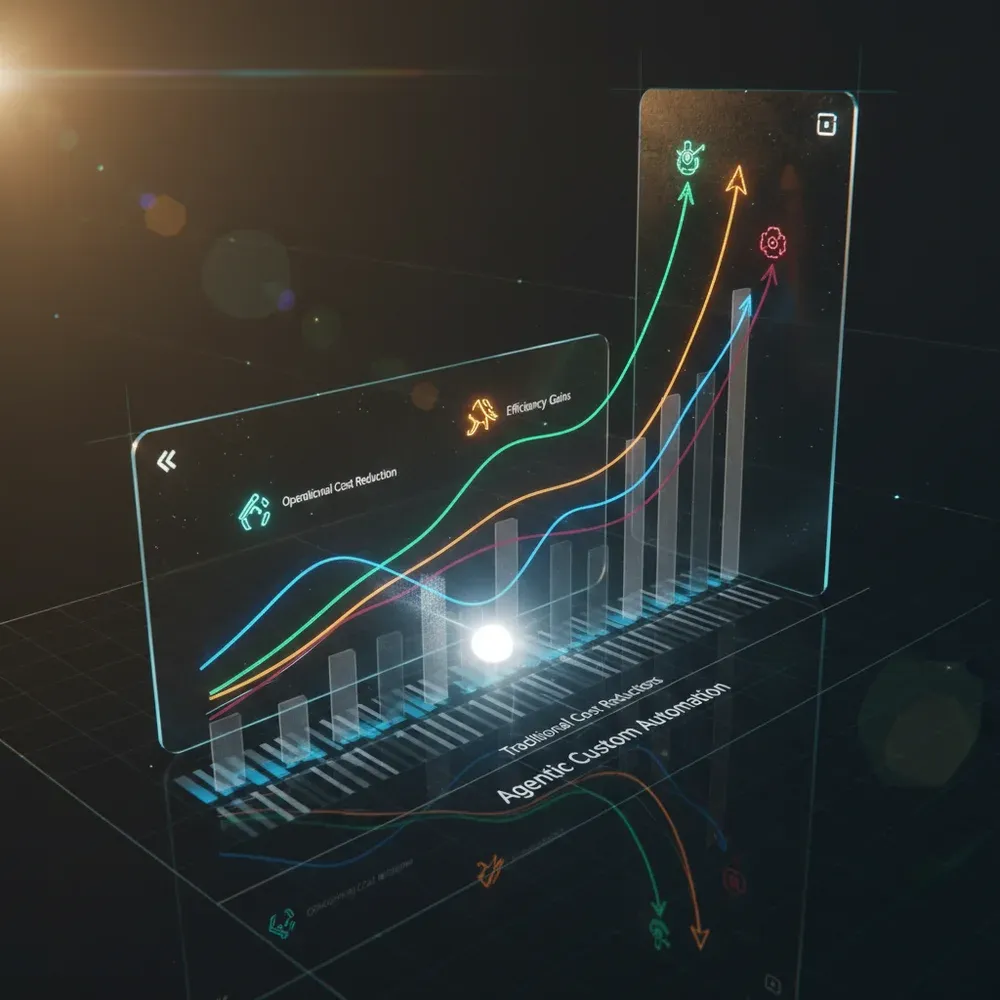
The first is the Drastic Reduction of Operational Costs (OPEX reduction). 70-80% of L1 and L2 IT support, data entry, and reporting tasks become fully automatable.
For an average enterprise, this can mean tens of thousands of man-hours and millions of dollars in savings annually, while the error rate drops to a fraction.
The second dimension is the Increase in Efficiency and Speed. AI agents work 24/7, have no downtime, and their response time is measured in seconds.
In a software development cycle, autonomous code testing and debugging can shorten Time-to-Market by weeks, providing an invaluable competitive advantage in fast-changing markets.
The third, often undervalued factor is the Unlocking of Innovation Capacity. When highly skilled engineers don't spend their time rebooting servers and patching scripts, they can finally focus on strategic product development.
Implementing agentic systems is not a cost, but an investment in the future. If you want to calculate how much time and money you can save, request a consultation from AiSolve's custom automation experts.
The Future of Custom Automation: Agentic OS as the Enterprise Backbone
Current developments, like the OpenAI Responses API, are just the tip of the iceberg. The future clearly points towards "Agentic Operating Systems" (Agentic OS).
In the next 3-5 years, we can expect AI agents to no longer operate as separate applications, but to become a fundamental, integrated part of enterprise infrastructure.
So-called "Multi-Agent Swarm" systems will emerge, where specialized AI agents communicate with each other, delegate tasks, and collaboratively solve complex problems.
For example, a "Finance Agent" notices an anomaly in expenses, notifies the "IT Agent" to investigate cloud infrastructure usage, and together they generate an optimization plan for the CTO.
This level of hyper-automation will completely transform organizational structures. The role of leaders will increasingly be to define the goals of AI agents and oversee their work, rather than micromanaging people.
The Agentic OS will be the central nervous system that connects data, software, and business processes, enabling companies to respond to market challenges with unprecedented agility.
Conclusion: Is Your Enterprise Ready for the Agentic Revolution?
The release of the OpenAI Responses API is a clear message to the market: the era of traditional, static automation is over. Agentic artificial intelligence is not the distant future, but the reality of the present.
Built-in shell tools, autonomous execution loops, and hosted containers give developers the tools to automate processes of previously unimaginable complexity.
The question is no longer whether this technology will transform your industry, but whether your company will lead this change or fall behind competitors.
The transition does not happen overnight. It requires strategic planning, building the right infrastructure, and strict adherence to security protocols.
Don't wait until your competitors are already optimizing their costs with autonomous systems. Take action today.
Contact the AiSolve team and discover how we can transform your company's operations with state-of-the-art custom automation and AI solutions.
Frequently Asked Questions (FAQ)
What is the difference between traditional and agentic custom automation?
Traditional automation (e.g., cron jobs, basic iPaaS workflows) follows pre-written, rigid rules. If the input data or environment changes, the process breaks. Agentic automation, on the other hand, uses artificial intelligence to understand goals, dynamically plan steps, and is capable of self-correction if it encounters an error, making it much more resilient and flexible in complex enterprise environments.
How does the OpenAI Responses API facilitate the development of agentic workflows?
The OpenAI Responses API accelerates development with three key innovations: 1. A native Shell tool that allows running command-line instructions. 2. A built-in execution loop that handles agent iterations and bug fixes on the server-side. 3. A hosted container workspace where the AI can safely run code and analyze data without developers having to build their own sandbox infrastructure.
What are the security risks associated with AI agents executing code?
The biggest risk is the potential for "prompt injection" attacks, where malicious input could instruct the agent to run harmful code. Furthermore, there is a risk of hallucination, where the AI accidentally issues an incorrect but syntactically valid command (e.g., deleting files). To mitigate these risks, it is essential to apply strict sandboxing, use the Principle of Least Privilege, and initially implement Human-in-the-Loop (HITL) approval processes.
Can agentic automation be integrated with existing enterprise systems?
Yes, absolutely. Agentic systems are designed to communicate with existing software (e.g., ERP, CRM, HR systems) via APIs, webhooks, and database connections. Through the "Tool Orchestration" layer, AI agents can send authenticated requests to internal and external endpoints, allowing them to be seamlessly integrated into the current IT architecture without having to replace the entire system.
Which industries can benefit most from agentic custom automation?
While every data-driven sector can benefit, it has the greatest impact in Financial Services (fraud detection, automated auditing), Healthcare (patient data processing, reducing administration), E-commerce (dynamic pricing, autonomous logistics troubleshooting), and IT/Software Development (DevOps automation, code testing). Wherever there are complex decision-making processes involving multiple systems, agentic AI provides a drastic ROI.
What are the first steps to implementing agentic AI in an enterprise?
A successful implementation consists of five steps: 1. Process audit and identifying appropriate tasks with high manual labor but structured nature. 2. Launching a narrowly focused Pilot Project (PoC) (e.g., an internal IT helpdesk agent). 3. Selecting the right technology stack (e.g., cloud-based APIs or on-premise models) and security guardrails. 4. Training staff to oversee the new systems. 5. Gradually scaling the system to other departments after a successful pilot.
What metrics can be used to measure the ROI of agentic automation?
The most important KPIs for measuring ROI are: Reduction in Operational Expenses (OPEX reduction) based on replaced manual labor hours; Error Rate Reduction by eliminating human errors; shortening of Turnaround Time in processes; and the number of "Freed-up Engineering Hours," which shows how much time professionals can spend on innovation and strategic development instead of maintenance.
Készen állsz a saját weboldaladra?
Ingyenes konzultáció során átbeszéljük, hogyan segíthetünk vállalkozásodnak növekedni egy modern, gyors és konverzióoptimalizált weboldallal. 14 nap alatt kész, 0 Ft induló költséggel.