

Key Takeaways
| Area / Area | Key Insight / Key Insight |
|---|---|
| Automotive AI | Nvidia's Alpamayo open-source model, debuting in the Mercedes CLA by 2026, marks a critical shift toward specialized, challenge-focused AI to solve complex 'long-tail' driving scenarios, demanding advanced `data processing AI agents`. |
| Industrial Automation | The expanded Siemens-NVIDIA partnership is focused on building an Industrial AI Operating System, using `data processing AI agents` to bridge the gap between digital models (Omniverse) and real-world factory operations, ensuring unprecedented efficiency. |
| Data Retrieval & RAG | Models like Llama Nemotron V-L demonstrate that combining visual and text data retrieval significantly improves accuracy in multimodal search, pushing the capabilities of modern `data processing AI agents` beyond simple text analysis. |
| Security & Compliance | Meta’s use of LLMs for mutation testing highlights a proactive approach to compliance hardening, contrasting sharply with the security vulnerabilities faced by 50+ large corporations due to a lack of basic multi-factor authentication (MFA). |
| Manufacturing Robotics | Hyundai's plan to use Boston Dynamics humanoid robots powered by Google DeepMind AI for assembly tasks underscores the increasing complexity and reliance on sophisticated, general-purpose AI for physical, multi-step operations. |
Introduction: The Era of Specialized AI Systems
The technological landscape of 2026 is defined not by the sheer power of large language models, but by their specialization. We have entered the era of the domain-specific, highly efficient AI Agent—an autonomous entity designed to master a single, complex task. This shift is evident across critical industries, from automotive safety to factory floor automation and corporate compliance. The recent collaboration between industry giants like NVIDIA and Mercedes-Benz, which will see the debut of the specialized Alpamayo AI driving technology in the Mercedes CLA by 2026, exemplifies this trend. Alpamayo is an open-source model family specifically created to tackle 'long-tail' autonomous driving challenges—the infrequent, highly complex events that traditional systems struggle with. This kind of real-time, high-stakes computation requires a new breed of AI infrastructure capable of reliable, instantaneous decision-making.
The common thread weaving through these advancements is the emergence of robust, reliable data processing AI agents. These agents are the operational backbone, processing massive streams of heterogeneous data—sensor readings, machine logs, visual documents—and translating them into actionable intelligence. Siemens and NVIDIA, for example, are expanding their partnership to build a dedicated Industrial AI Operating System, a clear signal that general-purpose AI is being adapted into hard-wearing, industrial-grade solutions. Such specialized systems demand precise control and monitoring, often requiring a professionally structured digital interface. The success of these industrial agents, and indeed all modern AI deployments, hinges on the quality of their foundation, including the digital storefront or control panel often built through professional website creation.
From self-driving cars to factory robots (as Hyundai plans to utilize Boston Dynamics humanoids with Google DeepMind support for assembly), the ability of an AI system to process, analyze, and act upon data in milliseconds is paramount. This article will delve into the architecture and implications of these specialized AI agents, exploring how they are redefining performance benchmarks in real-time environments, enhancing data security through advanced testing methods, and presenting new challenges in governance and scalability. We will examine the technologies driving this transformation and assess the strategic decisions companies must make to effectively deploy these powerful, autonomous systems.
Real-Time Decision Making: Autonomous Vehicles and the Alpamayo Project
The collaboration between Mercedes-Benz and NVIDIA, featuring the Alpamayo family of open-source models, represents a significant step beyond Level 2 driver assistance toward fully autonomous capabilities. Autonomous driving is arguably the most demanding real-time application of AI, where decisions must be made in fractions of a second based on constantly updated sensor data. The challenge isn't just navigating highways; it's tackling the 'long-tail' problems—the rare, unpredictable events like an obscure road sign, complex construction zones, or highly unusual weather conditions that confuse standard deep learning models. This is where specialized `data processing AI agents` prove their worth.
Alpamayo is designed to handle this complexity by integrating multi-sensor data fusion (LiDAR, radar, cameras) and using generative methods to predict a wider array of possible outcomes. The resulting system is a network of highly specialized custom automation solutions that analyze raw data, detect anomalies, classify potential risks, and execute control commands—all simultaneously. The processing load is immense, demanding not just raw computational power (like that provided by the NVIDIA Blackwell RTX platform mentioned in other news) but also optimized, low-latency algorithms. For commercial enterprises, this level of precision translates directly into efficiency, safety, and reduced liability, setting a new standard for how complex data is managed.
Strategic Insight: When developing real-time `data processing AI agents`, prioritize model efficiency and latency over absolute size. Specialized, smaller open-source models (like Alpamayo's concept) often offer better real-time performance for specific tasks than monolithic, generalized models.
The core function of these autonomous vehicle agents is robust object detection and prediction. They must filter noise, identify patterns, and project future movements of other entities (pedestrians, vehicles, animals) in a dynamic 3D environment. This intricate choreography of data streams and decision trees requires a highly resilient software layer, which often needs a custom-built, high-quality front-end for monitoring and debugging. Even a backend system as complex as Alpamayo requires a professional, responsive website creation foundation to provide developers and fleet managers with clear, real-time insights into system performance and risk profiles.

The Manufacturing Revolution: Siemens and the Industrial AI OS
The industrial sector is undergoing a parallel transformation, moving from simple robotic automation to complex, cognitive manufacturing systems. The expanded partnership between Siemens and NVIDIA to build the Industrial AI Operating System is a landmark development. This initiative aims to integrate AI seamlessly into every stage of the product lifecycle, from design and simulation (using tools like Omniverse) to production and optimization. The goal is to create a digital twin that not only mirrors the physical factory but also uses advanced `data processing AI agents` to manage and improve real-world operations automatically.
Industrial AI agents differ from autonomous driving agents primarily in their environment and timeline. While automotive agents focus on sub-second, life-critical decisions, industrial agents often manage long-cycle processes like predictive maintenance, quality control checks on assembly lines (where Hyundai is looking to deploy humanoid robots), and optimizing energy consumption. These agents rely heavily on analyzing vast amounts of time-series data from machinery sensors, temperature gauges, and acoustic monitors. This requires the development of bespoke custom automation solutions that can interface directly with legacy industrial control systems (ICS) and modern cloud platforms simultaneously, a common complexity in brownfield sites.
| Industrial Process | Traditional Monitoring | AI Agent Monitoring |
|---|---|---|
| Quality Control | Manual sampling, post-production checks, static camera vision. | Real-time vision processing, anomaly detection, in-line process correction by `data processing AI agents`. |
| Predictive Maintenance | Scheduled checks, rule-based alerts, historical failure averages. | Analysis of vibration/acoustic data, deep learning of component health, predicting failure days in advance. |
| Supply Chain Logistics | Static routing, human oversight of inventory levels, manual resource allocation. | Dynamic routing, real-time demand forecasting, autonomous material transport coordinated by the Industrial AI OS. |
The integration of humanoid robots for complex tasks, as planned by Hyundai using Boston Dynamics and DeepMind, further necessitates an overarching Industrial AI OS. These agents must not only process data but also interact physically with the environment. This requires advanced feedback loops managed by the central system. The development of the graphical interfaces and monitoring tools for these systems is often overlooked; the user experience for managing hundreds of autonomous agents must be flawless. A poor interface, despite powerful AI backend, leads to adoption failure, emphasizing the continuous need for expert professional website creation to structure and visualize complex operational data effectively.
The Role of Digital Twins in Agent Training
Digital twins are crucial in industrial AI, providing a safe, simulated environment for training `data processing AI agents` without risking physical machinery or halting production. The Industrial AI OS leverages these twins to rapidly iterate on optimization strategies. By simulating millions of operational hours, the agents learn to handle edge cases and optimize performance parameters that would be impossible to discover in real-world testing alone. This simulation-first approach is key to achieving the level of reliability required for mission-critical industrial applications, ensuring that when the AI is deployed on the factory floor, its data processing capabilities are already extensively validated.
Multimodal Accuracy: Combining Image and Text in RAG Models
The capabilities of specialized `data processing AI agents` are rapidly expanding beyond traditional text-based analysis. The news of Llama Nemotron RAG models from NVIDIA demonstrates a significant leap in multimodal search and visual document retrieval. In complex enterprise environments—think legal firms, engineering archives, or medical imaging centers—information rarely exists purely as text. It is often embedded in diagrams, blueprints, scanned documents, or photographs. Traditional RAG (Retrieval-Augmented Generation) systems, while effective for text, fail when the query requires visual context.
The integration of vision models with RAG allows the new breed of RAG AI chatbot and search agents to process a document that contains both a text description and a technical diagram, understanding the relationship between the two. For instance, an engineer could ask, "What is the tensile strength of the part labeled 'C' in the attached blueprint?" The multimodal agent processes the image to locate 'C', reads the corresponding text specifications, and provides an accurate, contextualized answer. This vastly improves accuracy, moving the needle from around 70-80% for unimodal RAG to over 95% in controlled tests involving complex visual documents.
Implementation Advice: Audit your enterprise data to identify multimodal assets (diagrams, spreadsheets, images). Prioritize the deployment of multimodal RAG `data processing AI agents` in departments (e.g., engineering, legal, logistics) where visual context is critical to information retrieval accuracy.
The ability to handle visual document retrieval is especially vital for `data processing AI agents` deployed in critical infrastructure and compliance roles. Analyzing incident reports, reviewing security camera footage contextually with event logs, or verifying assembly steps against visual quality standards all depend on this multimodal capability. The transition from simple language processing to complex visual and linguistic synthesis is a key differentiator for the latest generation of specialized AI systems. Furthermore, even sophisticated AI agents, such as those used for multimodal data retrieval, require a seamless user experience, reinforcing the importance of expert web development for the public-facing or internal front end.
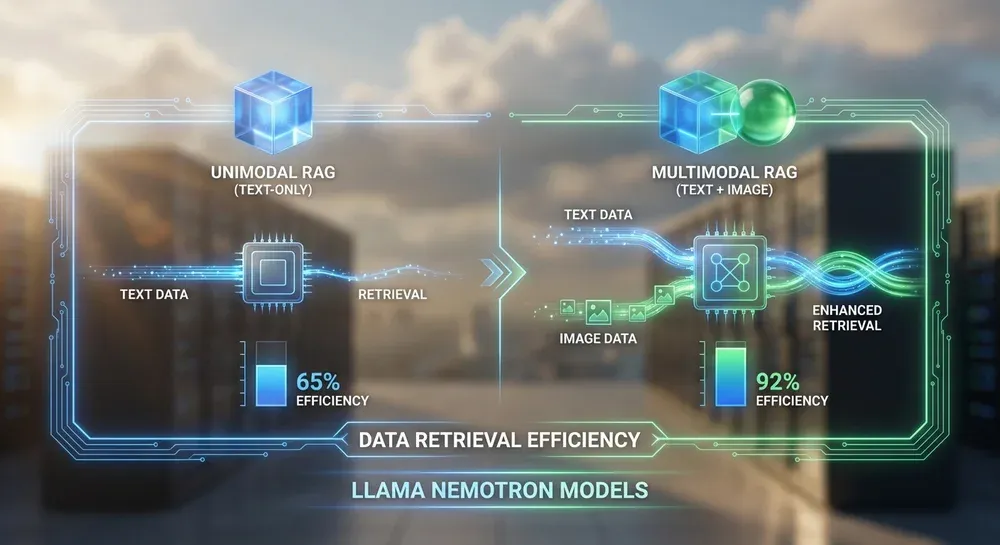
Figure: Comparison of Unimodal vs. Multimodal Data Processing Architectures
The Master of Compliance: AI-Driven Mutation Testing and Security
While the focus is often on high-speed industrial or automotive applications, one of the most crucial roles for specialized `data processing AI agents` is in the unseen world of software security and compliance. Meta's application of large language models (LLMs) to mutation testing through its Automated Compliance Hardening system illustrates how AI is now used to secure the very systems it powers. Mutation testing involves systematically introducing small, deliberate flaws (mutants) into code or configuration to test whether existing compliance and security tests are robust enough to catch them. Traditionally, this process is slow and manual.
By leveraging LLMs, Meta is generating targeted mutants and tests at scale, dramatically improving compliance coverage and reducing overhead. These specialized `data processing AI agents` act as sophisticated internal hackers, probing for privacy and safety risks with an understanding of human error and common vulnerabilities. This proactive, AI-driven approach to hardening systems is the antidote to complacency. It stands in stark contrast to the severe security lapse recently highlighted by the news that a single hacker managed to compromise sensitive internal data from over fifty large corporations—a breach primarily attributed to the organizations failing to enforce simple multi-factor authentication (MFA) on their cloud platforms.
| Security Strategy | Manual / Traditional | AI-Driven (Meta Example) |
|---|---|---|
| Test Generation | Based on human assumptions, limited by time and resources. | LLM-driven generation of thousands of targeted, complex vulnerability tests. |
| Compliance Coverage | Often reactive and incomplete, focused on known standards. | Continuous, proactive hardening against novel and complex compliance threats. |
| Risk Detection | Slow detection of zero-day exploits or logic flaws. | Rapid identification of privacy and safety risks through automated mutation analysis. |
Pro Tip: While deploying advanced `data processing AI agents` for security analysis, do not neglect foundational cybersecurity. The largest breaches still stem from basic failures like lack of MFA. Ensure your core systems are secured before attempting complex AI hardening.
The irony is stark: while the most advanced tech companies are using cutting-edge AI for scalable test generation, many large firms remain vulnerable to elementary password attacks. The lesson for any company deploying specialized AI, whether it is an AI phone customer service system or an industrial optimization agent, is that security must be designed into the system from the start. Robust `data processing AI agents` not only need strong internal security protocols but also must be deployed within an infrastructure that mandates best practices, such as MFA and secure access control, ensuring that the critical data they manage is protected against simple credential theft.
Risks and Limitations: Governance, Cybersecurity, and Scalability
The rise of specialized `data processing AI agents` brings immense opportunity, but also necessitates careful risk management. The core risks involve governance, cyber exposure, and the inherent difficulties in scaling custom solutions. In terms of governance, autonomous systems—especially those making real-time decisions in vehicles or managing high-stakes industrial processes—require transparent, auditable decision paths. If an Alpamayo-powered car makes an error, or if an Industrial AI OS shuts down a critical piece of machinery, the root cause must be quickly and accurately traced. This demands specialized logging and interpretation tools that go far beyond standard IT monitoring.
The cybersecurity risk is two-fold. First, as seen with the recent data breach impacting 50+ companies, the risk of data compromise through simple means remains high. Second, the complexity of the AI systems themselves introduces new attack vectors. An attacker might try to poison the data used to train the multimodal RAG models or subtly manipulate the sensor inputs feeding the autonomous vehicle agents. Therefore, all `data processing AI agents`, regardless of their specialization, must be developed with a Zero Trust architecture, verifying every input and action, and monitored continuously by specialized security agents. Furthermore, for systems like AI phone customer service solutions, robust security must also extend to protecting the integrity of voice data and preventing malicious prompt injection.
Scalability presents a unique challenge for these custom, specialized agents. Deploying a single, highly tuned AI system in a single Mercedes CLA is one task; deploying it across an entire fleet or replicating an Industrial AI OS across dozens of factories is another. Custom solutions inherently require bespoke infrastructure and integration work. Scaling effectively means modularizing the agent's components and relying on standardized, cloud-native deployments. Without this strategic planning, a successful pilot project can quickly become an unmanageable integration headache. Companies must ensure that their initial `data processing AI agents` are built on flexible platforms that facilitate exponential growth while maintaining control and observability, often provided through a high-quality interface from the start.
The Implementation Guide: How to Build Business AI Agents
For enterprises looking to move beyond simple chatbots and adopt truly specialized, autonomous `data processing AI agents`, a structured implementation plan is essential. The process must begin with a clear definition of the scope, focusing on a high-value, high-complexity problem that traditional automation cannot solve (e.g., long-tail driving issues or multimodal document retrieval). Once the problem is defined, the data strategy is paramount: identifying, cleaning, and labeling the specific, domain-relevant data required to train the agent (whether it be sensor data for an industrial agent or visual/text pairs for a RAG model).
The development phase requires expertise in specialized model selection—perhaps fine-tuning a model like Llama Nemotron for a multimodal task, or integrating an open-source framework like Alpamayo into proprietary hardware. The key is orchestration: ensuring that the agent can seamlessly move from data ingestion (data processing) to decision-making and execution. Crucially, every deployed agent requires an interface for human oversight. You cannot automate what you cannot monitor. This is where the discipline of professional website creation becomes non-negotiable. A custom dashboard is necessary for visualization, real-time KPI tracking, and manual override capabilities, ensuring agents function as accountable partners, not black boxes.
Deployment Strategy: Implement a 'Shadow Mode' deployment where the `data processing AI agents` run in parallel with existing human workflows, making decisions but not executing them, for at least 90 days. This allows for rigorous real-world validation and reduces the risk of operational disruption.
Finally, continuous compliance and maintenance are non-stop requirements. Agents must be continuously monitored for drift—the tendency for models to lose accuracy over time as real-world data changes—and retrained accordingly. Utilizing AI for compliance testing, as Meta does, becomes a built-in maintenance step. The infrastructure must be robust enough to support these training pipelines. By following this lifecycle—Define, Develop, Deploy (with oversight), and Drift Management—enterprises can successfully harness the power of autonomous `data processing AI agents` to transform their most complex operations.

Conclusion: The Significance of Data Processing Agents and the Future
The trend is clear: the future of enterprise AI lies in specialization. From the Alpamayo model navigating complex road conditions to the Industrial AI OS optimizing manufacturing, highly focused `data processing AI agents` are moving into critical infrastructure where their speed and accuracy translate directly into bottom-line improvements and enhanced safety. These agents represent a fundamental shift from simple task automation to autonomous, cognitive decision-making within highly specific domains. Their power is derived from their ability to expertly process and synthesize vast, heterogeneous data streams, whether they are multimodal documents or real-time sensor inputs.
However, this era of powerful autonomy mandates vigilance. As these systems grow in complexity, the importance of foundational security—such as enforcing MFA to prevent breaches like those recently reported—and robust governance becomes paramount. Every deployed agent requires a structured environment for monitoring and control. This oversight layer, which often takes the form of custom-built dashboards and applications, underscores the lasting necessity of high-quality website creation, ensuring that complex AI systems remain transparent and manageable by human operators. By prioritizing specialized development, robust security, and clear oversight, enterprises can responsibly and effectively harness the unparalleled power of `data processing AI agents` to solve their most challenging problems.
Ready to leverage the power of specialized, real-time data processing to automate your most complex industrial, automotive, or compliance workflows? Our custom AI agents are designed for high-stakes environments, ensuring accuracy, speed, and governance.
Start Your Specialized AI Agent Project TodayFrequently Asked Questions
What distinguishes a specialized data processing AI agent from a general-purpose LLM?
Specialized data processing AI agents are fine-tuned on highly specific, domain-relevant data, such as sensor readings (Alpamayo for cars) or industrial machine logs (Siemens OS). Unlike general LLMs, their primary focus is not conversation but high-stakes, real-time decision-making, often involving complex sensor fusion or multimodal data analysis. They are built for reliability and speed in critical, defined operational environments.
How does multimodal RAG improve data retrieval accuracy in enterprise settings?
Multimodal RAG (like the Llama Nemotron model) allows AI agents to process both textual data and visual data (images, diagrams, blueprints) during retrieval. This is crucial for documents where information is visually encoded. By understanding the context between the image and the text, the agent can answer complex queries with much greater precision, reducing the risk of errors that occur when text-only RAG systems ignore important visual cues.
What is the primary security risk associated with deploying specialized AI agents?
Beyond traditional IT risks, specialized AI agents face risks related to data integrity, such as data poisoning during training or adversarial attacks on real-time inputs (like sensor manipulation). However, the most immediate risk, as recent reports show, is the failure of foundational security like multi-factor authentication (MFA) on cloud platforms used to host the data, leading to massive breaches of internal sensitive information.
Why is website creation relevant to the deployment of industrial AI systems?
Even the most powerful backend AI, like an Industrial AI Operating System, requires a user-friendly, high-quality interface for human oversight, monitoring, and control. Professional website creation, in this context, refers to building custom enterprise dashboards and control panels. These interfaces are crucial for visualizing real-time KPIs, managing agent workflows, tracking drift, and providing manual override capabilities, turning complex data processing AI agents into accountable tools.
Recommended / Ajánlott
- Detailed Guide to Implementing Data Processing AI Agents
- Explore the Capabilities of Multimodal RAG Chatbot Solutions
- Advanced Custom Automation for Industrial and Enterprise Workflows
- The Necessity of Custom Interfaces for AI Agent Management
[Article generated by AiSolve AI Content System]
Készen állsz a saját weboldaladra?
Ingyenes konzultáció során átbeszéljük, hogyan segíthetünk vállalkozásodnak növekedni egy modern, gyors és konverzióoptimalizált weboldallal. 14 nap alatt kész, 0 Ft induló költséggel.