
Key Takeaways
| Terület / Area | Kulcsfontosságú Megállapítás / Key Insight |
|---|---|
| Agent Orchestration | The future of development is shifting from linear coding to managing parallel AI workstreams, where one human commands a 'fleet' of 5-10 specialized agents simultaneously. |
| Infrastructure Shift | NVIDIA's new platforms, like Rubin and BlueField-4 DPUs, are creating AI-native storage and compute infrastructures specifically designed for the high-throughput, low-latency demands of multi-agent systems. |
| Model Selection Strategy | Prioritizing the slower, smarter model (e.g., Opus 4.5 over Sonnet) minimizes the costly human time spent on corrections, proving that the 'Correction Tax' outweighs the 'Compute Tax'. |
| Institutional Memory | Implementing a shared, constantly updated instruction file (like CLAUDE.md) allows AI agents to learn permanently from past mistakes, transforming the codebase into a self-correcting organism. |
| Verification & Trust | Autonomous verification loops, where agents test their own UI or execute bash commands to prove code functionality, are the key to improving AI-generated output quality by 2-3x. |
| Governance & Oversight | The complexity of multi-agent systems necessitates robust human-in-the-loop governance models and specialized dashboards to ensure alignment and prevent cascading failures. |
The 'Fleet Commander' Paradigm: Orchestrating Autonomous AI Agents
The operational landscape of the modern enterprise is undergoing a fundamental transformation, driven not by single, monolithic AI systems, but by highly specialized, interconnected autonomous agents. This shift is best encapsulated by the 'Fleet Commander' paradigm, recently detailed by the creator of Claude Code. Instead of treating AI as a mere assistant for linear tasks, leading technologists are now operating multiple agents in parallel—a strategy that multiplies human output by a factor of five. This complex orchestration, where a single human manages 5 to 10 simultaneous workstreams, marks the true beginning of enterprise-grade custom automation solutions.
In this paradigm, the human operator transitions from executing tasks to commanding a workflow. For instance, while one agent refactors legacy code, another runs extensive test suites, and a third drafts corresponding documentation. This is not just faster coding; it is a shift from typing syntax to commanding autonomous units, reminiscent of a real-time strategy game. This layered approach to productivity is pushing companies to seek out sophisticated interfaces and deployment platforms that can handle this multi-threaded workflow. The success of this model is directly tied to the ability of the underlying infrastructure to manage diverse, high-volume computational demands without failure.
The ability to manage diverse and concurrent workflows is the essence of effective custom automation solutions. This level of complexity requires far more than simple scripting; it demands a robust, AI-native environment. Organizations aiming for exponential productivity gains must move beyond simple point solutions and adopt a structured orchestration layer. This involves setting up specialized agents with predefined roles (e.g., a "Code Simplifier" agent, a "Verify-App" agent) and providing them with the necessary tools (like slash commands for one-keystroke operations) to execute complex, multi-step processes autonomously. The immediate result is not only increased speed but a dramatically reduced burden of manual, bureaucratic tasks, such as version control and commit message writing.
The Critical Role of Orchestration in Productivity
The concept of running multiple AI agents in parallel highlights a critical bottleneck in traditional automation: sequential processing. By contrast, parallel agent orchestration allows for instantaneous context switching and concurrent task execution. The key technological components enabling this are sophisticated terminal setups, system notifications, and 'teleport' commands that seamlessly hand off agent sessions between web interfaces and local machines. However, integrating these disparate tools into a cohesive, manageable platform is where specialized knowledge in professional website creation and front-end development becomes crucial, as the operator needs a custom-built dashboard—an 'Inner Loop' UI—to monitor and direct their fleet of agents effectively. This UI acts as the single pane of glass for the entire autonomous workforce.
Strategic Insight: When designing your multi-agent architecture, treat the human operator's dashboard as a mission-critical component; its UI/UX directly dictates the efficiency gains of your entire custom automation solutions system.
The Infrastructure Engine: NVIDIA Rubin and BlueField-4
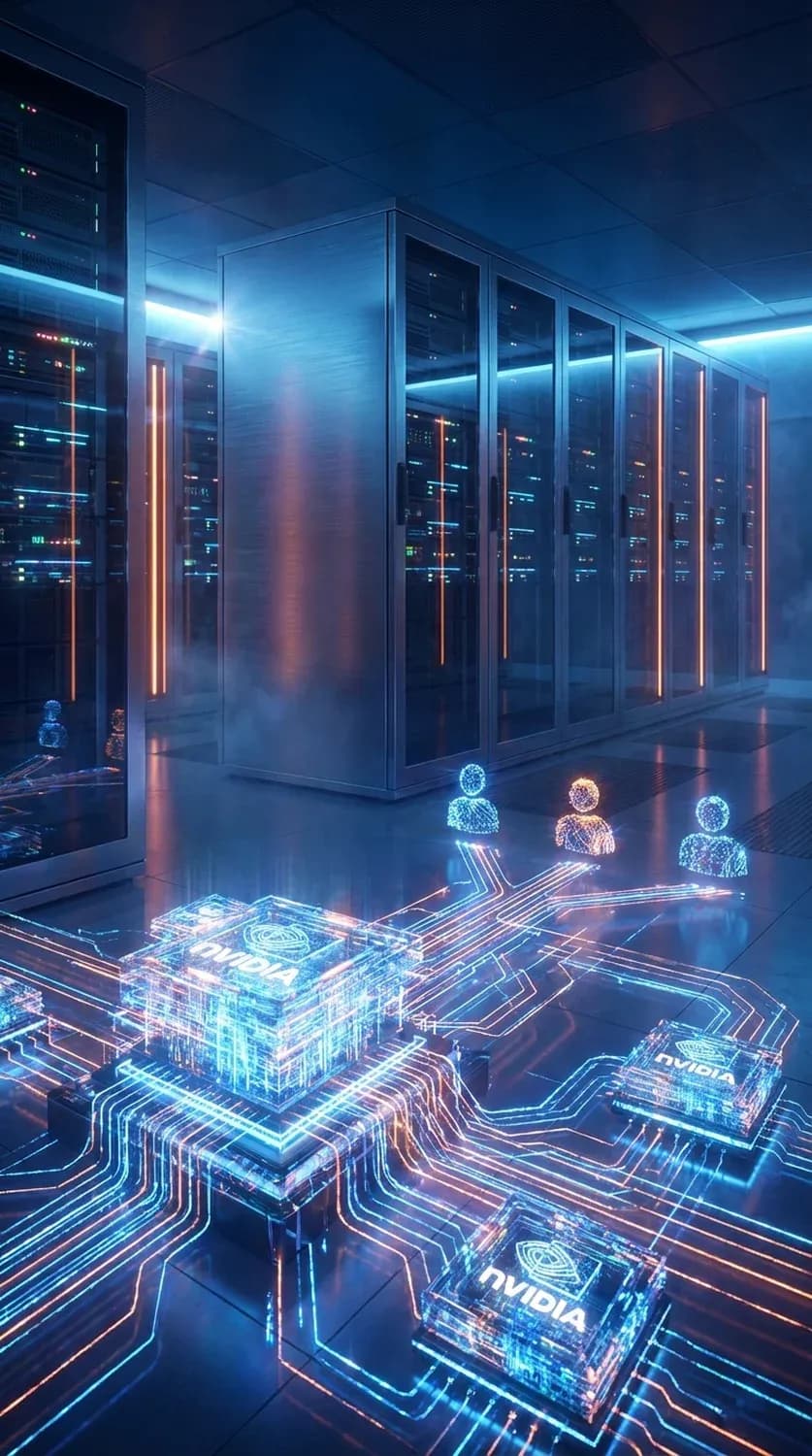
The exponential growth of multi-agent systems demands an equally powerful and tailored infrastructure. Jensen Huang, NVIDIA CEO, emphasized at CES 2026 that AI is scaling into every domain, fundamentally reshaping computing. This isn't just about faster GPUs; it's about re-architecting the entire data center stack. The introduction of the NVIDIA Rubin platform and the BlueField-4 data processor (DPU) directly addresses the high-throughput, low-latency requirements of complex agent workflows. These agents, which often generate and process massive amounts of intermediate data (like test results, draft code, and documentation), require storage and networking that can keep pace.
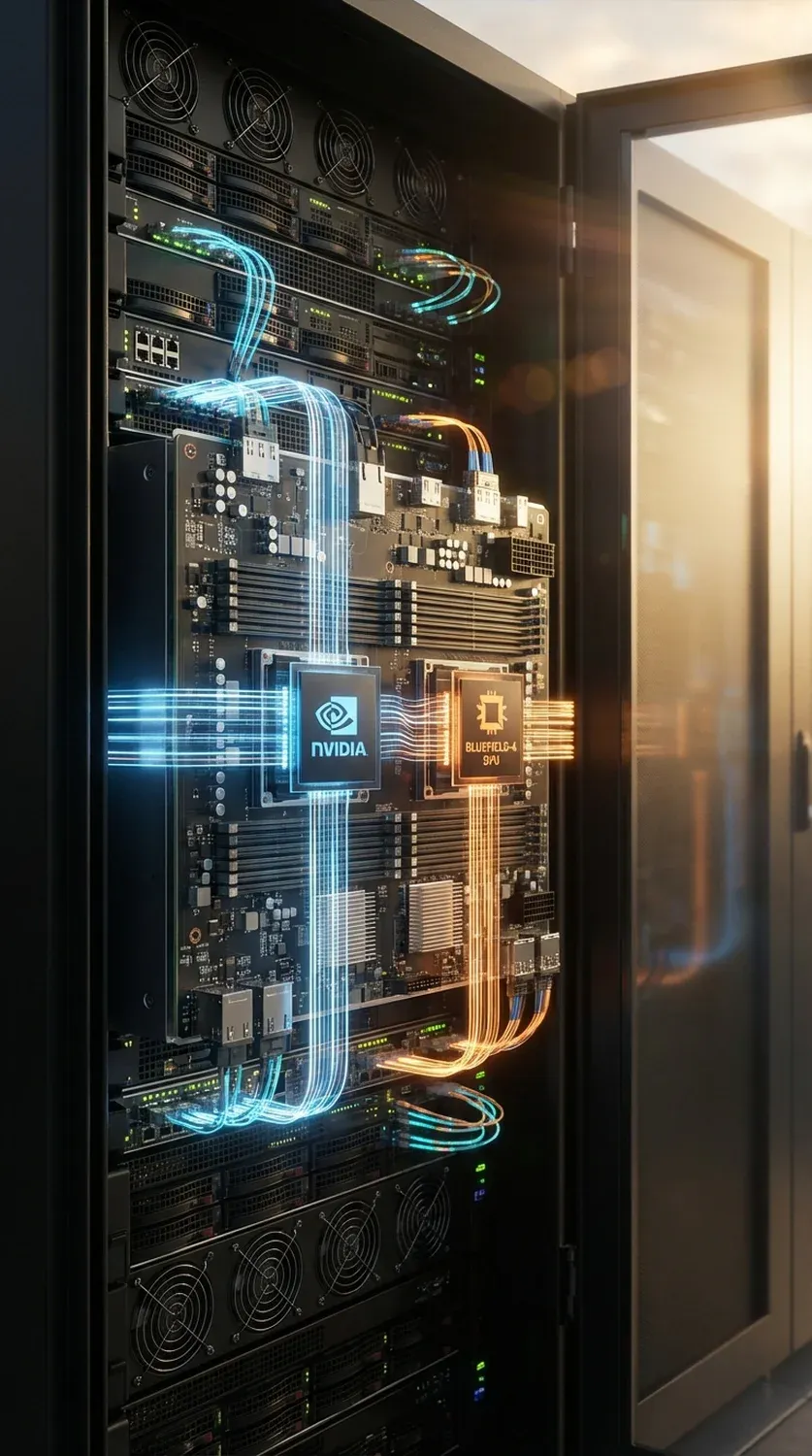
The BlueField-4 DPU is positioned to power a new class of AI-native storage infrastructure. In a multi-agent system, agents frequently need to access and modify shared knowledge bases, such as the crucial CLAUDE.md file (more on that later), or pull data from external systems. Traditional storage architecture often becomes a bottleneck. BlueField-4, as part of the full-stack NVIDIA BlueField platform, enables an Inference Context Memory Storage Platform. This system ensures that the vast memory context required by large, smart models is accessible almost instantaneously, minimizing the waiting time and maximizing the parallel efficiency of the agents. This infrastructure is essential for reliable, enterprise-scale data processing AI agents.
Furthermore, the NVIDIA Rubin platform, along with six new AI chips announced, confirms that the industry is moving toward more specialized hardware acceleration for AI workloads. This specialization allows for the efficient execution of different agent types—some optimized for fast inference (like the Code Simplifier), and others for complex, multi-step reasoning (like the Verify-App agent). Businesses planning to deploy advanced, parallelized custom automation solutions must consider this infrastructure overhaul. Ignoring the shift to AI-native storage and network fabrics will result in a performance ceiling that undermines the benefits of sophisticated agent orchestration.
The Need for AI-Native Storage
Why is AI-native storage critical? Consider a financial modeling firm using five parallel agents for market analysis: one gathering real-time feeds, one running proprietary LLM-based prediction models, one drafting risk reports, and two running regulatory compliance checks. If the data access latency is high, the entire parallel workflow stalls. The BlueField-4 architecture minimizes this by integrating processing power directly into the data path, reducing the time spent moving data between the compute cluster and storage. This low-latency environment is fundamental to achieving high reliability and throughput in complex agent systems, ensuring that autonomous driving systems and high-frequency trading platforms can react in real-time.
The Correction Tax vs. Compute Tax: Smart Agents Win
One of the most counterintuitive yet crucial insights from leading AI practitioners is the preference for the heaviest, slowest, and smartest models. The creator of Claude Code revealed using Anthropic’s Opus 4.5 model exclusively, despite its size and latency, over faster alternatives like Sonnet. This decision is based on a fundamental economic trade-off that enterprise technology leaders must understand: the "Correction Tax" versus the "Compute Tax."
The Compute Tax is the immediate cost of running a larger, slower model—measured in token generation time and monetary cost per token. The Correction Tax, however, is the far more significant hidden cost: the human time and effort spent correcting a smaller model's mistakes, steering it back on track, or debugging flawed output. Cherny’s observation is that paying the higher Compute Tax upfront eliminates the much more burdensome Correction Tax later. A smarter model requires less steering, is better at tool use, and often produces functionally correct code on the first attempt, making the overall development cycle faster, not slower.
For any organization deploying custom automation solutions, this realization shifts the focus from optimizing for speed to optimizing for accuracy and autonomy. If an AI agent controlling a physical process, or an AI phone customer service system, frequently makes small but costly errors, the continuous need for human intervention negates the automation benefit. Therefore, choosing a model with advanced reasoning capabilities, such as those demonstrated by the new NVIDIA Cosmos Reason 2 for physical AI, becomes paramount for achieving true autonomy. This approach ensures that the total cost of ownership for the automated system is reduced dramatically.
Pro Tip: When assessing new AI models for enterprise integration, use a metric that combines computation cost with human correction time. A 20% increase in model cost is often justified if it leads to a 75% reduction in necessary human oversight and debugging hours.
Economic Impact of Model Accuracy
The economic impact of this choice is vast. When running multi-agent workflows, an error in one agent can cascade into failures across the entire system. By utilizing the smartest available models, companies minimize the risk of cascading errors. The time saved by not correcting agent output can be repurposed for higher-value strategic work. This principle applies not only to coding but to all forms of generative AI, including internal documentation generation, complex financial analysis by data processing AI agents, and regulatory submission drafting. The initial investment in superior intelligence pays dividends in reduced operational friction and enhanced reliability.
| Metric | Smaller/Faster Model (High Correction Tax) | Larger/Smarter Model (High Compute Tax) |
|---|---|---|
| Initial Token Cost | Low | High |
| Correction Cycle Time | High (Frequent human intervention) | Low (Minimal human steering) |
| Output Quality | Variable, requires heavy verification | High, often correct first-pass |
| Total Time-to-Solution | Longer due to debugging | Shorter due to fewer errors |
Specialized Reasoning and Self-Correction (DeepMath & CLAUDE.md)
General-purpose LLMs often struggle with tasks requiring precise, specialized reasoning, such as advanced mathematics or adhering to specific corporate coding standards. The latest developments focus on addressing these foundational limitations through targeted enhancements and mechanism design. Intel's introduction of DeepMath, a lightweight agent built on Qwen3-Thinking, exemplifies the specialized reasoning trend. DeepMath tackles common LLM limitations in mathematical reasoning by generating small, verifiable Python scripts that support its problem-solving process. This concept—externalizing complex, structured thought into executable code or tools—is a significant step toward reliable data processing AI agents.
Equally transformative is the solution to the "AI amnesia" problem. Standard LLMs do not inherently remember a company's unique architectural decisions or coding style from one session to the next. The Claude Code team's solution is both simple and revolutionary: maintaining a shared, committed file named CLAUDE.md in the git repository. This file serves as the agent's permanent institutional memory. Whenever a human developer spots an error or a deviation from style, they add the corrective instruction to CLAUDE.md, instructing the AI on what not to do next time. "Every mistake becomes a rule," transforming the codebase into a self-correcting organism.
For enterprises adopting custom automation solutions, this pattern is essential. Whether the agents are managing complex logistics, drafting legal contracts, or handling customer queries via an RAG AI chatbot, they need a mechanism to build long-term memory that is separate from their immediate session context. The CLAUDE.md method provides a structured, version-controlled way for agents to internalize corporate best practices, risk parameters, and compliance guidelines. It creates a powerful feedback loop where human review directly enhances the AI's future performance, moving the system toward perpetual improvement.
Implementing Persistent Memory Architectures
Implementing a persistent memory architecture, like the CLAUDE.md system, requires careful planning. It must be easily accessible to all agents and consistently updated by human reviewers. This mechanism not only solves the amnesia problem but also provides an auditable trail of policy changes enforced upon the AI, a critical requirement for regulatory compliance. Furthermore, the integration of specialized subagents, like Intel's DeepMath, into a central orchestration system allows for the decomposition of highly complex problems, ensuring that the right tool—or agent—is used for the right job, significantly increasing the reliability of the overall automated workflow.
Implementation Advice: For compliance-sensitive sectors, use a version-controlled database (not just a plain file) for agent institutional memory. Integrate human review gates that require explicit approval before the agent's 'best practices' database is updated, ensuring auditable governance.
Verification Loops: The Real Unlock for Trustworthy Automation
The core challenge with any form of generative AI, particularly in production environments, is establishing trust. It is not enough for an agent to simply write code or draft a report; it must prove that its output is functional and correct. The single biggest reason for the success of sophisticated AI systems lies in the implementation of autonomous verification loops. This is the difference between an AI assistant and a true automated workforce: the ability of the agent to test its own work and iterate until the result is verified.
In the context of software development, this means that the AI doesn't just produce code; it runs test suites, executes bash commands, and uses browser automation tools (like the Claude Chrome extension) to test its own UI changes. This self-verification process reportedly improves the quality of AI-generated output by a factor of 2-3x. The agent, therefore, is given the necessary agency to check the functionality and user experience of its work before a human ever sees it. This drastically reduces the human workload and ensures that the automation layer is producing reliable, ready-to-deploy assets.
This principle of self-verification is crucial across all sectors utilizing custom automation solutions. For example, an AI phone customer service agent should not only generate an answer but should also verify that answer against three different RAG sources and perhaps a sentiment analysis model before delivering it to the customer. Similarly, in logistics, an agent proposing a new routing schedule must execute a simulation (the verification loop) to prove its efficiency gains against current metrics. The verification loop transforms the AI from a suggestion engine into a self-validating decision-maker, making it suitable for mission-critical applications like autonomous driving, which NVIDIA highlighted at CES 2026.
From Suggestion Engine to Self-Validating System
Implementing effective verification loops requires a clear definition of 'done' and access to the necessary tools (sandboxes, testing frameworks, and metric APIs). Developers must equip their agents with the permissions and environment to execute these tests. For companies developing proprietary software or highly specialized internal tools, the front-end—the user interface where these automated processes are managed—requires a robust and adaptable design. This need highlights the intersection between advanced AI automation and high-quality professional website creation, as the complex outputs and verification reports must be displayed clearly for human oversight and intervention. The UI is the key control panel for the entire verification ecosystem, transforming raw agent data into actionable intelligence for human "fleet commanders."
| Workflow Stage | Traditional Human Review | Autonomous Verification Loop |
|---|---|---|
| Code Review | Manual testing, syntactic check by human. | Agent runs unit/E2E tests, checks UI with browser extension. |
| Data Analysis | Statistical sampling, cross-check by second human. | Agent executes Python scripts (DeepMath), validates against known datasets. |
| Commit/Push | Manual git commands, human-written commit message. | Agent executes /commit-push-pr command, drafts commit message, opens PR. |
Implementation Risks and Governance in Multi-Agent Systems
While the productivity gains from multi-agent orchestration are undeniable, the risks associated with this complexity are non-trivial. The deployment of advanced custom automation solutions introduces unique security, ethical, and stability challenges that must be mitigated by robust governance frameworks. One primary risk is the potential for cascading failures. Since multiple agents operate in parallel and depend on shared resources (like the BlueField-4 powered storage platform) and institutional memory (CLAUDE.md), a single faulty instruction or a critical security vulnerability can propagate rapidly across the entire system. For instance, the recent news about generative AI systems misleading law enforcement by altering images underscores the potential for misaligned outputs in sensitive applications.
Another major governance challenge is ensuring alignment and controlling the autonomy of specialized subagents. If a code simplifier agent, operating independently, optimizes code for speed but violates a critical security standard, the human 'fleet commander' needs immediate, real-time alerts. This demands a human-in-the-loop (HITL) system that is both non-intrusive and mandatory at defined breakpoints (e.g., before any production deployment). Furthermore, the reliance on proprietary infrastructure like NVIDIA's platforms, while providing superior performance, also raises concerns about vendor lock-in, a challenge highlighted in the analysis of NVIDIA's new open models.
Deployment Strategy: Implement mandatory 'air-gaps' for critical decisions. Any agent attempting to access production data or financial systems must pass through a two-factor human authentication gate, regardless of its confidence score, to prevent autonomous regulatory breaches.
Establishing a Governance Framework
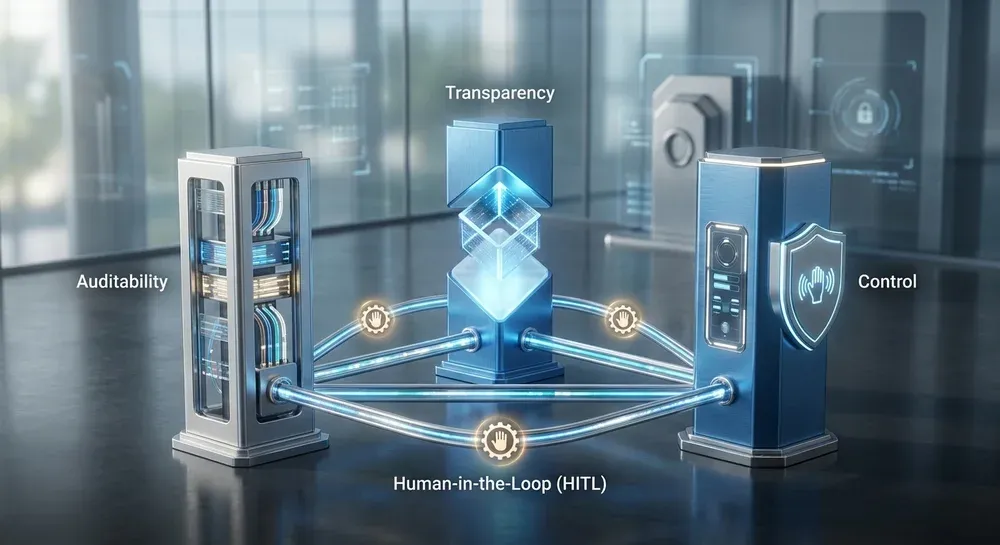
Effective governance for multi-agent systems includes three pillars: transparency, auditability, and control. Transparency means every agent's decision-making process must be logged and explainable. Auditability is ensured by the persistent memory system (CLAUDE.md) and the use of verification logs, allowing post-mortem analysis of failures. Control requires sophisticated orchestration software that allows the human operator to pause, re-route, or terminate individual agents or entire workstreams instantly. Without a clear governance framework, the exponential speed of multi-agent custom automation solutions can quickly turn into an exponential risk. Implementing this control panel often relies on expert professional website creation to build a clean, real-time dashboard that prioritizes risk signals over productivity metrics.
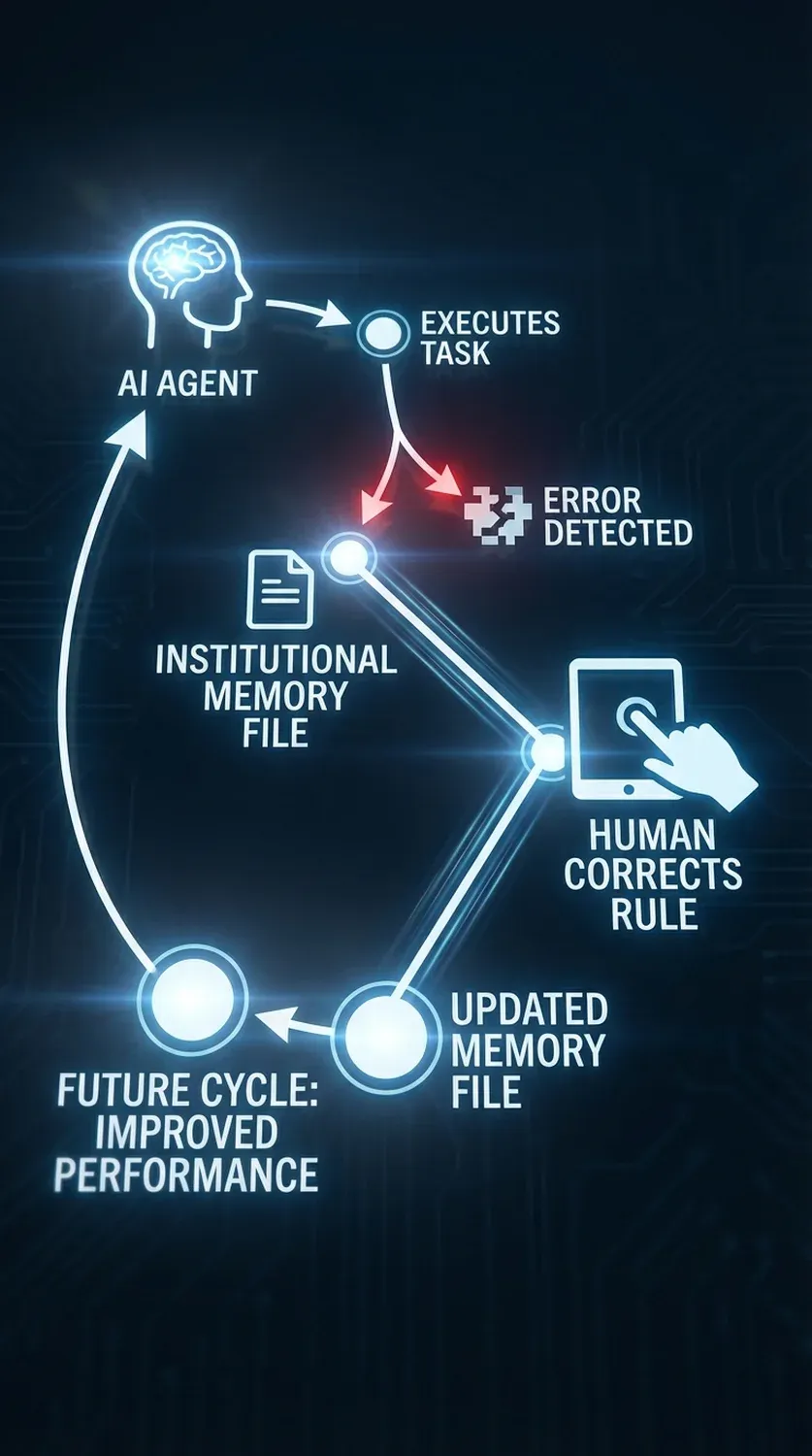
Figure: The Governance Framework for Multi-Agent AI Systems
Strategic Steps for Implementing Custom Automation Solutions
The transition to a multi-agent operational model is a strategic transformation, not just a technical upgrade. It requires a phased approach focused on foundational elements, specialized expertise, and clear orchestration. For companies looking to leverage custom automation solutions effectively, the following steps provide a roadmap to success.
1. Audit and Define Agent Roles
Start by identifying high-value, repetitive workflows that can be decomposed into smaller, specialized tasks. Don't try to build one monolithic "Super-Agent." Instead, define 3-5 distinct sub-roles, such as a "Drafting Agent," a "Verification Agent," and a "Compliance Agent." This specialization allows you to use the most suitable LLM or tool for each specific task, maximizing efficiency and minimizing errors. The initial design of this multi-agent communication structure is crucial for scalable custom automation solutions.
2. Establish Institutional Memory and Feedback Loops
Implement a persistent knowledge base (like the CLAUDE.md concept) from day one. This file, or a dedicated RAG database, must serve as the single source of truth for corporate style, risk boundaries, and past errors. Integrate human review processes that require mandatory updating of this knowledge base whenever an agent-generated output is corrected. This establishes the critical, self-correcting organism that makes the system smarter over time.
3. Prioritize Infrastructure and UI
A multi-agent fleet demands an AI-native infrastructure (like NVIDIA's BlueField-4) to eliminate data bottlenecks. Crucially, the human command center requires a custom-designed dashboard. This is where professional website creation expertise intersects with AI engineering. The interface must provide real-time status updates, one-click control over agents, and clear visualization of verification loop results. The UI/UX is the operational nexus for managing the ‘Correction Tax’ and ensuring efficient orchestration.
4. Integrate External Tooling
Agents must be equipped with powerful tools. This means setting up secure environments for them to run bash scripts, execute Python code (as seen with DeepMath), or interact with external APIs. Use slash commands or custom shortcuts to bundle complex operations into a single keystroke, empowering the agents to handle the bureaucracy of the modern digital workflow autonomously. This is the final layer that transforms a theoretical agent system into practical data processing AI agents.
Conclusion: Mastering the Multi-Agent Era
The convergence of powerful new hardware platforms like NVIDIA Rubin and BlueField-4, coupled with revolutionary orchestration strategies like the 'Fleet Commander' paradigm, signals a definitive transition to the multi-agent era. The future of enterprise productivity lies not in faster individual AI tasks, but in the intelligent, parallelized management of specialized autonomous agents. Organizations that recognize the strategic advantage of paying the 'Compute Tax' for superior intelligence and implement rigorous verification loops and institutional memory systems will be the first to unlock exponential productivity gains. The key to this success is the strategic implementation of robust, well-governed custom automation solutions.
The complexity of coordinating these advanced systems demands a professional approach to integration and governance. From building the AI-native infrastructure to designing the custom operator dashboards, every step requires specialized expertise. Ignoring the governance risks or failing to provide a clear, high-quality user interface for monitoring this autonomous workforce will limit the return on investment. The opportunity is immense: to transform the human role from executor to fleet commander, enabling a new level of operational efficiency and innovation.
Are you ready to transform your organization's potential by deploying autonomous multi-agent systems and eliminating the costly 'Correction Tax'? We specialize in architecting the high-performance orchestration layers and custom dashboards necessary for true operational excellence.
Start Your Multi-Agent Automation Strategy TodayFrequently Asked Questions
What is the 'Fleet Commander' paradigm in AI orchestration?
The 'Fleet Commander' paradigm refers to a new workflow where a single human operator manages five or more autonomous AI agents simultaneously, running them in parallel to achieve exponential productivity. The human shifts from doing the work to directing specialized agents, effectively transforming development and operations into a real-time strategy game. This approach is central to sophisticated custom automation solutions, enabling concurrent execution of tasks like coding, testing, and documentation.
How does the 'Correction Tax' influence model selection for automation?
The 'Correction Tax' is the human time and cost required to fix mistakes made by an AI model. This tax often significantly outweighs the 'Compute Tax,' which is the raw cost of running a larger, slower model. By choosing the smarter, more expensive model (like Opus 4.5), practitioners reduce the frequency of errors, minimize human intervention, and ultimately accelerate the overall time-to-solution. This strategy prioritizes accuracy and autonomy over low initial token cost, making the automation system more reliable.
What is the significance of the CLAUDE.md file concept?
CLAUDE.md represents an agent's permanent institutional memory. It is a shared, version-controlled instruction file where human reviewers add rules based on past agent mistakes. This practice ensures that the AI does not repeat errors across sessions and helps it internalize corporate coding standards, risk parameters, or style guides. It transforms the codebase into a self-correcting organism, essential for the reliability and long-term intelligence of custom automation solutions.
How do verification loops ensure trustworthy AI output?
Verification loops are autonomous processes where an AI agent tests its own generated output before presenting it to a human. This includes running E2E tests for code, executing Python scripts for data analysis, or running simulations for logistical plans. By giving the AI the ability to prove its work is correct and functional, the quality of its output improves significantly (2-3x). This self-validation capability is essential for deploying AI in high-stakes, mission-critical custom automation solutions.
Recommended / Ajánlott
- Advanced Workflow Automation and Orchestration
- Custom Dashboard and Front-End Development for AI Systems
- Deploying Data Processing AI Agents for Institutional Memory
- Nvidia intros new AI chips and open models (External Source)
[Article generated by AiSolve AI Content System]
Készen állsz a saját weboldaladra?
Ingyenes konzultáció során átbeszéljük, hogyan segíthetünk vállalkozásodnak növekedni egy modern, gyors és konverzióoptimalizált weboldallal. 14 nap alatt kész, 0 Ft induló költséggel.