
Why AI Strategy is Essential in 2025?
Artificial Intelligence is no longer a promise of the distant future; it is the reality of today. SMEs that do not have a conscious AI strategy will soon find themselves at a significant competitive disadvantage against rivals that operate more efficiently, faster, and cheaper. A well-constructed strategy does not simply put tools in your hands; it offers a framework for sustainable growth.
Most businesses make the mistake of starting with the technology (e.g., "We should have a chatbot") instead of identifying the problem. Real breakthroughs are brought by process-oriented thinking.
Step 1: Process Audit and Data Inventory
Before introducing any AI tool, we must see exactly how information flows within the company. During the audit, we focus on the following three key areas:
- Identification of Repetitive Tasks: Where do employees spend 2+ hours daily on boring, duplicatable data? (e.g., invoice processing, basic customer service answers).
- Mapping Data Sources: Do we have a well-structured knowledge base? Is there a CRM system, and is the data up-to-date? AI will only be as smart as the underlying data is reliable.
- Pain Points: What is the process that causes the most customer complaints or internal friction?
| Area | Automation Potential | Expected Impact |
|---|---|---|
| Customer Service | Very High (70-80%) | 0-24 response time, 40% cost reduction |
| Administration | High (60%) | 90% reduction in error rate |
| Sales | Medium (40%) | More leads, better quality screening |
Step 2: Business Goals and KPIs
AI implementation is not a technical project, but a business development. Therefore, defining precise success criteria is essential.
"If you can't measure it, you can't improve it." – This is doubly true for AI strategy.
Recommended KPIs for SMEs:
- Average First Response Time (FRT): How long does it take for AI to respond compared to a human?
- Automation Rate: What percentage of all incoming requests does AI resolve without human intervention?
- Saved Labor Hours: How many hours per month have we freed up for staff?
Step 3: Choosing the Right AI Solution
There are many "off-the-shelf" software solutions on the market, but the real value is provided by custom solutions trained on corporate data. Here we can start on three main paths:
- Off-the-shelf (ChatGPT, Gemini, etc.): Good for basics, but lack specific corporate knowledge and security focus.
- Low-code Automations (Make, Zapier): Excellent for connecting systems, but often limited in intelligence.
- Custom AI Agents (RAG Architecture): This is our recommended premium solution, where AI draws its knowledge directly from the company's internal documents (PDFs, Excel, CRM), making it infallible and secure.
The Financial Return on AI Implementation (ROI)
Common question: when does AI pay for itself? According to our experience, the introduction of a well-optimized AI agent shows full financial return on investment within 3-6 months. Considering 24/7 availability and the drastic reduction in error rates, operational profitability improves from the first month.
Pro Tip: Start small, scale smart!
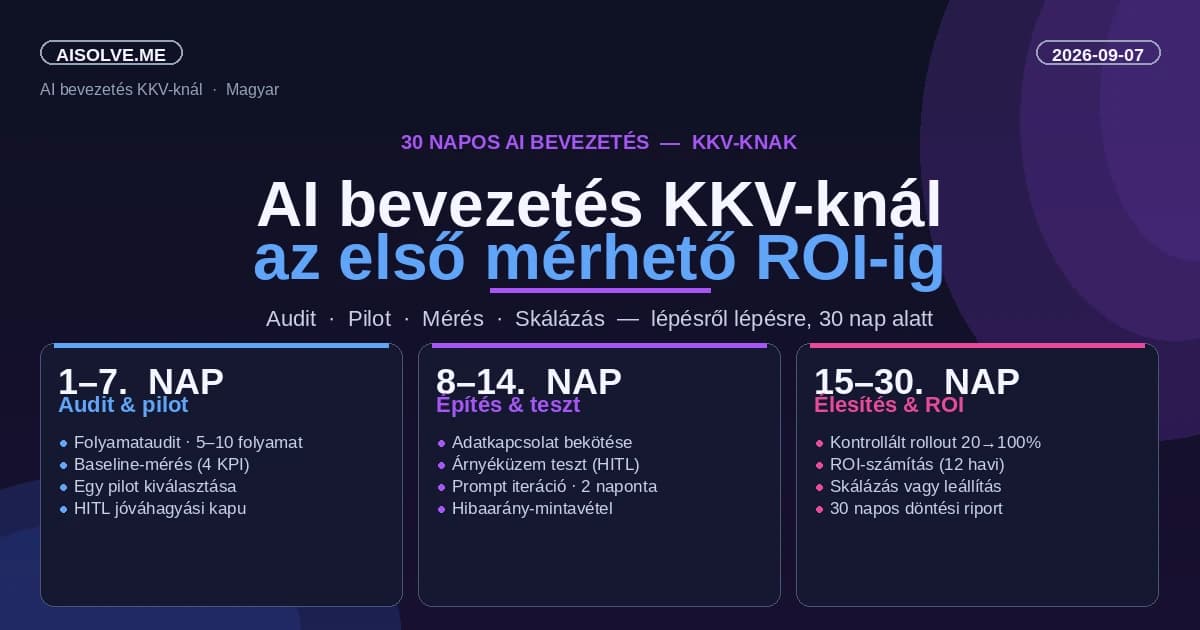
Don't try to automate the whole company at once. Choose the most critical 1-2 processes (e.g., incoming email triage or a FAQ chatbot), execute a 14-day deployment, and use the results achieved there to convince decision-makers to move forward.
Step 4: Data Security and Ethics
Data is a company's most important asset. The AI strategy must include GDPR compliance and confidential handling of data. With us, data is never included in the training of public AI models.
Step 5: Implementation, Testing, and Scaling
In the final phase, the AI agent is integrated into existing workflows. This is not only a technical transition but also a cultural one: employees must be taught how to collaborate with AI.
Frequently Asked Questions
How to build an AI strategy?
Audit processes, set KPIs, choose technology, launch a pilot, then measure and scale results.
When should an SME invest in AI?
When repetitive tasks hinder growth or customer service is too slow.
What is the difference between a chatbot and an AI agent?
A chatbot follows static rules, while an AI agent dynamically understands context and corporate data.
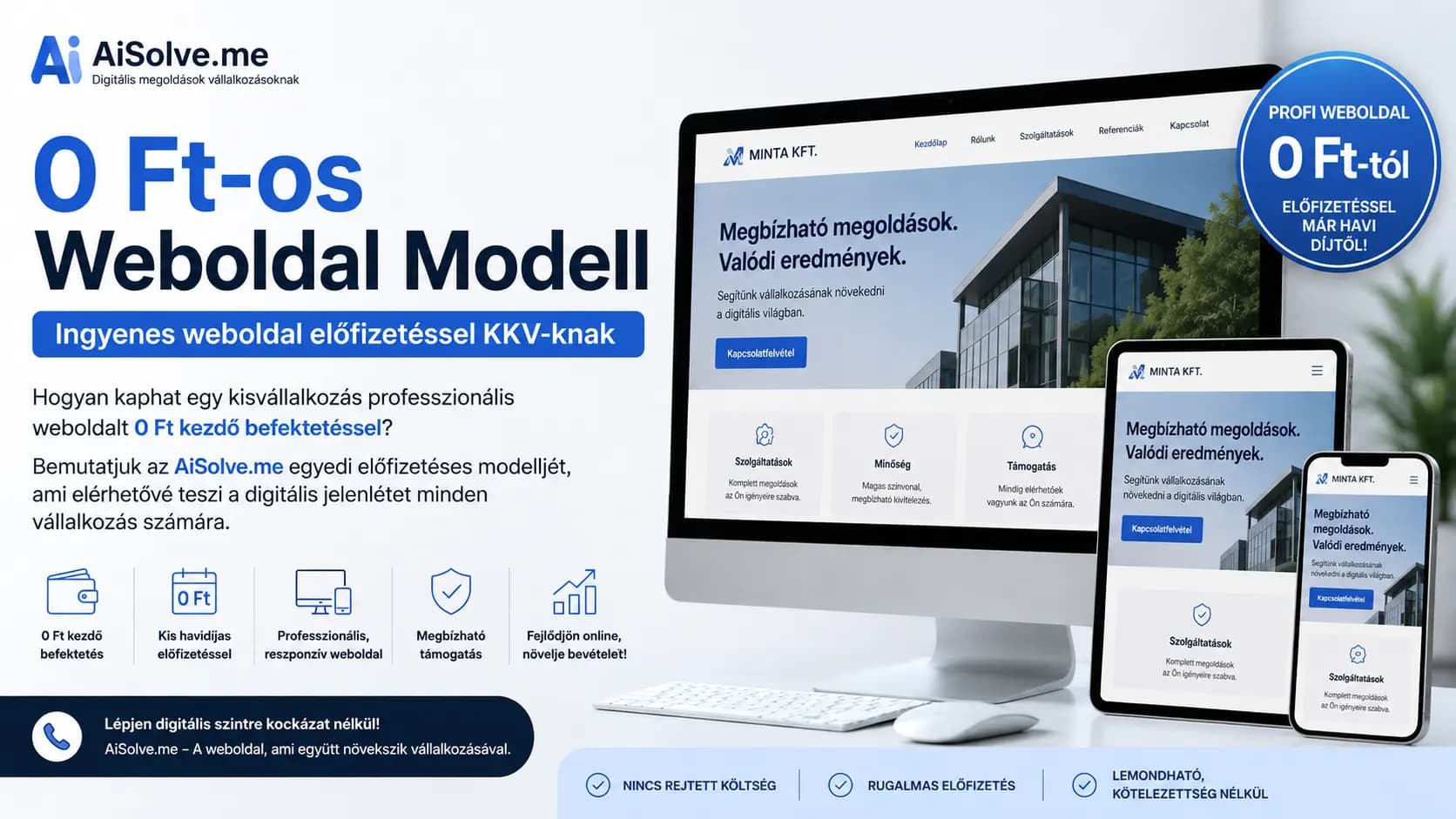
Készen állsz a saját weboldaladra?
Ingyenes konzultáció során átbeszéljük, hogyan segíthetünk vállalkozásodnak növekedni egy modern, gyors és konverzióoptimalizált weboldallal. 14 nap alatt kész, 0 Ft induló költséggel.