

Tartalomjegyzék / Table of Contents
- The Paradigm Shift: From General Models to Specialized Agents
- Industry Spotlight: Healthcare and Fashion Lead the Charge
- The Developer's New Ally: Augmenting Expertise, Not Replacing It
- The Cost vs. Performance Equation: Why Enterprise AI Isn't Free
- Building Your Custom AI Agent: A Strategic Framework
- Risks and Governance: Taming the Specialized AI
| Key Takeaway | Business Implication |
|---|---|
| Shift to Specialization | The market is moving from general-purpose AI to fine-tuned AI agents that solve specific industry problems. |
| Value Creation > Cost Cutting | Successful implementations, like at PVH, focus on increasing efficiency and creating new capabilities, not just trimming expenses. |
| Augmenting Human Expertise | Specialized AI tools, especially in development, are enhancing the productivity of senior experts rather than replacing them. |
| Industry Compliance is Key | The healthcare platforms from OpenAI and Anthropic show that success in regulated industries hinges on compliance and data integrity. |
| Custom Automation is the Future | Instead of off-the-shelf solutions, true competitive advantage comes from bespoke, deeply integrated custom automation solutions. |
Following the initial explosion of AI, led by general-purpose language models like ChatGPT, the corporate world is entering a new, more sophisticated era. The latest industry news—from OpenAI and Anthropic's healthcare platforms to fashion giant PVH's AI strategy and Ai2's open-source coding agents—paints a clear trend: the future belongs not to all-knowing AIs, but to specialized AI agents perfected for specific tasks. While Gartner's forecasts urge caution about AI's general cost-cutting impact, the reality is that targeted, custom automation solutions are not about trimming costs, but about creating unprecedented value. This article explores how these specialized agents are transforming industries and how a company can build its own custom AI capabilities for a true competitive edge.
The Paradigm Shift: From General Models to Specialized Agents
In recent years, the tech discourse has been dominated by general-purpose large language models (LLMs). These models possess impressive abilities in text generation, translation, and general question-answering. However, in a corporate environment where accuracy, reliability, and contextual understanding are critical, their limitations quickly become apparent. A general model doesn't know a company's internal processes, doesn't comply with strict industry regulations (e.g., GDPR, HIPAA), and may be prone to generating inaccurate or irrelevant information, which is unacceptable in a business context. This is where specialized AI agents come in. These are not just basic LLMs; they are systems fine-tuned on specific datasets and augmented with Retrieval-Augmented Generation (RAG) technology. RAG allows the model to access a company's own up-to-date knowledge base in real-time—be it product specifications, internal policies, or customer databases—ensuring its responses are always accurate and relevant. Ai2's latest family of open-source coding agents is a prime example of this trend. They aren't releasing a single monolithic model, but a toolkit that enables companies to create specialized code-generating and analysis assistants tailored to their specific needs and budget.
The Technical Foundations of Specialization
Specialization rests on three main pillars. The first is Fine-Tuning, where a pre-existing base model is further trained on a narrower, industry-specific dataset. This allows the model to learn the jargon, context, and logic of that particular domain. The second is the aforementioned RAG, which provides dynamic knowledge base access, overcoming the limitations of the model's static knowledge. The third is Process Integration, where the AI agent is deeply embedded into existing corporate software (CRM, ERP, etc.) via APIs. This deep integration is what enables true, custom automation solutions, where the agent not only provides information but actively executes tasks within the company's systems.
Industry Spotlight: Healthcare and Fashion Lead the Charge
The examples of two seemingly distant industries, healthcare and fashion, best illustrate the potential of specialized AI agents. OpenAI and Anthropic recently announced platforms specifically for healthcare use. These solutions go far beyond answering general medical questions. They are capable of adhering to strict patient data privacy regulations (HIPAA compliance), integrating with hospital information systems, and assisting doctors with clinical documentation or analyzing the latest research findings. Here, specialization is not an option but a fundamental requirement for operation; a general model's error could have severe consequences. The goal is not to replace the doctor, but to provide an intelligent assistant that takes administrative burdens off their shoulders, allowing them to focus on the patient.
On the other side, PVH Corp., the parent company of Calvin Klein and Tommy Hilfiger, is applying specialization in the fashion industry by adopting ChatGPT Enterprise. In their case, AI agents help designers gather inspiration, analyze global trends, optimize supply chain processes, and create more personalized customer experiences. A fashion-specific AI understands color theory, material science, and the subtle nuances of seasonal trends in a context that a general model never could. This kind of targeted approach proves that the key to effective custom automation solutions is the combination of deep industry knowledge and technology.

The Developer's New Ally: Augmenting Expertise, Not Replacing It
One of the most common fears surrounding artificial intelligence is job loss. However, recent research, such as the analysis from Corvinus University and the Complexity Science Hub, shows the exact opposite, especially in highly skilled professions. According to their findings, although AI now writes nearly a third of Python code, it is senior developers who benefit the most. Why? Because specialized coding agents don't create independently; they function as tools for expert developers. They take repetitive, routine tasks off their shoulders (writing boilerplate code, generating test cases, creating documentation), allowing developers to focus on complex problem-solving and architectural design.
This symbiosis fits perfectly with the philosophy of custom automation solutions: the goal is not to eliminate the human factor but to amplify it. A senior developer with a specialized AI assistant can work much faster and more efficiently, producing higher-quality code. The AI does the "grunt work," while the developer handles the strategic and creative tasks. This model is applicable not just in software development but in almost every knowledge-based role, from data analysts to marketers.
Strategic Insight: Instead of viewing AI as a replacement for the existing workforce, companies should focus on areas where AI can extend the capabilities of their most valuable employees, freeing them up for higher-value tasks.
Moreover, the effectiveness of these AI-based developer tools and internal systems heavily depends on the user interface. Complex AI capabilities are worthless if developers or business users cannot use them easily and intuitively. Therefore, an essential part of successful AI projects is professional professional website creation and application development, which provides a clear, responsive, and efficient interface to the AI engine.
The Cost vs. Performance Equation: Why Enterprise AI Isn't Free
Gartner's much-cited forecast suggests that implementing AI in customer service may not necessarily lead to cost savings and could even increase the cost per interaction. This statement might seem contradictory at first, but it perfectly highlights the difference between general-purpose and specialized AI. If a company simply implements a generic chatbot without deeply integrating it into its processes and providing it with specific knowledge, the result is a frustrated customer and an escalated problem that ultimately has to be solved by a more expensive human operator. In this scenario, Gartner is absolutely right: poorly implemented AI is just another cost center.
However, the approach of custom automation solutions is different. A specialized customer service AI agent that can access the company's CRM system, knows the entire product range, and has records of past customer interactions can resolve 80-90% of simpler inquiries independently, quickly, and accurately. This leaves only the most complex, empathy-requiring cases for human colleagues. Here, the goal is not direct cost reduction but increasing efficiency, improving customer satisfaction, and reallocating human resources to value-creating tasks. Ai2's model, which emphasizes the balance between cost and performance, is key. Companies should not choose the cheapest solution, but the most cost-effective one for the given task. The initial investment in a well-designed, specialized agent may be higher, but its long-term return on investment (ROI) far surpasses that of cheap but low-efficiency alternatives.
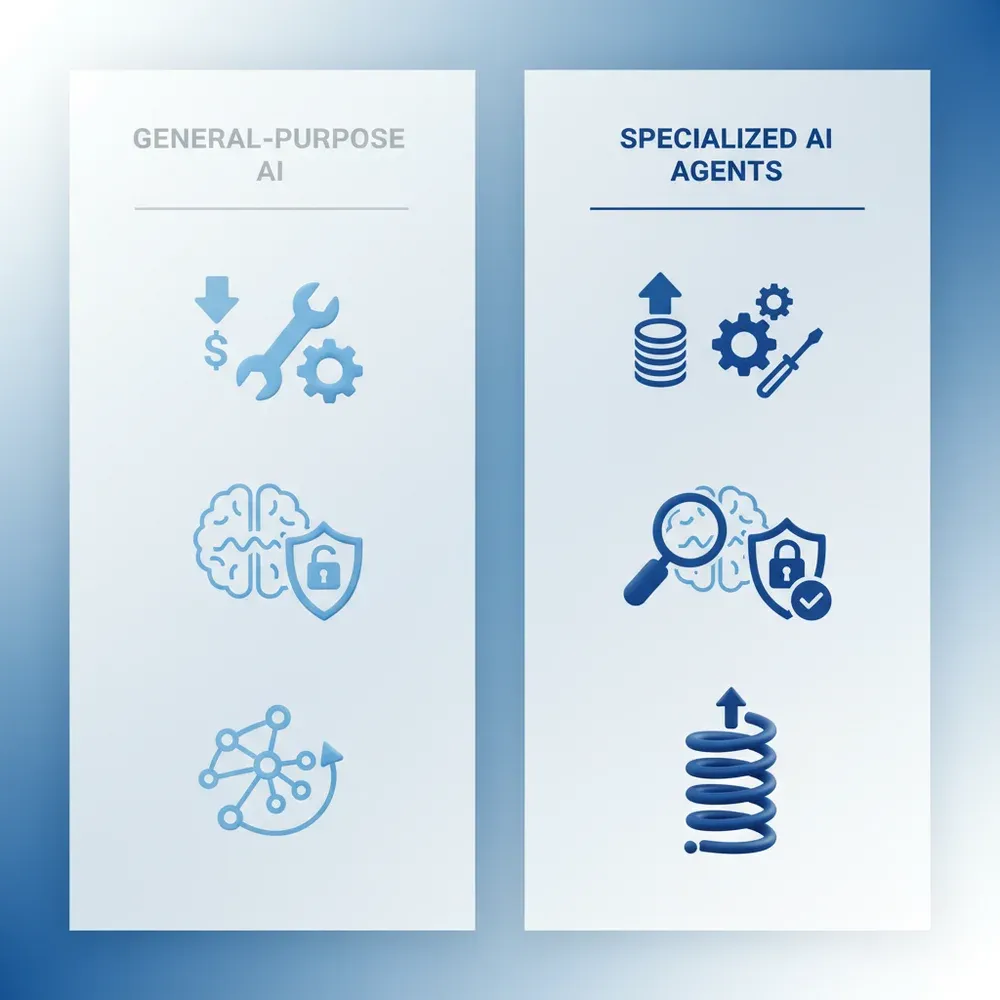
| Metric | General-Purpose AI | Specialized AI Agent |
|---|---|---|
| Domain-Specific Accuracy | Moderate | Very High |
| Implementation Cost | Low (initial) | Higher (development, integration) |
| Long-Term ROI | Low or Negative | High |
| Security & Compliance | Standard | Enterprise-grade, aligned with industry standards |
| Integration Depth | Shallow (e.g., API call) | Deep (two-way communication with internal systems) |
Building Your Custom AI Agent: A Strategic Framework
Realizing the need for a specialized solution is only the first step. Creating a successful enterprise AI agent requires deliberate strategic planning. The process begins not with technology, but with a precise definition of the business problem. Which process is the most time-consuming? Where are the most repetitive tasks? Where can the greatest efficiency gains be achieved? The answers will guide the development. The process for custom automation solutions consists of the following steps:
- Problem Definition and Goal Setting: Clearly define which business metric (KPI) you want to improve with the AI agent (e.g., reducing first response time, minimizing manual data entry, etc.).
- Data Strategy and Knowledge Base: Identify and collect the internal data (documents, databases, emails) that will form the basis of the agent's knowledge. The quality and structure of this data are crucial.
- Model Selection and Technology Stack: Choose the appropriate base model (it could be open-source, like Ai2's solutions, or commercial, like OpenAI's models) and the tools needed for RAG implementation.
- Integration and Process Automation: Plan how the agent will communicate with existing enterprise systems (APIs, database connections). Define the specific actions it can perform.
- User Interface and Experience (UI/UX): This is a critical, often neglected step. The most powerful AI is useless with a poorly designed interface. Professional professional website creation and application design ensure that users—whether internal employees or external customers—can interact with the AI agent easily and effectively.
- Testing, Feedback, and Iteration: Implementing an AI agent is not a one-time project. Its performance must be continuously monitored, user feedback collected, and its operation refined to achieve maximum business value.
Implementation Advice: Start with a well-defined, smaller pilot project. Select a single, high-impact process and build a minimum viable product (MVP) AI agent around it. Use the experience and data gained from the pilot's success to plan a broader rollout.
Risks and Governance: Taming the Specialized AI
Specialized AI agents hold immense potential, but their implementation is not without risks. Companies must proactively manage these challenges to ensure successful and secure operation. The most important risk areas are data security and privacy. When an AI model has access to a company's most sensitive data, it is essential to apply the highest level of security protocols. This includes data encryption, strict access controls, and full compliance with industry regulations (e.g., GDPR).
Another significant risk is model "hallucination" or inaccuracy. Although specialization and RAG significantly reduce this danger, no AI is infallible. Clear verification mechanisms and "human-in-the-loop" processes must be established, where critically important decisions or responses are approved by a human expert. Finally, there is the danger of over-reliance. Companies must ensure that business operations do not halt if the AI agent is temporarily unavailable. This requires developing appropriate redundancy and emergency protocols. A robust governance framework that clearly defines the rules, responsibilities, and ethical guidelines for AI use is essential for long-term, sustainable success.
Are you ready to gain a real competitive advantage instead of relying on off-the-shelf solutions? The future belongs to customized, deeply integrated AI solutions. With custom automation solutions, you can unlock the full potential of artificial intelligence.
Request a Consultation on Custom Automation Solutions[Article generated by AiSolve AI Content System]
Frequently Asked Questions
What's the main difference between a general AI (like ChatGPT) and a specialized AI agent?
A general AI has broad knowledge but lacks deep, contextual business understanding. A specialized AI agent is trained on a company's own data and processes using fine-tuning and RAG technology, allowing it to provide accurate, relevant, and reliable answers within a specific domain.
Will AI really not reduce customer service costs?
A poorly implemented, generic AI can indeed increase costs. However, a well-designed, specialized agent unburdens human operators by automating simpler tasks, increasing efficiency, and improving the customer experience, which results in a significant long-term return, even if the initial investment is higher.
How do I start developing a custom AI agent?
The first step isn't technology, but defining the precise business problem. Select a specific, high-impact process you want to automate. This is followed by data collection, choosing the right technology, and launching a pilot project to validate the concept.
Do specialized AI agents threaten developer jobs?
Current data suggests the opposite. Specialized AI tools, like coding assistants, enhance the efficiency of senior developers by taking over routine tasks. This allows experts to focus on more complex, higher-value problem-solving.
Készen állsz a saját weboldaladra?
Ingyenes konzultáció során átbeszéljük, hogyan segíthetünk vállalkozásodnak növekedni egy modern, gyors és konverzióoptimalizált weboldallal. 14 nap alatt kész, 0 Ft induló költséggel.