
For decades, enterprise automation has been synonymous with increasing efficiency, but a fundamental limitation has always defined its boundaries: specialization. Traditional Robotic Process Automation (RPA) and scripted bots are incredibly effective at performing a single, well-defined task, but they are incapable of adapting to new, unseen environments or instructions. According to recent research, over 40% of companies cite inflexibility and high maintenance costs as the biggest obstacles in their automation projects. This rigidity prevents the creation of a truly dynamic digital workforce. However, Google DeepMind's latest announcement, SIMA 2 (Scalable Instructable Multiworld Agent), heralds a new era where artificial intelligence not only executes but also generalizes, learns, and adapts—just like human employees. This article provides an in-depth analysis of how SIMA 2 technology could revolutionize enterprise processes and how custom automation solutions will become an indispensable element of future business strategy. What's at stake is nothing less than the complete redefinition of operational efficiency.
| Terület / Area | Kulcsfontosságú Megállapítás / Key Insight |
|---|---|
| Technological Foundation | SIMA 2 is a generalist AI agent based on a Gemini Flash-Lite model, capable of understanding and executing human instructions across various virtual environments (games, simulations). |
| Core Capability | The agent's main innovation is 'multi-world generalization,' the ability to apply what it has learned in one environment to a completely new, unseen one. |
| Business Significance | SIMA 2 is a precursor to a digital workforce that can handle complex, multi-software tasks, revolutionizing data entry, testing, and customer service. |
| Management Needs | Effectively managing and monitoring such advanced AI agents requires professional, custom-developed web interfaces and dashboards. |
| Strategic Goal | Companies must start preparing now to adopt generalist AIs, which involves modernizing data infrastructure and developing a custom automation strategy. |
What is SIMA 2? The Dawn of the Generalist Agent Era
SIMA 2, which stands for Scalable Instructable Multiworld Agent, represents a fundamental paradigm shift in artificial intelligence. It hasn't been trained for a specific task, like playing chess or operating a particular piece of software. Instead, SIMA 2 is a 'generalist' agent, designed to operate in a wide variety of even completely unfamiliar 3D virtual environments based solely on natural language instructions. Imagine a digital assistant that doesn't need every single step programmed in advance. You simply tell it, 'find the resources and build a shelter' in a survival game, and the agent—without prior game-specific training—can understand and execute the task.
This capability is radically different from traditional automation tools. While an RPA bot follows strict, predefined rules within a single, known application (e.g., 'click the top-left button, copy the value from the third field'), SIMA 2 understands the underlying intent. During their research, the DeepMind team tested the agent on several commercially available video games (such as No Man's Sky), proving its ability to adapt to different visual styles, physics, and game mechanics. This type of flexibility paves the way for truly intelligent, platform-independent data processing AI agents and other enterprise solutions.
Strategic Insight: Start mapping out your company's processes that require the use of multiple software applications with different interfaces. These complex workflows will be the primary targets for generalist agents like SIMA 2.
A Deep Dive into the Technology: Gemini Flash-Lite and Self-Improving Mechanisms
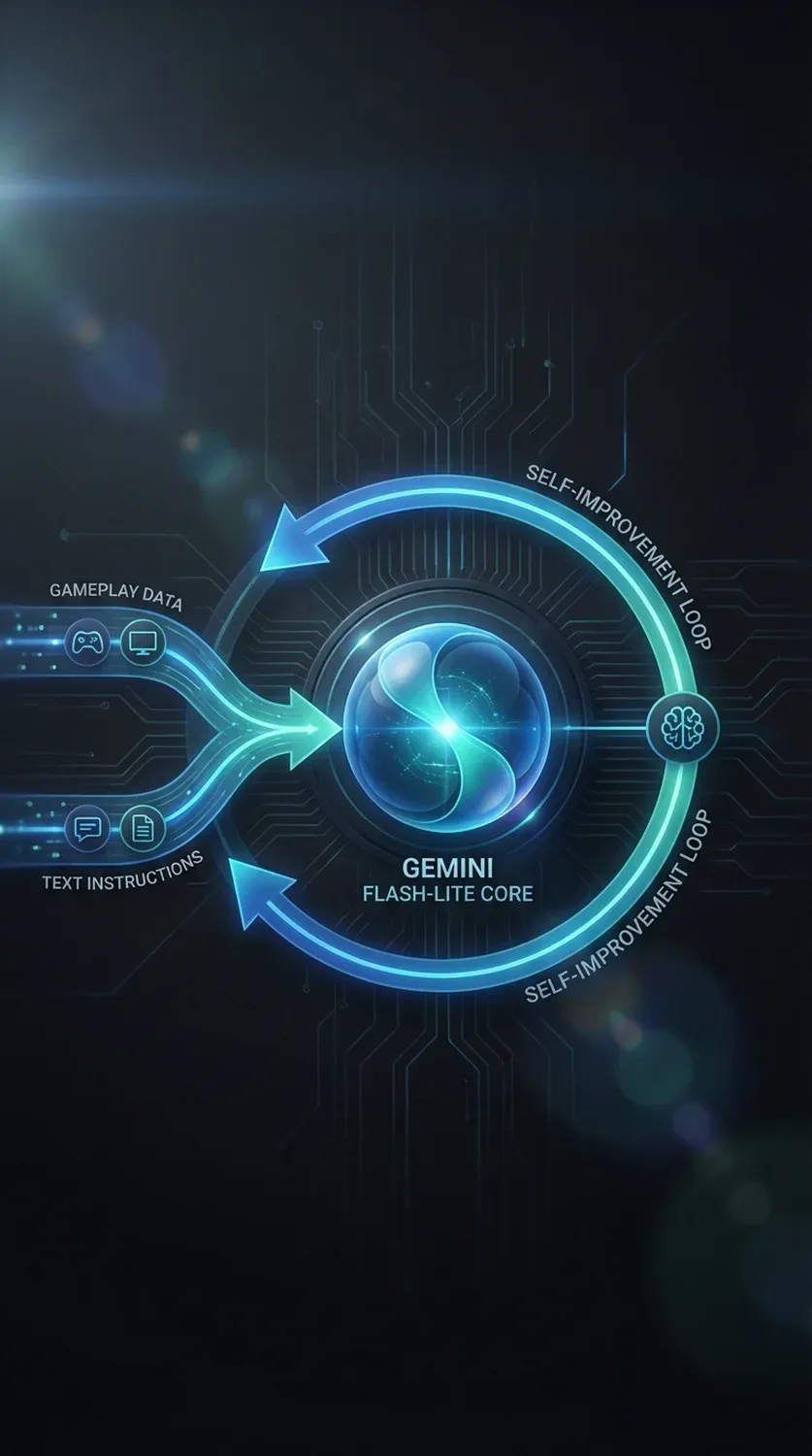
The engine behind SIMA 2's impressive abilities is the Gemini Flash-Lite model, an efficiency-optimized member of Google's Gemini family. This language model is responsible for jointly interpreting natural language instructions ('find the nearest mountain') and visual inputs (the pixels on the game screen). The system doesn't just translate words; it links them to the visual context to form an action plan. A key element of the architecture is that the model was trained on a mixed dataset: on one hand, it contains the general language and reasoning knowledge from Gemini, and on the other, specific data derived from gameplay.
However, the real breakthrough is SIMA 2's self-improving capability. The model is not static; it continuously learns from its own interactions. When it successfully completes a task in a new environment, the resulting data is fed back into its own training set. This creates a positive feedback loop (a self-improvement loop), making the agent progressively more skilled and efficient over time without developers needing to manually program every new skill. This mechanism is what makes SIMA 2 a scalable solution that can keep pace with ever-changing digital environments. Such self-learning systems represent the next step in the evolution of custom automation solutions, reducing maintenance needs and increasing autonomy.
Generalization Across Worlds: From Virtual Spaces to Real Business Processes
SIMA 2's most significant scientific contribution is 'multi-world generalization.' What does this mean in practice? Most AI models, if they learn to do something in one environment (e.g., drive in a racing game), have to start learning from scratch in another (e.g., a truck simulator). In contrast, SIMA 2 can learn abstract concepts like 'navigate,' 'collect,' or 'use,' and transfer these concepts to a world with a completely different visual and physical rule set. DeepMind researchers showed that an agent trained on multiple different games performed significantly better in a brand new, unseen game than one trained on only a single game.
Translated to the world of enterprise software, this capability is revolutionary. In a typical company today, an average employee might use 5-10 different software applications daily: a CRM system, an ERP, a communication platform, a project management tool, and several browser-based apps. Each has a different interface and logic. Generalist agents like SIMA 2 will be able to learn how to transfer customer data from the CRM to the ERP, then create an invoice in a third system, without needing to be trained pixel-perfectly for each interface. This level of flexibility is the foundation of true, end-to-end custom automation solutions, far exceeding the limitations of today's technology.
Implementation Advice: Start documenting your current manual, multi-software processes immediately. A detailed understanding of the process steps and decision points will be crucial when you delegate these tasks to a generalist AI agent.
The Revolution in Business Applications: Where Does SIMA 2 Change Everything?
Although SIMA 2 is still in the research phase and proving its capabilities in 3D games, the potential business applications of the underlying technology are immense. Virtual worlds are essentially complex, rule-based software environments—not so different from a modern enterprise software suite. Let's look at a few specific areas where generalist agents could bring about radical change:
1. Complex Data Entry and Migration
Instead of building expensive and fragile API integrations, a SIMA 2-like agent could simply be instructed to 'Take the new customer data from Salesforce, create their profile in SAP, and then send a welcome message on Slack.' The agent would visually interpret the interfaces and perform the task like a human would.
2. Software Testing and Quality Assurance
Manual software testing is repetitive and time-consuming. A generalist agent, given natural language instructions like 'Test the checkout process with a new user and try to use an invalid coupon code,' could execute complex test cases that simulate user behavior much more realistically than rigid test scripts.
3. Customer Service Process Automation
When a customer service representative has to solve a complex problem, they often need to use multiple internal systems at once. An AI agent could act as an assistant, handling these systems in the background based on the human operator's instructions ('Look up this customer's last three orders and initiate a refund for the most recent one'). This kind of collaboration combines human empathy with machine efficiency and is an ideal foundation for a RAG AI chatbot solution.
These examples are just the tip of the iceberg. The true value lies in creating a flexible, digital workforce that can be trained on a company's unique processes, all without expensive, months-long development projects. This agility will be the key to competitiveness in the future.
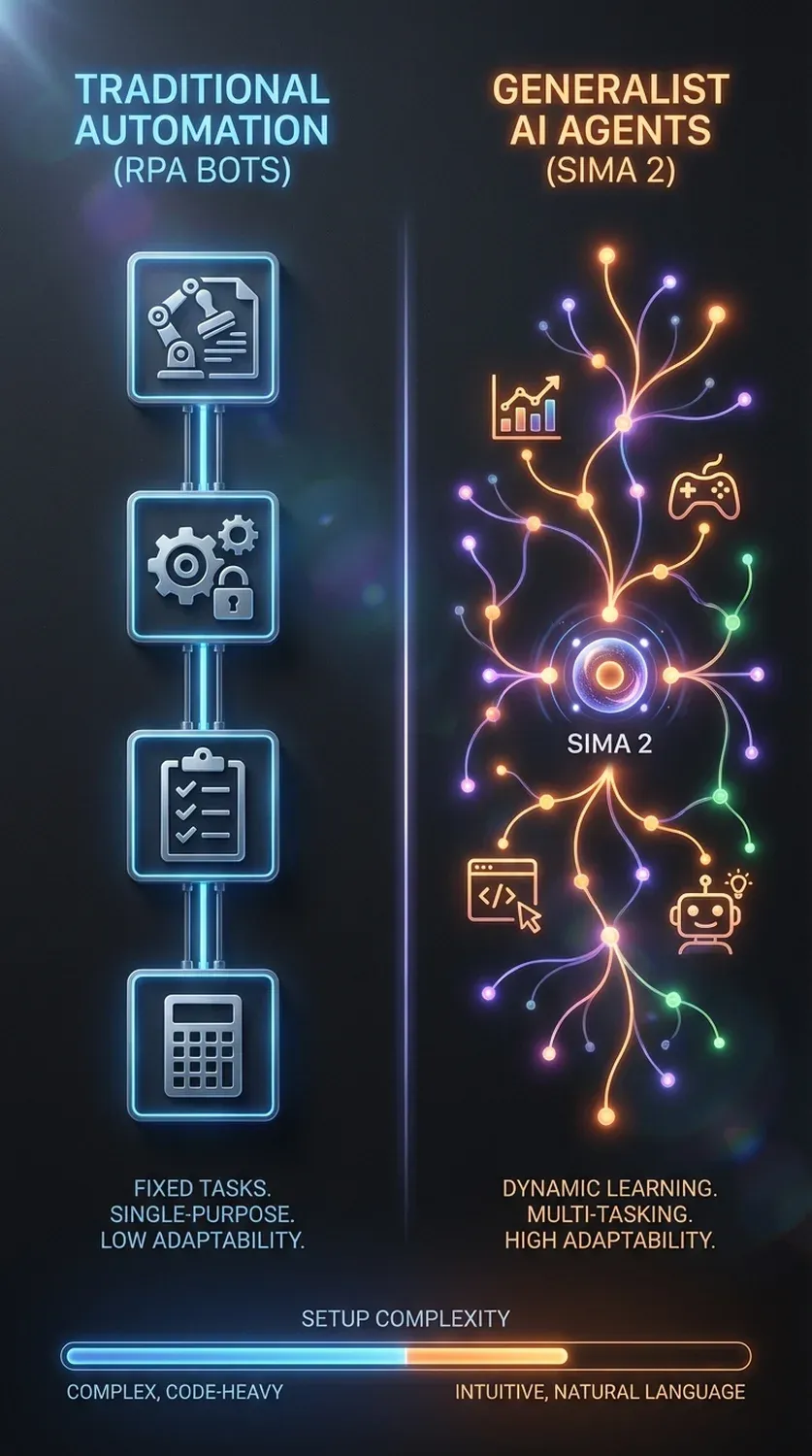
| Capability / Feature | Traditional Automation (RPA) | Generalist AI Agent (SIMA 2) |
|---|---|---|
| Adaptability | Low. Strictly rule-based; the smallest UI change can cause errors. | High. Capable of adapting to new, unseen interfaces and environments. |
| Learning | None. Processes must be manually programmed and updated. | Continuous. Learns from its own experiences through self-improvement mechanisms. |
| Task Execution | Optimized for a single, specific task. | Multi-tasking, capable of handling complex workflows across multiple applications. |
| Interaction | Programmed scripts. | Natural language instructions. |
| Implementation Complexity | High initial setup and maintenance costs. | Potentially lower, as it requires less specific programming. |
Dashboards and Management: The Role of Professional Website Creation in the AI Era
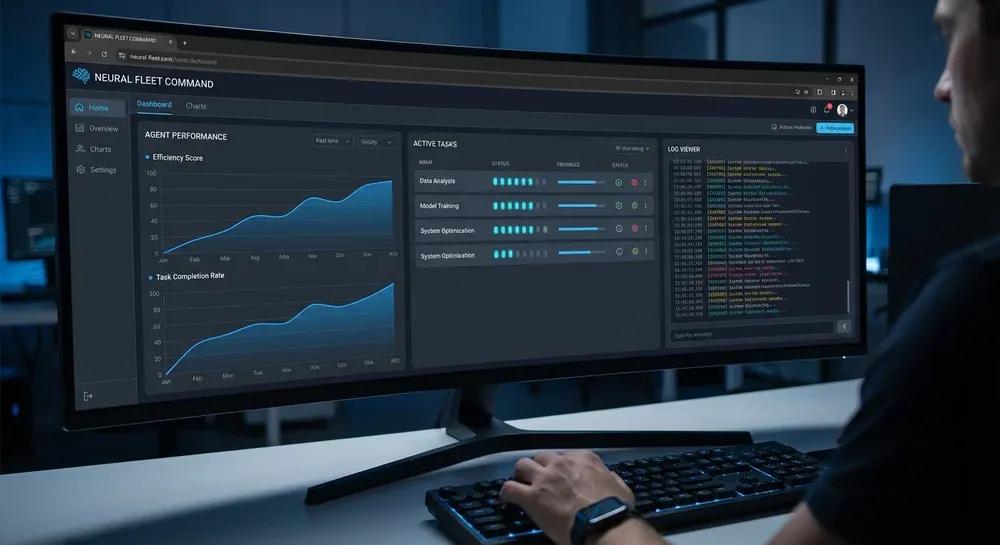
A technology as autonomous and powerful as a generalist AI agent cannot operate without supervision. As companies deploy more of these digital workers, the question of effective management, monitoring, and governance becomes critical. How do we assign tasks? How do we track their performance? How do we intervene if something goes wrong? The answer is not a simple command-line tool, but a complex, user-friendly web interface.
This is where professional website creation comes into play, which in this context, goes far beyond creating a marketing website. We are talking about a custom-developed web application, an internal management portal that functions as the central dashboard for AI agents. Through such a system, managers would be able to:
- Assign Tasks: Assign new tasks and projects to available agents using natural language or structured forms.
- Monitor Performance: Display real-time analytics and Key Performance Indicators (KPIs), such as the number of completed tasks, average execution time, or error rate.
- Logs and Auditing: Analyze detailed logs of every action taken by the agents for debugging and compliance purposes.
- Access Control: Set up fine-grained access levels to control who can assign which types of tasks to which agents.
Creating such a complex management system requires significant expertise in UI/UX design, secure backend development, and data visualization. Therefore, effective website creation is not just a support function but a fundamental prerequisite for implementing AI-based custom automation solutions. It ensures human oversight and control over highly autonomous systems.
Risks and Challenges: The Downsides of Implementing Generalist AI
While the potential of SIMA 2 is exciting, it would be irresponsible not to discuss the risks and challenges associated with its implementation. A generalist agent capable of acting autonomously across multiple systems raises serious security and ethical questions. Companies must proactively address these issues before widely adopting the technology.
1. Security Risks
If such an agent is compromised, attackers could gain access to all of the company's integrated systems. Precise management of the permissions granted to agents and continuous monitoring of their actions are essential. The Principle of Least Privilege must be strictly applied.
2. Reliability and Unpredictability
The behavior of a self-learning system is not always 100% predictable. An agent might 'hallucinate,' misinterpreting an instruction and performing an unexpected, potentially harmful action. Robust validation and human approval steps must be built into critical processes.
3. Data Privacy and GDPR
During their operation, agents process a vast amount of data, including potentially sensitive personal information. It must be ensured that the entire process complies with GDPR and other data protection regulations, with special attention to the handling of training data.
Pro Tip: Establish an internal AI ethics and security committee tasked with evaluating the risks of new automation solutions and developing an internal policy for the responsible use of AI agents.
A Strategic Guide to Implementation: How Your Business Can Prepare
The era of generalist AI agents is just beginning, but it's never too early to start preparing. Companies that take the foundational strategic steps now will gain a significant competitive advantage in the next 3-5 years. Here is a four-step guide to preparation:
- Audit and Prioritize Processes: Map your current business processes, paying special attention to those that are repetitive, involve multiple systems, and require human judgment. Identify 'high-value, high-complexity' workflows where a generalist agent could have the greatest impact.
- Data Strategy and Infrastructure: AI agents learn from data. Ensure your data is clean, structured, and accessible. Invest in a modern data infrastructure capable of serving the needs of future AI models. This step is fundamental to the success of any future data processing AI agent project.
- Launch Pilot Projects: Don't wait for the perfect technology. Start experimenting with the automation and AI tools available today. Build a small, internal custom automation solution for a well-defined problem. The experience your team gains in the process will be invaluable.
- Develop Expertise and Partnerships: Train your internal team in AI and automation. Identify missing competencies and seek external partners who have the necessary experience in implementing complex AI systems, including specialized solutions like AI phone customer service.
SIMA 2 and similar technologies are not just another piece of software; they enable a completely new operating model. Preparing for them is an investment in the future.
Google's SIMA 2 clearly signals the future: an era of flexible, intelligent, and multi-system automation. Don't wait for your competitors to build this capability. Take the first step today to modernize your company's processes with our help.
Request a Consultation on Your Custom Automation Strategy[Article generated by AiSolve AI Content System]
Frequently Asked Questions
What is the main difference between SIMA 2 and traditional RPA bots?
The main difference is the ability to generalize. While an RPA bot follows rigid, pre-programmed rules in a single, known environment, SIMA 2 can understand natural language instructions and execute them in completely new, unseen environments. RPA executes, whereas SIMA 2 understands and adapts.
How soon can we expect technologies like SIMA 2 to be adopted in business?
Although SIMA 2 is currently a research project, the underlying technology (advanced language models, multimodal understanding) is evolving rapidly. The first commercial solutions in niche areas like software testing or data migration could appear within 2-3 years. Widespread adoption of agents handling complex enterprise processes is expected in the next 5-7 years.
Will programming skills be necessary to manage these AI agents?
For day-to-day management and task assignment, likely not, as it will be done through natural language. However, deep technical expertise will still be required for system setup, security framework design, integrations, and creating the management dashboards. Alongside 'prompt engineering,' software development skills will remain crucial.
How can you ensure an AI agent like this doesn't make critical mistakes?
Achieving 100% error-free operation is an unrealistic goal. The key to risk management is multi-layered defense. This includes strict access control (the agent can only access what is absolutely necessary), human approval points for critical operations, continuous anomaly detection, and detailed audit logging. The goal is not to eliminate errors entirely, but to minimize their impact.
Készen állsz a saját weboldaladra?
Ingyenes konzultáció során átbeszéljük, hogyan segíthetünk vállalkozásodnak növekedni egy modern, gyors és konverzióoptimalizált weboldallal. 14 nap alatt kész, 0 Ft induló költséggel.