Modern enterprises accumulate vast amounts of internal data, but effectively leveraging this information often presents a challenge. While traditional Large Language Models (LLMs) are impressive, they frequently "hallucinate" or provide outdated information. This is where the RAG AI chatbot comes in, a revolutionary approach that connects the generative power of LLMs with real-time, specific data to provide accurate, reliable, and context-rich answers.
Why RAG is Essential for Modern AI Chatbots
Standard LLMs like GPT-4 are trained on a static, massive dataset. This means their knowledge is "frozen" at a specific point in time and they cannot access private, corporate documents or the latest internet information. This leads to two major problems in an enterprise setting: inaccurate or fabricated responses (hallucinations) and outdated knowledge. Retrieval-Augmented Generation (RAG) technology bridges this gap by enabling the chatbot to retrieve relevant information from an external knowledge base before generating a response. This ensures that answers are always up-to-date and grounded in the company's own data.
Definition: Retrieval-Augmented Generation (RAG)
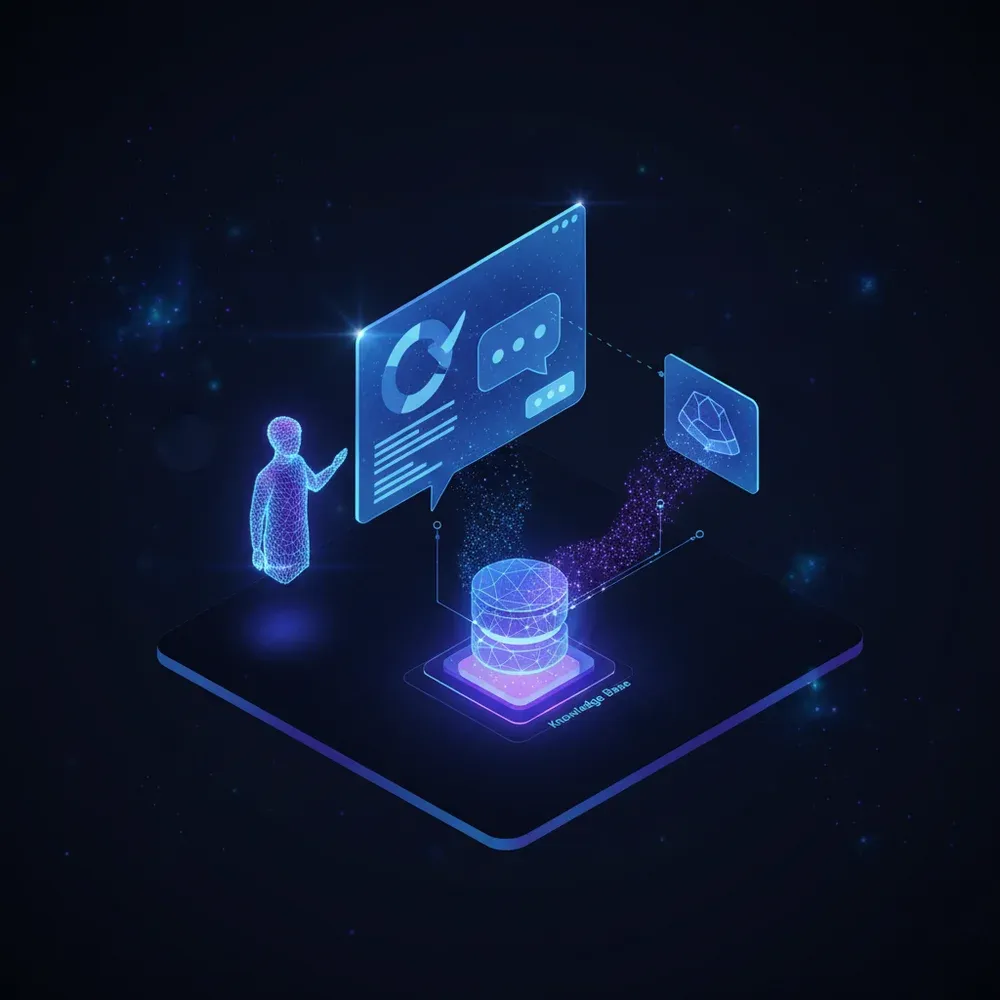
RAG is an AI architecture that combines an information retrieval component with a generative large language model (LLM). Instead of relying solely on its pre-trained knowledge, the model first searches for relevant documents in an external data source (e.g., a vector database) and then uses this context to generate an accurate and relevant answer.
Deep Dive into RAG Architecture: How It Works
A RAG system consists of two main phases: indexing and retrieval-generation. During the indexing phase, corporate documents (PDFs, websites, databases) are broken down into smaller, manageable chunks. An embedding model then converts these chunks into numerical representations called vectors. These vectors are stored in a specialized vector database, which allows for fast, semantic searching.
When a user asks a question, the process unfolds as follows:
- Query Embedding: The user's question is converted into a vector by the same embedding model.
- Semantic Search: The system compares the question vector to the document vectors in the database to find the most relevant pieces of information.
- Context Augmentation: The retrieved relevant text snippets (context) are inserted into the prompt for the LLM, alongside the original question.
- Response Generation: The LLM receives the augmented prompt and generates a precise, factual answer based on the provided context, rather than relying on its own general knowledge. Learn more about the effective data processing strategies essential for RAG systems.
Key Benefits of RAG for Enterprise AI
Implementing RAG offers numerous tangible benefits for businesses. It not only improves the quality of responses but also enhances operational efficiency and user trust. The table below summarizes the key advantages.
| Benefit | Description | Business Impact |
|---|---|---|
| Reduced Hallucinations | Responses are grounded in provided documents, minimizing false information. | Higher reliability and user trust. |
| Up-to-Date Knowledge | The knowledge base can be updated in real-time without retraining the model. | Decisions are always based on the latest data. |
| Cost-Effectiveness | Eliminates the need for expensive and time-consuming fine-tuning processes. | Lower development and maintenance costs. |
| Data Security | Internal data remains within the corporate infrastructure, not fed into public LLMs. | Protects sensitive corporate information. |
Pro Tip
Combine your RAG system with a solid knowledge management strategy. Clean, well-tagged, and regularly maintained data sources dramatically improve retrieval accuracy and the chatbot's overall performance. Explore our RAG AI chatbot solution to help maximize the value of your enterprise knowledge.
Implementing RAG AI Chatbots: Best Practices and Challenges
Deploying an effective RAG AI chatbot requires careful planning. The key to success lies in the details, from data preparation to model selection. Key best practices include choosing the right chunking strategy to balance context depth with processing efficiency. Additionally, selecting the appropriate embedding model and vector database to match your specific data and expected load is critical. Prompt engineering is also vital to ensure the LLM makes the best use of the provided context. Common challenges include minimizing latency and fine-tuning relevance tracking to ensure the system always finds the most accurate documents.
Performance Evaluation and Optimization in RAG Systems
Measuring the performance of a RAG system is a multi-dimensional task. It's not enough to just evaluate the quality of the generated responses. The retrieval component must be assessed with metrics like precision and recall to ensure the system is finding the right context. For the generative part, faithfulness—how well the response adheres to the source—and relevance are key. Comprehensive, end-to-end evaluation helps identify bottlenecks and areas for improvement, enabling iterative optimization of the system.
Case Study
A financial services company implemented a RAG-based internal chatbot to handle their complex compliance documentation. The system answered employee questions with 95% accuracy, reducing routine inquiries to the compliance department by 70%. The key to their success was continuous performance evaluation and fine-tuning based on feedback.
Security, Privacy, and Compliance in RAG Chatbots
In an enterprise setting, security and privacy are paramount. RAG systems allow for strict access control, ensuring users can only access information they are authorized to see. Data can be kept behind the corporate firewall, and techniques can be applied to anonymize personal data during processing. To comply with regulations like GDPR or HIPAA, it is essential to establish careful data governance policies and log interactions for transparency and accountability. AiSolve's automation services can help integrate secure and compliant AI solutions.
The Future of RAG: Hybrid Approaches and Advanced Retrieval Strategies
RAG technology is constantly evolving. The future is moving towards hybrid models that combine the flexibility of RAG with the deeper knowledge of fine-tuning. Advanced retrieval strategies, such as multi-modal RAG (which can handle images and text) and self-correcting systems (which learn from failed retrievals), will further increase accuracy. Agentic RAG systems will not only provide information but will also be able to perform tasks based on the retrieved knowledge, taking human-computer interaction to a new level. Just as the foundations were laid according to the original paper by Facebook AI Research, the pace of innovation is relentless.
Trend Alert
Keep an eye on the term "Agentic RAG." These systems will be able to solve complex, multi-step tasks by dynamically planning and executing the necessary information retrieval and processing steps. This is the next generation of automation.
Conclusion: RAG as a Strategic Advantage
In conclusion, Retrieval-Augmented Generation is not just a technical upgrade; it is a strategic tool that allows companies to transform their accumulated knowledge into real, tangible value. By implementing a RAG AI chatbot, organizations can create more accurate, reliable, and secure AI assistants that improve internal efficiency, boost customer satisfaction, and enable more informed decision-making. RAG is the key to unlocking the next level of enterprise AI.
Ready to unlock the full potential of your enterprise knowledge base with a RAG AI chatbot?
Request a ConsultationFrequently Asked Questions
What is the difference between RAG and fine-tuning for LLMs?
Fine-tuning involves modifying the weights of a pre-trained LLM on a specific dataset to make the model "learn" new knowledge. This is costly and time-consuming. In contrast, RAG does not modify the LLM itself but provides it with relevant context from an external source at runtime to generate an answer. RAG is more flexible and easier to update.
What types of data sources can be used with a RAG system?
Virtually any unstructured or semi-structured text-based data source can be used. This includes PDF documents, Word files, websites, Confluence or SharePoint pages, customer support tickets, emails, and even text fields from database records.
How does RAG help reduce hallucinations in AI chatbots?
RAG "grounds" the LLM in factual data. Because the model is instructed to answer based on the relevant context provided in the prompt, it is much less likely to invent or state incorrect information. The system is guided to rely on the facts found in the source documents.
What are the key considerations for ensuring the security of a RAG system?
The key considerations are: 1) Strict Access Control to ensure users only see data they are authorized to view. 2) Data encryption both at-rest and in-transit. 3) Anonymization or masking of personally identifiable information (PII). 4) Detailed logging and monitoring to detect suspicious activity.
Készen állsz a saját weboldaladra?
Ingyenes konzultáció során átbeszéljük, hogyan segíthetünk vállalkozásodnak növekedni egy modern, gyors és konverzióoptimalizált weboldallal. 14 nap alatt kész, 0 Ft induló költséggel.