
For millions of eyeglass wearers, the onset of presbyopia marks the beginning of a life of compromise: juggling bifocals, tilting heads to find the "sweet spot," and accepting a degraded visual experience. IXI's technological breakthrough is set to end this era. Unveiled in early 2026, their new model is not just a vision correction tool but a sophisticated feat of custom automation solutions that responds to physiological signals in real-time.
The industry has long struggled to make smart glasses viable for everyday wear. While tech giants like Apple and Meta chase virtual and augmented reality, IXI is solving a more human-centric problem: restoring natural vision. This development is a prime example of how custom automation solutions can step out of industrial settings to directly enhance our quality of life.
Key Takeaways
| Category | Details |
|---|---|
| Technology | Liquid crystal lenses combined with eye-tracking sensors. |
| Weight & Comfort | Only 32 grams, comparable to standard fashion frames. |
| Automation | Real-time custom automation solutions adjust focus based on gaze. |
| User Experience | Eliminates the distortion and head-tilting required by bifocals. |
The Eye-Tracking Revolution: How It Works
The heart of IXI's solution is a highly advanced sensor system that continuously monitors pupil movement and dilation. The system doesn't just detect where you are looking; it uses predictive algorithms to anticipate the intent to shift focus. This form of custom automation solutions allows the liquid crystal structure of the lenses to modify their refractive index in fractions of a second.
The technology relies on the "Oculenz" system, capable of manipulating light at the pixel level. practically, this means the glasses do not have a single fixed diopter but adapt dynamically to distance. When the user looks into the distance, the lens "flattens"; when reading, it shifts to the correct magnification. This process is imperceptible, eliminating the "swimming" sensation often caused by progressive lenses.
Technical Fact: IXI lenses use a pixel pitch smaller than 50 microns, bordering on the resolution limit of the human eye, ensuring the image remains sharp and natural.
Micro-Automation in Hardware
When we discuss automation, we often think of software bots or assembly lines. However, IXI's glasses highlight the importance of embedded or micro-level custom automation solutions. The processor inside the frame must make independent decisions in milliseconds without cloud connectivity. This type of "edge computing" is essential because latency is unacceptable in the visual process.
The system must also filter "noise": our eyes constantly perform microscopic movements (saccades) that the lens should not react to. It must only track intentional focus shifts. Programming this logic represents one of the highest challenges in custom automation solutions, where biology meets digital logic.

Ergonomics Victory Over Technology
In the wearables market, size and weight have always been the biggest hurdles. While prototypes like Meta's Orion or the Apple Vision Pro showcase impressive tech, their bulk makes them unsuitable for all-day, unnoticed wear. In contrast, IXI has achieved a weight of just 32 grams, matching that of average eyewear. This engineering feat proves that complex custom automation solutions do not necessarily require heavy hardware.
Placing batteries and sensors within thin frames is critical. If the device is clumsy, users won't wear it, regardless of its utility. IXI's success lies in making the technology invisible, so the user only perceives the result—perfect vision—not the device itself.
Industrial and Business Implications
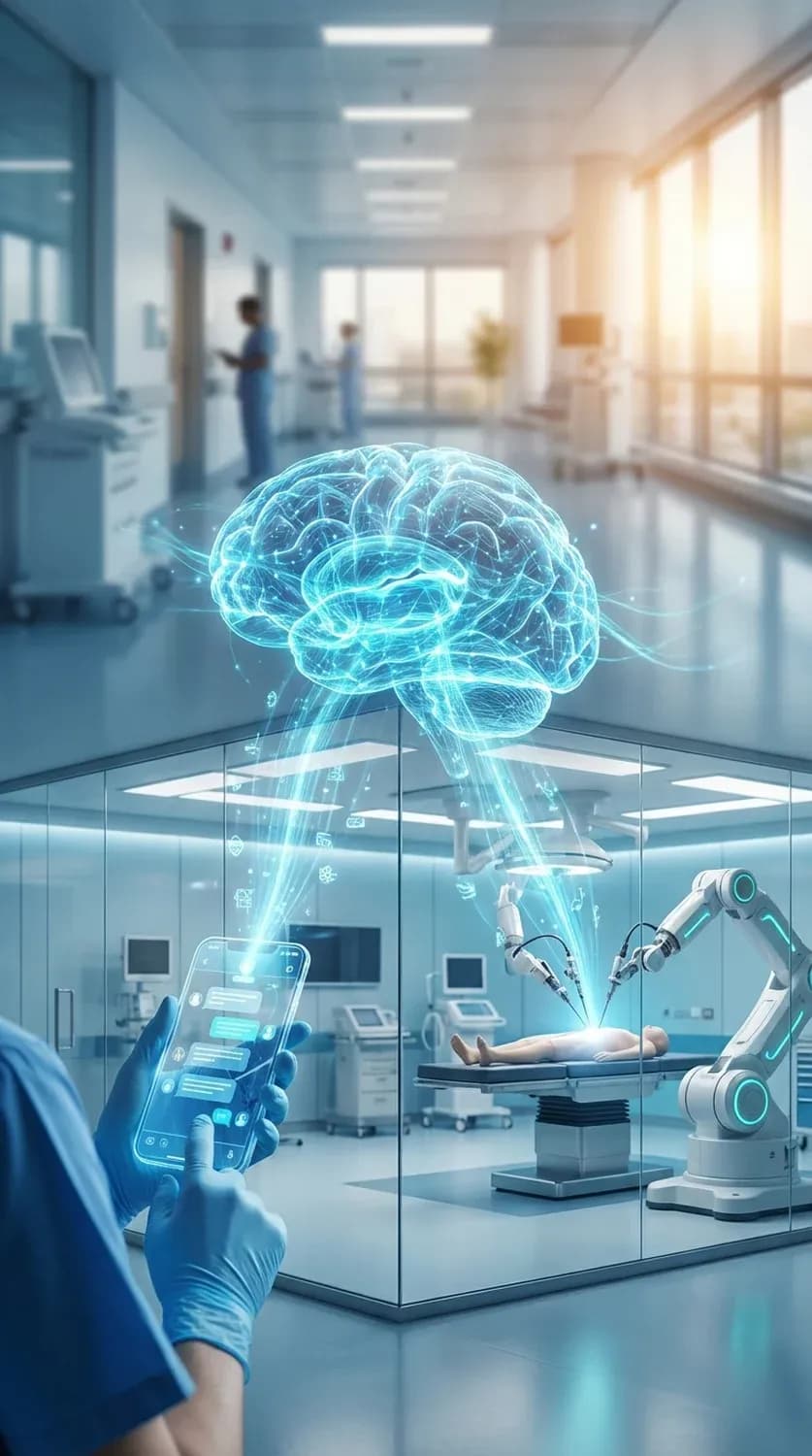
Although IXI primarily targets the consumer market for vision correction, the implications for the business sector are significant. Consider a surgeon who must constantly shift focus between a monitor, the patient, and instruments during a procedure. Active focus glasses could reduce eye strain and increase precision. This is a form of custom automation solutions application that directly impacts work quality.
Similarly, for workers in precision assembly or quality control who must examine tiny parts and then read documentation, this technology could mean a drastic increase in efficiency. In the future workplace, our physical capabilities—like vision—will be augmented and enhanced by such intelligent layers.
Strategic Insight: Executives should watch "human augmentation" technologies closely, as they will soon become cornerstones of workplace health and efficiency.

Figure: Comparison of focus switching speeds across technologies
Comparison: Traditional vs. Active Optics
To aid decision-making, it is worth comparing traditional solutions with this new automated technology. The table below illustrates where custom automation solutions offer more in the field of vision correction.
| Feature | Traditional Bifocal/Progressive | IXI Active Focus |
|---|---|---|
| Field of View | Limited, distortion at edges | Full field of view, distortion-free |
| Focus Switching | Requires head movement | Automatic, eye-movement based |
| Adaptability | Static, unchanging | Dynamic, real-time custom automation solutions |
| Power Requirement | None (passive device) | Requires battery charging |
Risks and Technological Limitations
As with any new technology, there are challenges. The primary risk is power dependency. While traditional glasses never run out of battery, IXI's device requires charging. If the battery dies, the glasses lose their adaptive function, which could be problematic in critical situations (e.g., driving), though there is likely a default "safety" diopter state.
Another issue is cost and accessibility. Such levels of custom automation solutions and miniaturization initially come with high costs. It remains to be seen how insurers will accept this innovation and how accessible it will be to the average user. Furthermore, the fragility of electronics is a concern for a device worn on the face all day.

Strategic Recommendations for Adoption
The arrival of active focus technology is not just news for glasses wearers but a signal for the automation industry. Here are some suggestions for interpreting and integrating this technology:
- • Seek "invisible" automation: The best custom automation solutions are those the user doesn't even notice. Strive to implement solutions that recede into the background while assisting workflows.
- • Prepare for IoT integration: Such devices will soon track not just the eye but the environment, providing data to enterprise systems.
- • Focus on User Experience: No matter how advanced a technology (like IXI lenses) is, if it's uncomfortable (heavy), it won't be used. Ergonomics is key.
Implementation Advice: If your business involves visually intensive tasks, start assessing where eye strain or focusing difficulties might be causing efficiency losses.
Automation is revolutionizing not just assembly lines but our everyday devices too. If you want to leverage the power of custom developments in your business, we help you find the right solution.
Explore Our Custom Automation SolutionsFrequently Asked Questions
How does the IXI glasses' automatic focus work?
Micro-sensors in the glasses frame continuously monitor pupil movement and distance. When the system detects the wearer looking near or far, liquid crystals in the lens change their refractive index via electrical impulses, providing an instantly sharp image.
How long does the battery last?
While exact specs vary by model, the goal is all-day use on a single charge. Since focus switching requires only momentary power and the system operates in a low-energy mode, the battery integrated into the 32-gram frame provides sufficient capacity for a daily routine.
How does this relate to custom automation solutions?
This technology is a textbook example of custom automation solutions at the hardware level: solving a specific problem (focusing) with a closed-loop system of sensors, data processing, and actuators (lenses), without human intervention.
Are these glasses heavier than traditional ones?
No. One of IXI's biggest innovations is condensing the entire technology into 32 grams, which matches the weight of average fashion eyewear, causing no extra strain during wear.
Recommended
- AiSolve: Custom Automation Services
- Original Article: New Superglasses Adjust Focus Based on Eye Movement
[Article generated by AiSolve AI Content System]
Készen állsz a saját weboldaladra?
Ingyenes konzultáció során átbeszéljük, hogyan segíthetünk vállalkozásodnak növekedni egy modern, gyors és konverzióoptimalizált weboldallal. 14 nap alatt kész, 0 Ft induló költséggel.