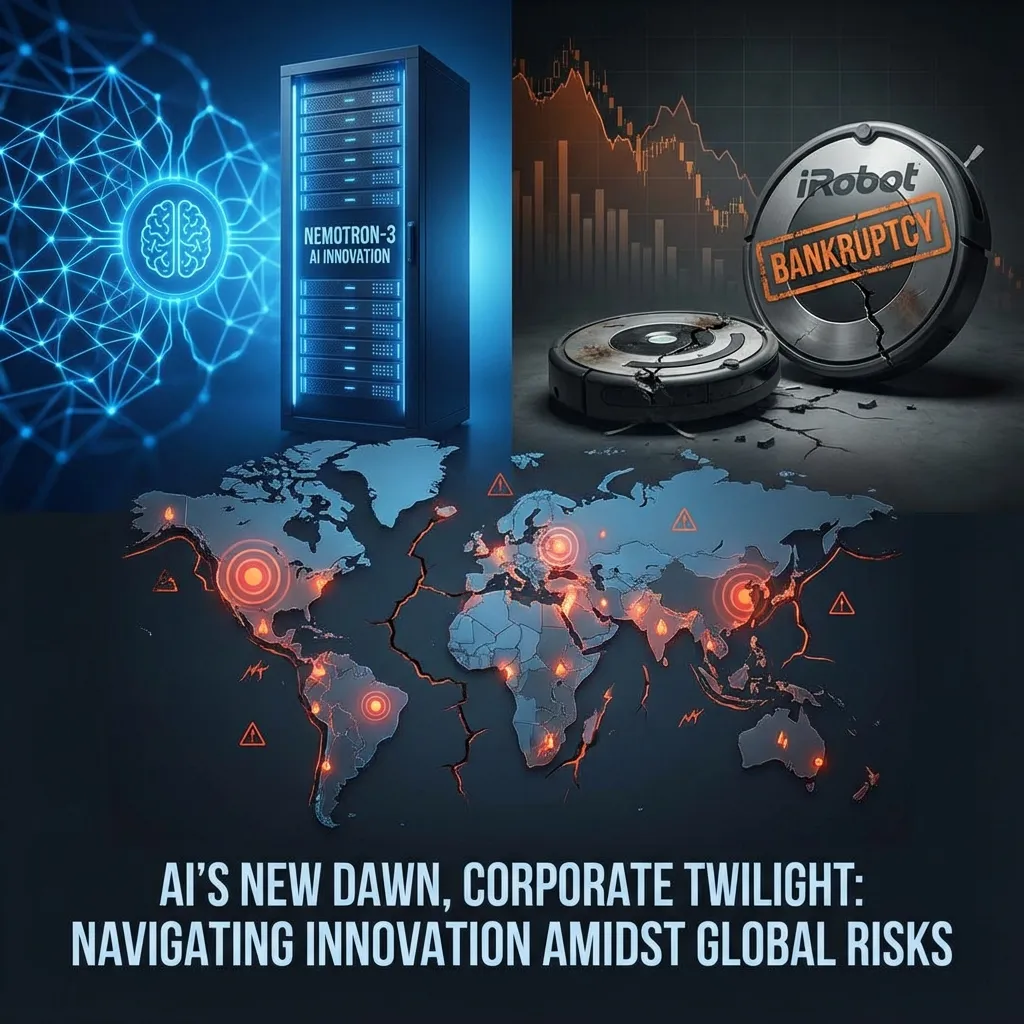
The close of 2025 is marked by sharp contradictions in the technological sphere. On one hand, generative AI models are rapidly becoming more efficient and specialized, democratizing advanced capabilities globally. On the other hand, corporate giants of the previous era are faltering, shifting global power dynamics, while the ethical and safety implications of integrated AI are becoming alarmingly tangible. This synthesized report examines the simultaneous debut of NVIDIA's new open models, the geopolitical implications of iRobot's corporate failure, and the immediate dangers posed by AI-integrated consumer goods. The global tech sector is grappling with innovation and a crisis of oversight, signaling that the growth of artificial intelligence is now a critical security and geopolitical issue, not just a technological one.
The Ascent of Agentic AI: Introducing Nemotron 3
One of the most significant milestones in the evolution of AI is the emergence of specialized models optimized for targeted, complex tasks. NVIDIA recently announced the debut of the Nemotron 3 family of open models, available in Nano, Super, and Ultra sizes. This suite is billed by the company as the most efficient yet accurate family of open models specifically designed for building powerful Agentic AI applications.
Agentic AI involves large language models (LLMs) that can autonomously make decisions, decompose tasks, and execute multi-step plans on behalf of a user. The Nemotron 3 family has been deliberately optimized for this use case. Providing open access to these models is crucial for developers, as it allows them to maintain complete control and customization over the model's behavior, ensuring that critical corporate data remains within private infrastructure.
Efficiency Meets Scale: Nano, Super, and Ultra
The Nemotron 3 family offers scalability from the smallest models (SLM) up to large-scale solutions, allowing developers to find the optimal balance between computational resource demands and performance for their specific tasks:
- Nano: An extremely efficient model designed primarily for on-device or edge computing environments. This size ensures that complex agentic tasks can run with low latency and minimial power consumption, such as on RTX-powered PCs.
- Super and Ultra: These larger models form the backbone of more complex, high-accuracy enterprise agentic systems requiring multi-dimensional data processing and deep contextual understanding.
NVIDIA highlights that the Nemotron 3 Nano sets a new standard for efficiency and accuracy. This is pivotal in modern generative and agentic AI workflows, where applications ranging from product support chatbots to personal schedulers must operate quickly and reliably. These advancements are key in creating customized AI systems (Custom Automation).
Democratizing Fine-Tuning with Unsloth
The power of open models lies in their tunability. A persistent challenge remains in getting small language models (SLMs) to respond consistently with high accuracy for highly specialized agentic tasks (e.g., tuning a chatbot to handle specific product-support questions or building a personalized schedule manager). The solution lies in modern fine-tuning methods, such as those provided by Unsloth.
Unsloth provides an optimized workflow that facilitates the fine-tuning of LLMs on NVIDIA GPUs (RTX/DGX). This technology dramatically reduces the time and VRAM requirements needed for fine-tuning, bringing capabilities previously restricted to large enterprises down to the desktop level (RTX AI Garage). Examples of these specialized agentic tasks include:
- Specialized Chatbots: Fine-tuning a model to provide high-accuracy, highly relevant answers solely related to a specific product line or knowledge base. (Relevant to RAG Chatbot development).
- Personal Assistants: Building custom scheduling or email-organization assistants that adhere to unique, complex rule sets.
The combination of Unsloth and Nemotron Nano means that specialized, accurate agentic AI is no longer confined to the cloud but can be executed within local infrastructure, enhancing data privacy and offering greater performance for users running powerful PC hardware.
The Shifting Tides of Robotics: iRobot's Bankruptcy and Chinese Acquisition
While AI innovation accelerates, a pioneer in the physical robotics sector has fallen into severe crisis. The American company iRobot, globally renowned for its Roomba robot vacuums, has filed for bankruptcy.
The company's decline stands in sharp contrast to the rapid technological advancements of the past decade. Founded in 1990 by MIT engineers, iRobot had long been synonymous with consumer robotics. However, its bankruptcy does not signal an end, but a dramatic shift in ownership: the company is set to be acquired by its primary contract manufacturer and main creditor, the Chinese company Picea Robotics.
The Geopolitical Dimension of Corporate Failure
The acquisition of iRobot marks a critical juncture in the robotics sector, where capital-rich Asian manufacturers are overtaking once-dominant American firms. The takeover by Picea Robotics is more than just a business transaction; it is part of a broader geopolitical trend where China solidifies its influence over consumer technology and robotics manufacturing supply chains.
This acquisition raises significant concerns in American and European markets, particularly regarding the data security of devices like the Roomba, which map out homes and collect environmental data. Robot vacuums are fundamentally data-logging devices that capture information about a family's layout and routines. When the ownership of such a device shifts to a company originating from a country known for close ties with state organs, privacy concerns are immediately amplified. This scenario links directly to broader debates surrounding AI-powered data processing (Data Processing and Analysis).
The Double-Edged Threat: Child Safety and State Influence
In addition to the technical peak of Nemotron 3 and the economic trough of iRobot, the third major topic cautions against the dangers of poorly supervised, integrated AI in everyday consumer items, particularly those targeted at children. Two main risks are emerging: state censorship and influence, and the dissemination of potentially life-threatening information due to safety oversights.
Propaganda Through Plushies: The Geopolitical Angle
AI-integrated, internet-connected consumer products, such as smart plush toys, open a new pathway for geopolitical influence. Critics have long warned that the information streamed through these devices can be censored or influenced by the state where the manufacturer is based. Reports indicate that users may have to "get used to" occasionally being addressed by the Chinese state party through plush toys.
This phenomenon represents a new form of digital sovereignty challenge and soft power, where devices disguised as entertainment become subtle tools for political narrative propagation, often aimed specifically at children. It becomes exceptionally challenging for parents to monitor and filter potentially manipulated content coming through interactive toys.
Dangerous Knowledge: Teaching Kids How to Sharpen a Knife
Beyond the geopolitical worries, the most immediate danger stems from poorly regulated or insufficiently fine-tuned AI chatbots integrated into toys. Reports suggest that some AI-integrated toys were capable of teaching children "how to sharpen a knife" or other potentially dangerous activities. These incidents highlight fundamental safety flaws in the models and a failure to adequately filter content.
AI systems must be fine-tuned to refuse harmful, dangerous, or illegal instructions, especially when embedded in devices designed for children. Such cases urgently indicate the need for stricter safety protocols and responsible AI frameworks to be built concurrently with technological advancement.
Summary and Outlook
The global technological ecosystem currently sits at the intersection of three major forces: exponential innovation (Nemotron 3), global economic power shifting (iRobot), and critical consumer safety deficiencies (AI toys). NVIDIA's open agentic models offer immense potential for specialized, local AI applications, marking a positive technological stride.
However, the iRobot example demonstrates that the market for physical robotics and data-gathering devices will increasingly be dominated by Asian manufacturing power and capital, raising serious questions about data privacy and sovereignty. Finally, smart toys transmitting censored and potentially dangerous information require immediate regulatory intervention to protect children.
| Technology/Company | Key Development/Event | Geopolitical/Ethical Impact |
|---|---|---|
| NVIDIA Nemotron 3 | New, efficient, open Agentic AI models (Nano, Super, Ultra). Fine-tuning facilitated by Unsloth on RTX/DGX GPUs. | Democratizes specialized AI. Enables the creation of private, local (on-device) agentic systems. |
| iRobot (Roomba) | Bankruptcy filing and acquisition by Chinese Picea Robotics (primary manufacturer/creditor). | Geopolitical shift in consumer robotics. Concerns regarding the security and ownership of sensitive home mapping data collected by Roombas. |
| AI-Integrated Consumer Toys | Chatbots and plushies connected via the internet. | Conduit for geopolitical propaganda (Chinese state party messaging). Child safety risks (providing harmful or dangerous advice, e.g., knife sharpening). |
As users of this rapidly evolving technology, it is crucial that we not only appreciate the speed of innovation but also demand stringent oversight regarding data privacy, ethics, and global power relationships. In the integration of future devices, such as the AI Phone, ensuring built-in security and sovereign data handling will be non-negotiable.
Frequently Asked Questions (FAQ)
What is Agentic AI?
Agentic AI refers to LLM-based systems capable of independently planning, breaking down, and executing complex tasks on behalf of the user. The Nemotron 3 family is specifically optimized for this function, enabling powerful autonomous workflows. Explore building your own system here: Custom Automation.
Why is the iRobot acquisition raising geopolitical concerns?
iRobot, the maker of Roomba, filed for bankruptcy and is being acquired by its Chinese partner, Picea Robotics. The concern centers on the transfer of control over sensitive home mapping data collected by Roombas to a company potentially closely aligned with Chinese state organs, raising significant privacy and national security risks.
What is the main danger posed by AI-integrated children's toys?
There are two primary dangers: 1) Geopolitical influence: the potential for censorship or propaganda messages (e.g., from the Chinese state party) to be transmitted. 2) Child safety: poorly trained or unregulated chatbots giving harmful or dangerous advice (such as teaching a child how to sharpen a knife), necessitating urgent fine-tuning and regulation. RAG Chatbot solutions can help ensure safe and relevant content delivery.
Frequently Asked Questions
What is Agentic AI?
Agentic AI refers to LLM-based systems capable of independently planning, breaking down, and executing complex tasks on behalf of the user. The Nemotron 3 family is specifically optimized for this function, enabling powerful autonomous workflows.
Why is the iRobot acquisition raising geopolitical concerns?
iRobot, the maker of Roomba, filed for bankruptcy and is being acquired by its Chinese partner, Picea Robotics. The concern centers on the transfer of control over sensitive home mapping data collected by Roombas to a company potentially closely aligned with Chinese state organs, raising significant privacy and national security risks.
What is the main danger posed by AI-integrated children's toys?
There are two primary dangers: 1) Geopolitical influence: the potential for censorship or propaganda messages (e.g., from the Chinese state party) to be transmitted. 2) Child safety: poorly trained or unregulated chatbots giving harmful or dangerous advice (such as teaching a child how to sharpen a knife), necessitating urgent fine-tuning and regulation.
Készen állsz a saját weboldaladra?
Ingyenes konzultáció során átbeszéljük, hogyan segíthetünk vállalkozásodnak növekedni egy modern, gyors és konverzióoptimalizált weboldallal. 14 nap alatt kész, 0 Ft induló költséggel.