
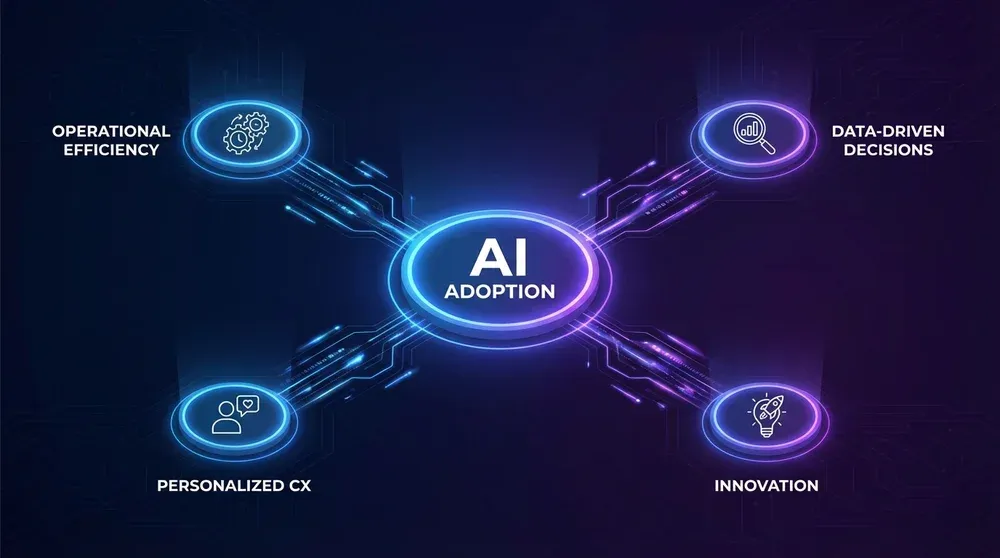
In 2026, the question is no longer *if* businesses should adopt Artificial Intelligence, but *how* and *how quickly*. Companies lagging in AI integration report an average 15% decline in operational efficiency compared to their AI-powered counterparts. This technology has transcended its buzzword status to become a fundamental driver of competitive advantage, reshaping industries from logistics to finance. This article provides a comprehensive guide on why integrating AI is not just beneficial but essential for survival and growth, exploring its impact on efficiency, customer experience, and strategic decision-making. The journey into AI begins with a clear strategy, and often, the first step is creating the digital platform where these technologies will live, which underscores the importance of professional website creation as a foundational element.
| Area | Key Insight |
|---|---|
| Efficiency | AI-driven automation can reduce operational costs by up to 40% by optimizing repetitive tasks and resource allocation. |
| Customer Experience | Hyper-personalization powered by AI can increase customer lifetime value (CLV) by 25% through tailored recommendations and support. |
| Decision-Making | AI analytics processes vast datasets to uncover predictive insights, improving strategic decision accuracy by over 50%. |
| Implementation | Successful AI integration requires a strong digital foundation, where professional website creation is key for building user-facing dashboards and interfaces. |
The AI Revolution: Current Statistics and Trends
The global AI market is projected to exceed $1.5 trillion by 2028, a testament to its explosive growth and widespread adoption. In 2026, we're seeing a clear shift from experimental AI projects to full-scale, mission-critical deployments. A recent industry survey found that over 75% of enterprises have now integrated AI into at least one core business function, up from just 40% two years ago. The driving force behind this acceleration is the demonstrable ROI; companies leveraging AI for process automation report an average 30% increase in productivity within the first year. These automations are often managed and monitored through custom dashboards, highlighting why quality user interface design, a core component of professional website creation, is intrinsically linked to successful AI deployment.
Key Trends Shaping 2026
Three dominant trends define the current AI landscape. First, the rise of Generative AI has moved beyond content creation to revolutionize product design, code generation, and synthetic data creation for training more robust models. Second, the focus on AI ethics and governance has intensified, with regulatory bodies establishing clearer frameworks for transparency and bias mitigation. Companies are now required to demonstrate the fairness and explainability of their models, making 'black box' solutions increasingly obsolete. Finally, the proliferation of Autonomous AI Agents is automating complex, multi-step workflows that previously required human intervention. These agents, capable of independent decision-making and task execution, are setting new standards for efficiency. Deploying these agents often involves creating sophisticated user interfaces, making a strong case for investing in data processing AI agents that can operate within a well-designed digital ecosystem.
Operational Efficiency and Cost Reduction
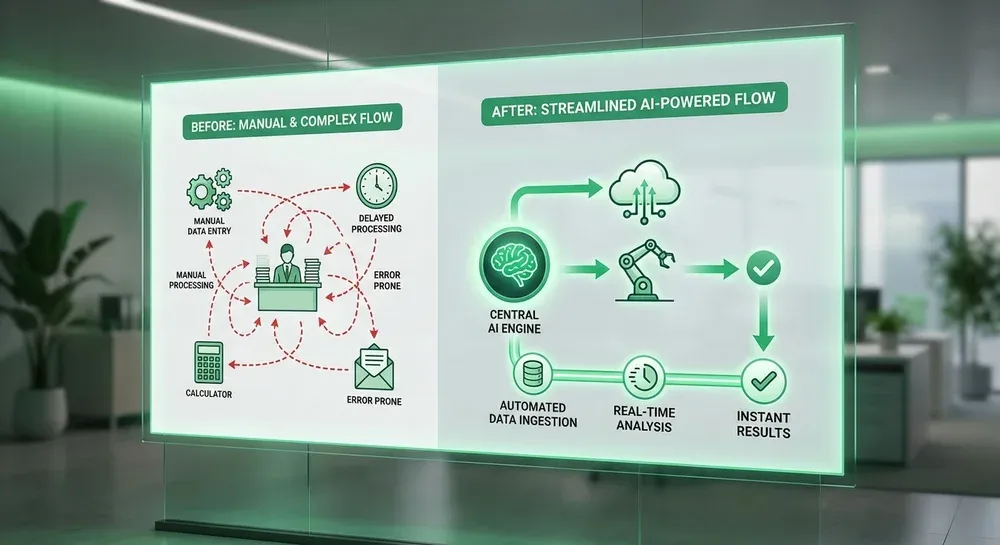
One of the most compelling reasons to adopt AI is its profound impact on operational efficiency and the bottom line. By automating repetitive, time-consuming tasks, AI frees up human employees to focus on strategic, creative, and high-value activities. For example, in manufacturing, AI-powered predictive maintenance algorithms can analyze sensor data to predict equipment failure before it happens, reducing downtime by up to 50% and maintenance costs by 40%. In administrative roles, AI tools can process invoices, manage schedules, and handle routine correspondence with near-perfect accuracy, eliminating hours of manual labor. This level of automation doesn't just speed up processes; it fundamentally redesigns workflows for maximum output with minimal waste. These new workflows are best managed through intuitive digital platforms, and effective professional website creation ensures that these platforms are user-friendly and powerful.
Implementation Advice: Start with a 'low-hanging fruit' analysis. Identify the top 3-5 most repetitive, rule-based tasks in your organization. These are prime candidates for an initial automation project, offering quick wins and a clear demonstration of AI's ROI before tackling more complex challenges.
Cost reduction is a direct result of this enhanced efficiency. Labor costs are significantly reduced as automation takes over manual tasks. Furthermore, AI optimizes resource allocation, whether it's managing inventory levels to reduce carrying costs or optimizing logistics routes to save on fuel and time. Financial institutions use AI to detect fraudulent transactions in real-time, saving billions annually. The cumulative effect is a leaner, more agile organization capable of reallocating capital from operational overhead to innovation and growth. To truly harness these benefits, businesses need robust interfaces to monitor these systems, which again highlights how essential professional website creation is for building the necessary infrastructure for AI management and oversight.
Enhanced Customer Experience and Revenue Growth
In a saturated market, customer experience (CX) is the key differentiator, and AI provides the tools to elevate it to an unprecedented level. AI-driven personalization engines analyze customer data—browsing history, purchase patterns, and demographic information—to deliver hyper-relevant product recommendations, content, and offers. This level of personalization makes customers feel understood and valued, leading to a 20% increase in customer satisfaction and a 15% boost in conversion rates on average. Unlike static rule-based systems, AI models learn and adapt in real-time, ensuring that the customer journey is continuously optimized. This dynamic personalization is often delivered through a company's digital storefront, making the quality of the user experience, driven by expert professional website creation, paramount to its success.
From Support to Proactive Engagement
AI's role in CX extends far beyond simple personalization. Advanced RAG AI chatbots and voice assistants provide 24/7, instant support, resolving over 80% of common customer queries without human intervention. This frees up human agents to handle more complex, emotionally nuanced issues, improving both customer and employee satisfaction. Furthermore, AI can power proactive engagement. Sentiment analysis tools can monitor social media and customer feedback to identify potential issues before they escalate, allowing companies to intervene and turn a negative experience into a positive one. By predicting customer churn with over 90% accuracy, AI enables businesses to launch targeted retention campaigns, directly protecting their revenue streams and fostering long-term loyalty.
Supporting Decision-Making and Data-Driven Strategy
Human intuition is valuable, but in an increasingly complex business environment, it's no match for data-driven insights. AI transforms raw data into a strategic asset. Machine learning models can sift through petabytes of information from market trends, competitor activities, and internal performance metrics to identify patterns and correlations that are invisible to the human eye. This capability allows leaders to move from reactive problem-solving to proactive, predictive strategy. For instance, AI can forecast demand with remarkable accuracy, allowing for optimized inventory and supply chain management. It can also identify high-potential market segments and predict the likely success of new product launches, significantly de-risking strategic investments.
Strategic Insight: Leverage AI to run complex simulations. Before launching a new pricing strategy or marketing campaign, use AI models to simulate potential outcomes based on various market conditions. This allows you to test hypotheses in a virtual environment, minimizing real-world risk and maximizing ROI.
Presenting these complex insights in an understandable format is critical for adoption. This is where the synergy between AI and user interface design becomes evident. AI-powered analytics platforms require intuitive dashboards and visualizations to make the data accessible to non-technical stakeholders. A well-designed dashboard can distill millions of data points into a clear, actionable overview of business health. Therefore, the value of an advanced AI analytics system is directly tied to the quality of its user interface, reinforcing the idea that investment in professional website creation is not just about aesthetics but about enabling effective data-driven decision-making across the entire organization. The ability to translate complex data into clear visuals is a core tenet of modern web development and is crucial for AI utility.

Figure: AI-driven personalization has been shown to increase Customer Lifetime Value by as much as 25%.
Risks and Challenges of AI Implementation
While the benefits of AI are substantial, the path to implementation is fraught with challenges that require careful navigation. The most significant hurdle is often data quality and availability. AI models are only as good as the data they are trained on; biased, incomplete, or 'dirty' data will lead to flawed outputs and poor decisions. Ensuring data integrity and establishing robust data governance protocols is a critical prerequisite for any AI initiative. Another major challenge is the skills gap. There is a global shortage of data scientists, machine learning engineers, and AI specialists, making it difficult and expensive to build an in-house team.
Ethical Considerations and Integration Complexity
Beyond technical hurdles, ethical considerations are paramount. Issues of algorithmic bias, data privacy, and transparency must be addressed proactively. A poorly designed AI system can perpetuate and even amplify existing societal biases, leading to significant reputational damage and legal liability. Finally, integrating AI systems with existing legacy IT infrastructure can be a complex and costly undertaking. Many companies struggle to bridge the gap between their old systems and modern AI platforms. This integration challenge often requires custom development and a clear architectural vision, which can be facilitated by a development partner skilled not just in AI but also in building the digital connective tissue, a service that overlaps significantly with custom automation solutions and web platforms.
| Challenge | Mitigation Strategy |
|---|---|
| Data Quality Issues | Implement a comprehensive data governance framework. Invest in data cleansing and preparation tools before model training. |
| Skills Gap | Partner with specialized AI firms. Invest in upskilling programs for existing staff to build a hybrid internal/external team. |
| Ethical Risks (Bias) | Conduct regular algorithmic audits. Establish a diverse AI ethics board to review projects and ensure fairness. |
| Integration Complexity | Adopt an API-first approach. Plan for phased integration rather than a 'big bang' cutover to minimize disruption. |
A Strategic Roadmap for Successful AI Adoption
Successfully integrating AI is not just a technology project; it's a strategic business transformation. A clear roadmap is essential. The first step is to define the business problem. Instead of starting with the technology, identify a specific, high-impact business challenge that AI can solve. This ensures that the project is aligned with strategic goals and has a clear metric for success. Once the problem is defined, the next step is to assess data readiness. This involves auditing existing data sources, identifying gaps, and establishing a plan for data collection and governance. This foundational work is non-negotiable for building effective AI models.
Deployment Strategy: Adopt a 'pilot-to-production' model. Start with a small-scale pilot project to test the technology, validate the business case, and identify potential challenges. Use the learnings from the pilot to refine the model and scale the solution across the organization.
The implementation phase requires a strong focus on the user interface and user experience. An AI tool, no matter how powerful, is useless if employees cannot easily use it and trust its outputs. This is where the discipline of web development is critical. Building an intuitive dashboard, a clear reporting interface, or a seamless user portal is a task for expert developers. Therefore, a significant part of any AI budget should be allocated to professional website creation and UI/UX design. This ensures that the final solution is not just technologically sound but also fully adopted and utilized by the team. Finally, establish a continuous monitoring and improvement loop. AI models can 'drift' over time as data patterns change. Regular retraining and performance monitoring are essential to ensure the long-term value and accuracy of the system.

The Future of AI: From Generative Capabilities to Autonomous Agents
Looking ahead, the evolution of AI promises even more transformative capabilities. Generative AI will continue to advance, moving from creating text and images to designing complex physical products, generating scientific hypotheses, and even composing sophisticated musical scores. This will unlock new levels of creativity and innovation, allowing businesses to prototype and iterate ideas at an unprecedented speed. The next frontier is the development of more sophisticated Autonomous AI Agents. These agents will function as digital employees, capable of managing entire business functions like marketing campaigns, supply chain logistics, or even customer service departments with minimal human oversight. They will be able to collaborate with each other, negotiate, and execute complex strategies to achieve business objectives.
The convergence of AI with other emerging technologies like IoT, blockchain, and quantum computing will create a new paradigm of intelligent, interconnected systems. Imagine smart factories that self-optimize in real-time or financial systems that can predict and prevent market crashes. As these powerful systems become a reality, the need for clear, secure, and effective human-computer interfaces will become more critical than ever. The interfaces through which we manage and interact with these autonomous systems will be highly complex digital environments. Their design and implementation will demand the highest level of expertise in digital platform engineering, making advanced skills in professional website creation and application development an essential component of this future. Preparing for this future means investing not just in AI models, but in the robust digital infrastructure and user interfaces needed to control them.
The evidence is clear: AI is the engine of modern business growth. From automating processes to delivering unparalleled customer insights, the benefits are too significant to ignore. The journey begins with a solid digital foundation.
Build Your AI-Ready Platform TodayFrequently Asked Questions
What is the primary benefit of using AI in business?
The primary benefit is a significant boost in operational efficiency. AI automates repetitive tasks, optimizes workflows, and reduces operational costs, allowing human employees to focus on strategic, high-value activities that drive growth and innovation.
How does AI improve customer experience?
AI enhances customer experience primarily through hyper-personalization. It analyzes customer data to provide tailored recommendations, content, and support. Additionally, AI-powered chatbots offer 24/7 assistance, leading to faster response times and increased satisfaction.
What is the biggest risk of implementing AI?
The biggest risk often lies in data quality and ethical considerations. Poor or biased data leads to inaccurate and unfair AI models. It's crucial to establish strong data governance and ethical review processes to mitigate risks like algorithmic bias and ensure data privacy.
How do I start with implementing AI in my business?
Start by identifying a specific, high-impact business problem rather than focusing on the technology itself. Assess your data readiness and begin with a small-scale pilot project to prove the concept and demonstrate ROI. Ensure you have a strong digital platform, as the user interface is key to adoption.
Recommended
- Building the Digital Foundation for AI
- Guide to Business Process Automation
- Leveraging Data with AI Agents
[Article generated by AiSolve AI Content System]
Készen állsz a saját weboldaladra?
Ingyenes konzultáció során átbeszéljük, hogyan segíthetünk vállalkozásodnak növekedni egy modern, gyors és konverzióoptimalizált weboldallal. 14 nap alatt kész, 0 Ft induló költséggel.