Google DeepMind has announced the release of Lyria 3 and Lyria 3 Pro models, now accessible via the Gemini API. This marks a revolutionary step in AI music generation.
- New Era: Lyria 3 can generate long, structurally coherent, studio-quality tracks from simple text prompts.
- Technological Leap: The system utilizes advanced transformer architectures and diffusion models to understand musical context and emotional depth.
- Business Potential: It drastically reduces the cost and production time of royalty-free music for content creators, game developers, and marketers.
- Developer Access: Through the Gemini API paid preview, companies can immediately integrate these capabilities into their own systems.
Introduction: Where AI Meets Music – New Horizons in Sound
Recently, Google DeepMind officially announced the arrival of Lyria 3 and the professional-grade Lyria 3 Pro models, which are now accessible to developers via the Gemini API. This milestone is not just another software update; it is a paradigm shift that fundamentally rewrites the rules of digital content creation and the music industry.
In recent years, artificial intelligence has rapidly conquered the creative industries. From text generation to image synthesis, AI tools have become commonplace, but music generation long seemed an impenetrable wall. Music is not just a sequence of sounds; it is a complex mathematical structure that demands emotion, rhythm, and long-term coherence.
The business role of artificial intelligence is now expanding into a new, auditory dimension. With the release of Lyria 3, machine learning models can finally understand the dynamics of musical tension and release. They can create studio-quality tracks that are indistinguishable from human-composed pieces.
This technology is thrilling not only for musicians. It offers unprecedented opportunities for marketing agencies, game development studios, and corporate content creators. Producing royalty-free, unique soundscapes is no longer a weeks-long, expensive process, but merely a matter of a well-crafted prompt.
What is AI Music Generation and Why is it Crucial for Modern Content Creation?
📌 Definition: AI Music Generation
AI music generation is the application of machine learning algorithms and neural networks capable of creating new, original musical compositions, melodies, harmonies, and full orchestrations. These systems train on massive musical databases to understand music theory rules, genre specifics, and acoustic characteristics, synthesizing new audio waveforms or MIDI data from this knowledge.
Modern content creation is unimaginable without proper auditory accompaniment. Whether it's a YouTube video, a corporate presentation, or a TikTok campaign, music determines the emotional tone. AI music generation solves one of the biggest problems for content creators: the lack of high-quality, royalty-free music that perfectly fits the specific content.
From Early Beginnings to Today's Complex Systems: The Evolution of AI Music
Algorithmic composition is not a new concept. Even in the 1950s, there were experiments with Markov chains and rule-based systems generating simple melodies. However, these early attempts were rigid and lacked musical intuition. The real breakthrough came with the advent of deep learning and neural networks.
Recurrent Neural Networks (RNNs) and Long Short-Term Memory (LSTM) architectures could remember longer musical sequences, but the generated audio quality often remained noisy and synthetic. Generative models like GANs (Generative Adversarial Networks) improved the sound significantly, but structural coherence remained a challenge.
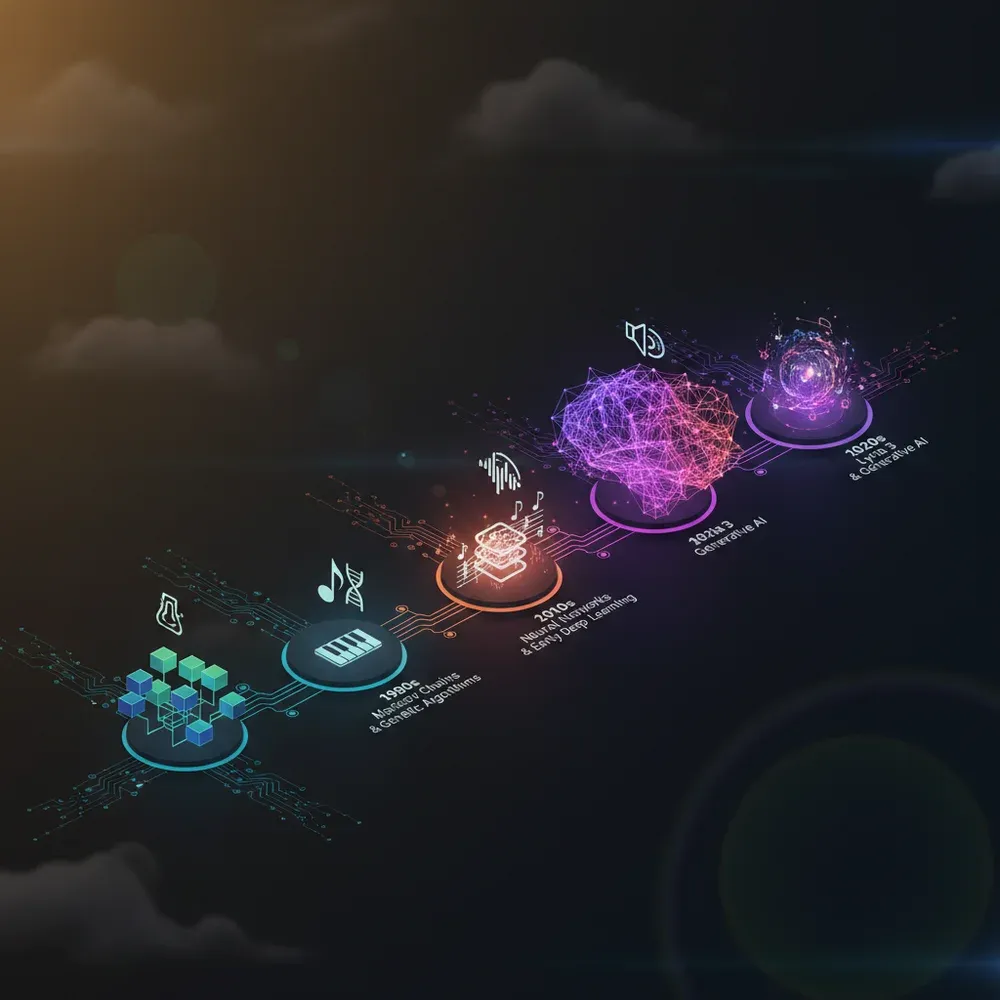
The latest generation, which includes Lyria 3, relies on transformer architectures and advanced diffusion models. These systems, similar to how Gemini 3 Pro interprets text, can recognize complex relationships between musical "tokens." They don't just predict the next note; they comprehend the structure of the entire piece.
Democratizing and Accelerating the Creative Process
The most significant impact of AI music generation is the democratization of the creative process. Previously, creating a studio-quality track required expensive equipment, instrumental skills, and audio engineering experience. Today, a marketer or an indie game developer can create stunning musical scores without ever touching an instrument.
This doesn't mean musicians become obsolete. On the contrary: AI is a new, incredibly powerful instrument in their hands. Composers can quickly generate core ideas, which they can then refine. Production time is drastically reduced, leaving more energy for fine-tuning and realizing the creative vision.
Google DeepMind's Lyria 3 and Lyria 3 Pro: At the Forefront of AI Music Generation
📌 Feature Highlight: Lyria 3 Capabilities
- Long-term Coherence: Capable of generating multi-minute, logically structured tracks (verse, chorus, bridge).
- High Fidelity: Provides 48 kHz, studio-quality, uncompressed audio output.
- Genre Versatility: Can create in any style, from classical symphonies to Electronic Dance Music (EDM).
- Stem Separation: The Pro version can export vocals, drums, and instruments on separate tracks.
Google DeepMind's Lyria 3 is not just a minor tweak compared to previous versions; it is a massive technological leap. The model's architecture was redesigned from the ground up to eliminate the biggest flaw of earlier AI music models: structural amnesia. Previous systems tended to "forget" the main melody after 30 seconds and descend into chaos.
Lyria 3, in contrast, maintains a global musical context. When a prompt requests that the song return to the intro motif at the three-minute mark with epic orchestral backing, the model does exactly that. This level of control makes Lyria 3 an indispensable tool for professional content production.
Lyria 3 vs. Lyria 3 Pro: What's the Difference and Who is it For?
Google has made two distinct tiers of models available via the Gemini API. The standard Lyria 3 focuses on fast, everyday content creation. It's ideal for YouTube video background music, podcast intros, or social media posts. It generates faster, requires less compute, and returns a high-quality stereo mix.
The Lyria 3 Pro, on the other hand, is designed for music industry professionals, game developers, and engineers building complex custom automation systems. The Pro version has a longer context window, supports highly detailed, parameterized prompts (e.g., specifying BPM, key, specific instruments), and crucially: it supports stem export.
This stem export feature is a true game-changer. Producers receive separate vocal, drum, bass, and synth tracks, which they can then further mix, effect, and master in their own DAW (Digital Audio Workstation) software (like Ableton or Logic Pro). This feature bridges the gap between AI generation and professional post-production.
Key Features and Capabilities: Where Does its Power Lie?
The power of Lyria 3 lies in its multimodal understanding. It doesn't just translate text to sound; it interprets musical instructions. If the prompt says: "A melancholic jazz piano solo that slowly transitions into an up-tempo funk bassline," the model understands the subtle dynamics of transitioning between musical texture and tempo.
Furthermore, the system excels at generating vocals. Synthetic vocals have long been robotic and lifeless. Lyria 3, however, can simulate the tiny imperfections of the human voice, the breaths, the vibrato, and the emotional nuances, making the result incredibly organic and believable.
The Technology Behind Lyria 3: How Next-Gen AI Creates Music?
From a technological standpoint, generating music is one of the hardest machine learning tasks. While text consists of discrete tokens (words, letters), audio is a continuous waveform. A single second of CD-quality audio contains 44,100 distinct data points (samples). Generating a three-minute song requires the precise calculation of millions of data points.
Lyria 3 solves this challenge with a hybrid architecture that combines neural audio codecs (like advanced versions of SoundStream or EnCodec) with the transformer foundations of Large Language Models (LLMs) and latent diffusion models.
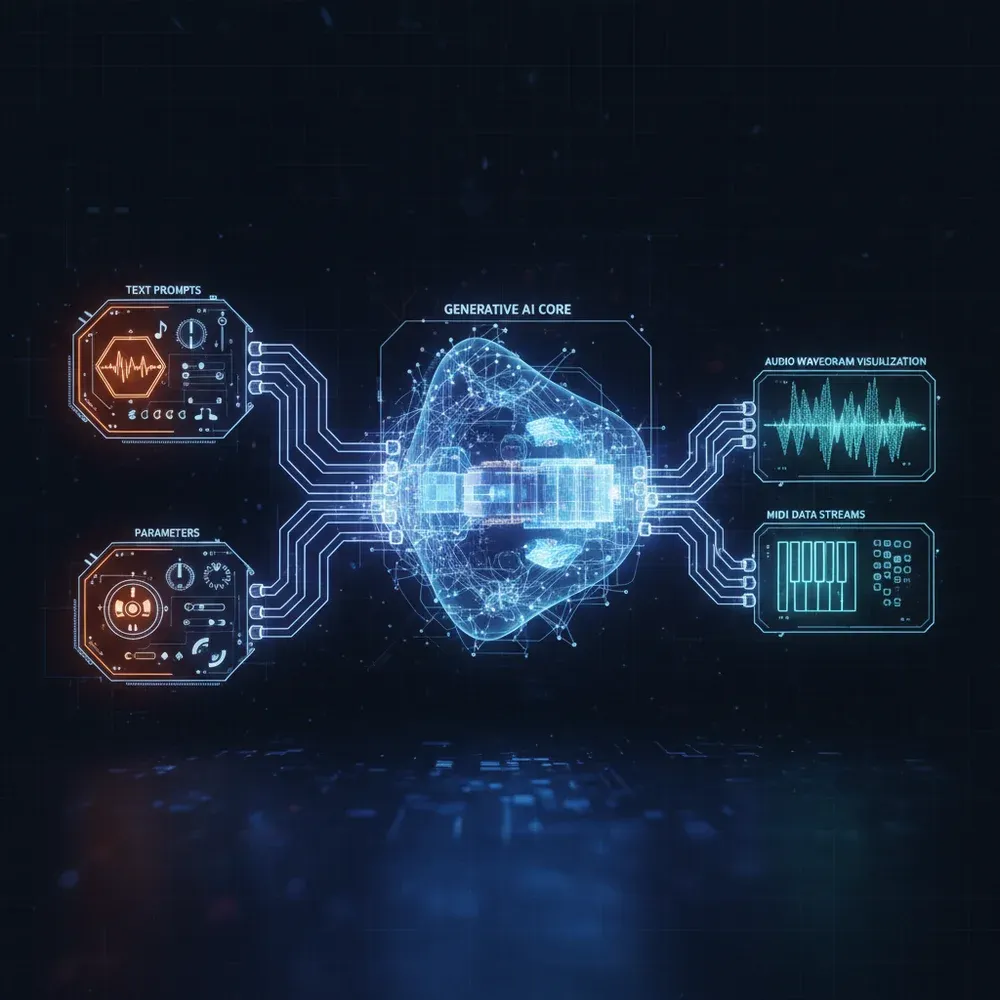
Generative Models and Neural Networks in Service of Music
The first step in the process is tokenizing the music. The neural codec converts the continuous audio waveform into discrete, compressed musical tokens. These tokens operate on two levels: semantic tokens (which encode melody, rhythm, and musical structure) and acoustic tokens (which contain timbre, texture, and fine details).
The transformer network then operates on these tokens. Based on the text prompt, the model predicts the sequence of semantic tokens, building the skeleton of the song. This phase is responsible for musical creativity and controllability. Subsequently, the diffusion model converts these semantic tokens back into high-resolution acoustic tokens, and finally into a raw audio waveform.
Achieving Structural Awareness and Long-term Coherence
Lyria 3's biggest breakthrough is structural awareness. This was achieved by introducing a hierarchical attention mechanism. The model doesn't just look at the immediately preceding notes; it also maintains a higher-level, abstract representation of the entire song.
This mechanism allows the model to remember the melody of the chorus and bring it back later in the song, perhaps with different instrumentation, but recognizably. This technological feat elevates Lyria 3 from a mere "sound generator" to a true "composer" capable of building musical narratives.
Use Cases and Applications: Who Will Lyria 3 Bring Breakthroughs To?
📌 Use Case Examples: Industry Applications
- Marketing & Advertising: Dynamically generated, royalty-free background music tailored to the campaign's mood.
- Game Development: Adaptive music systems where the score reacts in real-time to player actions.
- Customer Service: Unique hold music matching the brand identity for AI telephony systems.
- Software Development: Building music apps, DAW plugins, and creative assistants via API integration.
Thanks to its versatility, Lyria 3 can bring a revolution to almost any industry where sound plays an important role. Companies that recognize this early and integrate AI into their revenue growth strategy can gain a significant competitive advantage in content production speed and cost-efficiency.
For Developers and AI Engineers: New Integration Opportunities
Access via the Gemini API provides an unparalleled opportunity for developers. They can build custom music applications, automated podcast editing tools, or even RAG-based AI chatbots that can respond to users not just with text, but with uniquely generated songs.
The Lyria 3 Pro API endpoints allow for fine-tuning parameters, so developers can build their own musical logic around the model. For example, a fitness app developer could create a feature that plays real-time generated, motivating music tailored to the user's heart rate.
For Content Creators and Artists: Expanding the Creative Workflow
For YouTubers, streamers, and podcasters, licensing music has always been a pain point. Copyright strikes can ruin a channel's monetization. With Lyria 3, content creators can generate unique, 100% royalty-free tracks in seconds that perfectly match the edit and mood of their video.
For music producers, Lyria 3 is an inexhaustible source of ideas. If a producer is stuck writing a melody, they can use AI to generate dozens of variations, pick the best one, download the stems, and finish the piece in their own studio. This human-machine synergy is the future of modern composition.
For Businesses and Marketing Professionals: Building a Unique Sonic Brand
Branding is not just about visuals; sonic branding is equally important. Creating custom jingles, ad music, and campaign scores previously required expensive studio time. An average marketing agency can spend thousands of dollars a month on premium stock music.
By integrating Lyria 3, these costs can be drastically reduced. Furthermore, it enables hyper-personalized marketing: a data processing AI agent can analyze user preferences and generate ad music in real-time that resonates most with the specific target audience.
For Game Development and Interactive Media: Adaptive Musical Experiences
Composing music for video games is a unique challenge, as the music must adapt to the unpredictable actions of the player. The traditional method is stringing together pre-written, short musical loops. However, using the Lyria 3 API, game developers can create true procedural, adaptive music engines.
Imagine an RPG game where the intensity, instrumentation, and tempo of the battle music change in real-time based on how much health the player has or what type of enemy they are facing. This level of immersion was previously unimaginable, but with the speed of the Gemini API and Lyria 3's capabilities, it becomes reality.
Integrating Lyria 3 via the Gemini API: A Step-by-Step Guide
The true power of the technology is revealed when developers integrate it into their own systems. Google has integrated the Lyria 3 models into the existing Gemini API infrastructure, so for those who have already worked with Google's language models, music generation will be a familiar process.
It is important to note that Lyria 3, and especially Lyria 3 Pro, are currently available in a "paid preview" phase. This means that access requires a proper Google Cloud account, configured billing, and occasionally special approval on the Google AI Studio interface.
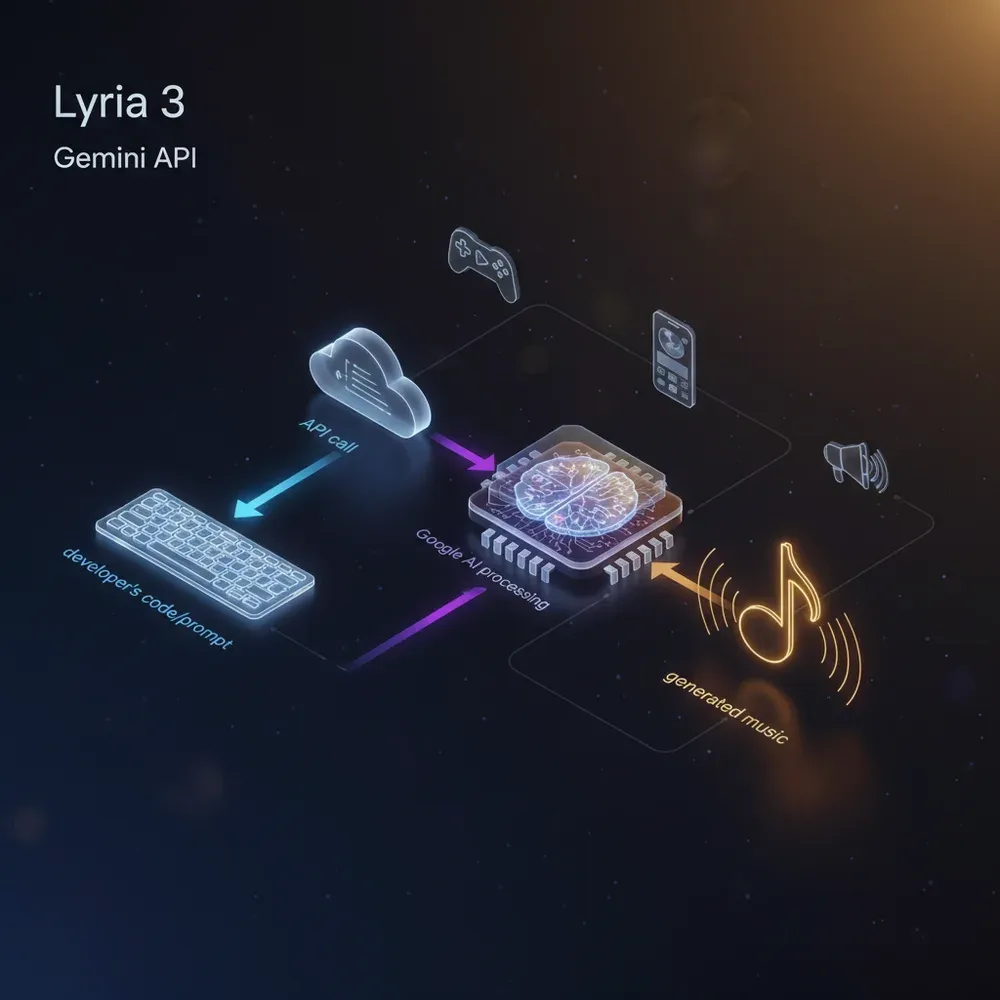
Accessing the Gemini API and Lyria 3 Paid Preview
The first step is creating a project in the Google Cloud Console and enabling the Gemini API. Once we have the API key, our development environment (whether it's Node.js, Python, or a modern web frontend) needs to be prepared for REST API calls or using the official Google AI SDK.
Calling Lyria models differs from standard text generation. The endpoints operate asynchronously, as generating a multi-minute song can take seconds or even minutes. Developers must implement a "polling" mechanism or webhooks to query the status of the generation.
Basic Workflow and Prompts for Music Generation
The core of Lyria 3 API requests is a well-structured JSON payload. Alongside the prompt, we can specify several parameters that fine-tune the final result. Here is a conceptual example of an API request structure:
{
  "model": "models/lyria-3-pro",
  "prompt": "An epic cinematic orchestral piece in D minor. Starts with a slow cello solo, then builds up to a massive brass and percussion climax at 2 minutes.",
  "parameters": {
    "duration_seconds": 180,
    "genre": "cinematic orchestral",
    "mood": "epic, dark, building",
    "export_stems": true
  }
}
The response returns a job ID. When the job finishes, the API provides a download URL for the generated audio file (usually in high-quality WAV or FLAC format), and in the case of the Pro version, a ZIP file containing the separated stems.
Tips for Achieving Best Results and Troubleshooting
Prompt engineering is crucial for music as well. The best results are obtained when the prompt includes musical terminology (e.g., tempo, key, specific instruments, dynamic instructions). Avoid overly generic descriptions like "good music for a video." Instead, use specific descriptions: "120 BPM synthwave track with a pulsating bass and arpeggiated analog synths."
A common mistake is providing overly complex, contradictory instructions in a single prompt. If the model gets confused, the music can become chaotic. It's worth working iteratively: first, generate a shorter 30-second snippet, and if the direction is right, use it as a reference to request the longer version.
Challenges and Ethical Considerations in AI Music Generation: Questions for the Future
📌 Ethical Dilemma: The Question of Originality
If an AI learns from songs written by millions of people and then creates a new one, who owns the copyright? The developer, the user who wrote the prompt, or the original artists whose works the model trained on? Legal frameworks are currently struggling to keep pace with the rapid technological advancement, while the industry searches for fair compensation models.
While the technological achievements are impressive, AI music generation raises serious ethical and legal questions. Plagiarism and copyright infringement have always been sensitive issues in the history of the music industry. The emergence of generative models amplifies this problem exponentially.
Copyright and Ownership for AI-Generated Content
Google DeepMind places a strong emphasis on safety and legal compliance. For the Lyria models, they introduced SynthID technology, which embeds an inaudible digital watermark into the generated audio waveforms. This allows platforms (like YouTube) to identify AI-generated content and prevent the spread of deepfakes.
However, the issue of training data remains controversial. Although big tech companies claim they train their models on licensed or publicly available data, artists are increasingly demanding transparency and an "opt-out" option. In the future, new legal categories will likely be created to protect AI-assisted works.
The Role of Creativity, Originality, and the Human Touch
Can a machine create true art? Lyria 3 generates technically flawless music, but many critics argue it lacks that inexplicable "human touch," the soul born of imperfection that makes the greatest hits immortal. The machine does not feel pain, joy, or love; it merely calculates mathematical probabilities.
Therefore, the most likely scenario is not the replacement of human musicians, but the transformation of their roles. The composer of the future will be more of a "musical director" who shapes, curates, and infuses the raw material generated by AI with human emotions. AI will become part of the toolkit, just like the synthesizer or autotune.
The Future of Music with AI: Human-Machine Collaboration in the Studio
The future of studio work clearly points towards collaboration. Lyria 3 and similar models will soon be natively integrated into popular Digital Audio Workstations. Imagine a composer playing a simple piano melody, and the AI orchestrating it for a full symphony orchestra with a single button press, taking the composer's style into account.
This collaboration accelerates experimentation. Artists can create in genres and orchestrations they previously had no experience in. The technology breaks down the technical barriers between the musical idea and the realized piece, allowing pure creativity to take center stage.

What the Industry Says: The Impact of AI Music Generation on the Music Industry and Creative Economy
Industry analysts predict that the AI music generation market will grow exponentially over the next five years. The business models of stock music libraries and "royalty-free" providers could be in serious jeopardy, as why would someone pay for pre-written, generic music when an AI can generate a completely unique track for the same price?
At the same time, new business models are emerging. "AI music prompt engineers" are appearing, specializing in getting the best results out of these models. Record labels might start licensing the voice and style of their famous artists, allowing fans to create remixes or new songs in their idol's style using official AI tools.
Ready for Musical Innovation? Partner with Us for AI Music Generation!
The integration of Google DeepMind's Lyria 3 and the Gemini API is just the beginning. If your business wants to leverage the opportunities AI offers in content production, enhancing customer experience, or automating internal processes, the AiSolve team is ready to help.
Our experts assist in implementing the latest technologies. Whether it's complex website development integrating generative AI features, or setting up an AI phone customer service with unique, dynamic hold music, we make your vision a reality. Contact us and elevate your company's digital presence to a new level!
Conclusion: Lyria 3 – A New Horizon for Music Creation and Our Role
The arrival of Lyria 3 in the Gemini API sends a clear message: AI music generation has stepped out of the experimental phase and arrived on the stage of professional use. The technology is capable of creating long, complex, and emotionally resonant musical pieces, democratizing music creation for developers, content creators, and businesses alike.
Although ethical and legal questions still need clarification, the direction of progress is unstoppable. Companies and creators who learn to use these systems as tools and "creative partners" will gain an insurmountable advantage. The music of the future will be written not only through instruments but also through code and prompts.
Frequently Asked Questions (FAQ)
How does AI music generation work, and what distinguishes Lyria 3 from previous models?
AI music generation uses neural networks trained on massive datasets to recognize musical patterns and synthesize new audio waveforms. Lyria 3 differs from previous (e.g., RNN-based) models by employing advanced transformer architectures and diffusion models, enabling it to maintain long-term structural coherence (like verse-chorus structure) and produce studio-quality (48 kHz) sound.
Is Google DeepMind Lyria 3 free to use, or is it a paid service?
The Lyria 3 and Lyria 3 Pro models are accessible via the Gemini API and currently operate on a "paid preview" model. This means developers must pay through the Google Cloud platform based on a pay-as-you-go pricing structure, charged per second of generated music or compute capacity used.
What are the copyright and ownership implications for AI-generated music?
The legal landscape is currently evolving. The main question is who owns the copyright to the generated work, and whether the creators of the copyrighted works used to train the model are entitled to compensation. Google uses SynthID watermarking technology to make AI content traceable, but full legal clarification is still pending.
Can AI music completely replace human composers and performers?
It is unlikely. While AI may capture a significant market share in functional music (e.g., background music, stock audio, ad jingles), artistic self-expression, the magic of live performances, and human storytelling will remain irreplaceable. AI will serve more as a powerful new instrument and assistant for musicians.
How can developers and businesses integrate Lyria 3 into their own applications or services?
Developers can request access to the Gemini API via the Google Cloud Console. Integration is done through REST API calls or official SDKs. During the process, JSON-formatted prompts and parameters (e.g., style, length, stem separation) are sent to the server, which asynchronously generates and returns the finished audio files.
What types of music can Lyria 3 generate, and how versatile is it across different styles?
Lyria 3 is incredibly versatile. It can create in almost any genre, from classical orchestral pieces to modern pop, hip-hop, electronic dance music (EDM), and ambient soundscapes. Notably, it can also create hybrid styles (e.g., "cyberpunk jazz") and generate highly realistic vocals.
Which industries stand to benefit most from AI music generation and Lyria 3's capabilities?
The biggest winners will be content creators (YouTubers, podcasters), marketing and advertising agencies (custom campaign music), game development studios (adaptive, procedural music), and software developers who can build new, innovative music applications and creative tools around the technology.
Készen állsz a saját weboldaladra?
Ingyenes konzultáció során átbeszéljük, hogyan segíthetünk vállalkozásodnak növekedni egy modern, gyors és konverzióoptimalizált weboldallal. 14 nap alatt kész, 0 Ft induló költséggel.