Where We Started – The Need for Digitalization
Our client, Ruhaimport Kft., started operations in 2009 with the goal of offering premium quality second-hand clothing imported from Europe — primarily England — to the Hungarian market. Over fifteen years, the company built a stable market position: regular shipments, reliable quality grading, and personal customer relationships defined the operation.
However, the demands of the digital era fundamentally changed. A portion of the customer base now exclusively researches and purchases online; the new generation of retailers browse webshops rather than calling by phone; competitors are appearing on more and more digital channels. It became clear: having excellent merchandise is not enough — the digital presence must also stand up to competition.
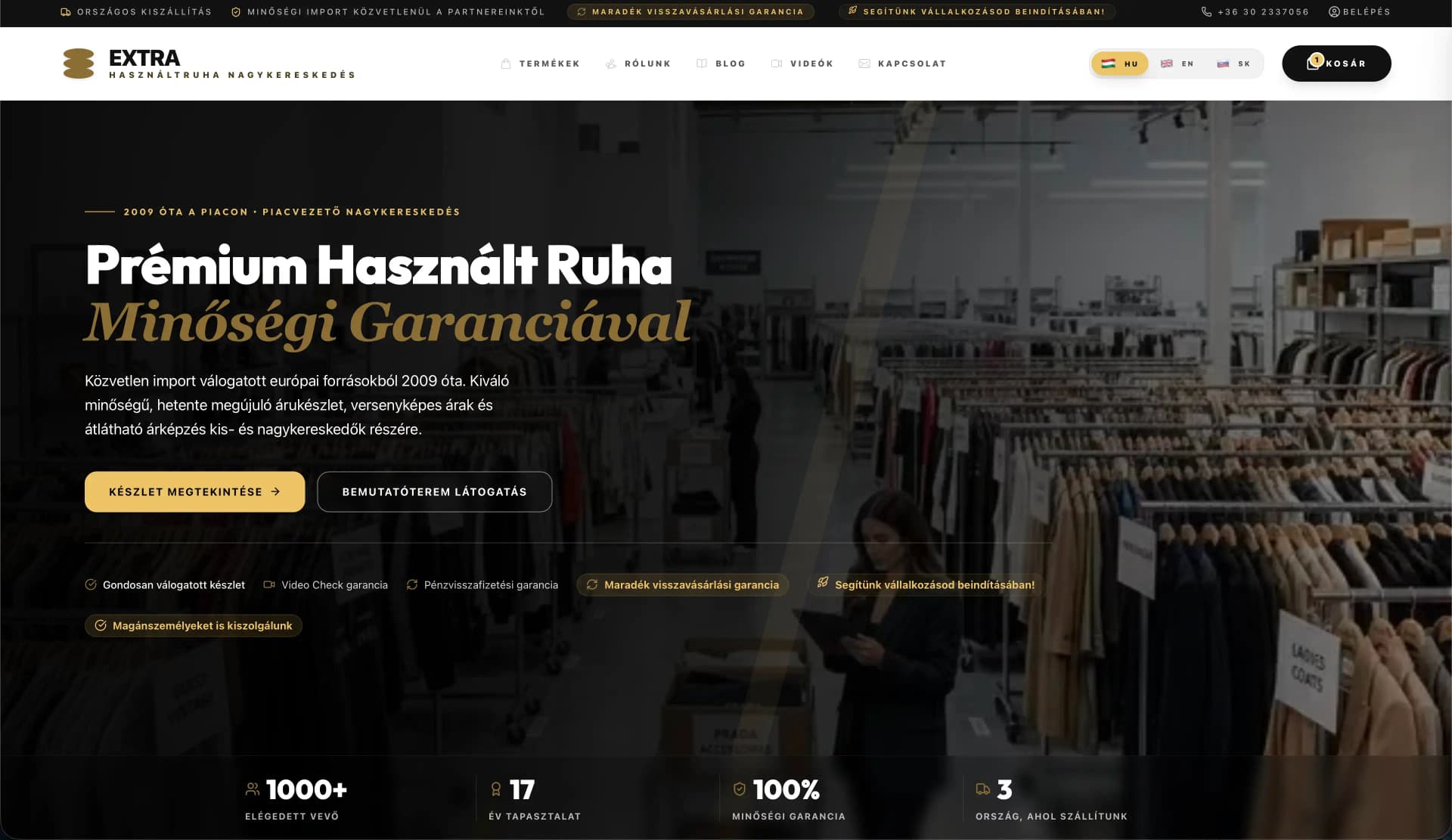
When Ruhaimport Kft. first approached us, it was clear: they needed more than just a webshop. The AiSolve team was tasked with designing and building a complex, integrated digital platform that provides transparent product presentation and online ordering for both B2B and B2C customers, automates invoicing and order management, offers trust-building tools like video inspection, enables multilingual service, and provides a strong administrative backend — all in a single, maintainable system.
The Technology Foundation – Why Next.js and Why Now?
The frontend-backend choice is one of the most critical decisions in an e-commerce project. For our team, the two main criteria were performance and SEO efficiency — a webshop must load quickly, and the content on product pages must be indexable by search engines.
Our decision landed on Next.js App Router architecture, which has several serious advantages over the traditional, purely client-side approach. By combining server-side rendering (SSR) and static generation (SSG), product pages load blazingly fast while dynamic content (cart, ordering process) updates in real time.
We implemented TypeScript throughout the entire project in strict mode. This initially means slower development, but in the long run drastically reduces runtime errors. The Sharp library handles image processing: every uploaded product photo automatically converts to WebP and AVIF formats. Modern image formats result in 30-50% smaller file sizes at equal quality, directly impacting page load speed and conversion rate.
"The technology stack is not self-serving — every single tool answers a real business problem, whether it's load speed, SEO accessibility, or long-term maintainability."
Database and Backend Architecture
We designed the data management layer following Clean Architecture and Domain-Driven Design (DDD) principles. Business logic is strictly separated from database queries and UI code — each layer has a well-defined responsibility.
The database engine is PostgreSQL 16, with Prisma ORM providing type-safe access. The Prisma schema is the single source of truth for the entire system's data model: TypeScript types, database migrations, and query methods all generate from it.
The system works with a schema organized around seven main domains: Products (per-kg pricing, quality grades, images, videos), Orders (separate shipping and billing addresses, Stripe status, invoice number), Invoices, Customer CRM, multilingual BlogPosts, admin Users with 2FA, and ShopSettings as a singleton configuration.
The main advantage of layered architecture is that business rules are independent of the database and UI. If a database needs replacing in the future, or an API needs to be built around it, the business logic doesn't need rewriting — only the outer layers are swapped.
The Webshop and User Experience
When designing the user experience, our team had to simultaneously satisfy two extremely different buyer profiles: the bulk B2B buyer thinking in per-kilogram pricing and tonne-quantities — and the individual buyer looking for a few bags of clothing for resale.
Products are displayed with per-kilogram pricing, mirroring wholesale logic digitally. The buyer enters the desired quantity in kilograms, and the system automatically calculates the total and shipping cost. Minimum order quantity and quantity step are configurable per product — ensuring smaller packaging units don't disrupt logistics.
The cart runs entirely client-side, on React state and localStorage, preserving its contents between page loads. At checkout, however, full server-side validation runs — prices, shipping fees and availability are re-verified, excluding potentially manipulated client-side data.
The payment flow runs on two parallel channels: Stripe Checkout Session for immediate card payments and cash-on-delivery (COD) for those preferring bank transfer or in-person pickup. Stripe integration ensures the highest level of PCI compliance without card data ever reaching the own servers.
The Video Check – Trust in the Digital Space
The main obstacle to online second-hand commerce is lack of trust. When someone spends tens of thousands of forints on a bag of clothing whose contents they can't see in advance, that feels like a natural risk. The classic approach is for the webshop to show nice pictures and describe the quality class — but the buyer can't truly verify this before purchasing.
At the client's request, we built a custom solution: the Video Check system. The concept is simple but effective: before purchasing, buyers can request a video inspection of the item they're considering. The Ruhaimport team physically opens the bag or bale on camera — so the buyer sees exactly what they're getting.
Video Check is not just a feature — it is the platform's business differentiator. It builds trust capital that competitors cannot simply copy, as it requires not only software but operational culture and commitment. Videos are displayed on the homepage and product pages, keeping the trust-building message present throughout the entire user journey.
Automated Invoicing and Finance
For a wholesale business, invoicing is not optional — it's a legal obligation. Manual invoice issuance is time-consuming, error-prone, and doesn't scale well with growing order volume. We therefore fully integrated the Számlázz.hu API and Stripe payment system into the platform.
For card payments, the successful Stripe event immediately triggers automatic invoice generation and confirmation email. For bank transfer orders, the system also reconciles incoming bank account statements with open orders via API connection. If the transfer is identifiable, the order status automatically updates, the invoice is issued, and the customer receives a notification email — without any manual intervention. This three-way automation (Stripe + bank transfer + Számlázz.hu) ensures financial processes keep pace with order volume without administrative burdens growing proportionally.
Full automation on both payment channels. Card payment: order → Stripe → event → invoice → email. Bank transfer: incoming transaction → API reconciliation → order update → invoice → email. The administrator only needs to intervene in exceptional cases, such as refunds or erroneous orders.
Multilingual – Cross-Border Commerce
We designed the platform from the ground up in three languages: Hungarian (hu), English (en), and Slovak (sk). Multilingualism is handled by next-intl, natively integrated with the Next.js App Router. The URL structure is locale-prefix based: /hu/termekek, /en/products, /sk/produkty — each page is accessible at a unique URL, which is also optimal for SEO.
Translation content lives in structured text files, completely separated from the code. Blog posts are linked through translation groups: one piece of content can be published in three different locales, the system automatically linking them with the appropriate hreflang tags, helping Google index the correct language version. Dynamic metadata (OpenGraph, Twitter Card, page title) are also localized.
The Admin Panel – The Control Center
A modern e-commerce platform is only as good as it is easy to use for the team working with it daily. We built the admin panel as a full CMS and CRM system, providing access to every dimension of the business in a unified interface.
The dashboard entry screen greets the administrator with KPI cards: total orders, total revenue, active products count. The monthly revenue chart is rendered by Chart.js — the traffic trend is immediately visually clear. The product management page is one of the most complex interfaces: category, quality class, per-kg price, minimum order quantity, step size, description, images and videos — all in a single, well-structured form.
The customer CRM module links order history, contact data and newsletter subscription status to every buyer. The integrated blog CMS manages content in three languages on a unified editor. Slugs are auto-generated, featured image upload works drag-and-drop, and posts can be saved as drafts before publishing.
Admin authentication is handled by NextAuth.js. Passwords are encrypted with bcryptjs at 10 salt rounds. Two-factor authentication (2FA) is also available, implementing TOTP algorithm with QR-code setup (e.g. Google Authenticator, Authy). New administrators are guided by an interactive onboarding tour on first login, reducing learning time and the likelihood of human errors.
Summary and Outlook
The extrahasznaltruha.hu platform is the result of a digital transformation led by AiSolve — where every technological decision is backed by a concrete client need. Next.js App Router ensures SEO efficiency and performance; Prisma and PostgreSQL provide reliable, type-safe data management; Stripe and Számlázz.hu integration automates financial processes.
Future development directions include enhancing the search and filtering experience, introducing a loyalty program, and improving the mobile native experience. The automation potential is also significant: AI-based product description generation and image-based quality assessment are directions on the future roadmap.
"A good platform doesn't just enable what you do today — it prepares your business for what it can become tomorrow."
The extrahasznaltruha.hu project proves that traditional industries based on personal relationships can benefit enormously from modern software architecture — when development truly serves the business's needs. We are proud that AiSolve could partner with Ruhaimport Kft. to build a platform of 2026 technological standards, helping them continue what they've always done: delivering reliable, quality merchandise to people.
Want a similar platform for your business?
Just like we did for Ruhaimport Kft., the AiSolve team can build your next-level digital platform — from strategic planning to live launch.
Frequently Asked Questions
Why did AiSolve choose Next.js for this project?
The Next.js App Router enables server-side rendering and static generation simultaneously. Product pages load quickly (SSG), dynamic features update in real time (SSR), and search engines can fully index content — all essential for e-commerce.
What is the Video Check feature and how does it work?
Video Check is a trust-building system: before purchasing, buyers can request a video inspection of the item they're considering. The team physically shows the contents of the bag or bale on camera, so the buyer knows exactly what they're getting — eliminating most purchasing uncertainty from the online sales process.
How does the automated invoicing work for bank transfers?
The system receives the incoming bank account statement via API connection and automatically reconciles it with open orders. If the transfer is identifiable, the order status updates, the Számlázz.hu invoice is issued, and the customer receives a notification email — without any manual intervention, exactly like with Stripe card payments.
Why is Clean Architecture important for an e-commerce platform?
Layered architecture ensures business rules are independent of the database and UI. If a component needs replacing in the future — whether it's the database, payment provider, or frontend framework — the other layers remain untouched.
What security measures did AiSolve implement on the admin panel?
Passwords are stored encrypted with bcryptjs at 10 salt rounds. The admin panel supports two-factor authentication (2FA) using TOTP algorithm with QR-code setup (e.g. Google Authenticator). Webhook endpoints run cryptographic signature verification, excluding unauthorized access.
Készen állsz a saját weboldaladra?
Ingyenes konzultáció során átbeszéljük, hogyan segíthetünk vállalkozásodnak növekedni egy modern, gyors és konverzióoptimalizált weboldallal. 14 nap alatt kész, 0 Ft induló költséggel.