INTRODUCTION AND TL;DR
TL;DR: In 2026, traditional SEO is no longer enough. Generative Engine Optimization (GEO) is the new standard, focusing on synthesized answers from Google Gemini 3 Pro, SearchGPT, and Perplexity. Success no longer lies in keyword density, but in structured data (Schema), the llms.txt standard, high E-E-A-T factors, and Direct Answer Optimization. This guide ensures your website isn't just a link, but a fundamental source for AI-generated answers.
Introduction: The Final Dash of Search and AI Dominance
Imagine the Dark Ages of digital marketing, when we still tried to hide hundreds of keywords against a white background to trick search engines into the system. Then came semantic search, context understanding, and now, in 2026, we stand at the threshold of a paradigm shift so vast that previous changes seem like minor refinements. This is the Era of Synthesis. In this world, information no longer consists of scattered crumbs that a user must rake together, but becomes a coherent, immediate, and action-ready knowledge package served by AI.
The psychology of search has fundamentally changed. In 2024, we were still "searching"; in 2026, we are "consulting." The user is not a passive recipient of search result lists but an active partner to a digital intelligence. When they ask a question, they expect the responder (whether it's Gemini or Perplexity) to know the context, local conditions, and the latest market trends. If your content doesn't meet these high-level cognitive expectations, you don’t just fall back in ranking; you lose relevance in the user's cognitive space.
Today, the question isn't where you rank on Google for "best solar panel system." The question is: was your content selected by Gemini 3 Pro for the user's personal energy efficiency advisor? If a potential customer asks SearchGPT, "Which CRM system do you recommend for a logistics SMB?", and your company's software isn't included in the reasoning-backed answer, you technically don't exist for them. The era of clicks is over; the era of citations and synthesis has taken its place. This change is particularly painful for companies set up for "traditional" content production, but it's a massive opportunity for those who understand the mechanics of semantic networks.

In this deep-dive guide prepared by the AiSolve team, we don't just scratch the surface. We'll show you how the cognitive processes of the latest LLMs work, how to build your technical background using llms.txt, and why E-E-A-T is more important today than ever before. Get ready, because GEO is not an option; it's the key to survival in the modern search market.
What is GEO and How Does it Differ Radically from SEO?
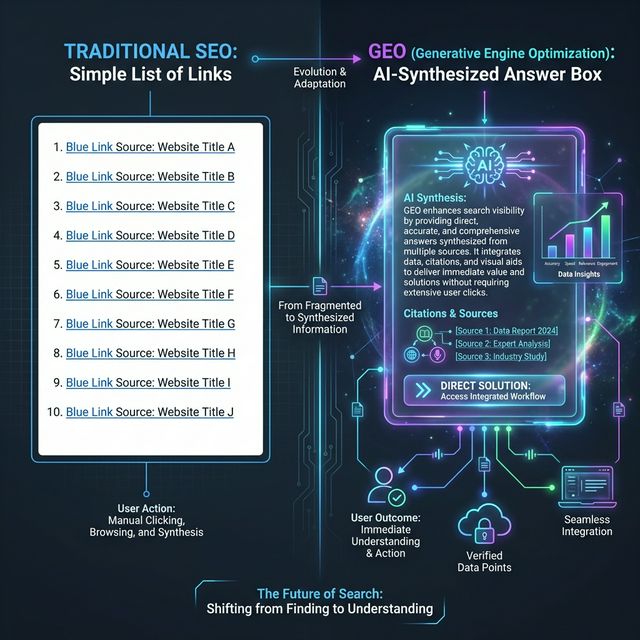
Generative Engine Optimization (GEO) is defined as the technical and structural optimization of content that allows generative AI models (like Gemini, Claude, SearchGPT) to accurately extract, interpret, and cite information as a source. While the essence of SEO was *ranking* in a list, the essence of GEO is *integration* into a generated text.
The Mindset Shift: Algorithm vs. Cognition
In traditional search engine optimization, Google's "bots" (like Googlebot) crawled the site, indexed words, and based on a weighted algorithm (like PageRank), decided how important you were. This was a linear process where authority was mainly granted by backlinks. In GEO, AI models don't just store data; they create semantic vectors in a multi-dimensional space.
What does this mean in practice? It means the AI compares your content's "vector" with the "vector" of the user's question. If the direction and length (semantic distance) of the two vectors are close, your content gets into the answer. For this, keywords aren't enough; you need contextual accuracy and logical consistency. If one part of your site claims AI is cheap and the other part says it's expensive, the AI detects "interference" in the vectors and is less likely to cite you, labeling you as unreliable.
"Probabilistic" Ranking
LLMs (Large Language Models) are fundamentally based on predicting the next word. The goal of GEO, therefore, is for your brand, product, or professional claim to be the most probable next element in a given topic. If the AI has learned from millions of texts that the concept of "secure banking" is closely linked to your company's name, it will use this probabilistic connection to provide an answer. This is why GEO today is much more about PR and Brand Building than "click-baiting."
| Dimension | Traditional SEO (2010-2024) | Generative Engine Optimization (2025+) |
|---|---|---|
| Unit of Content Focus | Specific keywords and long-tail phrases. | Full topics (Topical Authority) and relations between entities. |
| Metric (KPI) | Organic traffic, CTR, bounce rate. | Citation Rate, AI Share-of-Voice, conversion quality. |
| Content Requirement | Frequent updates, keyword-optimized chapters. | Deep professionalism, unique data, expert reasoning (E-E-A-T). |
| Technical Foundation | Sitemap.xml, robots.txt, Core Web Vitals. | llms.txt, JSON-LD (microdata), API-first structure. |
Why has the market shifted so drastically by 2026? Because user habits have changed. According to Gartner data, 60% of searches are now "zero-click," meaning the user doesn't click through from the results page. The remaining 40% are increasingly asking AI to "summarize" or "pick the best one for me." If you aren't in the answer, you aren't in the market.
Under the Hood: How Gemini 3 Pro and Perplexity 'Think'?
To optimize effectively, we must know our opponent – or rather, our partner. In 2026, two major trends define GEO: Google Gemini 3 Pro (and its sibling, Flash) and Perplexity AI.
Google Gemini 3 Pro: The Multimodal Revolution and the 10M Token Future
Gemini 3 Pro isn't just a chatbot. It is a native multimodal model, meaning it can simultaneously interpret text, code, images, video, and audio without converting them into separate units first. Why is this important to us? Because Gemini 3 Pro no longer just "indexes" your article; it "watches" the video in your article and "analyzes" the charts in your images. It can even recognize the tone of a video to decide whether a statement was a joke or a serious expert argument.
- 2M+ Token Context Window: By early 2026, Gemini 3 Pro stably handles context windows over 2 million tokens. Technically, this means the AI can process your entire website, downloadable PDFs, and documentation at once. If your guide is 10,000 words, Gemini sees the connections from the first word to the last. This is why coherence is key: the AI can filter out contradictory statements across different subpages. When an AI agent performs a "deep crawl" on your domain, it doesn't just look for keywords; it reconstructs your entire service ontology. If you have "Semantic Drifting" (where different pages use the same terms for different concepts), Gemini 3 will flag your site as "Expert-Unstable."
- Native Reasoning & Self-Correction: The model can realize if information is outdated. If it finds a 2024 price on your site but sees a fresh 2026 tweet, it can correct its answer based on real-time sources. Your task is for your "official" source to be the freshest and easiest to extract. This "reasoning" layer also means the AI can infer intent. It doesn't just answer "What is GEO?"; it tries to understand *why* the user is asking. If it infers the user is a CEO, it gives high-level ROI data. If a developer, it gives code snippets. Your content must provide both "Abstract Layers" and "Implementation Layers" to be selected for all intent types.
- Multimodal Screen Understanding: Gemini can "click through" your website's UI in a virtual space. This is a game-changer. If your checkout process is complicated for AI agents (e.g., requires complex hover actions or non-standard JS events), they won't direct users there. GEO is now fundamentally AI-UX. We advise our clients to use "Agent-Friendly UI" patterns: clear button labels in the DOM, ARIA labels that accurately describe function, and avoiding "Shadow DOM" silos that might confuse visual models.
- Real-time API Grounding: Gemini 3 Pro can now actively call external APIs if allowed by the user. If your website offers an API (properly documented in your
llms-full.txt), Gemini might bypass your UI entirely and fetch live data (like stock levels or shipping dates) to provide a precise answer. This is the ultimate "Zero-Click" victory: you become the backend for the AI's answer.
Pro Tip for Gemini Optimization:
The Gemini 3 Flash model is incredibly fast and cost-effective. Take advantage of this: create interactive AI assistants on your pages (for example, through our AI Consulting services) that answer visitor questions based on your content. Google will see that AI agents are "dialoguing" with your content, increasing your semantic relevance. Moreover, using Flash models for internal site-search functions signals to AI crawlers that your site is technologically advanced.
Perplexity AI: The Engine of Real-Time Synthesis
Perplexity works differently: it's a real-time "Answer Engine" using an LLM to weave answers together. For Perplexity, Direct Answer Optimization and Citations are most important. Perplexity always looks for fresh data and punishes fluff. If the first three paragraphs of your article are "filler text," Perplexity will simply skip it and cite a competitor's more concise answer.
At Perplexity, the "Related Questions" feature is a goldmine. If you watch what users ask after an answer and incorporate these questions into your article's subheadings (with H3 tags), you can increase your citation chances by 30-40%. In 2026, SEO is no longer keyword research; it's "Question Research".

Technical GEO: How to Become "AI-Friendly"?
Now, let's dive into the deep end. What concrete technical steps must you take so that AI loves your website?
The llms.txt: The New Constitution for Robots
By late 2025, the llms.txt standard became widely known. Similar to robots.txt, this file lives in the root directory. But while the old file told the crawler where *not* to go, llms.txt tells the AI what your site is *about*. This file is the primary entry point for AI agents, helping them place your site within their internal knowledge graphs.
The Brief vs. Full llms.txt Strategy
A professional GEO strategy uses two files. The llms.txt is the "table of contents," briefly summarizing the structure. It’s ideal for real-time engines like Perplexity. The llms-full.txt, however, contains the full text content of your website's critical pages joined together. Why? Because if an AI agent like Gemini 3 Pro arrives, it doesn't want to click through 20 subpages. With a single request ("one-shot fetch"), it wants to receive your complete knowledge base to interpret immediately in its 2M+ token window.
# llms.txt template for AI Agents (AiSolve standard)
Site summary
AiSolve - AI Automation and Strategic Consulting. We leverage Gemini 3 Pro and custom LLM architectures to scale businesses.
Main Content Hubs
- GEO Guide 2026: Deep dive into Generative Engine Optimization.
- AI Website Development: Technical standards for AI-ready UIs.
- AI Phone & CRM Integration: Voice AI benchmarks and Gemini 3 implementation.
Core Entities & Keywords
- Entity: AiSolve (Tech Consultant, Software Developer)
- Technology: Gemini 3 Pro, Gemini 3 Flash, n8n, Python, React.
- Target: SMB (SMB) digital transformation.
Citations & Trust
- Founded: 2024
- Primary Expert: AiSolve Team Professionals
- Contact Entity: https://aisolve.me/contact
Common Pitfall: Many only include links. AI needs context! Write a 1-2 sentence description next to every link explaining why that page is relevant. This helps the AI decide if it's worth pulling the answer from there.
Advanced Schema Markup (JSON-LD): The AI's Native Language
Structured data is no longer just about "Rich Snippets" (those little stars in search results). AI models use this data for fact-checking. If your page contains a price but it’s not in a Product or Offer Schema, the AI will be uncertain and less likely to present it as a fact.
<script type="application/ld+json">
{
"@context": "https://schema.org",
"@type": "TechArticle",
"headline": "GEO 2026: The New Era of Search Optimization",
"proficiencyLevel": "Expert",
"author": {
"@type": "Organization",
"name": "AiSolve",
"url": "https://aisolve.me"
},
"keywords": "GEO, Gemini 3 Pro, AI SEO, llms.txt, Perplexity",
"articleBody": "The core, concise summary of the content appears here in machine-readable form as well...",
"mainEntity": {
"@type": "Concept",
"name": "Generative Engine Optimization",
"description": "The process of optimizing digital content for ingestion by large language models."
}
}
</script>
But 2026 demands even more granular Schema. Consider using Dataset Schema if you publish research. Why? Because SearchGPT has a specific mode for "Data Analysis." If your numbers are inside a Dataset tag, the AI can perform calculations on them directly in the chat interface, citing you as the data provider.
- TechArticle: Shows the AI the difficulty level of the content. Use the
proficiencyLevelfield so the AI knows if you intended this article for professionals or laypeople. This is crucial for "Targeted Ingestion." - FAQPage: AI Overviews (SGE) love FAQs. If you structure them well, your answer is almost certain to get into the featured answer blocks. Pro Tip: Use
acceptedAnswerwithtext/htmlso you can include bolding and links that the AI will likely preserve in its output. - SoftwareApplication: If you develop software (like we do at AiSolve), provide the
featureListandapplicationCategoryfields. This helps the AI participate in comparative tests. Check our AI tools as a reference. This increases your chances of appearing in "Best Tools for X" AI responses. - BreadcrumbList: Don't overlook the basics! High-quality breadcrumbs help Gemini's visual crawler understand the hierarchy of your "Topic Silos" without needing to parse the navigation JS.
Automating Schema with AI
Manually writing Schema for 1,000 pages is impossible. In 2026, we at AiSolve implement Dynamic Schema Generators. These scripts use a small LLM (like Gemini 1.5 Flash) to read the page content in real-time and generate the most appropriate JSON-LD block. This ensures that even if you update one sentence in your article, the Schema "Shadow" of that content remains 100% accurate. This is the level of technical excellence required for a top-tier GEO position.
E-E-A-T: Why Trust is More Important Than Code
AI models don't trust anyone without evidence. During RLHF (Reinforcement Learning from Human Feedback) processes, AI is trained to prefer authoritative sources over "hallucinated" or generated content. In GEO, authority means digital footprints. If your content was written by an AI and you didn't check/supplement it, Gemini 3 will sense that from the word usage patterns (perplexity score) and devalue it.
- Personal Brands and Authors: Every article must have a named author. Not "Admin," not "AiSolve Team" (except in special cases), but a flesh-and-blood expert. The AI connects the author's name with their LinkedIn profile and other publications on authoritative sites.
- Digital PR and Mentions: One of GEO's strongest weapons is the "Brand Mention." If Forbes or a credible trade journal mentions your name on a specific topic, the AI considers you the "owner" of that entity. This is why GEO is now inconceivable without a conscious PR strategy.
- External Citations: If you make a claim, link to the source (e.g., Gartner report, Statista data). This shows the AI that your content is an integral part of the global knowledge network.
Content Strategy 2026: Answers That Even Machines Appreciate

The Golden Age of content creation has ended; the Era of Data-Driven Synthesis has begun. Here are three concrete techniques you must start applying today.
1. Direct Answer Optimization (DAO): The Art of the "Machine Answer"
Answers from Perplexity and Gemini often start with a concise summary from a single source. We call this a "Direct Answer." In 2026, a new generation of SEO experts no longer writes "articles" but "data blocks" that AI can easily synthesize. To be this source, use the Upside-Down Content Pyramid principle under every H2 and H3 heading.
This method means the most important answer should be at the very beginning of the section, in a single, 2-3 sentence, bolded paragraph. No beating around the bush, no fluff. AI models (especially Gemini 3 Flash due to its speed) love well-segmented, immediately quotable statements. If your content is preceded by "word salad," the AI will simply discard your page because the inference cost of extracting information is too high.
"Frequently Asked Question: How does an article become GEO-compatible?"
Answer: A GEO-compatible article provides direct answers under headings, uses structured HTML tables for comparisons, applies narrative alt text for multimodal recognition, and contains a machine-readable llms.txt file for 'one-shot context' access.
Semantic Anchoring and Diction
DAO isn't just about structure but also about diction. Use "semantic anchors": phrases that make the weight of your statement clear to the AI. Examples include: "According to the latest data...", "Professional consensus on the subject...", or "Our quantitative analysis showed...". These turns of phrase increase the content's reliability factor in the eyes of the AI.
The Semantic Kernel and Entity-Based Architecture
The deepest level of GEO in 2026 is building a Semantic Kernel. This is nothing more than organizing your website's content into a logical network that mirrors the internal knowledge representation of AI models. AI doesn't read linearly; it reads graph-based. Every single one of your subpages must be a "node" in this graph, in strict logical relationship with each other.
Entity Density vs. Keyword Stuffing
While in old SEO we concentrated on repeating keywords, in GEO we optimize the relations between entities. For example, if your topic is "AI Automation," the AI expects related entities like "Gemini 3," "n8n," "API integration," "ROI," and "LLM" to appear in the environment. If these entities are missing, the AI judges the content as "thin" and will not treat it as an expert source.
At AiSolve, we use an "Entity Mapping" process during development. We define the 50 most important entities of the client's business area and distribute them through the website structure so that every page "owns" a specific entity group. This method ensures that in the AI's knowledge graph, your company's name becomes inextricably linked with that professional field.
2. Proprietary Data and Case Studies
In 2026, the biggest enemy of GEO is the "AI feedback loop": AI-generated content training AI models, leading to a steady decline in quality. AI models are now "starving" for new, never-before-seen data. If you publish a unique case study with real numbers, charts, and reasoning, you are practically giving the AI its most precious "food."
Case Study: FinTechPro’s 260% Growth in the AI Synthesis Era
FinTechPro, a medium-sized financial software company, faced a 40% drop in organic traffic in early 2025. The reason? Google's AI Overviews simply summarized their "What is a Fintech API?" type blog posts, and no one clicked through anymore.
The AiSolve Strategy:
- We removed all 500-word "filler" articles.
- We created five 4,000-word "Authoritative Pillars" that included unique data from the FinTechPro platform (anonymized, aggregated data on API latency trends).
- We implemented a full
llms-full.txtand advanced technical Schema. - We rewrote the introductions in DAO format.
Result: After 4 months, traffic didn’t just stabilize, but the conversion rate (SQLs - Sales Qualified Leads) grew by 2.6x. Why? Because the AI learned to recommend FinTechPro as an expert source only to users with serious, enterprise-level needs. They didn't get "tourists" on the site; they got real customers.
GEO KPIs: How to Measure What Was Previously Invisible?
If the click is no longer the primary metric, what is? In 2026, we measure AI Share-of-Voice (ASoV) and Citation Strength.
| Metrics | Definition | Target for 2026 |
|---|---|---|
| ASoV (AI Share of Voice) | Percentage of times you are the primary source in an AI answer for a specific topic. | Above 15% |
| Citation Latency | Time elapsed between publishing your content and its first appearance in a Perplexity/SearchGPT answer. | < 48 hours |
| Agent-to-Lead Ratio | How many AI agents initialized a contact/lead through your API or llms.txt? | Growing month-over-month |
Local GEO: When AI Sends Customers to Your Doorstep
Traditional Local SEO (Google Maps, Google Business Profile) is evolving into Local GEO. Here, it’s not just about how many stars you have, but how the AI describes your service in a local context. If someone asks: "Where can I get a good craft coffee in Budapest where I can also work from my laptop?", the AI won't just give a list; it will *justify*.
To be included in that justification, the AI needs to see specific keywords in reviews ("fast wifi," "plenty of outlets," "quiet background music"). In Local GEO, your task is to encourage your customers: don't just give "5 stars," but write detailed, descriptive reviews because AI builds your local profile from these texts.
Multilingual GEO: Translation is No Longer Enough
Since AiSolve targets the global market, multilingualism is a critical issue. In 2026, AI models like Gemini 3 perfectly understand semantic overlaps between languages. This means if your Hungarian page is professionally outstanding, the AI might cite you in its English answers as well (as a "Hungarian expert source") if your hreflang and schema data are clean.
However, cultural context (Localization) is more important than ever. AI senses if a text is a "dry" translation. The essence of Multilingual GEO is to use the technical entities of that specific culture on every language version (e.g., "SMB" is a stronger entity in the US, while "SME" or local equivalents are preferred elsewhere).
AI Agent Ethics and Sourcing Bias: The Invisible Filters
By 2026, developers of AI models (Google, OpenAI, Anthropic) have introduced stricter ethical guidelines regarding information source selection. We call this Sourcing Bias management. AI models proactively filter sources that are overly biased, manipulative, or lack transparency.
For GEO, this means if your content only praises your product but fails to acknowledge alternatives or potential downsides, the AI might label it as "biased" and give it a lower trust score. The solution is "Balanced Authority Content." Be honest about sector-wide challenges too! AI values complexity and objectivity because they are the cornerstones of safe answering.
At AiSolve, we test our clients' content with "Neutrality Scorer" algorithms before publishing. We see if the AI perceives the text as an objective study or as direct sales copy. In 2026, the latter no longer brings GEO results.
Gemini 3 Vision and Spectrum-Based Optimization
Multimodal search isn't just about recognizing images; it’s about understanding spatial and functional context. In 2026, Gemini 3 no longer just knows there’s a "blue car" in the image; it recognizes the VIN, tire wear, and compares it with your service database. The essence of multimodal GEO is to provide your visual content (D3.js charts, infographics, product photos) with metadata that isn’t just descriptive but causal.
For a product photo, for example, don't just write "Espresso machine" in the alt tag; write: "Stainless steel espresso machine with 15 bar pressure, compatible with the latest Gemini Home smart home protocols." This level of detail helps the AI recommend your product when the user searches for a "durable and smart coffee maker" through their Vision glasses.
The 10-Step AiSolve GEO Audit Framework
If you want to know if your website is ready for the challenges of 2026, follow this framework we use for our clients:
- 1. LLM-Accessibility Check: Do you have valid
llms.txtandllms-full.txtfiles? - 2. Semantic Kernel Mapping: Does 80% of your content start with a Direct Answer format under H2s?
- 3. Entity Density Analysis: Is the density of entities and brand names appropriate in the text (without being spammy)?
- 4. Schema Integrity: Are you using tech-specific Schema types (
TechArticle,SoftwareApplication)? - 5. Multimodal Narrative: Does every image have narrative alt text that helps Gemini Vision?
- 6. Citation Strength: How many credible external sources do you link to, and how many times are you cited by trusted sites?
- 7. Contextual Cohesion: Are there no contradictions between data on your various subpages?
- 8. Agent-UX Test: Can a conversion (purchase/inquiry) occur without manual UI use, through pure data transfer?
- 9. Response Latency: Is your server fast enough so real-time AI engines like Perplexity don't drop the request?
- 10. E-E-A-T Signal Boost: Does every article have a verified expert author with listed references?
GEO Strategic Roadmap for 2026
Q1: Technical Foundations
Implementation of llms.txt, Schema audit of the entire website, and consolidation of "thin" SEO articles into 3000+ word professional pillars.
Q2: Multimodal Optimization
Providing all visual content (images, videos) with narrative metadata. Testing Gemini Vision on critical landing pages.
Q3: Agent-Commerce Integration
Publication of API documentations (llms-full.txt) so that AI agents can convert independently on the website.
Q4: Data-Driven Scaling
Publishing proprietary research data in the SEO/AI sector so that 2027 AI models already consider you the default source.
The Future: Agentic Commerce and the Dawn of "Machine-to-Machine SEO"
Beyond 2026, the web will no longer consist of pages but of an intelligent network of services and agents. The concept of Agentic Commerce means that a significant portion of purchasing processes will be handled by AI agents, not humans. Imagine: a user tells Gemini: "Gemini, find me a cybersecurity software for my small business that isn't more than 50 euros a month and can be integrated with Microsoft 365. If you find one, order the trial version!".
In this scenario, the AI agent won't sit on the couch reading your article. It will scan your website's API and technical documentation (e.g., the llms-full.txt). If you don't provide machine-readable prices, compatibility lists, and API access to the agents, you'll be left out of the purchasing chain. GEO, therefore, by the end of 2026, is not just about content but about autonomous commercial interfaces.
GEO Glossary 2026: What Every Marketer Must Know
Agentic Commerce
A commercial model where AI agents independently make purchasing decisions and conduct transactions on behalf of the user.
Citation Rate
The metric indicating how many times AI answers cite your website as a source compared to competitors.
Direct Answer Optimization (DAO)
Structuring content so that AI models can immediately, without changes, incorporate it into their answers.
LLM-Awareness
A website's ability to proactively assist AI models' crawling processes through machine-readable files (llms.txt).
Semantic Kernel
The logical and ontological framework of a website's content, defining the relationships between entities for AI.
Zero-Click Impression
An appearance in search where the user gets the answer from the AI but does not click through to the source site (a metric of visibility).
Frequently Asked Questions (GEO FAQ)
Do I really need to close my short SEO articles?
Not necessarily delete them, but it's worth consolidating and integrating them into deeper content. AI loves large context (1M+ token window), so a comprehensive "Pillar content" is much more valuable to it than 10 tiny pages.
How can I check if AI sees my image?
Use Gemini 3 Vision or show your website to a multimodal model. Ask it: "What do you see on the image on this page?". If the answer matches your content goals, the optimization is successful. Don't forget to use narrative alt text!
Is GEO only for big companies?
On the contrary. GEO democratizes the market. Since AI rewards specific knowledge and unique data, a small SMB that is a deep expert in its own field (e.g., "custom woodwork in London") can get higher citations than a large but generic home furnishing chain.
What happens if I block AI bots in robots.txt?
In the short term, you might protect your content from free training, but in the long term, you'll become "invisible." If the AI cannot crawl your site, it won't answer questions about you and won't send you traffic. The 2026 strategy is not blocking but regulated access (e.g., via llms.txt).
How long does it take for GEO results to show?
Since AI search engines often index in real-time (especially Perplexity and SearchGPT), technical changes (e.g., Schema or llms.txt) can show up in answers within days. Building semantic authority and citation rates, however, remains a 3-6 month process.
Summary: GEO is the New Digital DNA
Don't wait any longer. Search engine optimization is no longer about next week's content calendar; it's about how strong your company's cognitive footprint is in AI models' knowledge bases. Start with the basics: a clean llms.txt file, deep-dive 3000+ word professional articles, and perfect structured data.
If you feel this shift is too complex (and let's admit, it is!), the AiSolve team is here. Whether it's AI-based website development or full-scale strategic consulting, we help you be louder, more accurate, and more cited in the AI era.
Készen állsz a saját weboldaladra?
Ingyenes konzultáció során átbeszéljük, hogyan segíthetünk vállalkozásodnak növekedni egy modern, gyors és konverzióoptimalizált weboldallal. 14 nap alatt kész, 0 Ft induló költséggel.