
In today's hyper-competitive business landscape, making decisions based on gut feelings is increasingly risky. Companies that ignore the potential hidden within their data are falling behind. According to Forrester research, data-driven organizations are growing at an average of more than 30% annually and are far more likely to outperform their competitors. Data-Driven Decision-Making (DDDM) is no longer an optional luxury; it's a fundamental requirement for survival and sustainable growth. This strategy allows companies to make strategic, tactical, and operational choices based on objective facts rather than assumptions. This comprehensive guide will walk you through the fundamentals, process, tools, and transformative power of data-driven decision-making. We'll explore how modern technologies, such as data processing AI agents, can help extract valuable business intelligence from raw data.
| Terület / Area | Kulcsfontosságú Megállapítás / Key Insight |
|---|---|
| Core Concept | DDDM bases decisions on the analysis of relevant, verified data instead of intuition, reducing risks and increasing accuracy. |
| Business Impact | It increases revenue, optimizes operational costs, improves customer experience, and provides a significant competitive advantage in the market. |
| Process | It's an iterative cycle that spans from defining objectives, through data collection, processing, and analysis, to measurement and refinement. |
| Technology | BI tools, databases, cloud platforms, and AI-powered systems like data processing AI agents form the backbone of modern DDDM. |
| Cultural Shift | Beyond technology, the success of DDDM requires a corporate culture that values data, supports experimentation, and prioritizes objectivity. |
What is Data-Driven Decision-Making (DDDM)?
Data-Driven Decision-Making (DDDM) is a strategic approach where decisions are based on the analysis of relevant and verified data, rather than on gut feelings, personal experience, or anecdotal evidence. The essence of the process is for companies to systematically collect, process, and analyze data to gain deeper insights into market trends, customer behavior, internal operational efficiency, and other critical business areas. The goal is to shift from decisions based on "what we think" to those based on "what we know."
This methodology contrasts with traditional, often hierarchical decision-making models where the experience and intuition of leaders are the primary guides. While experience remains valuable, DDDM supplements it with objective data, thereby reducing the risk of human error and bias. In a data-driven organization, decisions about marketing campaigns, product development, or resource allocation are backed by concrete metrics, A/B test results, or predictive models. This approach makes decisions more transparent and justifiable at all levels of the organization.
Why is DDDM Crucial for Modern Businesses?
Transitioning to a data-driven operation is not just a technological upgrade; it's a fundamental business strategy that yields tangible benefits. Companies that successfully implement DDDM outperform their competitors in almost every area. One of the most significant advantages is increased profitability. According to Nucleus Research, companies see an average revenue increase of 8-10% from investments in analytics tools. By leveraging data, firms can identify the most profitable customer segments, optimize their pricing strategies, and reduce unnecessary expenses.
Another critical area is the improvement of operational efficiency. From supply chains to HR processes, data helps uncover bottlenecks, automate repetitive tasks, and better allocate resources. Furthermore, DDDM enables a deeper understanding of customers. By analyzing customer behavior, preferences, and feedback, companies can create more personalized products, services, and marketing messages, which increases customer satisfaction and loyalty. Last but not least, a data-driven approach makes companies proactive: instead of reacting to problems, they can predict market changes and potential risks, allowing them to act in a timely manner.
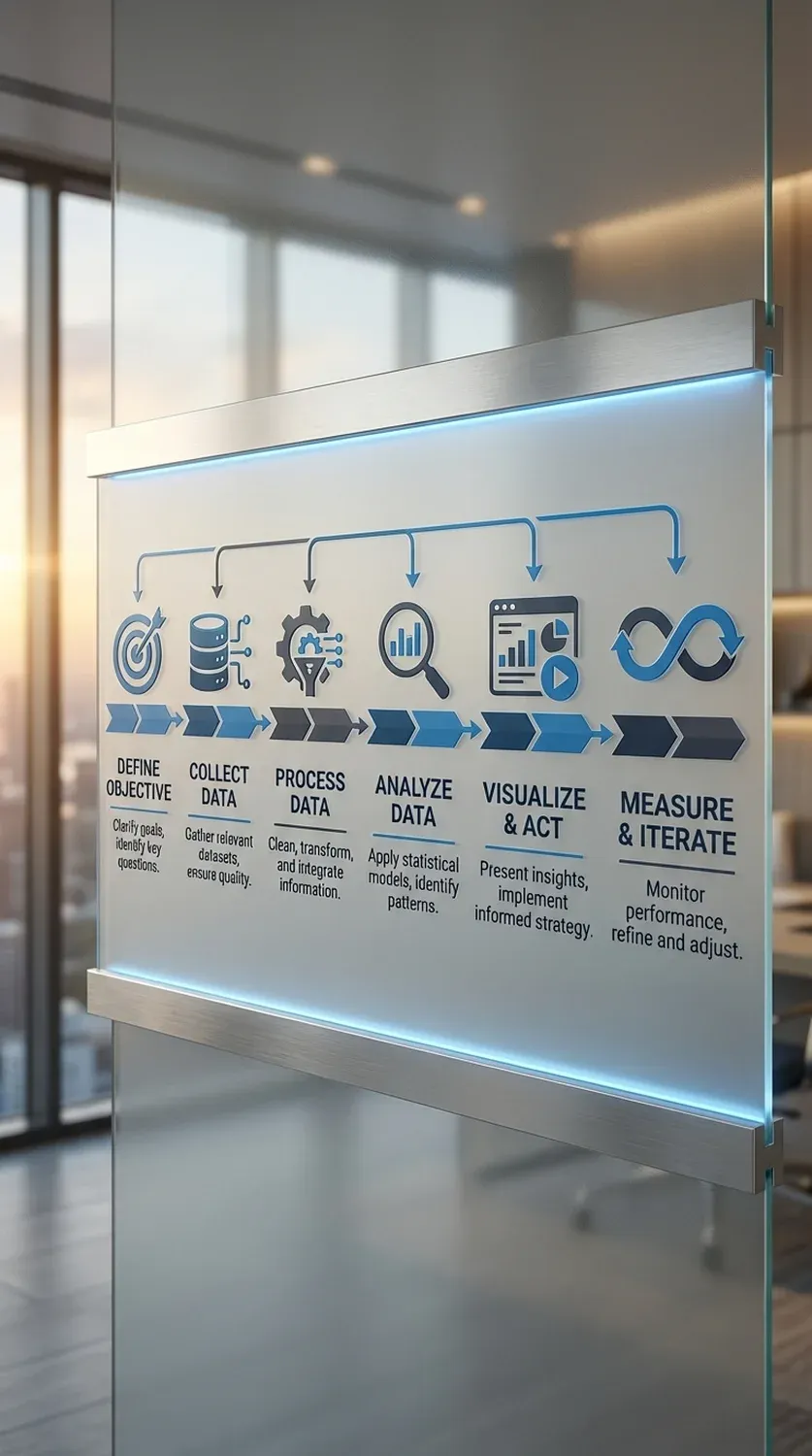
The DDDM Process: A Step-by-Step Breakdown
Data-driven decision-making is not a one-time event but a continuous, iterative cycle. While the specific steps may vary depending on the industry and problem, most DDDM processes consist of the following fundamental stages, which ensure a structured and effective approach.
1. Define Objectives and Ask Questions
Every data-driven project begins with a clear business question or objective. What are we trying to solve or achieve? For example: "How can we reduce customer churn by 15% in the next quarter?" or "Which marketing channel provides the highest return on investment (ROI)?" A well-defined goal serves as a compass for the entire process.
2. Data Collection
Once the objectives are set, the next step is to collect the relevant data. Data can come from internal sources (e.g., CRM, ERP systems, website analytics) and external sources (e.g., market research, social media, public databases). It is crucial that the collected data is relevant, accurate, and reliable.
3. Data Processing and Cleaning
Raw data is rarely ready for analysis. This stage involves cleaning the data (handling errors, duplicates, missing values), transforming it (formatting, normalization), and structuring it. This step is critical, as poor-quality data (garbage in, garbage out) leads to flawed conclusions. Modern companies increasingly rely on automated tools, such as efficient data processing AI agents, to accelerate and improve the accuracy of this labor-intensive phase.
Strategic Insight: Automating data processing is one of the highest-return investments you can make. AI-powered tools not only save time but also reduce the potential for human error, ensuring higher quality datasets for analysis.
4. Data Analysis
Once the data is clean and structured, the analysis can begin. Various statistical and machine learning techniques are applied to uncover patterns, correlations, trends, and anomalies in the data. The type of analysis depends on the question being asked and can be descriptive (what happened?), diagnostic (why did it happen?), predictive (what will happen?), or prescriptive (what should we do?).
5. Visualize Results and Make a Decision
The results of the analysis and the conclusions drawn from them must be presented to decision-makers in an understandable format. Data visualization tools—such as charts, graphs, and interactive dashboards—are key to making complex information easily digestible. Based on clear visualizations, leaders can make informed, data-driven decisions.
6. Measure, Monitor, and Iterate
The process doesn't end after a decision is made. It is vital to track the impact of the decision and measure the results against the original objectives. This feedback loop allows for the refinement of the strategy and continuous learning, ensuring that the organization gets better and better at using data in the future.
Key Technologies and Tools in the DDDM Stack
Effective data-driven decision-making requires a robust technological foundation, or a "DDDM stack." This stack consists of various interconnected tools and platforms that cover the entire data lifecycle. For modern organizations, this stack typically includes the following components:
| Component | Description | Examples |
|---|---|---|
| Data Sources | Systems that generate and store raw data. | CRM (Salesforce), ERP (SAP), Web Analytics (Google Analytics), Social Media APIs |
| Data Integration Tools (ETL/ELT) | Tools that extract data from sources, transform it, and load it into a central repository. | Fivetran, Talend, Informatica, custom scripts |
| Data Storage | Centralized systems for storing large volumes of structured and unstructured data. | Data Warehouses (Snowflake, Google BigQuery), Data Lakes (Amazon S3), SQL/NoSQL Databases |
| Data Analysis & Processing Platforms | Frameworks and platforms for performing complex data analysis and processing tasks. | Apache Spark, Databricks, and increasingly sophisticated data processing AI agents. |
| Business Intelligence (BI) & Data Visualization | Tools used to turn analysis results into interactive reports and dashboards. | Tableau, Microsoft Power BI, Looker, Qlik |
Choosing the right tools depends on the company's size, industry, and specific needs. A small business might find a combination of Google Analytics and Power BI sufficient, while a large enterprise will need a complex, cloud-based data warehouse and advanced machine learning platforms to handle its massive data volumes.

The Role of Artificial Intelligence in Decision-Making
Artificial intelligence (AI) and machine learning (ML) are revolutionizing data-driven decision-making, going far beyond the capabilities of traditional business intelligence (BI). While BI primarily focuses on analyzing past data to answer the question "what happened?", AI looks to the future, enabling proactive and even automated decision-making.
AI enhances DDDM in three key areas:
- Predictive Analytics: AI models can analyze vast amounts of historical data to forecast future events and trends. For example, an e-commerce company can use predictive models to estimate customer demand, identify customers at risk of churning, or predict stock shortages. This allows companies to prepare for the future instead of just reacting to events that have already occurred.
- Prescriptive Analytics: This is the most advanced form of analytics, which not only predicts what will happen but also recommends what actions should be taken to achieve the best outcome. Prescriptive models simulate different scenarios and optimize decisions based on specified goals (e.g., maximizing profit, minimizing cost). An example is a dynamic pricing system that adjusts prices in real-time based on demand, competition, and other factors.
- Automation: AI enables the automation of routine data processing and decision-making tasks. Modern custom automation solutions and intelligent data processing AI agents can independently perform data collection, cleaning, analysis, and even make simpler decisions without human intervention. This frees up human experts to concentrate on more strategic, complex problems.
Implementation Advice: Start your AI integration with a well-defined problem that has high business value. Building a predictive model to forecast customer churn often yields quick, measurable results, making it easier to gain executive buy-in for further AI projects.
Common Challenges and Pitfalls in Implementing DDDM
Although the benefits of data-driven decision-making are undeniable, its implementation is not a seamless process. Organizations can face numerous technical, cultural, and strategic hurdles. Understanding and proactively addressing these challenges is crucial for a successful transition.
| Challenge | Description | Suggested Solution |
|---|---|---|
| Poor Data Quality | Incomplete, inaccurate, or inconsistent data leads to unreliable analyses and bad decisions. | Implement robust data governance policies, use automated data cleaning processes, and employ tools like data processing AI agents. |
| Data Silos | Data exists in isolation within different departmental systems, making it difficult to get a unified view. | Create a central data warehouse or data lake, and use data integration platforms to connect the silos. |
| Lack of Expertise | The organization lacks sufficient data analysts, data scientists, or employees who can understand and use data. | Launch internal training programs, hire key talent, and/or engage with external partners. |
| Cultural Resistance | Employees and leaders cling to traditional, intuition-based decision-making and are skeptical of data. | Lead by example from the top, communicate the success of data-driven projects, and democratize access to data. |
| Data Privacy and Security | Collecting and analyzing large amounts of data, especially personal data, raises significant privacy (e.g., GDPR) and security risks. | Develop strict data privacy policies, implement access controls, and use data anonymization and encryption. |

Strategies for Building a Successful Data-Driven Culture
Acquiring technological tools is just the first step. The true power of data-driven decision-making is realized when it becomes an integral part of the corporate culture. This means that at every level of the organization, data becomes the starting point for discussions and decisions. Building such a culture requires conscious and persistent effort.
- Start at the Top: The transformation must begin with leadership. Senior executives should not only support data-driven initiatives but also actively lead by example, basing their own decisions on data.
- Democratize Data: Break down data silos and make data and analytics tools accessible to as many people in the organization as possible. User-friendly BI dashboards can empower non-technical professionals to explore data and answer their own questions.
- Invest in Training: Provide training for employees on the basics of data literacy. You don't need to turn everyone into a data scientist, but it's important that teams understand metrics, can read charts, and know how to ask the right questions of the data.
- Start Small and Aim for Quick Wins: Don't try to transform the entire organization at once. Select one or two smaller, high-impact projects where a data-driven approach can quickly deliver visible results. These success stories will help convince skeptics and build momentum for further expansion.
- Reward Curiosity and Experimentation: Foster an environment where employees are encouraged to ask questions and test hypotheses using data. Don't punish failure; view it as part of the learning process. Establishing a culture of A/B testing is an excellent way to do this.
The Future of DDDM: Trends and Predictions
Data-driven decision-making is constantly evolving as new technologies emerge and the volume of data grows exponentially. In the future, the following trends are expected to shape the evolution of DDDM:
Real-Time Analytics: Decision-making windows are getting shorter. It's no longer enough for companies to rely on weekly or daily reports. Streaming data and real-time analytics platforms will allow companies to react instantly to market changes, such as an e-commerce site providing personalized offers to visitors in real time.
Hyperautomation and Autonomous Decision-Making: In the future, AI-powered systems, like advanced data processing AI agents, will make an increasing number of operational decisions autonomously, without human intervention. This could range from inventory management to optimizing marketing campaigns, enabling companies to operate much faster and more efficiently. For more complex, strategic decisions, RAG AI chatbot technology can provide instant, context-aware insights from vast internal knowledge bases.
Explainable AI (XAI): As AI models become more complex (e.g., deep learning networks), it becomes increasingly difficult to understand how they reached a particular conclusion. The goal of XAI is to make these "black box" models more transparent, which is essential in regulated industries (e.g., finance, healthcare) and for building user trust.
Data Fabric: Instead of moving all data to a central location, a data fabric is a flexible, intelligent architecture that virtually integrates data from different sources. This simplifies data access and management in complex, distributed IT environments.
Unlocking the value in your data isn't a future goal—it's a present-day business imperative. Effective data processing is the first and most critical step on the path to informed decisions. Are you ready to turn your raw data into a competitive advantage?
Discover Our Data Processing AI Solutions[Article generated by AiSolve AI Content System]
Frequently Asked Questions
What is the first step to implementing data-driven decision-making?
The first and most important step is to define a specific, well-defined business problem or objective. Don't start with the data; start with the question you need to answer. For example, instead of "let's analyze our customer data," the goal should be "identify the top 10% of customers at risk of churning." This focuses your efforts and ensures that the analysis creates real business value.
What is the difference between data-driven and data-informed decision-making?
In a data-driven approach, the data and the results of the analysis directly determine the decision. In a data-informed approach, data is just one factor among others, such as experience, intuition, and other qualitative factors. Both are valuable, but a data-driven strategy places a much higher weight on objective evidence.
What skills are needed in a data-driven team?
An ideal team has a mix of technical and business skills. You need data engineers to build the data infrastructure, data scientists to develop complex models, and data analysts to create business intelligence reports. Equally important, however, are business professionals who understand the context and can ask the right questions.
How do we handle privacy concerns during DDDM?
Data privacy should be a priority from the very beginning (Privacy by Design). Implement strict access controls to ensure employees can only access the data necessary for their jobs. Where possible, anonymize or pseudonymize data. Always comply with relevant data protection regulations, such as GDPR, and be transparent with your customers about your data handling practices.
Készen állsz a saját weboldaladra?
Ingyenes konzultáció során átbeszéljük, hogyan segíthetünk vállalkozásodnak növekedni egy modern, gyors és konverzióoptimalizált weboldallal. 14 nap alatt kész, 0 Ft induló költséggel.