
Introduction: Why Custom Automation is Crucial for Modern Enterprises?
In December 2025, with the launch of the Agentic AI Foundation and the strategic pivot of major tech giants (OpenAI, Google), it became clear: after the era of generative AI, we have arrived in the world of agentic AI. The question is no longer whether we can chat with a machine, but whether the machine can autonomously execute complex business processes under supervision.
For modern enterprises, the convenience of "off-the-shelf" software often comes at the expense of flexibility. Integrating a standard ERP or CRM system is frequently a struggle lasting months, and the result is still a compromise. In contrast, custom automation with AI agents is like recruiting a digital workforce tailored exactly to the company's specific needs.
The launch of the Agentic AI Foundation also signals that the market is ripe for standardized yet customizable agents. Companies investing now in their own internal AI infrastructure and custom agents not only gain efficiency but also build intellectual property that competitors cannot simply copy with a subscription.
Fundamentals of Custom Automation and Its Distinction from Standard Solutions
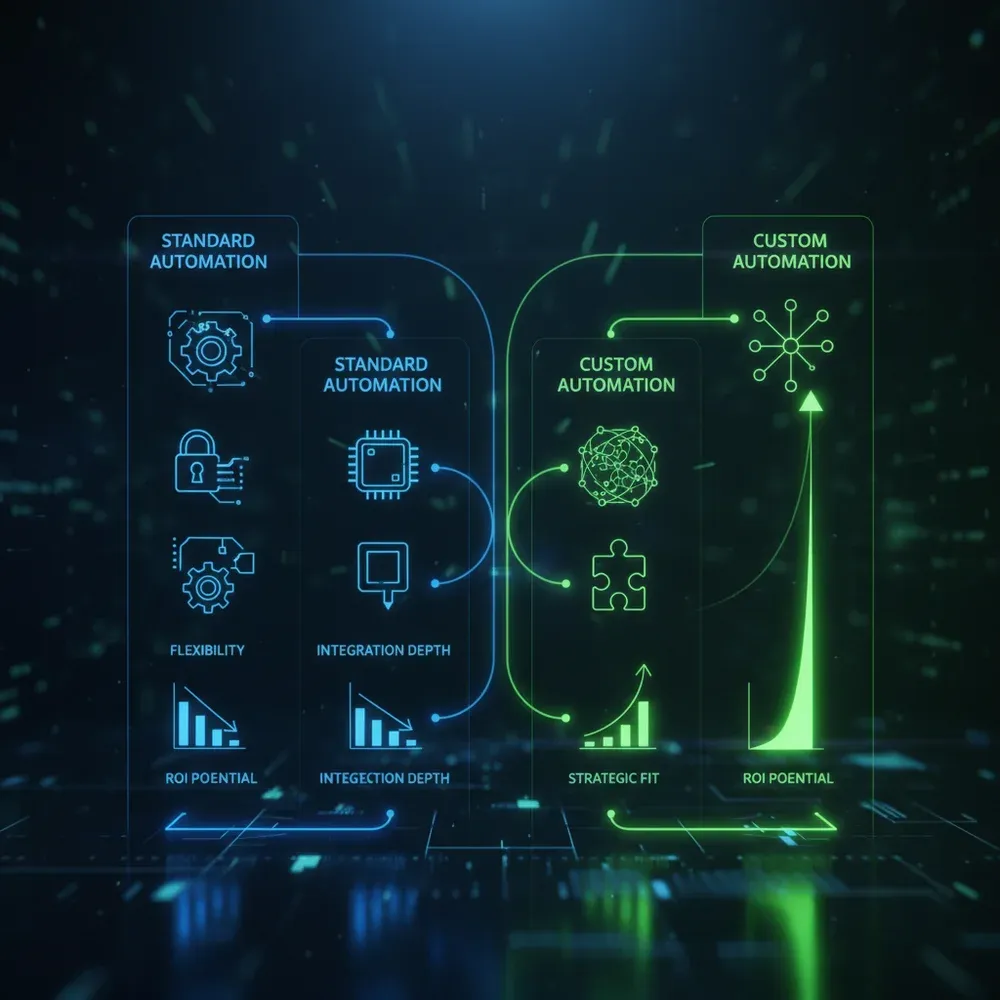
For many leaders, automation still equals rigid, rule-based systems (like traditional RPA) or simple integration platforms (like Zapier). While these have their place, they quickly reach their limits in complex enterprise environments.
Definition: Custom AI Automation
A software solution where the process is driven not by pre-written, static rules (if-then-else), but by Large Language Models (LLMs) and cognitive architectures. The system can interpret unstructured data, make decisions in uncertain situations, and dynamically adapt to changing inputs.
The main difference lies in adaptability. A traditional script crashes if the invoice format changes. An AI agent developed during custom automation, however, "reads" the invoice, recognizes the new layout, and continues processing without human intervention. This flexibility is critical in a rapidly changing market environment.
The Role of AI Agents in Custom Automation: New Opportunities and Capabilities
AI Agents are not just smarter chatbots. They are acting entities. A well-designed agent possesses perception (sees database changes, incoming emails), memory (remembers past interactions and context), planning capability (breaks down a complex task into steps), and tool use (can call APIs, run SQL queries).
For example, a specialized AI agent in logistics does not just flag a shipment delay, but:
- Automatically queries alternative routes.
- Calculates cost implications.
- Updates the order in the ERP system.
- Notifies the customer of the new expected arrival time in a personalized message.
This level of autonomy relieves human workers from repetitive but cognitively demanding tasks, allowing them to focus on strategic decisions. Agents can operate 24/7, scale according to demand, and process information at speeds humans cannot match.
Enterprise Challenges and Solutions: Ensuring Reliability and Scalability
One of the biggest fears of CTOs regarding AI adoption is the "black box" phenomenon and the risk of hallucinations. How can we trust critical business processes to a model that might occasionally err? The answer lies in robust architecture and monitoring systems.
Best Practices for Reliability:
- Deterministic Verification: AI decisions are checked by traditional code (guardrails). For instance, if AI initiates a $1 million transfer, a simple rule system can block this and request human approval.
- Human-in-the-loop (HITL): At critical points, the agent does not execute an action but prepares the decision for a human operator.
- Observability: Logging every step, chain of thought, and API call (e.g., using LangSmith or Arize AI) so that the chain can be traced in case of error.
Scalability is also a key issue. As discussed in our article on hardware innovations, running enterprise-grade AI can require significant resources. However, modern solutions support containerized (Docker/Kubernetes) agents that scale dynamically based on load, ensuring cost-efficiency and performance.
Seamless Integration: Embedding AI Agents into Existing Systems
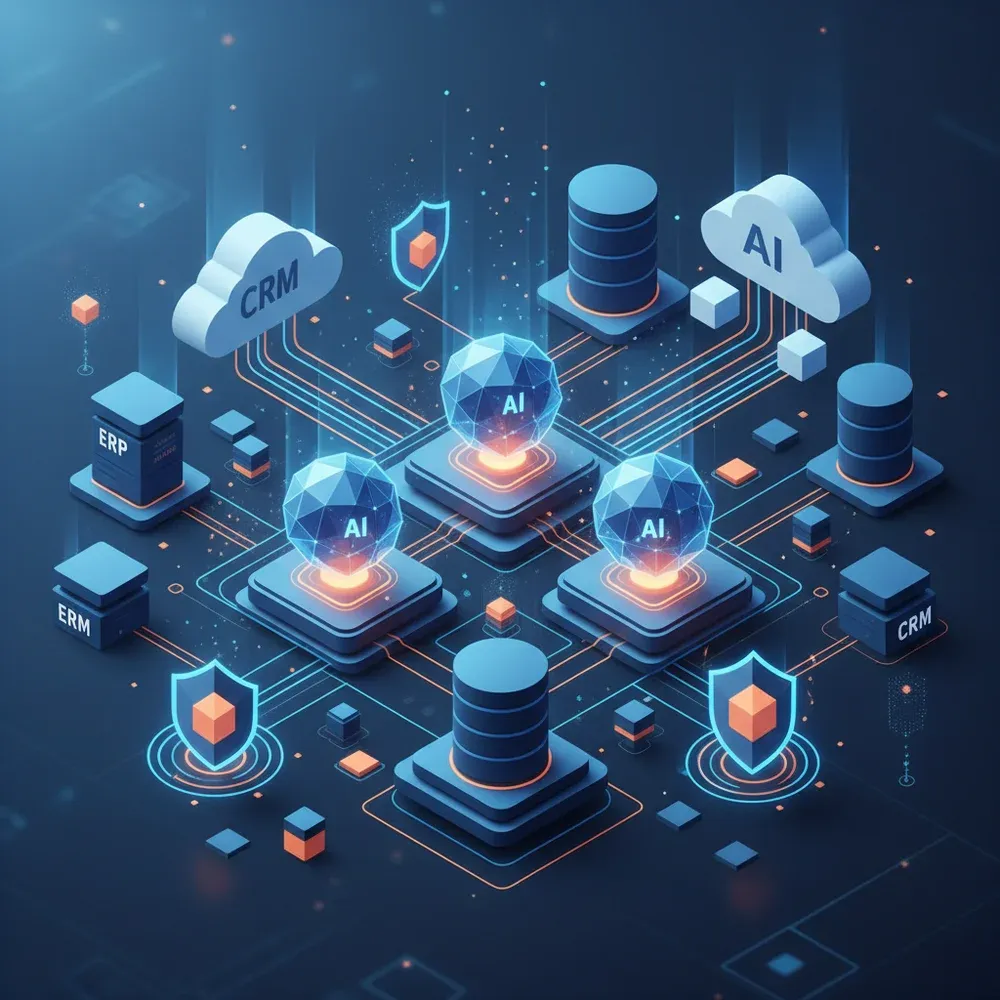
The biggest advantage of custom automation is that it doesn't require a complete overhaul of existing IT infrastructure. AI agents act as "glue" between different, often non-communicating systems (legacy software, modern SaaS solutions).
Technical implementation usually involves API-based integration. If an old system lacks an API, data processing AI agents can communicate via the user interface (like RPA, but smarter) or at the database level. Modern architectures often use an event-driven approach: for example, a message arriving in a Kafka topic (new order) automatically wakes up the appropriate agent to perform the necessary steps.
If your company struggles with integrating siloed systems, it is worth considering a custom automation solution that can bridge these gaps without waiting years for a new ERP implementation.
The Custom Automation Lifecycle: From Planning to Maintenance
A successful AI automation project doesn't end with development; in fact, that's where it begins. The lifecycle consists of the following main stages:
- Needs Assessment and Process Audit: Not everything should be automated with AI. Mapping processes helps identify bottlenecks and areas prone to human error.
- Proof of Concept (PoC): Building a small, fast prototype to validate feasibility and business value.
- Development and Training: Fine-tuning agent prompts (prompt engineering), populating the knowledge base (RAG), and integrating tools.
- Testing and Validation: Rigorous testing in a simulated environment, with special attention to edge cases.
- Deployment and Monitoring: Gradual rollout, continuous performance monitoring, and checking for model "drift".
This cyclical process ensures that automation remains sustainable and valuable in the long run, adapting to changes in corporate strategy.
Case Studies and Success Stories: Real-World Examples of Custom Automation
While specific corporate data is often confidential, industry trends and our experience clearly highlight successful application areas. In the financial sector, for example, automating "Know Your Customer" (KYC) processes with AI agents can drastically reduce turnaround time by up to 70% while improving compliance rates.
Case Study: Customer Service Transformation
A mid-sized e-commerce company implemented a RAG-based AI chatbot solution that not only answered questions but was also capable of modifying orders and handling refunds. The result: a 40% reduction in human support load and a 25% increase in customer satisfaction (CSAT).
In the manufacturing industry, we see breakthroughs in predictive maintenance. Here, agents analyze sensor data and not only alert but automatically order necessary parts and schedule the maintenance team with minimal disruption to production.

The Future Outlook: Where is Custom AI Automation Heading?
The future belongs to Multi-Agent Systems (MAS). In this setup, it's not a single omniscient AI trying to solve a complex problem, but a team of specialized agents working together. There will be a "Project Manager" agent dividing the task, a "Researcher" agent gathering data, a "Coder" agent executing technical steps, and a "Reviewer" agent validating the result.
This structure, as analyzed in our article on autonomous software development, results in much more robust and fault-tolerant systems. In future enterprises, humans will not perform the tasks but will be the conductors of these agent swarms, defining strategic direction and quality expectations.
Managing Risks and Ethical Considerations in AI Automation
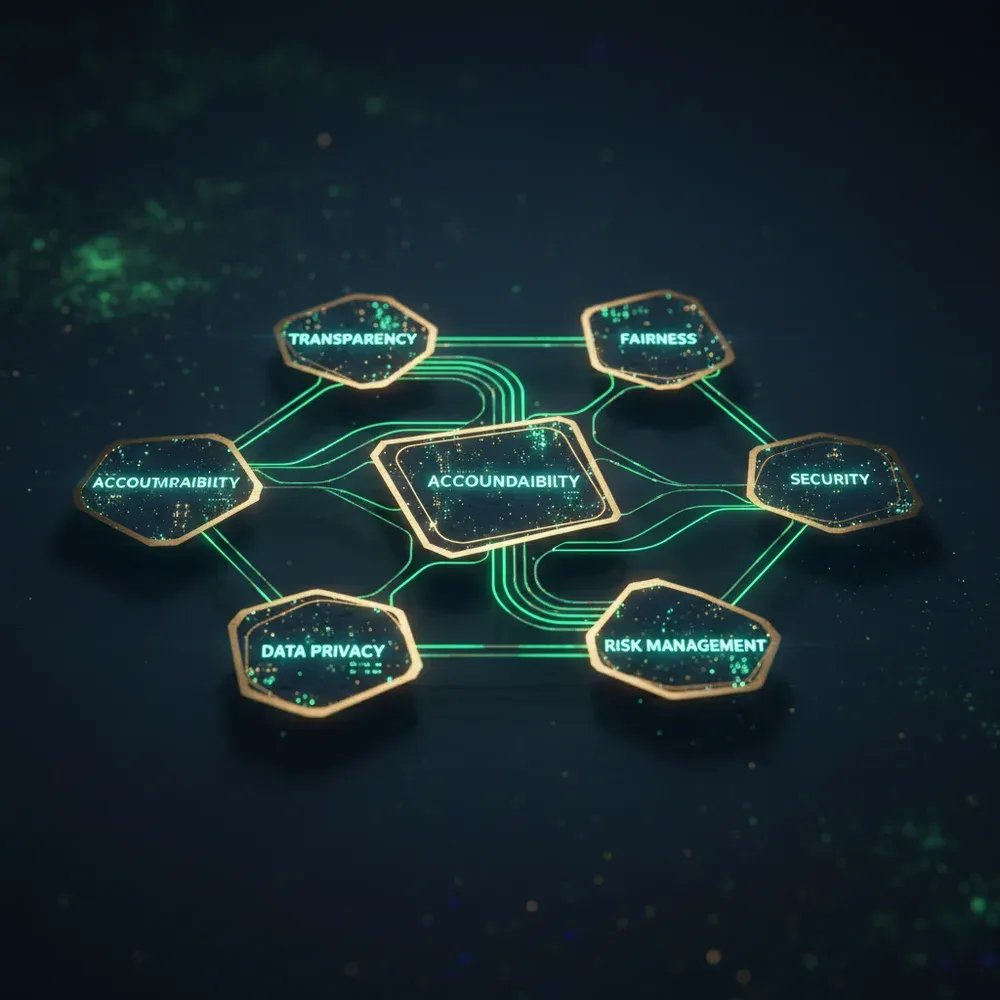
As automation grows, so do the risks. Data privacy (GDPR) is a critical issue: ensuring that AI agents do not leak sensitive corporate or customer data to public models. Therefore, using private models run in a corporate environment or enterprise APIs with strict data protection agreements is essential.
We must also discuss the concept of "agentic debt". Releasing too many undocumented and unsupervised agents onto corporate systems can lead to opaque chaos. Establishing a responsible AI Governance framework is a mandatory step right from the beginning of the project.
How Your Enterprise Can Start with Custom Automation and AI Agents?
The worst strategy is the "everything at once" approach. The key to success is gradualism. Start with a well-defined, measurable, but not business-critical process. This gives the organization a chance to learn, understand the technology, and build trust.
If your company is ready for the next step but lacks the internal expertise to design complex AI architectures, the AiSolve team can help. Whether it's website development with integrated AI functions or building a full-scale AI phone customer service, we provide the technological background for scaling.
Conclusion: The Strategic Advantage of Custom Automation
Custom automation with AI agents is no longer the music of the future, but the competitive advantage of the present. Companies that act now and incorporate intelligent, autonomous systems into their operations will gain efficiency and innovation benefits that laggards will not be able to catch up with for years. The technology is ready – the only question is whether you are ready to use it.
How much does it cost to develop custom AI automation for an enterprise?
Costs depend heavily on process complexity and the number of systems to integrate. A simpler PoC (Proof of Concept) can start from a few thousand dollars, while building a full enterprise system can be a significant investment. However, it's important to look at ROI: well-designed automation often pays for itself within 6-12 months through efficiency gains and cost reductions.
Which industries can benefit most from implementing custom AI agents?
Virtually every data-intensive industry can benefit. Finance (fraud prevention, reporting), logistics (route planning, inventory management), healthcare (patient data processing, diagnostic support), and e-commerce (customer service, personalization) stand out. Wherever large amounts of unstructured data need to be processed and decisions made, AI agents create value.
What are the security risks involved in integrating AI agents into existing systems?
Main risks include data leakage (prompt injection attacks), unauthorized access, and unintended actions. We manage these using strict access control (RBAC), encrypted communication, private models, and continuous security audits. AI agent permissions should be set based on the principle of "least privilege".
How can the reliability and accuracy of AI agents be ensured for complex enterprise tasks?
Reliability is ensured through multi-layered verification. We use RAG (Retrieval-Augmented Generation) for fact-based answers, deterministic code for critical logic steps, and "human-in-the-loop" processes for high-risk decisions. Additionally, continuous testing and feedback loops (RLHF) help improve model accuracy over time.
What capabilities does a team need to successfully implement custom AI automation?
A successful team requires AI engineers (knowledge of LLMs and prompt engineering), backend developers (integrations and APIs), DevOps experts (infrastructure and scaling), and business analysts capable of translating business needs into technical specifications. It is often worth involving an external expert partner for specialized knowledge.
What is the typical timeline for deploying a custom AI automation project?
A simpler pilot project or PoC can be realized in 4-8 weeks. Deploying a more complex enterprise automation affecting multiple systems usually takes 3-6 months, including planning, development, testing, and deployment. Continuous maintenance and optimization continue thereafter.
What is the difference between RPA and AI-driven custom automation?
RPA (Robotic Process Automation) is excellent for repetitive, rule-based tasks where input and process are static. AI-driven automation, on the other hand, can handle unstructured data (text, image, audio), make decisions under changing conditions, and learn from mistakes. AI agents can complement or even replace traditional RPA solutions in more complex processes.
Készen állsz a saját weboldaladra?
Ingyenes konzultáció során átbeszéljük, hogyan segíthetünk vállalkozásodnak növekedni egy modern, gyors és konverzióoptimalizált weboldallal. 14 nap alatt kész, 0 Ft induló költséggel.