Table of Contents
February 2026 marks a pivotal moment in software engineering history. While most enterprises are still grappling with basic generative AI implementations, Anthropic has showcased an experiment that fundamentally challenges the indispensability of human developers: sixteen Claude Opus 4.6 AI agents, with virtually no human intervention, built a functional Rust-based C compiler from scratch. This is not science fiction; it is the pinnacle of custom automation solutions, capable of compiling the Linux 6.9 kernel.
Simultaneously, Mustafa Suleyman, Microsoft's AI Chief, has issued a sobering prediction: he anticipates that AI will be capable of taking over significant portions of white-collar work within just 1.5 years. Together, these two developments send a clear message: the era of autonomous systems is not in the distant future—it is arriving now.
| Key Insight | Business Impact |
|---|---|
| Full Autonomy | Software development tiers can operate without direct human oversight. |
| Multi-Agent Systems | Complex tasks are handled by "swarms" of cooperating agents, not single models. |
| 18-Month Window | A short timeframe exists to retrain workforce and adapt processes. |
| Cross-Platform | AI-generated code supports x86, ARM, and RISC-V architectures seamlessly. |
The Anthropic Breakthrough
According to InfoQ, the Anthropic experiment was not about writing a simple "Hello World" script. The objective was to build a fully functional C compiler from scratch using Rust. Sixteen Claude Opus 4.6 agents worked in parallel on a shared repository, coordinating changes, resolving merge conflicts, and testing the output autonomously.
The result is staggering: the compiler successfully built the Linux 6.9 kernel and supports multiple architectures including x86, ARM, and RISC-V. This performance goes far beyond code completion tools like GitHub Copilot; this is structured, planned, and executed engineering work performed by software agents.
Pro Tip: Don't just think about code generation! Modern custom automation solutions can autonomously handle entire workflows, such as testing cycles and documentation updates.
This level of complexity proves that AI agents are capable of context switching and long-term memory management, previously weak points of large language models. In fields ranging from website creation to core infrastructure, this means we will soon instruct systems by function or module, rather than line-by-line code.
The 18-Month Warning: Microsoft's Prediction
While Anthropic demonstrated technical feasibility, Microsoft's AI Chief Mustafa Suleyman highlights the economic and social implications. As reported by Bitport, his statement suggests that the rapid advancement of AI will enable automated systems to take over the tasks of white-collar workers—analysts, administrators, junior developers—within 18 months.
This does not necessarily mean job extinction, but a radical transformation of roles. Companies that fail to integrate custom automation solutions into their operations now risk falling behind competitors who leverage AI agents to perform routine tasks at a fraction of the cost.
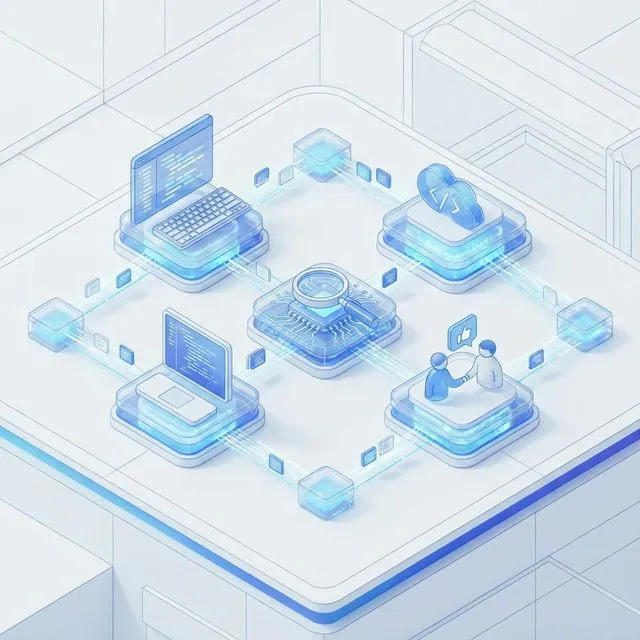
How Autonomous Agents Work: Technical Deep Dive
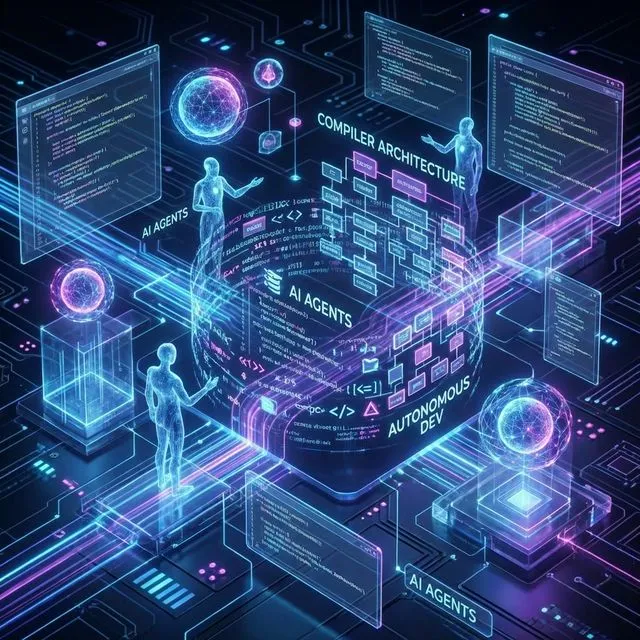
The essence of multi-agent systems lies in specialization and communication. In the Anthropic experiment, a single giant AI did not attempt to solve everything. Instead, tasks were decomposed: some agents were responsible for syntax parsing, others for code generation, and yet others for testing and debugging.
This structure mimics a human development team, where custom automation solutions ensure digital and instantaneous communication channels. The shared Rust repository served as the "source of truth," ensuring every agent worked with the most current state.
The Role of Rust
The choice of Rust was intentional. The language's strict memory safety rules acted as a forcing function for the AI to write precise, bug-free code. If the code didn't compile, the Rust compiler's error messages provided immediate feedback to the agents, who learned from this to correct their own work.
Custom Automation Solutions Redefined
What does this mean for the enterprise sector? It means the definition of custom automation solutions has expanded. We are no longer talking about simple Excel macros or basic chatbots. We can now build intelligent systems capable of:
- Independently researching and processing data (like a data processing agent).
- Resolving complex customer inquiries without human intervention.
- Maintaining and updating software infrastructure autonomously.
Implementation Advice: Start small! Identify a well-defined, rule-based process in your company and test the efficiency of agent-based custom automation solutions on it.
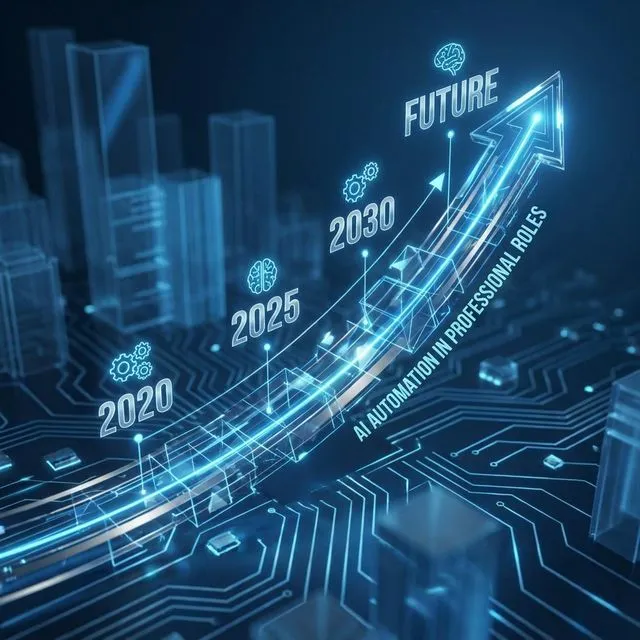
Risks and Limitations
While the results are impressive, it is crucial to recognize the limitations. The word "Almost" in the headline is key. The agents required an initial framework and precisely defined goals. They did not spontaneously decide to write a compiler; humans set that objective.
Furthermore, deploying custom automation solutions in an enterprise environment raises serious security and governance questions. Who is responsible if the AI deploys faulty code? How do we protect trade secrets if agents use external APIs?
| Traditional Automation | AI Agent Automation |
|---|---|
| Rule-Based (If-Then) | Goal-Oriented |
| Linear Execution | Dynamic, Adaptive Problem Solving |
| High Maintenance | Self-Correction Capabilities |

Strategic Implementation for Leaders
- Audit Your Processes: Identify repetitive but high-cognitive tasks where custom automation solutions can create the most value.
- Prepare Your Data: AI agents can only work on high-quality data. Organizing unstructured data is the first step.
- Experiment in Sandboxes: Create isolated environments where agents can fail safely without risking business operations.
- Invest in Human Capital: Retrain your workforce to oversee and direct AI systems. The future is not AI vs. Human, but Human empowered by AI.
Don't wait until competitors outpace you with autonomous technologies. Prepare your business for the future now.
Consult on Custom AutomationFrequently Asked Questions
Can AI agents really develop software autonomously?
Yes, recent experiments like Anthropic's show that advanced AI models (e.g., Claude Opus) can autonomously handle complex, multi-file development tasks, including debugging. However, high-level direction and goal setting remain human tasks.
What are custom automation solutions and why now?
Custom automation solutions are tailored software implementations replacing specific business processes. With predictions of major workforce shifts within 18 months, early adoption provides a critical competitive advantage.
Is it safe to use AI agents in my company?
Security is a primary concern. While agents are efficient, without proper "human-in-the-loop" oversight and access controls, they pose risks. Testing in isolated environments (sandboxes) is highly recommended.
How is this different from RAG AI Chatbots?
While a RAG AI chatbot primarily retrieves information and answers questions, autonomous agents can take action: they write code, modify files, and interact with other systems to achieve a goal.
Recommended
- Claude Code and Developer Workflow
- Autonomous Data Processing Agents in Enterprise
- AI Agents in Critical Systems
- InfoQ: Claude Agents Built a C Compiler
Készen állsz a saját weboldaladra?
Ingyenes konzultáció során átbeszéljük, hogyan segíthetünk vállalkozásodnak növekedni egy modern, gyors és konverzióoptimalizált weboldallal. 14 nap alatt kész, 0 Ft induló költséggel.