

| Terület / Area | Kulcsfontosságú Megállapítás / Key Insight |
|---|---|
| Evolution | AI is evolving from reactive LLMs to proactive, autonomous agents capable of independent planning and executing multi-step tasks. |
| Architecture | Successful enterprise-scale deployment hinges on a combination of concurrency, advanced planning capabilities, and strict governance frameworks. |
| Application | Autonomous agents are already being successfully used in critical areas like controlling particle accelerators and automating large-scale customer service processes. |
| Developer Tools | The emergence of agentic command-line interface (CLI) tools allows developers to focus on defining goals, while the AI handles the planning and execution. |
| Governance | Built-in auditing and monitoring mechanisms are essential for reliability and security, ensuring agent activities are transparent and verifiable. |
By 2026, the world of artificial intelligence has undergone a significant transformation. While previous years were dominated by the awe-inspiring capabilities of Large Language Models (LLMs) like the GPT series or Gemini, the market's focus has now decisively shifted from reactive models to proactive, autonomous systems. According to the latest case studies from Netomi and the Lawrence Berkeley National Laboratory, **autonomous AI agents are no longer a promise of the future but a critical component of today's business and scientific reality, capable of reducing complex data processing cycles by up to 70%.** This article explores how these systems are moving beyond chatbot functions to become reliable executors of complex, multi-step tasks. We will examine the architectural principles, enterprise use cases, and governance strategies that enable the reliable and scalable deployment of autonomous AI. The goal is nothing less than to understand how these intelligent systems are becoming an indispensable part of modern corporate strategy.
The Shift from LLMs to Autonomous Agents: More Than Just Text
Large Language Models (LLMs) have revolutionized human-computer interaction, but their fundamental operation is reactive: they take an input (a prompt) and produce an output (a response). While this is incredibly useful for content generation, summarization, or simple Q&A systems, real-world business processes rarely consist of a single step. This is where autonomous agents come into play. These systems use an LLM as a central "thinking" core but augment it with components like planning, memory management, and tool use. Instead of just responding, agents can interpret a high-level goal, break it down into a series of concrete, executable steps, and then carry out those steps autonomously using external tools (e.g., APIs, databases, software). This capability makes them ideal for automating complex tasks.
The key difference lies in proactivity. While an LLM can write an email, an autonomous agent can analyze incoming emails, identify urgent customer service requests, query relevant data from the CRM system, draft a personalized response, and send it for approval to a human supervisor. This multi-step, context-aware, and goal-oriented operation represents a true paradigm shift. These types of data processing AI agents are no longer just assistants; they are digital colleagues capable of taking ownership of entire workflows. This ability fundamentally changes how we think about productivity and automation.
Strategic Insight: Start implementing autonomous agents with well-defined, repetitive, but multi-step tasks. Examples include generating monthly reports from multiple data sources or automatically qualifying and routing incoming leads.
The Architecture of Autonomy: Concurrency, Planning, and Governance
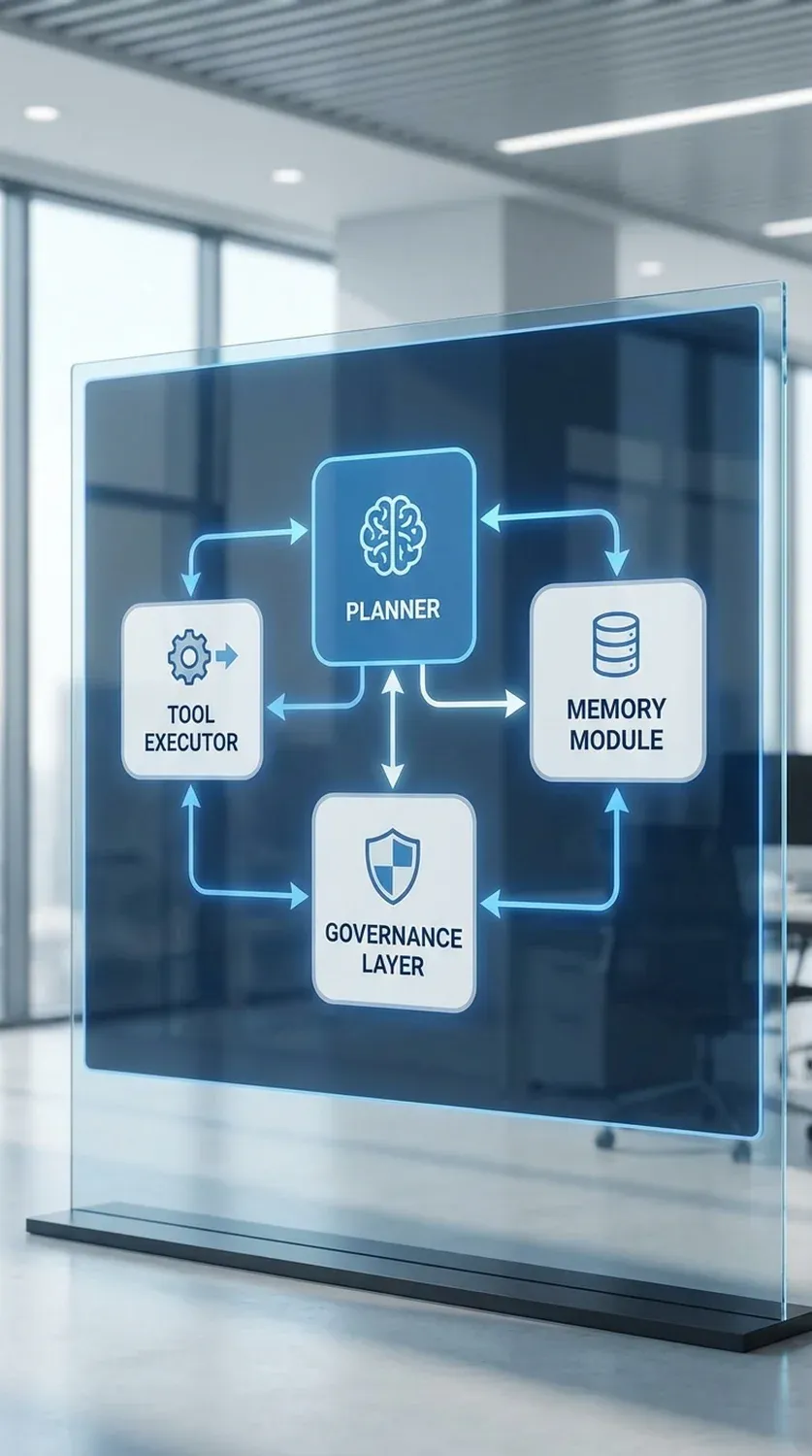
The enterprise-grade reliability of an autonomous AI agent goes far beyond a powerful language model. Netomi, which scales enterprise customer service systems, has identified three key architectural pillars for successful implementation: concurrency, multi-step planning, and strict governance. The ability to handle tasks concurrently allows a single agent to manage thousands of operations simultaneously without performance degradation. This isn't just about scaling hardware; it's about the agent's ability to intelligently manage wait times (e.g., waiting for a response from an external API) while working on other tasks. This efficiency is critical for real-time applications, such as an AI phone customer service, where latency is unacceptable.
The planning capability is the central element of the agent's "brain." Modern systems, like those Netomi builds on GPT-4.1 and GPT-5.2 models, can break down complex goals (e.g., "Resolve the customer's refund issue") into smaller, logical steps (1. Identify customer. 2. Query order history. 3. Check refund eligibility. 4. Initiate refund. 5. Notify customer.). Last but not least, the governance layer ensures reliability. This is a built-in framework that continuously checks the agent's steps, ensures they comply with business rules, and prevents unwanted or harmful actions. Without these pillars, autonomous agents would remain experimental technology; with them, they become reliable enterprise tools.
High-Stakes Applications: Scientific and Enterprise Data Processing
The value of autonomous agents is most evident in high-stakes, complex environments. A prime example is the case of the Lawrence Berkeley National Laboratory, where an AI agent called the "Accelerator Assistant" helps researchers operate the Advanced Light Source (ALS) particle accelerator. Here, the smallest error can lead to the failure of expensive experiments or even damage to the equipment. The agent's task is to continuously monitor hundreds of accelerator parameters, detect anomalies, and proactively suggest corrections or even autonomously perform the necessary fine-tuning. The LLM-driven system can interpret complex physical relationships and identify problems that might escape a human operator's notice. This application proves that properly designed autonomous systems can operate reliably in the most critical environments.
The stakes are similarly high in the corporate world. In financial services, healthcare, or legal technology, the accuracy and security of data processing are paramount. In this context, data processing AI agents can automate compliance checks, fraud detection, or the analysis of complex contracts. The key to success here, again, is the governance framework, which ensures that every action taken by the agent is logged, auditable, and reversible. When an AI agent handles millions of customer records or oversees critical infrastructure, reliability is not an option—it's a fundamental requirement. The Berkeley lab's example shows that this level of reliability is now achievable when AI is implemented with robust engineering principles.
Agentic Terminals: Empowering the Developer Ecosystem
Autonomous AI is transforming not only end-user applications but also the way software is developed. The concept of the "Agentic Terminal," popularized by command-line interface (CLI) implementations of tools like Gemini, Claude, and Auto-GPT, is fundamentally changing the interaction between developers and their code. Traditional CLI tools require precise commands and switches to perform tasks. In contrast, in an agentic terminal, the developer states a high-level goal, such as: "Create a new Docker container for the project's web application, install the dependencies from `requirements.txt`, and start the server on port 8080."
The AI agent then autonomously plans and executes the necessary steps: creating the Dockerfile, running the `docker build` and `docker run` commands with the correct parameters, and providing feedback on the process. If it encounters uncertainty or needs user approval (e.g., to overwrite an existing container), it proactively asks. This workflow significantly speeds up development cycles, reduces the potential for errors, and allows developers to focus on problem-solving instead of typing repetitive commands. These types of tools make implementing complex custom automation solutions accessible to developers directly within their familiar work environment.
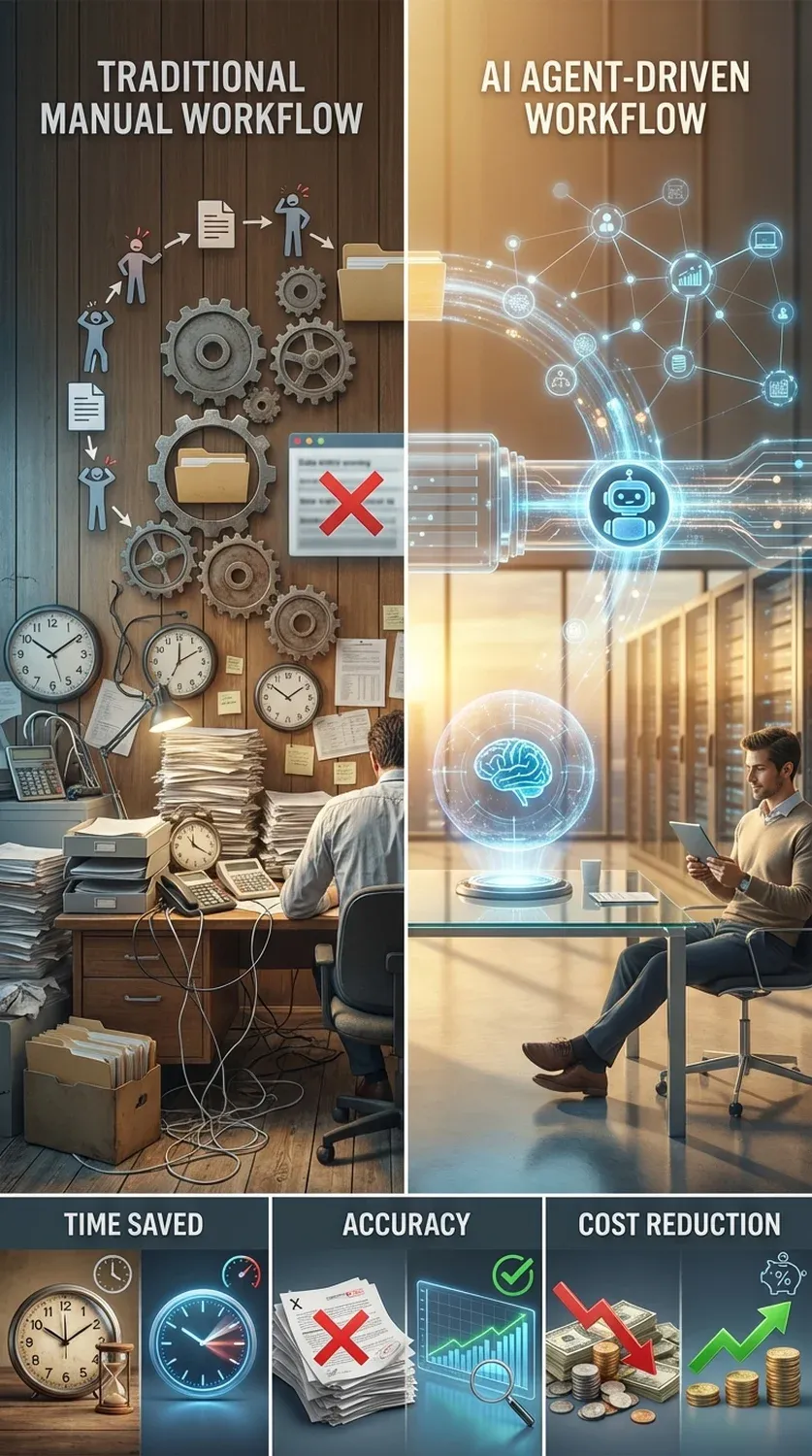
Figure: A comparison of the efficiency of traditional versus AI-driven workflows.
The Critical Role of Governance and Auditing for Reliable Operation
As AI agents gain more autonomy, ensuring control and transparency over their operations becomes increasingly critical. In a corporate setting, a "black box" system whose decision-making processes are neither understandable nor verifiable is unacceptable. Therefore, modern agent architectures incorporate robust governance and auditing layers as integral components. The governance framework defines the rules and constraints within which the agent can operate. This might include restricting data access permissions, setting maximum cost limits (e.g., for API calls), or requiring human approval for certain actions.
Auditing is the other side of the same coin. Everything the agent does—every thought, every tool it invokes, every decision it makes—must be logged in detail. This logging is essential not only for debugging but also for meeting compliance requirements (e.g., GDPR, HIPAA). In the event of a dispute or error, it must be possible to trace exactly why and how the agent reached a particular conclusion. Advanced platforms for data processing AI agents offer visual tools that allow supervisors to monitor agent activities in real-time and easily review past events. This transparency builds the trust necessary for the widespread adoption of autonomous technologies.
Implementation Advice: When deploying agents, establish a "human-in-the-loop" mechanism at critical decision points. Initially, have the agent only make recommendations, with a human operator approving the execution. As trust grows, this supervision can be gradually reduced.
Integrating Agents with Existing Enterprise Infrastructure
The true power of autonomous AI agents lies not in their standalone capabilities but in their seamless integration with existing enterprise systems. No agent can operate in a vacuum; it needs data from CRMs, ERPs, and internal databases, and it must be able to perform actions within these systems. The key to integration is the world of well-defined Application Programming Interfaces (APIs). Agents are designed to use "tools," and these tools are most often API calls that allow them to read and write data or invoke functions in other software. This modular approach makes them extremely flexible. There is no need to replace existing, proven systems; agents can be built as an intelligent layer on top of them, automating the manual processes that occur between systems.
Another critical aspect of integration is the user interface. Although agents work autonomously in the background, users and supervisors need a central place to monitor their activity, set their goals, and manage exceptions. This is where professional website creation becomes essential, not just for an external presence, but for a functional, internal management dashboard. A well-designed web interface gives managers a comprehensive view of performance, while developers can easily configure and deploy new agents. Thus, successful deployment requires more than just an intelligent agent; it also needs a robust integration strategy and a user-friendly monitoring platform. For instance, an effective RAG AI chatbot can only perform well if it is seamlessly integrated with internal knowledge bases.

Strategic Advantages and the Business Case for Adoption
Adopting autonomous data processing AI agents is not just a technological upgrade; it is a major strategic decision that yields tangible business benefits. The first and most obvious advantage is a dramatic increase in efficiency. By having agents take over repetitive, manual, but multi-step tasks, human employees are freed up to focus on higher-value, creative, and strategic work. According to the Netomi case study, agents can reduce the resolution time for complex customer service tickets by up to 80%. This not only translates to cost savings but also results in increased customer satisfaction due to faster and more accurate responses.
The second key benefit is scalability. Expanding human teams is time-consuming and expensive. In contrast, a fleet of digital agents can be scaled almost instantly to meet demand. During seasonal peaks or unexpected events, thousands of agents can be deployed without the need for weeks of recruitment and training. Finally, the third strategic advantage is better decision-making based on higher-quality data. Autonomous AI agents perform tasks tirelessly and consistently, reducing inaccuracies caused by human error. They can also identify patterns and anomalies in vast datasets that human analysts might miss, providing more accurate and timely business intelligence for leadership.
| Capability | Traditional Automation (RPA) | Autonomous AI Agent |
|---|---|---|
| Task Handling | Follows strictly defined, linear rules. | Can interpret complex goals and dynamically plan the steps. |
| Adaptation | Requires reprogramming for the slightest process change. | Can adapt to unexpected situations and find new solutions. |
| Data Interpretation | Works only with structured data. | Understands unstructured data (emails, documents, images). |
| Decision-Making | Based on predefined "if-then" logic. | Makes autonomous, context-based decisions to achieve a goal. |
The Future Outlook and Challenges of Responsible Scaling
The rapid advancement of technology suggests that autonomous agents will take on increasingly complex and responsible tasks. In the future, teams of communicating agents may coordinate not just individual workflows but entire business functions (e.g., procurement, HR administration). It is conceivable to have an ecosystem where companies can "hire" digital labor for specialized tasks, who seamlessly integrate with internal teams. This vision holds enormous potential for productivity and innovation, but it also raises serious ethical and security questions.
The biggest challenge of responsible scaling is maintaining control and predictability. How can we ensure that the behavior of a system composed of hundreds of agents always aligns with corporate values and legal regulations? The solution lies in continuous research and development, especially in the areas of AI safety and interpretability. Furthermore, it is essential to retrain and prepare the workforce for a future where humans and AI agents work in close partnership. Success will depend not only on the sophistication of the technology but also on our ability to build socio-technical systems in which human oversight and artificial intelligence effectively complement each other. The era of data processing AI agents has already begun; our task is to guide this revolution responsibly and strategically.
Ready to delegate your repetitive, manual data processing tasks to an intelligent, autonomous system? Discover how you can increase your company's efficiency and accuracy with customized AI agents.
Automate Your Data Workflows Now[Article generated by AiSolve AI Content System]
Frequently Asked Questions
What is the main difference between an LLM (e.g., ChatGPT) and an autonomous AI agent?
An LLM is reactive: it takes an input and produces an output. In contrast, an autonomous AI agent is proactive: it receives a high-level goal, independently breaks it down into steps, and then executes them using external tools (e.g., APIs, databases). The agent plans, acts, and can adapt to its environment to achieve the goal.
What types of tasks are data processing AI agents best suited for?
They are ideal for tasks that are repetitive, rule-based, but involve multiple steps and interact with multiple systems, which would otherwise require human intervention. Examples include validating and updating customer data across several databases, automatically compiling monthly reports, processing incoming invoices and initiating approval workflows, or executing complex data analysis pipelines.
How secure is it to entrust corporate data to autonomous agents?
Security depends on the system's architecture. Modern, enterprise-grade agent platforms place a strong emphasis on security. This includes strict access control, built-in governance rules that constrain the agent's actions, and detailed auditing that tracks every step. With "human-in-the-loop" mechanisms, human approval can also be required for critical operations.
How can a company get started with implementing autonomous AI agents?
The best strategy is the "start small, scale fast" principle. Select a well-defined, lower-risk process with high potential for efficiency gains for a pilot project. Measure the return on investment (ROI) and gather lessons learned. After a successful pilot, gradually expand the technology to other areas, always ensuring the proper governance and monitoring frameworks are in place.
Készen állsz a saját weboldaladra?
Ingyenes konzultáció során átbeszéljük, hogyan segíthetünk vállalkozásodnak növekedni egy modern, gyors és konverzióoptimalizált weboldallal. 14 nap alatt kész, 0 Ft induló költséggel.