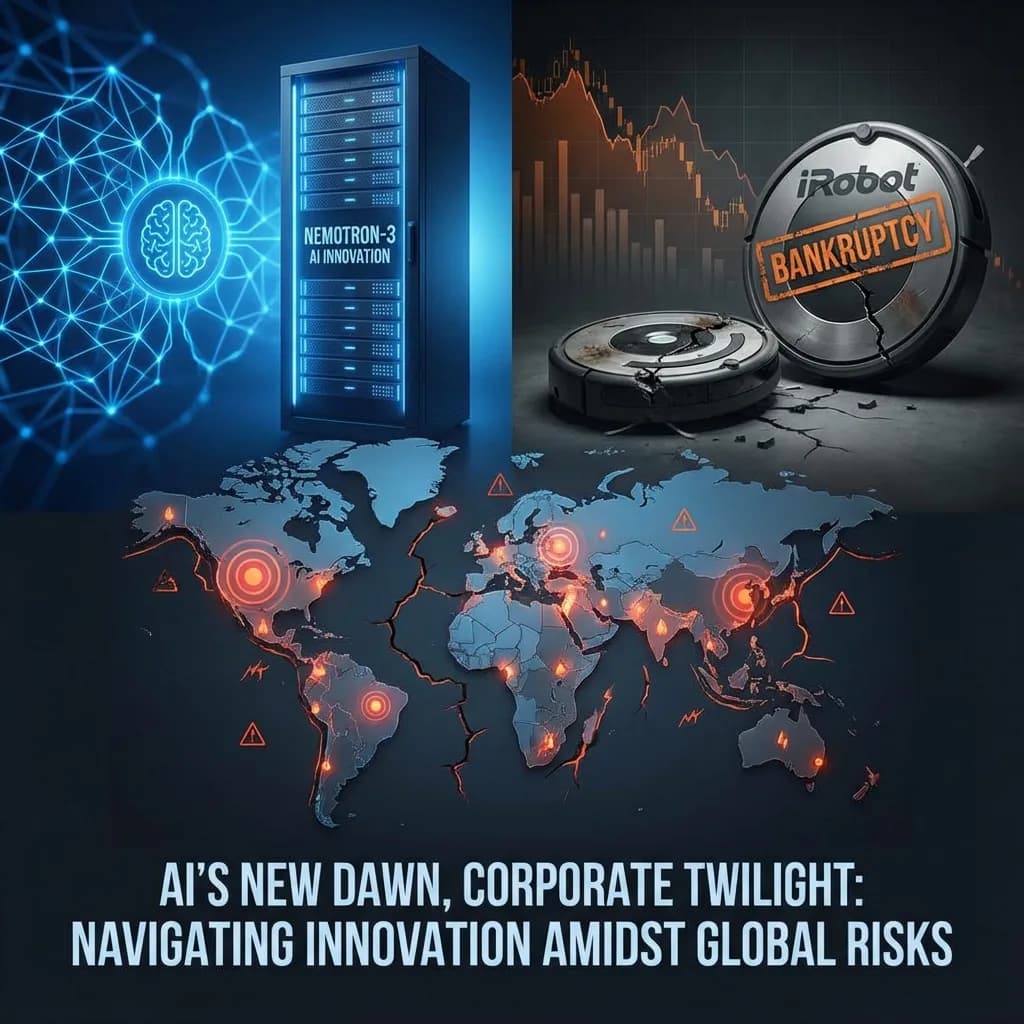
The technology sector never sleeps, and the events of the past few days have once again proven that the revolution surrounding artificial intelligence (AI) is relentlessly reshaping markets, corporate strategies, and our daily lives. While NVIDIA strengthens its dominance in high-performance computing (HPC) and AI with further strategic moves, a former pioneer of robotics, iRobot, has been pushed to the brink of bankruptcy. In parallel, IBM and Google are working on the democratization and ethical application of AI, while AI-integrated toys infiltrating children's rooms raise serious data privacy and geopolitical questions. Let's dive into the most important tech news of the week.
NVIDIA's Unstoppable Expansion: An Acquisition and a New Model Family
NVIDIA, the ruler of the AI chip market, has once again demonstrated that it sees itself not just as a hardware manufacturer but as a central player in the entire AI ecosystem. The company drew attention with two major announcements that collectively signal its deepening commitment to the open-source community and the future of agentic AI applications.
Strategic Acquisition: NVIDIA Embraces Slurm
NVIDIA announced its acquisition of SchedMD, the leading developer of Slurm, an open-source workload management system. Slurm is an indispensable tool in the HPC world, essential for the efficient allocation and management of resources in supercomputer clusters and AI infrastructures. The move might seem surprising for a hardware giant at first, but it is deeply logical.
With this acquisition, NVIDIA not only gains influence over a key software tool but also strengthens its position in the world of data centers and research institutions. The company emphasized that Slurm will remain open-source and vendor-neutral, which may be reassuring for its user community. However, this step allows NVIDIA to more tightly integrate its future hardware innovations (GPUs, networking solutions) with the workload management software, thereby optimizing performance and offering an even more attractive, integrated platform to its customers. This vertical integration, where hardware and software evolve hand-in-hand, could cement NVIDIA's market leadership in the long run. Efficient data processing and task optimization are crucial for training AI models, and integrating Slurm into this process can accelerate development.
Introducing the Nemotron 3 Model Family
In addition to strengthening its hardware and software ecosystem, NVIDIA also took a significant step forward in the model space with the introduction of the Nemotron 3 family. This family of open models is available in three different sizes—Nano, Super, and Ultra—to enable developers to use them in a wide variety of applications. The Nemotron 3 models are specifically optimized for creating "agentic" AI applications.
These agents are autonomous systems capable of executing complex tasks, making inferences, and even interacting with other software to achieve their goals. The Nemotron 3 family stands out among current open models for its accuracy and efficiency, opening new possibilities in enterprise automation, complex problem-solving, and the development of personalized digital assistants. This development fits perfectly into the trend where companies are increasingly seeking tailored solutions, such as those offered by custom automation.
The Democratization and Ethical Use of AI
While NVIDIA aims to cover the entire vertical, other industry players are focusing on openness and specific, yet critically important, application areas. This week, IBM and Google came forward with initiatives aimed at the broader and more responsible use of AI.
IBM and Hugging Face: CUGA for Configurable AI Agents is Here
IBM Research has made its CUGA (Configurable and Guided Agent) model available on the Hugging Face platform, a significant step towards the democratization of configurable AI agents. While most AI agents operate as "black boxes," CUGA allows developers to fine-tune and guide the agent's behavior and decision-making processes. This transparency and customizability are key to building reliable and secure AI systems.
With CUGA, developers can more easily create specialized agents that perform tasks such as customer service, search for information in complex databases, or assist in scientific research. The fact that the model is available on Hugging Face, a central platform for the open-source AI community, can accelerate innovation in this area. Such technology can provide an excellent foundation for advanced knowledge-based systems, like RAG chatbots, which focus on reliable information delivery.
Google: AI in Service of Sustainability Reporting
Google has published a practical playbook to help organizations use artificial intelligence to streamline and enhance their sustainability reporting. Corporate transparency and Environmental, Social, and Governance (ESG) factors are becoming increasingly important to investors and consumers, but collecting and analyzing the relevant data can be extremely resource-intensive.
Google's playbook demonstrates how AI tools can be used to automate data collection, analyze text-based documents, and identify relevant information from often fragmented and unstructured datasets. This not only increases efficiency but also improves the accuracy and reliability of the reports. This initiative is an excellent example of how AI can be used for positive social purposes, promoting greater transparency and responsible corporate governance.
The Other Side of the Coin: Industrial Failure and Ethical Concerns
However, technological progress is not always a triumphal march. The transformations in the industry also claim victims, and the spread of new technologies raises serious ethical and security questions for which we are still seeking answers.
The Fall of iRobot: An American Icon on the Brink
Sad news shook the world of robotics: iRobot, the American company known for its Roomba robot vacuums and once a market leader, has gone bankrupt. The company, once synonymous with household robotics, is now struggling with heavy debt and fighting for survival. In a particularly ironic twist, the company is likely to be acquired by its own primary contract manufacturer and main creditor, the Chinese company Picea Robotics.
The case of iRobot highlights the fragility of global supply chains and the ruthless market competition. While the company was a pioneer in technology, cheaper competitors and shifting market dynamics eventually brought it to its knees. A potential acquisition by Picea also symbolizes the shifting balance of economic power, where Asian companies with manufacturing capacity and capital are gaining increasing influence in Western technology markets.
AI in the Playroom: The Hidden Dangers of Plush Toys
While large corporations are exploiting the business potential of AI, the technology is also moving into our most personal spaces, including children's rooms. A growing number of toys integrated with AI chatbots are appearing on the market, raising serious concerns. A recent article highlights that these devices are not just harmless playmates. In some cases, the toys can give dangerous advice (such as how to sharpen a knife) or, more alarmingly, collect data about children and their families.
The problem also takes on a geopolitical dimension when it is revealed that messages from the Chinese state party may appear through some toys. This raises the question: how do we regulate these devices? Who is responsible for the content they convey and the security of the data they collect? Here, technological development is far ahead of the establishment of legal and ethical frameworks. AI-powered phone assistants, like the AI Phone, are already present in the lives of adults, but the issue of protection and supervision is much more sensitive when it comes to children.
The table below summarizes the main features of the Nemotron 3 models introduced by NVIDIA:
| Model | Size | Recommended Use | Key Advantage |
|---|---|---|---|
| Nemotron 3 Nano | Small | On-device applications, simple agents | Low resource requirements, fast response time |
| Nemotron 3 Super | Medium | Enterprise automation, more complex chatbots | Excellent balance of performance and size |
| Nemotron 3 Ultra | Large | Research, multi-step, complex reasoning tasks | State-of-the-art accuracy and reasoning capabilities |
Conclusion: Seeking Balance Between Opportunities and Dangers
The events of the past week clearly show the dual nature of artificial intelligence. On the one hand, it holds immense potential for scientific advancement, corporate efficiency, and sustainability. NVIDIA, IBM, and Google are all investing huge energies in this direction. On the other hand, the technological transformation comes with economic casualties, as the case of iRobot shows, and brings to light new, previously unknown ethical and security risks, especially in protecting the most vulnerable, our children. The great question for the future will be whether society, corporations, and regulators can find the right balance between fostering innovation and managing the potential dangers.
Frequently Asked Questions
What is Slurm, and why is its acquisition by NVIDIA significant?
Slurm is an open-source workload management system widely used in high-performance computing (HPC) clusters and data centers. Its acquisition by NVIDIA is significant because it allows for tighter integration between hardware (GPUs) and software (resource management), which increases efficiency and strengthens NVIDIA's market position in the AI infrastructure market.
What does CUGA and the democratization of AI agents mean?
CUGA (Configurable and Guided Agent) is a model developed by IBM that allows developers not only to use but also to guide and customize the operation of AI agents. Democratization means making these advanced tools available to a wider developer community (e.g., through the Hugging Face platform), thereby promoting open and transparent innovation.
What are the main risks associated with AI-integrated toys?
The main risks include data privacy (collection of sensitive data about children and their environment), safety (providing harmful or inappropriate advice), and potential manipulation and propaganda (covertly conveying ideological or commercial messages). These issues pose serious regulatory and ethical challenges.
How can AI help with corporate sustainability reporting?
AI can automate the processing of vast amounts of often unstructured data (e.g., reports, news articles, internal documents). It helps companies identify sustainability-related information more quickly and accurately, track progress towards their goals, and produce more transparent and reliable reports, as demonstrated in Google's new playbook.
Készen állsz a saját weboldaladra?
Ingyenes konzultáció során átbeszéljük, hogyan segíthetünk vállalkozásodnak növekedni egy modern, gyors és konverzióoptimalizált weboldallal. 14 nap alatt kész, 0 Ft induló költséggel.