
Introduction: The Pain Points of Traditional Customer Service and the Promise of AI
Recently, Google DeepMind announced a technological breakthrough that will permanently change enterprise communication: the arrival of the Gemini 3.1 Flash Live model. This announcement is not just another software update, but a paradigm shift in real-time, voice-based artificial intelligence. The model's capabilities provide a direct answer to the challenges modern enterprises face daily in customer service.
Traditional phone customer services (call centers) have struggled with the same structural problems for decades. For customers, the main frustrations are endless waiting times, complex and inflexible IVR (Interactive Voice Response) menus, and frequent routing errors. There is nothing more annoying than listening to hold music for minutes, only to have the line drop or be connected to an agent who lacks the competence to solve our problem.
From a corporate perspective, the situation is equally critical. Fluctuation in the call center industry is exceptionally high, often reaching 30-45% annually. Recruiting, training, and quality assurance for new employees consume massive resources. Furthermore, sudden spikes in call volume (for example, during a system outage or a successful marketing campaign) place an almost unmanageable burden on the infrastructure, leading to immediate quality degradation and dissatisfied customers.
This is where modern AI phone customer service steps in. The promise of artificial intelligence is not the complete replacement of the human workforce, but the radical optimization of processes. AI can answer calls 24 hours a day, 7 days a week, with zero wait time, while instantly accessing the company's entire knowledge base. With the release of Gemini 3.1 Flash Live, this technology has finally reached a level of naturalness where customers often don't even realize they are talking to a machine.
What is AI Phone Customer Service? Fundamentals and Operation
AI phone customer service is a complex software ecosystem capable of understanding, processing, and responding to human speech in real-time with a natural, human-like voice. Unlike old, push-button IVR systems, here the caller can freely articulate their problem in their own words. The system doesn't hunt for keywords; it interprets the full context and intent.
Definition: AI Phone Customer Service
An autonomous, voice-based interaction system that uses artificial intelligence (typically large language models and speech recognition algorithms) to conduct real-time, two-way phone conversations with customers, execute tasks, and query data from enterprise systems.
The operation of the technology is traditionally built on four main pillars, collectively known as the "conversational pipeline". The first step is ASR (Automatic Speech Recognition). This module is responsible for converting incoming analog or digital audio signals (like PCM audio over a phone line) into text. Modern ASR systems can already handle dialects, accents, and background noise.
The second component is NLU (Natural Language Understanding). Once the text is available, the NLU model (which today is almost exclusively an LLM, such as GPT-4 or Claude) analyzes it. It extracts the user's intent, identifies relevant entities (e.g., dates, names, order numbers), and determines the context of the conversation.
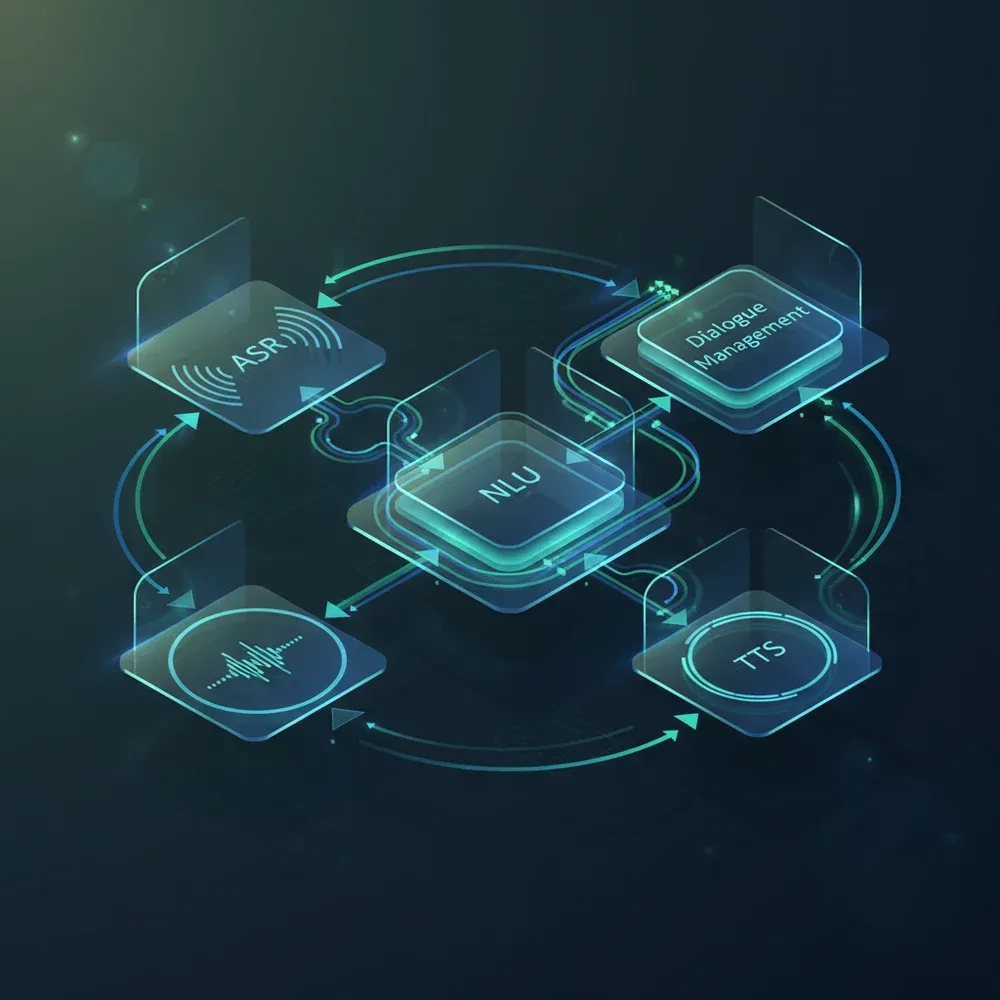
The third step is Dialogue Management. This is the "brain" of the system that decides the next step. If the user wants to check a balance, the dialogue manager connects to the banking backend via an API call, retrieves the data, and formulates the response. This is where data processing AI agents play a huge role, performing the necessary database operations in the background.
Finally, the fourth component is TTS (Text-to-Speech). The generated text response is converted back into a human voice by this module. The latest neural TTS models (such as ElevenLabs or Google Cloud TTS) don't just speak the words; they can convey the appropriate intonation, emphasis, and emotional charge, making the result indistinguishable from a real human voice.
The Evolution of Conversational AI: From Simple Chatbots to Real-time Interactions
To understand the significance of current technology, it is worth looking back at the evolution of conversational AI. The journey from rigid, rule-based systems to today's fluently conversing agents has been long and bumpy. The beginnings were marked by DTMF (Dual-tone multi-frequency) based IVR systems, where the user had to navigate a predefined tree structure using the phone's keypad. This solution was highly frustrating, and most callers immediately pressed "0" to reach a live operator.
The next generation was represented by early, keyword-based voice recognition systems. These could understand simple commands (e.g., "account balance", "customer service"), but the slightest deviation from the trained patterns caused the system to fail. If the user said, "I'd like to know how much money is on my card," the system often couldn't interpret the request because it was expecting the word "balance".
The real breakthrough came with Machine Learning and intent-based NLU models, such as Google Dialogflow or Amazon Lex. These systems were able to analyze the meaning of sentences and handled synonyms and different expressions much more flexibly. However, even these struggled with serious limitations: conversations were still linear, and the system couldn't handle complex, multi-step, context-dependent problems.
The emergence of Large Language Models (LLMs) like GPT-3 and GPT-4 ushered in the era of generative AI. These models no longer selected from pre-written answers but generated text in real-time with full context awareness. By integrating RAG AI chatbots (Retrieval-Augmented Generation), they became capable of working from a company's own closed database, minimizing the risk of hallucinations. However, there was still a massive hurdle in voice communication: latency.
The Game Changer: Google DeepMind Gemini 3.1 Flash Live for Real-time Conversations
The biggest flaw of the traditional "pipeline" architecture presented above is processing time. Converting audio to text, analyzing the text, generating a response, and then converting the text back to audio often took 2-4 seconds combined. In a human conversation, a 3-second pause is awkwardly long; it feels like communicating through a walkie-talkie with a distant planet. This latency made previous AI voice assistants feel unnatural.
This problem is fundamentally solved by Google DeepMind's latest development, Gemini 3.1 Flash Live. This model is not a cobbled-together pipeline, but a native multimodal architecture. What does this mean in practice? It means the model doesn't convert audio to text to analyze it. Gemini 3.1 Flash Live processes audio waves (specifically, audio tokens derived from them) directly, and generates the output directly as audio tokens.
Key Technology: Native Multimodal Processing
Gemini 3.1 Flash Live skips the intermediate text phase. The end-to-end neural network directly interprets acoustic features, including emphasis, tempo, and emotions, which drastically reduces response time to under 200 milliseconds and enables the understanding of non-verbal cues.
This native processing brings two massive advantages. The first is speed. The response time (Time to First Byte - TTFB) of Gemini 3.1 Flash Live is typically around 150-200 milliseconds. This is faster than average human reaction time. The conversation becomes completely fluid and uninterrupted. The caller doesn't even notice they are talking to a machine, as the answers arrive instantly, in a natural rhythm.
The second, perhaps even more important advantage is the understanding of context and emotion. During speech-to-text conversion, a lot of information is lost. A written "Yes" can mean enthusiasm, uncertainty, or even sarcasm. Gemini 3.1 Flash Live, because it analyzes raw audio, "hears" these subtle nuances. It can sense if the customer is tense, angry, or in a hurry, and can adapt the style and tempo of its response accordingly. If the customer is nervous, the AI can switch to a calmer, more empathetic tone.

Furthermore, the model has perfected the "Barge-in" capability. With traditional systems, once the AI started speaking, it had to finish its sentence. If the user interrupted, the system got confused. Gemini 3.1 Flash Live listens continuously in real-time (full-duplex). If the AI is listing options and the user interjects, "Wait, the first option is fine!", the model instantly stops talking, processes the new information, and seamlessly continues the conversation in the new direction.
Key Benefits of AI Phone Customer Service for Enterprises
Technological breakthroughs are worth little on their own if they are not coupled with tangible business benefits. However, implementing AI phone customer service offers such a drastic ROI (Return on Investment) and operational efficiency increase that for Telco CTOs and enterprise leaders, the question is no longer whether to implement it, but when.
The most obvious benefit is cost reduction. In a traditional call center, the average Cost Per Call (CPC) ranges from $3 to $8 depending on the industry, including wages, infrastructure, and training. With an AI-based system, this cost drops to a fraction of API calls and server time, often $0.20 - $0.50 per call. For a mid-sized company, this can mean saving tens or hundreds of thousands of dollars annually, while improving service quality.
The second critical factor is scalability and 24/7 availability. Human workforce capacity is finite. If call volume suddenly increases tenfold due to a marketing campaign, the traditional system collapses, and wait times skyrocket. An AI system, on the other hand, can spin up new virtual agents in the cloud (e.g., on Kubernetes clusters) in seconds, ensuring that the hundredth and the thousandth caller receive the exact same instant, quality service, even at night or on holidays, without extra shift premiums.
The increase in Customer Satisfaction (CSAT) cannot be overlooked either. Although many fear that customers don't like talking to machines, the reality is that customers mostly dislike waiting. If an AI answers the phone immediately and solves the problem (e.g., activates a bank card or modifies a booking) within 2 minutes, the customer experience is much more positive than waiting 15 minutes for a tired human operator. The First Contact Resolution (FCR) rate increases dramatically.
Finally, AI relieves the human workforce. 70-80% of calls are usually repetitive, simple routine tasks (password resets, status checks, opening hours). If the AI handles these automatically, human operators only need to deal with truly complex cases requiring high empathy or unique judgment, which have high added value. This not only increases efficiency but drastically reduces employee burnout and turnover.
Use Cases and Industry Applications
AI phone customer service is not a one-size-fits-all solution; thanks to its flexibility, it can be tailored to the specific needs of almost any industry. Through custom automation, the systems can be deeply integrated into the company's existing processes, so they don't just talk, they act.
In the banking sector and financial services, security and speed are paramount. An AI agent can perform voice-based biometric identification, then immediately handle blocked bank cards, provide information on current balances, or guide the customer through the pre-screening of a loan application process. Because Gemini 3.1 Flash Live can maintain complex context, the caller can even jump between multiple accounts during the conversation without the system losing the thread.
In healthcare, reducing administrative burdens is the main goal. Virtual assistants can book, modify, or cancel appointments 24/7, integrating with hospital HIS (Hospital Information System) systems. They are also suitable for simple symptomatic triage (pre-screening) or making automated outbound calls to check on chronic patients' medication adherence, thereby supporting prevention and doctors' work.
In retail and e-commerce, logistical questions dominate. "Where is my package?", "How can I return the product?" - these are the most common questions. The AI system queries the courier service's API in real-time and provides an instant, accurate answer to the caller. Moreover, it can act proactively: if an order is delayed, the system can automatically call the customer, apologize, and offer a compensation coupon, preventing complaints.
In the telecommunications sector, troubleshooting is the main application area. When a customer calls in because they have no internet, the AI agent can immediately run a line diagnostic in the background. If there is a central fault, it informs the customer of the expected repair time. If the problem is unique, it guides the user step-by-step through the router restart process, all with infinite patience and zero wait time.
Implementation Strategy: Step-by-Step Guide to Deploying AI Customer Service
Deploying an intelligent, voice-based AI system is a complex engineering task that requires careful planning. Successful implementation depends not only on selecting the right model (e.g., Gemini 3.1 Flash Live) but also on the robustness of the surrounding infrastructure. The following strategy provides a guide for CTOs and IT leaders for seamless integration.
The first phase is Scoping and Intent Mapping. Before writing a single line of code, you must precisely define what types of calls the AI will handle. It is worth starting with the most common, easily structured processes (e.g., password reset, appointment booking). You need to analyze audio recordings and transcripts of previous calls to understand what phrases customers use and what the most common branching points in conversations are.
The second step is Infrastructure and Platform Selection. To provide the Telephony Layer, you need a SIP (Session Initiation Protocol) trunk provider, such as Twilio or Plivo. These providers receive traditional phone calls and forward the audio stream (RTP stream) via WebSockets to our servers. This is where a Voice AI platform (like Vapi.ai or a custom Node.js backend) comes in, orchestrating the connection between telephony and the Gemini API.
Implementation Checklist
- Analyze existing call data and most common intents.
- Integrate SIP Trunking and telephony provider (e.g., Twilio).
- Vectorize enterprise knowledge base (establish RAG architecture).
- Prompt engineering and designing the virtual agent's "Persona".
- API-level connection of CRM/ERP systems (Salesforce, SAP).
- Closed beta testing, latency, and hallucination measurement.
The third, and most critical phase is Knowledge Base Integration (RAG) and Data Processing. The AI alone is just a "smart conversationalist", but it doesn't know the company's internal policies or customer data. Using RAG (Retrieval-Augmented Generation) technology, company documents (PDFs, internal wikis) are loaded into vector databases (e.g., Pinecone, Qdrant). When the customer asks a question, the system retrieves the relevant information in milliseconds and passes it as context to the Gemini model, ensuring factual and accurate answers.
The fourth step is Testing and Fine-tuning. Testing voice-based systems is much more complex than text-based chatbots. You must examine network latency (jitter), audio quality degradation, and the sensitivity of VAD (Voice Activity Detection) algorithms. You need to test how the system reacts to heavy background noise, simultaneous speech, or suddenly interrupted sentences. "Red Teaming" (intentional attacks on the system) is essential to filter out security vulnerabilities and prompt injection attempts.
Challenges and Considerations: Data Privacy, Ethics, and Integration
Although the technology is impressive, deploying it in an enterprise environment presents several challenges. The most important of these is data privacy and GDPR compliance. During phone conversations, customers often share sensitive personal data (PII - Personally Identifiable Information), such as social security numbers, credit card details, or health information. Transmitting this data to cloud-based LLMs (like Gemini) raises serious privacy concerns.
The solution is real-time Data Redaction. Before the audio stream or text transcript reaches the external language model, a locally running Small Language Model (SLM) or a dedicated security layer identifies and anonymizes the sensitive data. From the sentence "I am John Doe, my card number is 1234...", the system generates "I am [NAME], my card number is [CARD_NUMBER]", so the external API never encounters the real data.

Ethical considerations are also crucial. Gemini 3.1 Flash Live speaks with such a natural voice that the caller can easily believe they are conversing with a real human. In the spirit of transparency, the best practice is for the system to clearly identify itself at the beginning of the call: "Hello, I am the company's virtual assistant." Additionally, a seamless, frustration-free escalation path to a human operator must always be provided if the AI cannot solve the problem, or if the customer specifically requests to speak with a human.
System integration (Legacy Systems) is often the most painful point. Many companies use decades-old, monolithic CRM or ERP systems that lack modern REST APIs or Webhooks. In such cases, integrating AI agents requires the involvement of middleware or RPA (Robotic Process Automation) solutions so that the AI can read and write data in these closed systems without having to replace the entire enterprise architecture.
Measuring Success and Optimizing Performance
Deploying an AI phone customer service is not a one-time project, but a product that needs continuous optimization. To measure success, traditional call center KPIs (Key Performance Indicators) must be combined with AI-specific metrics. The most important metric is the Containment Rate, which shows the percentage of calls the AI was able to successfully close independently, without human intervention. In a well-optimized system, this value can reach 60-80%.
Average Handle Time (AHT) is also critical. While for human operators a shorter AHT is the goal, for AI, it is important that the system does not waste time with unnecessary loops, but leaves enough time for the customer to explain the problem. Due to the speed of the AI system, AHT generally decreases drastically, as there is no "Please hold while I look that up" type of waiting.
To measure technical performance, you must monitor Latency values, especially TTFB (Time to First Byte for the audio response). If this value creeps above 500 milliseconds, the conversation becomes unnatural. You must also monitor the ASR Word Error Rate (WER) metric, which indicates the accuracy of speech recognition. If the system frequently misunderstands specific industry terms, the model needs to be fine-tuned with the company's own dictionary.
Finally, the most important is the Customer Satisfaction Score (CSAT). At the end of calls, it is worth asking customers for brief feedback on the AI's performance. Modern systems are also capable of in-call Sentiment Analysis: based on tone and vocabulary, they evaluate the customer's frustration level in real-time, and if it crosses a critical threshold, the system automatically routes the call to a human supervisor.
The Future of AI Phone Customer Service: Proactive, Predictive, and Multimodal
Gemini 3.1 Flash Live is just the beginning. Based on the pace of technological development, in the next 2-3 years, AI phone customer services will completely transform, shifting from reactive problem-solving to proactive, value-creating services. With the help of predictive analytics, the system will know why the customer is calling before they even speak.
Imagine the following scenario: A customer tries to pay with their credit card in a foreign webshop, but the transaction is blocked by the bank's fraud protection system. The customer immediately calls customer service. The predictive AI system identifies the caller ID, retrieves the latest failed transaction, and upon answering the call says: "Hello! I see that a 50 euro transaction just failed. Are you calling about this? If so, after a security identification, I will immediately lift the block." This level of personalization results in an unprecedented customer experience.
Proactive outbound calls (Outbound AI) also hold massive potential. AI agents can automatically call customers to remind them of an upcoming medical appointment, inform them of a flight delay and immediately offer a rebooking, or even make personalized, interactive upsell offers for existing subscriptions, all without human intervention, on a massive scale.
The future is clearly about multimodal interactions. Voice-based conversation will seamlessly flow into other channels. If a customer is struggling with a complex router setup, the AI agent can send an SMS with a link during the phone call. Clicking the link opens the camera, and the AI, using Augmented Reality (AR) elements through the video feed, shows which cable to plug where, while continuously instructing the user verbally.
Conclusion: Step into the Future with AI Phone Customer Service
Google DeepMind's Gemini 3.1 Flash Live model has proven that voice-based artificial intelligence has moved beyond the experimental phase. Today, the technology is not only fast and accurate, but also capable of understanding the subtle nuances of human communication. The era of traditional, frustrating IVR systems and overloaded call centers is coming to an end.
Companies that are the first to integrate AI phone customer service solutions will gain an insurmountable competitive advantage. They will drastically reduce their operating costs, eliminate wait times, and provide premium, instant service to their customers 24/7. And the human workforce will finally be freed from monotonous routine work, allowing them to focus on true value creation.
The transition is not the music of the future, but the business imperative of the present. The technology, infrastructure, and security frameworks are available. The only question is: when will you take the first step towards the customer service of the future?
Frequently Asked Questions (FAQ)
How much does it cost to implement an AI phone customer service system?
The cost of implementation depends heavily on the complexity of the system, required integrations (CRM, ERP), and call volume. A basic system implementation can start from a few thousand dollars, while complex, custom enterprise solutions require a higher investment. However, it's important to look at the ROI: the per-call cost of AI (API fees) is only 10-20% of a human operator's cost, so the investment often pays for itself within 6-12 months.
How secure is AI in handling sensitive customer data?
Security is a top priority. Modern systems use real-time data masking (PII redaction), which means personal data (e.g., credit card numbers, passwords) are anonymized before they even leave the company's servers and reach the language model (e.g., Gemini). In addition, the systems comply with the strictest GDPR and industry regulations (e.g., HIPAA, PCI-DSS).
How quickly can an AI customer service solution be integrated with existing systems?
A basic, knowledge base (RAG) driven AI assistant that answers general questions can go live in as little as 2-4 weeks. Deeper, transactional integrations (e.g., automatic order modification in Salesforce, or banking backend connection) can take 2-3 months depending on complexity. However, using an agile development methodology, the system can be rolled out gradually, in phases.
Can AI handle complex or emotionally charged customer requests?
Native multimodal models like Gemini 3.1 Flash Live can already detect tone of voice and emotional state (Sentiment Analysis). If the system senses that the customer is highly frustrated, angry, or the problem is overly complex (e.g., a unique equity request), the AI automatically escalates the call to a live human operator, passing along the full context, thus avoiding further dissatisfaction.
What training data is needed for an effective AI phone customer service?
Base models (like Gemini) already possess general linguistic and logical capabilities. For company-specific knowledge, existing documentation is needed: Terms and Conditions, FAQ documents, product descriptions, internal procedures, and transcripts of previous, anonymized customer service calls. This data is processed by the RAG (Retrieval-Augmented Generation) system, so the AI always answers based on the latest, official company information.
What role do human agents play after AI implementation?
AI does not eliminate, but transforms human work. Because 70-80% of monotonous, repetitive questions (e.g., password changes, package tracking) are solved automatically by the AI, human agents can focus on high-value, complex problems. Their role shifts towards "problem-solving expert" and "customer relationship manager", where deep empathy, creative judgment, and personal attention are paramount.
How does Gemini 3.1 Flash Live differ from other conversational AI models?
The main difference is the native multimodal architecture. While older systems first converted audio to text (ASR), then analyzed the text (LLM), and generated the response back to audio (TTS), causing second-long delays, Gemini 3.1 Flash Live processes audio waves (audio tokens) directly. This enables sub-200ms, human-level reaction times, the understanding of non-verbal cues (tone, laughter), and seamless interruption (barge-in) handling.
Készen állsz a saját weboldaladra?
Ingyenes konzultáció során átbeszéljük, hogyan segíthetünk vállalkozásodnak növekedni egy modern, gyors és konverzióoptimalizált weboldallal. 14 nap alatt kész, 0 Ft induló költséggel.