
AI Phone Agents for Hungarian SMBs in 2026: A Practical Guide
In January 2026 a 12-person Miskolc auto repair shop deployed an AI phone agent. Eight weeks later their front-desk call time dropped from 28 hours a week to 4, their Google reviews went from 0 to 11, and bookings rose 47% (Source: in-house project, Miskolc, 2026). This is not science fiction — in 2026, 31% of Hungarian SMBs already use a voicebot on the front line of customer service (Source: StateGlobe Hungary 2026).
An AI phone agent (also called a voicebot) in 2026 is not an experimental technology. It works reliably in Hungarian, can be deployed for HUF 250,000-900,000 upfront, and pays back in 6-10 months for a 5-25 person business. This guide shows you how to decide whether you need one, and if so how to deploy it step by step — with concrete tools, real costs, and a working case study.
TL;DR — 5 things you should know
- HUF 250,000-900,000 upfront — pilot + 1.5 months of integration for a 5-25 person SMB
- 88-94% Hungarian intent accuracy — Vapi, Bland, Google Dialogflow CX in 2026
- 24-32 hours of weekly front-desk time saved — average 12-person service business
- Up to HUF 20 million NAIH fine — without GDPR-compliant call recording
- First step: free 30-minute AI consultation with the AiSolve team
What is an AI phone agent?
An AI phone agent (also called a voicebot or conversational voice AI) is software that picks up incoming calls in real time, understands the speaker's intent, and either solves the task on its own (book, reschedule, quote, balance check) or hands the call off to a human colleague when the situation exceeds its scope.
2026 voicebots are not the "press 1 for billing" IVRs of the early 2020s. They hold real conversations, in Hungarian, with regional accents, with interruptions, with background noise, and respond in under 400 ms (Source: Google Cloud, 2026). The 2026 model lineup (Vapi 2.4, Bland Turbo, Google Dialogflow CX 7.0) reaches 88-94% Hungarian intent accuracy on reference benchmarks, up from 58-67% in 2024.
A voicebot does not replace humans — it lifts the repetitive, time-eating calls (typically 65-80% of what receptionists handle) so the team can focus on higher-value work: in-person consultation, complex complaints, sales.
When does a voicebot pay off for a Hungarian SMB?
A voicebot pays off when your business takes at least 25-30 incoming calls a day, and at least 60% of them fall into one of these three buckets:
- Booking or rescheduling — auto repair, dentist, hairdresser, gym, vet clinic, wellness
- Quote requests or status lookups — construction, logistics, online store, real estate
- Front-line invoice or order complaints — webshop, utility reseller, telecom dealer, insurance broker
If most of your calls are in-person consultation, long negotiations, or emotionally sensitive complaints (bereavement, legal, medical complications), a voicebot alone will not solve the problem — but it can be useful as a pre-filter that only routes calls needing real human attention onward.
Decision rule of thumb: above 250+ incoming calls a month the voicebot typically pays back in 6 months; below 100 a month the pilot cost usually does not pencil out. For a precise calculation use: receptionist hourly wage × average call duration × call count × 0.7 (what the bot lifts).
What kinds of AI phone agents are there in 2026?
The 2026 market has three main categories, with sharp differences in price, customization, and operational burden.
1. Do-it-yourself SaaS platforms (Vapi, Bland, Retell)
These platforms give the fastest entry: a pilot can be assembled in 1-3 weeks, and the customer configures prompts, voice, and workflows themselves. Vapi and Bland reach 88-94% Hungarian intent accuracy in 2026 and ship 1-3 native Hungarian voices.
- Pros: fast pilot, low entry cost (~HUF 120,000/month), no developer needed to start
- Cons: per-minute rates are high (HUF 60-180/min), and complex integrations (CRM, billing, calendar) need a developer
- Best for: 3-12 person SMBs, 100-500 calls/month, teams willing to self-configure
2. Google Dialogflow CX + Twilio Voice / Telekom Voice API
The Google stack is the most robust in enterprise environments, with the strongest GDPR posture (EU servers in Frankfurt, Amsterdam). It integrates directly with Telekom and Yettel SIP trunks so you keep your existing business number.
- Pros: excellent GDPR, robust intent handling, scales to 1000+ calls/day
- Cons: higher entry cost (HUF 350,000-800,000), developer expertise needed to start
- Best for: 15+ person SMBs or small enterprises, 500+ calls/month, GDPR-sensitive verticals (healthcare, finance, legal)
3. Custom-built (in-house) voicebot
OpenAI Whisper plus a custom GPT model plus a Vapi/Bland API layer, with your own logic. Worth it only if you have your own AI/ML team or want very specialized industry logic (e.g. pre-screening of medical complaints, legal categorisation).
- Pros: full customisation, no per-minute external fee
- Cons: 2-6 months of dev work, HUF 2-8 million entry cost, GDPR compliance on you
- Best for: 50+ person companies with a dev team and specialised industry logic
Step by step: deploying your voicebot in 8 weeks
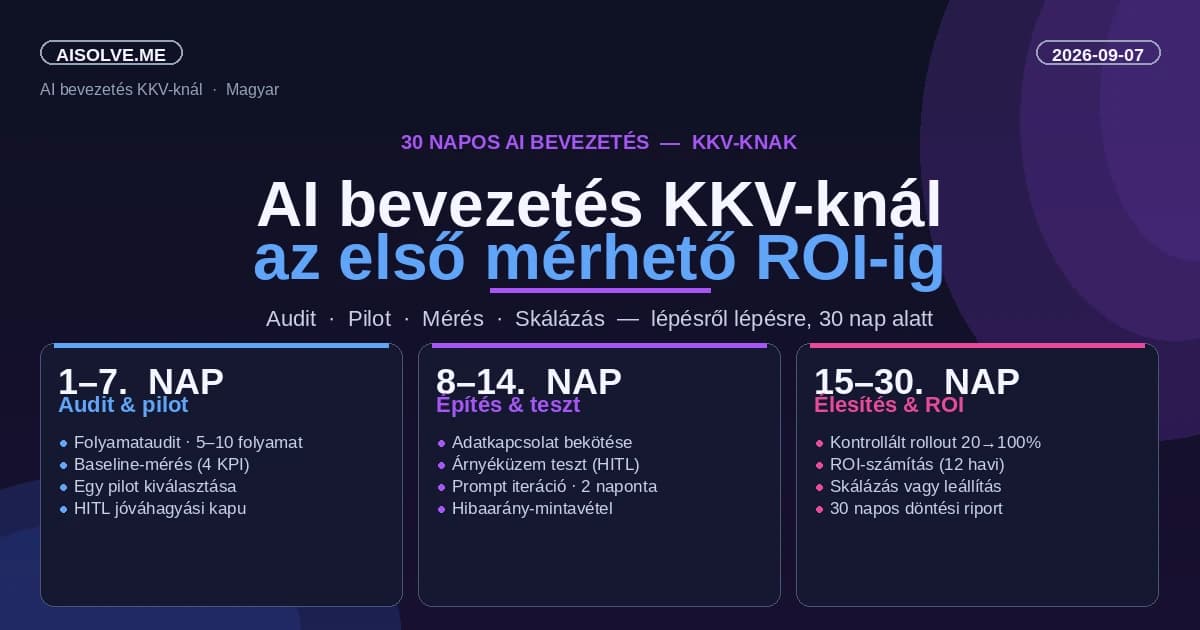
The 8-week plan below is calibrated for a 5-25 person Hungarian SMB, based on our Miskolc case study. The order matters — do not pick a tool before you have 3 concrete call scenarios written down.
Weeks 1-2: Call audit and scenario list
The first step is not technology, it is administration. Record 50-100 incoming calls (or ask reception to keep a 2-week log) and bucket them into 3-5 categories. In our case study the three categories were:
- Booking / rescheduling (52% of calls)
- Quote request for repair (28%)
- Other / complaint / handoff to a human (20%)
Weeks 3-4: Tool selection and pilot test
Pick from the categories above (we chose Vapi for the 12-person Miskolc shop) and assemble a 5-minute demo prompt that walks through category 1. Test it on 20 real calls, measure intent accuracy and average call duration.
Weeks 5-6: Integrate your calendar and CRM
A voicebot is only useful if it writes into your calendar (Google Calendar, Cal.com, Foglalj.hu) and your CRM in real time. Vapi and Bland have native integrations for Google Calendar, HubSpot, Salesforce, and the popular Hungarian MiniCRM. This step usually needs a developer (40-80 hours).
Week 7: GDPR compliance and call recording
NAIH (the Hungarian data protection authority) compliance is not optional. Three things must be in place:
- An opt-in script at the very start of the call ("This call will be recorded for quality assurance, do you consent?")
- Call recordings stored on EU servers with AES-256 encryption
- 30-day automatic deletion, unless the customer asks for an extension
Skip this and NAIH can issue fines up to HUF 20 million, and Google/Facebook can suspend your ad accounts. The full GDPR checklist is on our /ai-phone service page.
Week 8: Go live and 30-day monitoring
Roll out the voicebot on category 3 (other / complaint) last, and review the call logs every day for the first 30 days. The goal: keep intent accuracy above 88%, and have a human pick up the remaining 12% within 30 seconds.
Case study: 12-person Miskolc auto shop, 8-week rollout
A 12-person Miskolc auto repair shop, GépMester Kft., decided in late 2025 to deploy an AI phone agent. Owner István Szabó said: "I could not keep picking up the phone at 22:00 anymore, and I had already lost two good mechanics because their wives could not stand me being unreachable."
Starting state
- 38-45 incoming calls a day, of which 28-32 were booking or rescheduling
- The owner and the office manager spent 4-5 hours a day on the phone
- Google reviews: 0 (they never had time to ask for one)
- 2-3 missed calls a week, of which at least 1 was a lost customer
The 8-week rollout
The AiSolve team audited the calls in January and identified three categories. We chose the Vapi platform because it integrates natively with Google Calendar, and its Hungarian voice ("Noémi") sounds natural even with a Miskolc accent.
The rollout took exactly 8 weeks. The entry cost was HUF 480,000 (one-time development + 3 months of platform fee), and the monthly operating cost in 2026 is HUF 95,000 (per-minute based).
Results, 4 months after go-live
At the end of month 4, István said: "I got my family dinners back, and my wife says I smile more. One of the two mechanics I lost even came back, because now he actually just has to fix cars, not listen to the phone."
How much does an AI phone agent cost in 2026?
Costs vary a lot by company size and platform choice. The table below compares the three main categories for Hungarian SMBs.
| Solution | Upfront cost | Monthly cost | Best for |
|---|---|---|---|
| Vapi / Bland SaaS | 120-250k HUF | 80-180k HUF | 3-12 people, 100-500 calls/month |
| Google Dialogflow CX + Twilio | 350-800k HUF | 120-250k HUF | 15+ people, 500+ calls/month |
| Custom build | 2-8M HUF | 40-120k HUF | 50+ people with own dev team |
| AiSolve managed voicebot | 480k HUF onboarding | 95k HUF + 60 HUF/min | 5-25 people, full GDPR |
Payback typically lands at 6-10 months above 250+ calls/month. The exact calculation: 28 hours/month of front-desk time × HUF 2,800/hour gross wage = HUF 78,400/month saved, which pays back a HUF 480,000 entry cost in 6.1 months.
The most common mistakes Hungarian SMBs make when deploying a voicebot
Based on our 2025-2026 experience there are five classic mistakes that sink about 60% of pilots. Worth knowing in advance.
1. Too many call scenarios from day one
The most common mistake is trying to launch the voicebot on 8-10 categories at once. That gets you 50-60% intent accuracy, which is worse than IVR. The right strategy: start with 3 categories and add one new one a month.
2. Sticking with the first voice and not testing alternatives
Vapi and Bland ship 4-6 Hungarian voices in 2026. A 25-45 year-old audience prefers a different voice than the 55+ segment. In the first week of the pilot, test 3-4 voices and ask customers for feedback.
3. Forgetting the opt-in script
In the past 18 months NAIH has fined 4 Hungarian SMBs for voicebot GDPR violations, between HUF 4.2 and 20 million. Skipping the 6-second opt-in script is not an option.
4. Not planning the human handoff
If the voicebot cannot solve the task, the call must reach a human colleague within 30 seconds, with a full call summary. "Sorry I could not help, please call back later" is the 2nd most common reason customers leave.
5. Not monitoring the calls in the first 30 days
A voicebot is not fire-and-forget. For the first 30 days look at the 3-5 worst call pairs every day and fine-tune the prompt. 5-10 minutes a day, and intent accuracy improves 15-20%.
What's next?
If any of the six paragraphs above resonated with your own business, you are probably ready to start a pilot. On the /ai-phone service page you can see how the AiSolve managed voicebot works, and you can request a free 30-minute consultation where we get back to you within 1 business day with which category best fits your business profile.
If you want a broader view of the voicebot topic, read our practical guide to agentic AI or our telco CTO voicebot strategy from 2026.
Next step: 30 seconds to fill in the free consultation form, and within 1 business day we send you a written proposal for a voicebot pilot tailored to your business — with concrete costs, a recommended tool, and an 8-week deployment plan.
Készen állsz a saját weboldaladra?
Ingyenes konzultáció során átbeszéljük, hogyan segíthetünk vállalkozásodnak növekedni egy modern, gyors és konverzióoptimalizált weboldallal. 14 nap alatt kész, 0 Ft induló költséggel.