

Introduction: The Imperative of Automation in Complex IT Environments
Modern IT infrastructures have reached unprecedented levels of complexity. The web of microservices, hybrid cloud environments, and containerized applications has created an opaque ecosystem that is nearly impossible to manage efficiently with human effort alone.
When AWS announced the DevOps Agent, the market reacted immediately. The realization was clear: the era of manual operational tasks and static alerts has ended. A significant portion of engineers' time is still consumed by "toil"—repetitive, low-value troubleshooting.
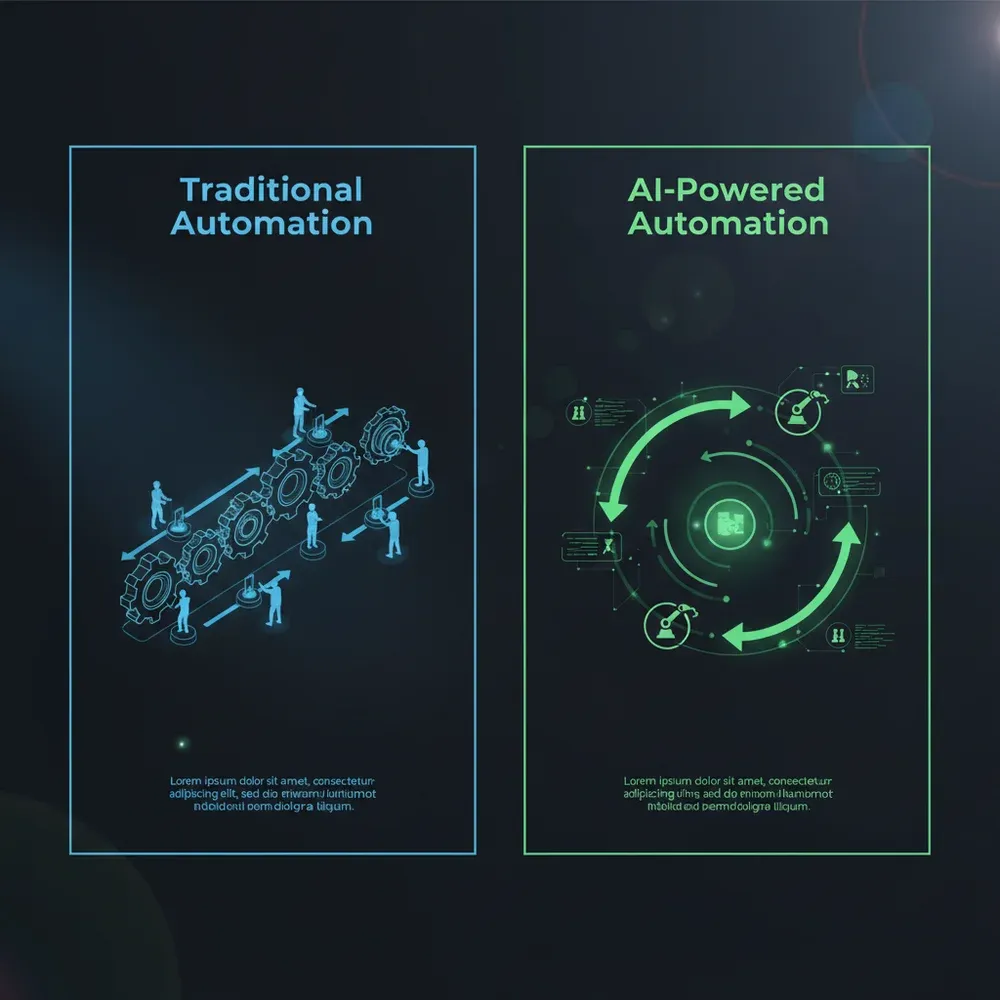
Traditional automation tools, while useful, are too rigid. They can only react to scenarios that have been pre-programmed. In the event of an unexpected memory leak or a complex network anomaly, static scripts fail, and human intervention becomes inevitable.
This is where custom automation steps in. Combined with the power of artificial intelligence, it doesn't just execute commands; it understands context, learns from mistakes, and proactively intervenes in system operations.
What is Custom Automation, and Why is it Essential?
Definition: Custom Automation
Custom automation refers to the design and implementation of tailored technological solutions that address a company's specific business processes and infrastructural challenges. Unlike off-the-shelf software, this approach integrates deeply into existing systems and uses generative AI to create adaptive, learning workflows.
Many companies make the mistake of trying to force general-purpose automation platforms onto their unique processes. This often leads to the creation of "shadow IT," security vulnerabilities, and a failure to achieve the expected Return on Investment (ROI).
The essence of custom automation is precision. Imagine a system that not only restarts a crashed service but first analyzes the logs, identifies the line of code causing the error, and suggests a fix in the form of an automated pull request. This is no longer future tech; it is the present.
Today, competitive advantage doesn't lie in using the cloud, but in how quickly and deeply we can automate our cloud infrastructure. Companies that recognize this can drastically reduce their Time-to-Market and increase their operational resilience.
The AI Revolution in Automation: Beyond Standard Scripts
The advent of artificial intelligence, particularly Large Language Models (LLMs) and machine learning (ML), has fundamentally rewritten the rules of automation. AI-driven solutions replacing manual coding allow systems to understand context.
Rule-based systems are binary: if X happens, do Y. AI-driven systems, however, operate on probabilities. They can recognize patterns in load data that indicate a future outage, even before it occurs.
This predictive capability is the foundation of AIOps (Artificial Intelligence for IT Operations). AI is no longer just a tool in the hands of a DevOps engineer, but an autonomous colleague that monitors, analyzes, and optimizes the system 24/7.
With the inclusion of generative AI, writing automation scripts has also transformed. Engineers no longer need to write hundreds of lines of Python or Bash scripts; they simply state the desired state in natural language, and the AI agent generates, tests, and deploys the necessary code.
Key Pillars of AI-Driven Custom Automation in DevOps
Integrating AI into the DevOps culture is not a single step, but a multidimensional process. A modern, intelligent infrastructure rests on four main pillars, each critical for stable operations.
- Proactive monitoring and anomaly detection: Traditional alerts often lead to "alert fatigue." AI can filter out the noise, correlate metrics from various sources, and only warn about true, critical anomalies.
- Intelligent incident response (Self-Healing): When an error occurs, the AI agent immediately begins diagnostics. It can autonomously query databases, analyze network traffic, and execute recovery steps (e.g., restarting pods, rerouting traffic) without human intervention.
- Automated deployment and configuration management: Enhancing CI/CD pipelines with AI enables automatic, in-depth code quality analysis. AI can predictively determine how deploying new code will impact system performance.
- Predictive resource optimization: Controlling cloud costs is a major challenge. AI continuously analyzes usage patterns and dynamically scales resources, avoiding overprovisioning and unnecessary expenses.
Strategic Advantages for CTOs & DevOps Leaders: ROI and Innovation
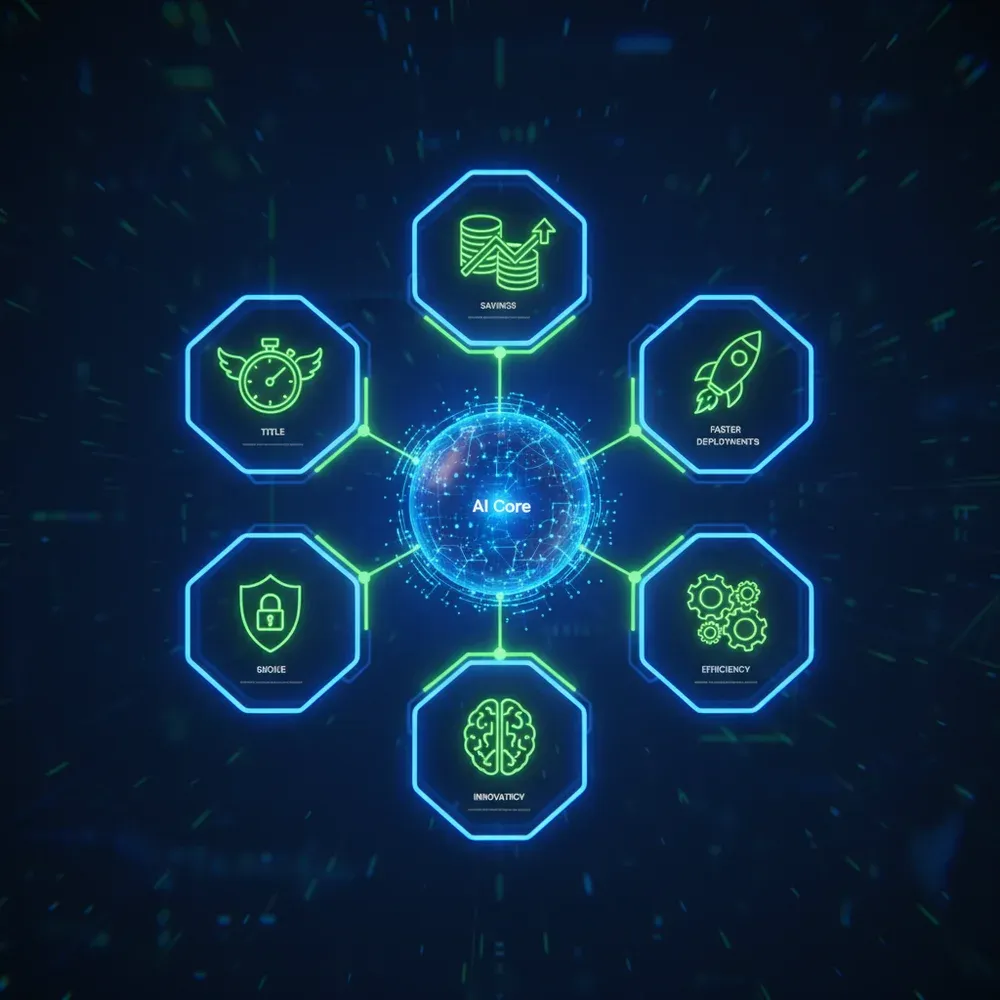
For technology leaders, AI-driven custom automation is not just a technical curiosity, but a hardcore business strategy. The Return on Investment (ROI) manifests on multiple fronts, drastically improving a company's financial and operational metrics.
Key Business Benefits
- ✓Cost Reduction: Dynamic optimization of cloud resources and minimizing downtime caused by human error can result in up to 30-40% savings in operational costs.
- ✓Decreased MTTR: Mean Time To Resolution drops from hours to minutes, or even seconds, through autonomous troubleshooting.
- ✓Freeing up engineering capacity: Senior developers and DevOps engineers can focus on innovation and developing new features instead of repetitive firefighting.
Improving the security posture is also a critical factor. AI agents can identify vulnerabilities in real-time and automatically apply necessary patches. If you want to maximize your company's efficiency, Request a free consultation about our custom automation solutions.
Implementing AI-Driven Custom Automation: A Strategic Roadmap
Introducing AI into DevOps processes cannot happen overnight. A poorly planned implementation can do more harm than good. A successful transition requires a well-structured, iterative approach that also considers changes in the Software Development Life Cycle (SDLC).
The first step is the Initial Assessment. You must identify the bottlenecks where the most manual work occurs and where the potential for error is highest. Do not try to automate everything at once; proceed based on the "low-hanging fruit" principle.
The second critical phase is developing a data strategy. The quality of AI models is directly proportional to the quality of the data fed into them. Centralizing and cleaning logs, metrics, and incident reports is essential for machine learning algorithms to find relevant patterns.
Next comes selecting the right tools and launching a pilot project. It's worth starting with a non-critical but highly measurable process. After a successful pilot, the solution can be iteratively scaled to the rest of the organization, while continuously managing the cultural shift within the team.
Challenges and Solutions: Data, Integration, and Trust
While the benefits are undeniable, implementing AI-driven automation also comes with serious challenges. One of the biggest hurdles is the "black box" phenomenon. Engineers find it difficult to trust a system whose decision-making mechanism is opaque to them.
The solution is applying Explainable AI (XAI) and ensuring transparency. Automation agents must log every step they take and clearly justify (e.g., by attaching relevant log snippets) why they made a specific decision or executed a certain command.
Integration with legacy systems can also cause major headaches. Modern AI tools communicate via APIs, but many older systems lack proper interfaces. In such cases, involving custom middleware layers or RPA (Robotic Process Automation) technologies may be necessary to build the bridge.
Finally, there's the issue of security and access management. An autonomous agent capable of modifying the production environment poses a massive security risk if compromised. A Zero Trust architecture and strict adherence to the principle of least privilege are essential.

The AWS DevOps Agent and the Future of AIOps: Autonomous Operations
Returning to the news mentioned at the beginning of the article: the AWS DevOps Agent (built on Amazon Q technology) perfectly exemplifies where the industry is heading. This agent is not just a chatbot that answers questions; it is an active participant in operations.
It can autonomously analyze network configurations, identify performance bottlenecks in code, and most importantly: execute fixes with developer approval. This capability is what we call Agentic AI.
The future of AIOps is autonomy. Just as we talk about different levels of autonomy in self-driving cars, we will reach level 4 or 5 in IT operations, where human intervention will only be necessary in the most extreme, unprecedented cases.
AWS's move forces other cloud providers and independent software developers to accelerate their own AI developments. The market is clearly shifting from a "Human-in-the-loop" model to a "Human-on-the-loop" (supervisory) model.
Measuring Success: Metrics and KPIs for Automation Initiatives
To prove the value of custom automation projects to management, it is essential to define and continuously track the right metrics (KPIs). Evaluation based on feelings and anecdotes is not enough.
The most important metric is Mean Time To Resolution (MTTR). You must measure the time elapsed from detecting an incident to its full resolution before and after AI implementation. For a successful project, we should see a drastic, even exponential decrease here.
Other critical metrics include Deployment Frequency and Change Failure Rate. AI must not only speed up processes but also increase stability. If we deploy faster but have more errors, automation is not achieving its goal.
Last but not least, Developer Experience (DevEx) must be measured. The goal of AI is to eliminate frustrating, repetitive tasks. If engineers feel that AI tools aid their work and reduce stress, it will lead to decreased turnover and increased productivity in the long run.
Future Trends: Hyperautomation and Proactive Systems
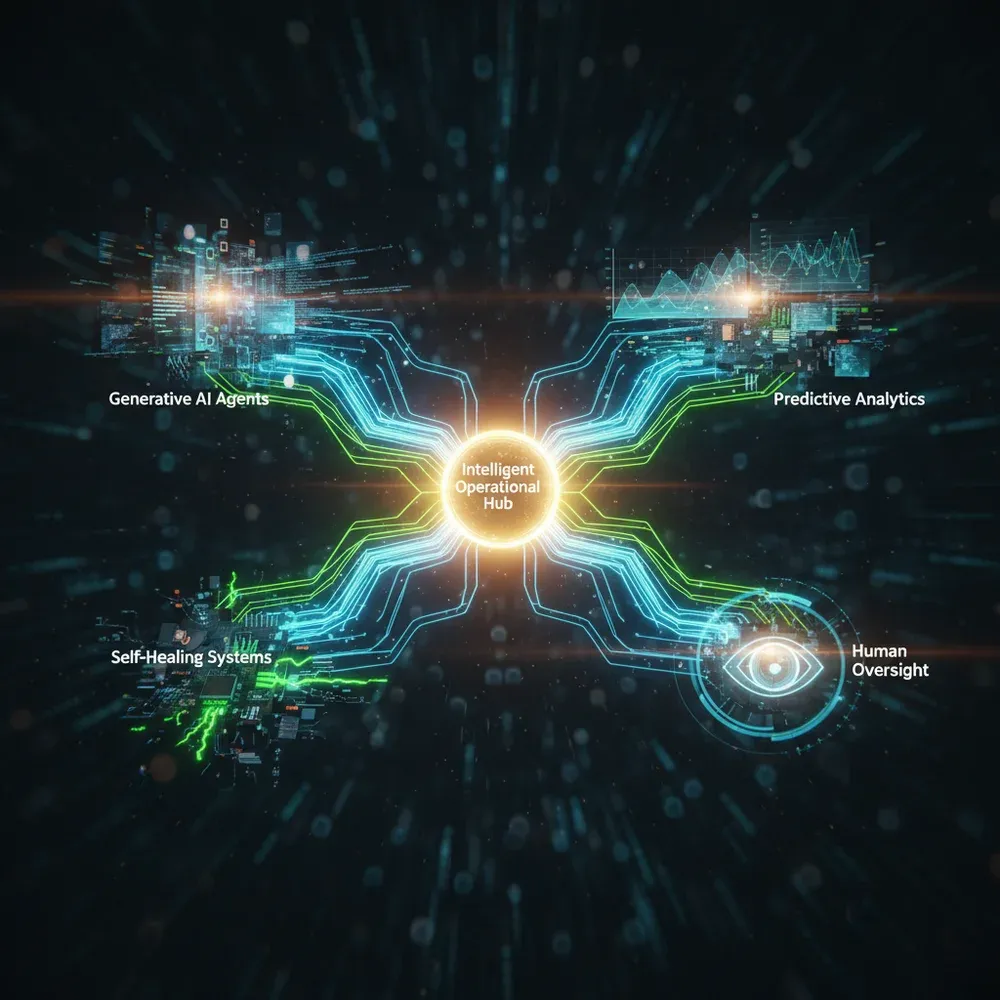
The evolution of automation does not stop at AI agents. The next big leap will be Hyperautomation, which means integrating artificial intelligence, machine learning, RPA, and Process Mining into a single, cohesive ecosystem.
Future agentic systems will be able to not only react to errors but completely proactively redesign their own architecture based on expected load or changing business needs. This will be the era of "Self-Architecting" infrastructure.
Imagine an e-commerce platform that, as Black Friday approaches, not only spins up new servers, but the AI analyzes purchasing patterns from previous years and pre-optimizes database queries, even rewriting caching logic for maximum performance.
Proactivity will also be key in security. AI systems will continuously simulate cyberattacks (Automated Red Teaming) against their own infrastructure to find and patch vulnerabilities before real attackers can exploit them.
Conclusion: Your Path to Autonomous Operations
The release of the AWS DevOps Agent and the explosive development of AI technologies carry a clear message: the future of IT operations is autonomous. Companies that continue to rely on manual processes and rigid scripts will fall into an insurmountable competitive disadvantage.
AI-driven custom automation is not just a technological upgrade, but a fundamental paradigm shift in corporate culture and process management. It allows teams to focus on innovation rather than survival, creating value that directly contributes to business success.
The question is no longer whether to introduce AI into automation, but when and how. The path to autonomous operations is challenging, but with the right strategy and expert support, the ROI is guaranteed.
Ready to level up?
Don't let your competitors get ahead. Our team helps assess your infrastructure and design a custom AI automation strategy tailored to your company.
Request a Free AI Automation ConsultationFrequently Asked Questions (FAQ)
What is the typical cost of implementing custom AI automation for an enterprise?
Costs depend heavily on infrastructure complexity, the state of existing legacy systems, and the desired level of autonomy. Implementing a basic AI-driven monitoring and alerting system can start from a few thousand dollars, while building a comprehensive, self-healing AIOps ecosystem may require a six-figure investment. However, it's important to note that for successful implementations, ROI is often realized within 6-12 months through drastically reduced downtime and freed-up engineering capacity.
What volume and type of data are required for effective AI-driven automation?
Modern generative AI and LLM models (like those used by the AWS DevOps Agent) are pre-trained on vast amounts of general IT and coding data. However, for company-specific fine-tuning or RAG (Retrieval-Augmented Generation) based context provision, local data is needed. Generally, at least 3-6 months of clean, structured log data, incident ticketing history, and performance metrics are required for the system to reliably recognize specific anomalies and minimize false positives.
How can the security and compliance of AI automation systems be ensured?
Ensuring security requires a multi-layered approach. First, AI agents must run in a strict Zero Trust architecture, with only the privileges absolutely necessary to perform their tasks (Least Privilege). Second, "Human-in-the-loop" checkpoints must be introduced before critical production changes. Third, all AI-generated code and executed commands must undergo automated security scanning (SAST/DAST). Finally, for compliance (e.g., GDPR, HIPAA), it must be ensured that AI models do not access sensitive personal data during training or log analysis.
How does the AWS DevOps Agent differ from traditional automation tools?
Traditional tools (e.g., Ansible, Terraform, simple bash scripts) are deterministic: they execute exactly what the engineer pre-programmed. They cannot adapt to unexpected situations. The AWS DevOps Agent, in contrast, is a generative AI-based, context-aware assistant. It can understand questions asked in natural language, autonomously analyze error messages, review AWS documentation, and synthesize a proposed solution. Moreover, it can write the fix code and (upon approval) deploy it. This represents a shift from reactive execution to proactive problem-solving.
What skills are necessary within a DevOps team to implement AI automation effectively?
The focus shifts from pure coding to systems thinking and AI governance. The team will need "Prompt Engineering" and "Context Engineering" skills to communicate effectively with AI agents. Additionally, a data-driven mindset becomes more valuable: understanding how to structure logs and metrics for AI. Traditional DevOps engineers will increasingly transition into an "AI Orchestrator" role, where their task is not writing scripts, but supervising autonomous systems, setting security guardrails, and strategic optimization.
What is the expected Return on Investment (ROI) timeframe for AI-driven custom automation?
ROI realization typically occurs in two phases. Short-term ROI (3-6 months) comes from automating "low-hanging fruit": replacing repetitive L1/L2 support tasks and immediate cloud cost optimization. Long-term, strategic ROI (12-18 months) stems from increased system stability (fewer critical outages), faster Time-to-Market, and increased innovation capacity. With a well-managed implementation, companies report an average of 30-50% reduction in operational costs by the end of the first year.
Is it feasible to implement AI automation in an existing, heterogeneous IT infrastructure?
Yes, in fact, that is exactly what custom automation is for. Unlike boxed solutions, custom AI agents can integrate into a wide variety of systems (even on-premise legacy) via APIs, webhooks, or custom middleware layers. The key is gradualism: the goal is not to immediately replace the entire infrastructure, but to build an intelligent, central AIOps layer that can communicate with existing tools (e.g., Jira, Datadog, old databases), collect data, and gradually take control over specific workflows.
Készen állsz a saját weboldaladra?
Ingyenes konzultáció során átbeszéljük, hogyan segíthetünk vállalkozásodnak növekedni egy modern, gyors és konverzióoptimalizált weboldallal. 14 nap alatt kész, 0 Ft induló költséggel.