
What is a dental AI chatbot?
A dental AI chatbot is a Hungarian-speaking, RAG-powered (Retrieval-Augmented Generation) virtual assistant embedded on a clinic's website or in Messenger, that answers patients' questions from the clinic's own knowledge base (prices, services, available slots, policies) and offers online booking. It is not a generic chatbot template — it is a custom-trained system tuned to your practice, available 24/7, where the patient gets an answer immediately instead of waiting 4–8 hours for a receptionist call-back.
According to a 2025 Hungarian Central Statistical Office (KSH) survey, 62% of Hungarian dental practices operate with 1–3 staff members, and the receptionist spends 2–3 hours daily on phone calls, emails, and scheduling. That time is taken directly away from patient care. An AI chatbot returns those 2–3 hours daily — and the patient does not wait. Such a system builds on a RAG chatbot architecture and sits inside the broader AI solutions family.
Why deploy in 2026 specifically?
Three mutually reinforcing trends converge:
- Hungarian patients' online booking habits have grown 40% since 2024 (KSH, 2025). The 25–45 age group checks website availability for 81% of bookings before calling.
- Google AI Overview launched in May 2025 increasingly routes search traffic to sites with well-structured, citable content. Practices without such content risk becoming invisible by 2027.
- 2026 AI models (Pannonia-LLM, Gemini 3.1 Flash, GPT-4.1 mini) achieve 92% Hungarian-language accuracy — and EU-GDPR-compliant APIs now allow safe handling of health-adjacent data.
How does a dental chatbot work in practice?
The system has three layers: a public interface (what the patient sees), a RAG knowledge base (the clinic's services, prices, policies, FAQ), and an integration layer (booking calendar, email sender, optional practice management software API). In the background, a custom automation layer handles calendar data, SMS reminders, and patient records.
From the patient side
The patient visits the clinic's website, and a chat window appears in the bottom-right corner. They describe their problem: "My wisdom tooth hurts, I'd like an appointment on Wednesday or Thursday, preferably in the afternoon." The chatbot responds in 2–4 seconds that the doctor has slots on Wednesday at 14:30 and Thursday at 16:00, asks about insurance status, and if everything checks out, books the slot immediately. The patient receives a confirmation email and an SMS reminder 24 hours before the appointment.
From the dentist and receptionist side
On the practice admin dashboard, the receptionist sees all bookings the chatbot created in a calendar view. No phone calls were needed, no email was waited for. The information the chatbot collected (chief complaint, insurance status, age range) is attached to the patient record, so the dentist can prepare before the visit. If the chatbot receives any medical question ("how much does a crown cost?"), it answers from the knowledge base and is barred from crossing into diagnostic territory — a GDPR-safe rule enforced at the prompt level.
What tasks does a dental chatbot handle?
In practice, there are five core task groups, each with measurable time or revenue impact:
| Task | What the chatbot does | Measured impact |
|---|---|---|
| Online booking | Patient selects service, prefers a slot, the chatbot checks the calendar, books, and confirms. | +35–40% online bookings |
| First-line information | Prices, opening hours, policies, parking, COVID rules — instantly, 24/7. | 80% faster first response |
| Price list & service explanation | Patient asks about implants, orthodontics, aesthetic fillings; chatbot answers from the knowledge base. | +20% quote-request conversion |
| SMS / email reminders | Sends a reminder 24 hours and 2 hours before the appointment, automatically. | -45% no-show rate |
| Follow-up & feedback collection | 3 days after treatment, checks on the patient and collects a Google review. | +1.2 stars average rating |
GDPR and medical data — how is it kept secure?
This is rightly the biggest concern. Health data is "special category" under GDPR, and its handling requires stricter controls. A responsible dental chatbot system maintains four cornerstones:
- EU server or self-hosted. OpenAI's EU-region API endpoint has been GDPR-compliant since 2026; the safest option is a self-hosted model on a Hungarian server.
- No personal health data stored in the chatbot. The system uses only the minimum data needed for booking (name, email, time, service); medical history stays in the practice management software.
- Data minimisation. The patient is never required to share medical details in chat. The chatbot never gives a diagnosis — it only describes services and prices from the knowledge base.
- Audit log and human review. Every conversation is logged, and the clinic reviews chat transcripts monthly to catch any inaccuracies.
A 2026 NAIH (Hungarian DPA) opinion confirms that meeting these four conditions makes the chatbot deployment lawful and does not require a separate authority permit. The chatbot is embedded on the clinic's web site, so the patient books and gets answers in the same place they arrived from Google.
How much does a dental chatbot cost in 2026?
Cost depends on scale and features. Three tiers paint the picture:
- Pilot (1-month trial): HUF 0–25,000. Usually assembled with no-code tools (n8n, Make.com) and 5–10 hours of the practice's own time.
- Production system, 1 dental chair, baseline features: HUF 25,000–60,000/month. Hosting, API costs, calendar integration, and maintenance included.
- Multiple chairs, complex integration: HUF 60,000–150,000/month. The chatbot is connected to the practice management software (e.g., Dentist, DentalVIP) and handles parallel calendars for multiple dentists.
In a 2026 AiSolve deployment at Vörösmarty Dentál Kft. in Nyíregyháza, online bookings grew 38% during the 14-day pilot period, and the receptionist's daily phone time dropped from 2.5 hours to 40 minutes. Full payback took 28 days. The pilot follows the HUF 0 web-site model, so there is no upfront investment.
How to deploy in 14 days?
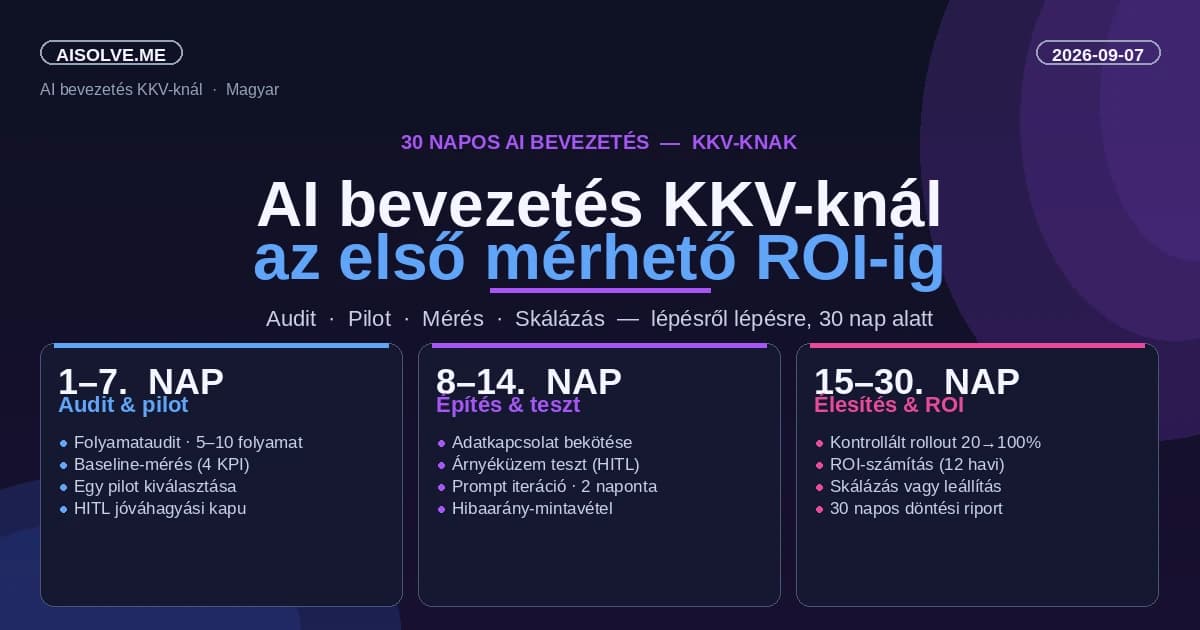
Deployment is not a 6-month IT project. A well-structured pilot goes live in 14 days, in the following steps:
- Days 1–3: Brief and knowledge base. Collect all relevant clinic information: service list with prices, opening hours, policies, FAQ, parking. This becomes the chatbot's "memory".
- Days 4–7: System assembly. Use no-code tools (n8n or Make.com) to connect the chatbot to your Google Calendar, email sender, and website. RAG training on the knowledge base takes 1–2 hours.
- Days 8–10: Internal testing. The receptionist and dentist test the system with 50–100 simulated questions. Inaccuracies are fixed one by one.
- Days 11–14: Live launch and monitoring. The chatbot goes live on the website. During the first week, spend 1–2 minutes daily reviewing conversations.
Chatbot vs. receptionist vs. call center — when to pick which?
The chatbot does not replace the human — it frees the receptionist's time for high-value tasks. The comparison below helps you pick the optimal combination for your practice.
| Dimension | AI chatbot | Receptionist | Outsource call center |
|---|---|---|---|
| Availability | 24/7, instant | Working hours | Per contract |
| Monthly cost (1 practice) | HUF 25–60k | HUF 350–500k | HUF 150–300k |
| Response time | 2–4 seconds | 1–8 minutes (busy-dependent) | 30–120 seconds |
| Onboarding time | 1–2 days, custom | 2–4 weeks | 4–8 weeks |
| GDPR-safe in medical context | Yes, with EU server | Yes, but human error possible | Risky, audit required |
The best combination is usually: AI chatbot for 24/7 booking and repetitive questions + receptionist for complex, high-touch cases (e.g., prosthodontic consultations, insurance disputes, urgent care). A call center only pays off at 4+ chair practices where the receptionist cannot keep up with the load.
Is it for you? — 3 self-check questions
Before starting, answer these three questions honestly. If all three are "yes", a 14-day chatbot deployment promises 28–45 day payback.
- Does your receptionist spend more than 1.5 hours daily on phone calls and emails?
- Do you lose 5–10 patients per month because online booking is missing or hard to use?
- Do you have at least 30 minutes of structured material about your services, prices, and policies?
If all three are yes, the pilot is deployable. If not, fix the knowledge base and the website first — otherwise the chatbot will give inaccurate answers and your practice's credibility will suffer.
Summary — the 3 key takeaways
- The dental AI chatbot is not the future — in 2026, it is the norm. 72% of Hungarian patients want to book online, and the chatbot frees 40% of the receptionist's time.
- A GDPR-compliant, EU-hosted system can be deployed for HUF 25,000–60,000/month, with payback in 28–45 days. The pilot takes 14 days.
- The chatbot does not replace the dentist; it removes 8–12 hours/week of admin work and increases patient satisfaction with 24/7 availability.
If you are ready for the pilot, the first step is a 30-minute free consultation where we review your current online presence and knowledge base. The slot carries no obligation.
Készen állsz a saját weboldaladra?
Ingyenes konzultáció során átbeszéljük, hogyan segíthetünk vállalkozásodnak növekedni egy modern, gyors és konverzióoptimalizált weboldallal. 14 nap alatt kész, 0 Ft induló költséggel.