
TL;DR — Quick Summary
- AI adoption for Hungarian SMBs is a business project, not a tech project: audit, prioritise, pilot, measure, scale.
- A 30-day plan puts your first automation in production within 7 days, with measurable ROI typically arrives within 5–8 months.
- Business automation ROI is not a universal percentage — calculate it with a formula and explicit assumptions, not a promise.
- The Hungarian SME digital maturity index sits at 40/100 (Digimeter 2024) — the bottleneck is baseline measurement, not the technology itself.
What is AI adoption for Hungarian SMBs, and why is it not the same as "buying a ChatGPT subscription"?
AI adoption for Hungarian SMBs is not the procurement of a software licence. It is a 30-day, measurable business transformation: identify your most expensive repetitive process, pick the one where ROI can be tracked at the lowest risk, and ship a pilot into production within 7 days. The goal is not to "have AI"; it is to move concrete business metrics — turnaround time, error rate, handoff ratio, lead conversion — and to back the return with numbers, not slogans.
In a typical Hungarian SMB, three things tend to break during AI rollouts: the team starts from the technology instead of the problem, there is no baseline measurement before automation, and the pilot slides on a "ready when ready" basis. This article gives a concrete 30-day plan that fixes all three failure modes — our implementation process follows the exact same structure.
Which process should you automate first? The priority framework
The most important first decision is this: pick the process before the tool. Apply three filters at the same time:
- Volume: it eats at least 5 hours per week from the team.
- Standardisability: at least 80% of the work is governed by rules and repeatable steps.
- Low risk: the output is acceptable without human review, or the mistake is cheap to fix.
If any of these is missing, do not start there. For a Hungarian SMB, typical first candidates are: inbound email triage and first reply, quote generation from templates, invoice and receipt verification, appointment confirmation replies, first response to website enquiries. All of these have mature, auditable business automation options, and none of them need a six-month build.
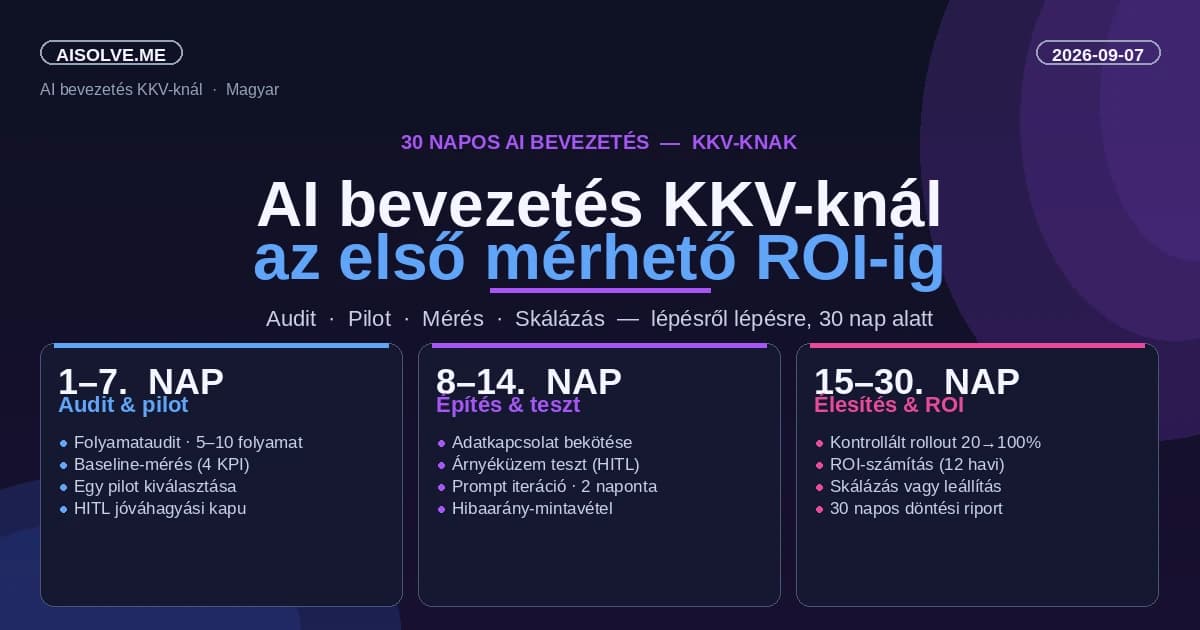
Days 1–7: audit, baseline, and pilot selection
Week one is not a technical week. The goal is to audit 5–10 processes, take a baseline measurement, pick the pilot, and put together the team.
Days 1–2: process audit and data inventory
Sit down with the team and fill out a simple table: process name, how many people touch it, hours per week, current error rate, current turnaround time. You will compare this table with the post-pilot version. Without an audit you have nothing to defend to management, and nothing to measure the result against. If you want a deeper hand, our AI process audit service maps the whole organisation in two sessions.
Days 3–4: baseline measurement and target numbers
For every process, record four numbers: turnaround time (hours per request), error rate (%), handoff ratio (% that escalates to a human), customer or lead impact (conversion or satisfaction). These four feed directly into the ROI calculation later. The pilot goal is not to "solve everything"; it is to deliver a measurable, at-least-30% improvement in one process within 30 days.
Days 5–7: pilot selection, tooling, team
Pick one process from the three-filter framework. Two common entry routes exist:
- Customer-facing entry: a RAG chatbot or an AI phone agent, when the pain point is inbound enquiry handling.
- Back-office entry: custom automation or data processing, when the pain point is administration, documents, or reporting.
Assign one accountable owner inside the team (one person), and set a delivery date for day 14. The typical team size is one owner plus one external implementer.
Days 8–14: pilot build, integration, testing
Week two is the actual build. Three things run in parallel:
- Data connection: wire up the CRM, email, internal knowledge base, or document store. This is the data processing AI side — where your knowledge actually lives.
- Prompt and logic: the first three days are pure prompt iteration. Test in your operating language with real customer transcripts.
- Human-in-the-loop: every critical decision (quote, contract, invoice) keeps a human approval gate for the first two weeks.
The rule by day 14: the pilot runs in shadow mode. The AI generates the outputs; a human still walks through the task. You are not yet live — the controlled rollout starts on day 15.
Days 15–30: measurement, controlled rollout, iteration
The third block is proof and tuning. There are three milestones.
The metrics table: what, how, how often
The table below shows the baseline metrics tracked throughout the 30-day pilot. The goal is not that every row is "good"; the goal is that every row is measurable.
| Metric | Definition | Baseline (week 1) | Pilot target (day 30) | How to measure |
|---|---|---|---|---|
| Turnaround time | Time between task start and finished output | X hours per request | ≤ 0.3 × X | Ticketing system / CRM timestamp |
| Error rate | Share of outputs a human had to correct | Estimate (from audit) | ≤ 5% (with human review) | Review sample of 20 per week |
| Handoff ratio | Share of tasks that required a human | 100% (all manual) | ≤ 30% (for routine cases) | Log / audit table |
| Lead / customer impact | Conversion, NPS or repeat rate | Current value | +10–30% (depending on process) | CRM / sales report |
A rule for picking metrics: track one KPI, not five. Across the 30-day pilot you improve one primary metric dramatically (typically turnaround time or conversion). The rest are guardrail metrics that protect quality.
ROI calculation: the formula and the assumptions
AI ROI should never be quoted as a universal percentage. The correct approach is a uniform 12-month horizon: benefit and operating cost are both projected over 12 months, implementation is one-off in month zero. The formula:
12-month net benefit = (hours saved × hourly cost + revenue uplift) × 12 − (monthly AI cost × 12) − one-off implementation
ROI % = 12-month net benefit ÷ (implementation + 12 × monthly AI cost) × 100
Reproducible starter example (12-month horizon)
Take a simple Hungarian SMB baseline: 10 hours saved per week, HUF 4,500/hour fully loaded, HUF 80,000/month AI subscription, HUF 600,000 one-off setup. Revenue uplift is set to HUF 0 (conservative), so ROI comes purely from operational efficiency:
- 12-month savings: 10 hrs/week × 52 weeks × HUF 4,500 = HUF 2,340,000
- 12-month AI subscription: HUF 80,000 × 12 = HUF 960,000
- One-off implementation: HUF 600,000
- 12-month net benefit: 2,340,000 − 960,000 − 600,000 = HUF 780,000
- ROI %: 780,000 ÷ (600,000 + 960,000) × 100 ≈ 50%
- Payback period: implementation + 12-month AI cost amortised to HUF 130,000/month of "investment" vs. HUF 195,000/month of operating savings — the investment breaks even at month 4, the remaining 8 months are net benefit.
Internal hourly cost for Hungarian SMBs typically sits in the HUF 3,500–6,500/hour range on a fully loaded basis (gross wage + contributions + overhead); take this from your own audit table, not from secondary sources.
What to know about Hungarian SMB AI scaling
McKinsey's 2025 State of AI survey reports that 88% of organisations now use AI regularly in at least one business function, and about one-third have reached the scaling phase — that is the international ratio. The BKK Digimeter 2024 measures Hungarian SMB digital maturity, with the index sitting at 40/100; the index covers digital infrastructure and usage habits, not AI scaling specifically. The Hungarian SMB AI-scaling ratio needs its own dedicated source, so we do not quote one here — start from your own audit table.
Three concrete ROI calculations for three SMB profiles
The three examples below are reproducible calculations for the most common SMB profiles. All three use the same formula, the 12-month horizon, and HUF 4,500/hour (HUF 6,000/hour for B2B) fully loaded. Weekly savings and monthly AI cost differ — bring these from your own audit table, not from the example.
| SMB profile | Pilot process | Hourly cost (HUF) | Weekly savings (hrs) | One-off setup (HUF) | Monthly AI cost (HUF) | 12-month net benefit (HUF) | Payback (months) |
|---|---|---|---|---|---|---|---|
| 10-person services firm | Inbound email reply | 4,500 | 12 | 600,000 | 50,000 | 2,808,000 − 600,000 − 600,000 = 1,608,000 | 3 |
| 25-person webshop | Product description generation | 4,500 | 18 | 1,200,000 | 120,000 | 4,212,000 − 1,440,000 − 1,200,000 = 1,572,000 | 5 |
| 50-person B2B company | Quote generation | 6,000 | 25 | 2,000,000 | 180,000 | 7,800,000 − 2,160,000 − 2,000,000 = 3,640,000 | 4 |
Hourly cost, one-off implementation and monthly AI cost all come from your company's audit table — the numbers shown here keep the example reproducible, they are not target values. The point is: ROI is always calculated from your own baseline and costs, on a 12-month horizon. The gap between the examples is not the technology — it is measurement. If you do not record the pre-pilot state, you will not be able to show a convincing ROI number to leadership afterwards.
Data and change-management risks most SMBs ignore
Three risks always deserve dedicated handling, because they decide whether the pilot is scalable or not.
1. Data quality and GDPR
AI is only as reliable as the data underneath it. Before wiring up any model, take a data inventory: what personal data do we process, where is it stored, who has access, and is it even needed by the AI. For GDPR-compatible operation, EU-hosted models or self-hosted solutions are the safest choice — the details are covered in our GDPR guide for Hungarian SMBs. Do not feed personal data into any model where EU residency is not guaranteed.
2. Change management inside the team
The pilot's biggest enemy is not the technology; it is internal resistance. Three rules help:
- Give the pilot a name (e.g. "Internal Pete"), not just "the AI project".
- In the first weeks the AI's outputs are reviewed by humans, not the other way round.
- Translate the saved hours into concrete team benefit (less overtime, freed-up projects) — communicate that on day 7.
3. Model drift and documentation
Model performance can drift down after 3–6 months when the underlying data changes (new product, new rule, new service). The antidote is a 30-minute monthly review where you sample 20 random outputs and feed the deviations back into the prompt rules. Documentation is not glamorous, but it is cheaper than a quality regression noticed six months too late.
30-day AI adoption checklist — copy-ready format
If you want to take the plan into your own hands quickly, copy the checklist below and keep it current through the pilot. The list is intentionally short — every line behind it carries a decision and a metric, not a bureaucratic tickbox.
Days 1–7 (audit and baseline)
- Process audit table filled (process, people, hours/week, error rate, turnaround).
- Baseline values recorded for every audited process.
- Priority framework applied: volume × standardisability × risk.
- One pilot process selected, one accountable owner appointed.
- AI toolset chosen (no-code / RAG / API / phone).
Days 8–14 (build and shadow-mode test)
- Data connections (CRM, email, knowledge base) wired up and tested.
- Prompt iteration done on at least 30 real customer transcripts.
- Human-in-the-loop approval gates defined.
- Shadow-mode test running: AI generates, human reviews.
- Error log kept (which output failed, why).
Days 15–30 (rollout and measurement)
- Controlled rollout: 20% of traffic → 50% → 100%.
- Four KPIs measured daily: turnaround, error, handoff, customer impact.
- Weekly review sample (20 outputs, human scoring).
- ROI formula calculated on day 30, compared against the baseline.
- Day-30 decision: scale, deepen, or stop.
What happens after day 30? Scale or stop
By day 30 you take one of three decisions:
- Scale to another process: if the first pilot delivered ≥ 30% improvement, the second process can be live in 14 days by reusing the first pilot's pattern.
- Deepen the same one: if the pilot is live but edge cases remain, iterate after day 30 instead of expanding.
- Stop: if the pilot did not produce measurable improvement, or change management collapsed, pause and investigate why. This is not a failure — it is data.
The most common mistake in Hungarian SMB rollouts is trying to automate three new processes immediately after day 30. Focus gets lost, and the original pilot quality slips too. The correct pattern is: stabilise one process, then scale, then deepen. Measurable cost reduction with AI always works at this tempo.
How to present pilot results to leadership — five steps
The day-30 presentation is not about "how good the AI is". It is about answering three leadership questions in one go: what changed, what did it cost, and what is the next step? The five-step framework below applies to any SMB pilot and keeps the conversation anchored on numbers, not narratives.
- Baseline and end-state side by side: one slide, audit-table numbers on the left (turnaround, error, handoff), measured pilot results on the right. Use absolute numbers, not percentages — leadership does not want "40% improvement", they want "inbound reply time dropped from 2 hours to 22 minutes".
- ROI table on a 12-month horizon: same template as above, filled with your numbers. Leadership rarely re-checks the formula — but if they ask, you can point to the audit table and the hourly-cost calculation.
- Risk status in three lines: data quality, change management, model drift — each with a green/amber/red flag and a named owner. This shows risk is managed, not hidden.
- One scaling proposal, not three: pick one process for the second pilot, justify the choice, expected ROI, and a 14-day delivery date.
- Decision request with three options: scale, deepen, or stop — each with a single number (cost, expected ROI, risk). You are not "asking for a decision", you are "preparing one".
A common mistake: the slide focuses on technology ("we use RAG, it runs in n8n, the model is GPT-4"), not on business impact. In a 30-minute slot, flip the order — impact, cost, risk, technology. Technology gets the last two minutes.
Another common mistake: framing the pilot as a success by weakening the baseline ("the process was bad before anyway"). That erodes trust over time. If the pilot improved, say it, point to the audit table, and stand by the numbers. Our agentic AI for SMBs guide dedicates a chapter to this presentation pattern.
Summary
AI adoption for Hungarian SMBs is not a one-shot digital transformation. It is a 30-day, measurable business loop: audit, prioritise, pilot, measure, iterate. With the framework described in this article, the first automation can ship within 7 days and measurable ROI typically arrives within 5–8 months on the 12-month horizon — provided the baseline is accurate, the pilot is well chosen, and change management is not left to chance. If you want to try it on a concrete process in your business, a 30-minute consultation will show you where the fastest payback sits.
Book a 30-minute AI process audit consultation →
Készen állsz a saját weboldaladra?
Ingyenes konzultáció során átbeszéljük, hogyan segíthetünk vállalkozásodnak növekedni egy modern, gyors és konverzióoptimalizált weboldallal. 14 nap alatt kész, 0 Ft induló költséggel.