

| Area | Key Insight |
|---|---|
| Core Problem | Standard AI models lack "contextual integrity," leading to privacy breaches even with anonymized data. The challenge is teaching AI not just *what* data is, but *how* it should be used in specific contexts. |
| Microsoft's Solution | Microsoft introduced a dual approach: PrivacyChecker, a real-time inference shield, and CI-CoT + CI-RL, an advanced training method to teach models to reason about privacy rules proactively. |
| Business Impact | Implementing these technologies is crucial for regulatory compliance (GDPR, CCPA), mitigating brand damage from data leaks, and building customer trust in an AI-driven market. |
| Implementation | Businesses can integrate these privacy layers into their custom automation and data processing workflows, making their AI agents safer and more reliable for handling sensitive information. |
| Future Outlook | The future of enterprise AI isn't just about capability; it's about governance. Proactive, trainable privacy frameworks will become a standard requirement for all corporate AI deployments. |
The proliferation of Large Language Models (LLMs) across every business sector has been nothing short of meteoric. From customer service to data analysis, these AI systems promise unprecedented efficiency. However, this rapid adoption has exposed a critical vulnerability: the alarming lack of robust, context-aware privacy controls. A recent report highlighted that over 60% of businesses deploying AI have low confidence in their ability to manage data privacy and compliance risks effectively. This isn't just a technical problem; it's a ticking time bomb for corporate reputation and regulatory standing. Traditional data protection methods like anonymization are proving insufficient against the nuanced ways LLMs can infer and expose sensitive information. The core issue lies in "contextual integrity"—an AI's ability to understand that the appropriateness of sharing data depends entirely on the situation.
In a significant step towards solving this challenge, Microsoft Research has unveiled a groundbreaking dual-pronged approach designed to embed sophisticated privacy reasoning directly into AI models. Their solution consists of PrivacyChecker, a lightweight, real-time privacy shield, and CI-CoT + CI-RL, a novel training methodology. This development moves beyond simple keyword filtering, aiming to create AI that intrinsically understands and respects the contextual boundaries of data. This article will dissect these innovative technologies, explore their profound implications for enterprise-level AI deployment, and provide a strategic roadmap for integrating them. We will examine how these tools can transform standard AI models into highly secure data processing AI agents, capable of navigating the complex web of modern data privacy regulations and safeguarding sensitive corporate information.
The Escalating Crisis of Contextual Privacy in AI
For years, the primary focus of data privacy was on securing data at rest and in transit—encryption, access controls, and anonymization were the tools of the trade. However, the rise of generative AI has introduced a far more subtle and dangerous threat: the violation of contextual integrity. Contextual integrity is the principle that information should be used and shared according to the norms of the specific context in which it was collected. For example, a patient shares medical history with a doctor for diagnostic purposes; that context is violated if the doctor discusses the case in a public cafe, even if the patient's name isn't used. LLMs, trained on vast, undifferentiated datasets from the public internet, have no inherent understanding of these social and professional boundaries.
This leads to situations where an AI can inadvertently create a privacy breach by connecting seemingly anonymous data points. An AI-powered HR assistant, for instance, might be asked to summarize performance reviews. While not revealing names, it could combine project details, timelines, and feedback in a way that makes it easy for colleagues to identify the employee being discussed. This is a classic failure of contextual integrity. The AI processed factually correct data but failed to grasp the implicit privacy norms of an internal performance review. These subtle breaches are incredibly difficult to prevent with traditional rule-based systems because the number of potential contexts is nearly infinite. This is why building smarter data processing AI agents that can reason about context is no longer a luxury but a fundamental necessity for enterprise AI.
Why Standard Anonymization Fails
The core limitation of standard anonymization techniques is that they focus on removing Personally Identifiable Information (PII) like names, addresses, and social security numbers. However, they often leave behind "quasi-identifiers." These are pieces of information that aren't unique on their own but can be combined to re-identify an individual. Consider a dataset containing an employee's department, job title, and the month they joined the company. Individually, these data points are anonymous. But in a company of 500, they might be enough to single out one specific person. LLMs are exceptionally good at finding these patterns and making these connections, effectively reversing the anonymization process without ever being explicitly instructed to do so. This is the challenge that Microsoft's new tools are designed to address head-on.

Microsoft's First Line of Defense: The PrivacyChecker Module
Microsoft's first innovation, PrivacyChecker, is an open-source, lightweight module designed to act as a "privacy shield" during inference. Inference is the stage where a trained AI model is actively used to answer queries or generate content. Think of PrivacyChecker as an intelligent gatekeeper that sits between the user's prompt and the LLM. It inspects both the prompt and the AI's potential response in real-time to ensure they comply with predefined contextual privacy policies before the final output is delivered to the user. This approach is powerful because it doesn't require retraining the entire LLM, making it a relatively fast and cost-effective way to add a layer of security to existing AI systems.
The module operates on a set of configurable rules that define what constitutes a privacy violation in a given context. For example, a company could configure PrivacyChecker with a policy that "employee performance data should not be correlated with data from their personal social media profiles." If a user then asks the AI, "Show me the performance reviews of employees who frequently post about politics on their public social media," PrivacyChecker would intercept this query. It would identify that the prompt attempts to bridge two distinct contexts (professional performance and personal social media) and would block the query, preventing the LLM from even attempting to process the inappropriate request. This reactive, real-time validation is a crucial first step in deploying safer AI. Effective management of these complex rule sets often necessitates a clear and intuitive user interface, underscoring the importance of professional website creation not just for public-facing sites, but for internal management dashboards as well.
Implementation Advice: Start by deploying PrivacyChecker on internal, low-risk AI applications. Use it to monitor the types of privacy-sensitive queries users are making. This data is invaluable for refining your policies before deploying the AI in customer-facing scenarios.
The Technical Architecture of PrivacyChecker
At its core, PrivacyChecker leverages a smaller, specialized language model that has been fine-tuned to recognize potential privacy violations based on a formal framework of contextual integrity. When a prompt is received, it's first passed to this specialized model, which analyzes the relationships between the entities and data types mentioned. It checks for requests that cross contextual boundaries defined by the organization's policies. For instance, it can distinguish between a valid request ("Summarize sales performance by region") and an invalid one ("Which salesperson lives in the highest-income zip code?"). The former relates to business operations, while the latter improperly links professional data with personal, socio-economic data. This architecture allows for rapid analysis without introducing significant latency, making it practical for real-world applications.
Proactive Privacy Training: The CI-CoT + CI-RL Paradigm
While PrivacyChecker provides an essential reactive shield, Microsoft's second innovation, CI-CoT + CI-RL, aims to solve the privacy problem proactively. This is a sophisticated training methodology designed to teach an LLM to *reason* about privacy from the ground up. Instead of just blocking bad requests, an AI trained with this method learns to understand *why* a request might be inappropriate and can explain its reasoning. This represents a major leap forward, moving from simple rule-following to genuine cognitive understanding. This method is what elevates a standard model into a truly intelligent data processing AI agent.
The process breaks down into two stages:
- Contextual Integrity Chain-of-Thought (CI-CoT): In this stage, the model is trained on examples where it must explicitly "think out loud" about privacy rules. It learns to generate a step-by-step analysis of a prompt, identifying the context, the actors involved, the type of information, and the relevant privacy norm before formulating an answer. For example, given a prompt, it might first internally generate text like: "The user is a manager. They are asking for an employee's health information. This is a violation of the 'medical privacy' norm. Therefore, I must refuse this request and state the reason."
- Reinforcement Learning from Contextual Feedback (CI-RL): After the initial CoT training, the model is further refined using reinforcement learning. It is presented with ambiguous scenarios and is rewarded for making privacy-preserving choices and penalized for making violations. This fine-tuning process hones its decision-making capabilities, making it more robust in handling novel situations that weren't explicitly covered in its initial training data.
An AI trained this way doesn't just block a problematic query; it can engage with the user, explaining, "I cannot provide specific medical details as that would violate employee privacy policies. However, I can provide an anonymized summary of sick leave trends across departments." This ability to explain its reasoning is critical for building user trust and for creating genuinely collaborative custom automation solutions that work with, not against, human operators.
Head-to-Head: Reactive vs. Proactive AI Privacy Controls
Choosing between a reactive approach like PrivacyChecker and a proactive one like CI-CoT training depends on an organization's specific needs, resources, and risk tolerance. A reactive shield can be deployed quickly on existing systems, offering an immediate layer of protection. It's an excellent solution for businesses that are already using third-party AI models and need to add a governance layer without modifying the core model. However, it functions as a gatekeeper and can sometimes be circumvented by cleverly worded prompts. Its effectiveness is entirely dependent on the quality and comprehensiveness of its predefined rule set.
A proactively trained model, on the other hand, is inherently more secure. Privacy is baked into its decision-making process. This approach is more resilient to novel or adversarial prompts because the model isn't just checking rules; it's reasoning from first principles. The drawback is the significant upfront investment in training and fine-tuning. This is typically a better long-term strategy for organizations developing proprietary models or those handling extremely sensitive data, such as in healthcare or finance. For many businesses, a hybrid approach will likely be the most effective, using a proactively trained model as the core engine and a reactive shield like PrivacyChecker as a final safety net and audit layer. This dual strategy is the gold standard for building enterprise-grade data processing AI agents.

Figure: A comparison of key characteristics between reactive and proactive AI privacy enforcement mechanisms.
| Feature | Reactive Control (PrivacyChecker) | Proactive Control (CI-CoT + CI-RL) |
|---|---|---|
| Implementation Effort | Low. Deployed as a wrapper around existing models. | High. Requires deep model fine-tuning or training from scratch. |
| Flexibility | High. Policies can be updated in real-time without retraining the core LLM. | Low. Changes in privacy philosophy may require significant retraining. |
| Resilience to Novel Threats | Moderate. Relies on the comprehensiveness of its rule set. | High. Can reason about new scenarios not seen during training. |
| Performance Overhead | Low. Adds minimal latency to the inference process. | Negligible at inference, but high compute cost during training. |
| Explainability | Limited. Can state which rule was violated but not the deeper "why". | High. Can generate natural language explanations for its privacy decisions. |
| Best For | Retrofitting privacy controls onto existing AI systems quickly. | Building new, inherently secure models for handling highly sensitive data. |
Navigating the Compliance Maze: GDPR, CCPA, and Beyond
The development of these advanced privacy tools is not happening in a vacuum. It's a direct response to an increasingly stringent global regulatory landscape. Regulations like the EU's General Data Protection Regulation (GDPR) and the California Consumer Privacy Act (CCPA) impose severe penalties for data breaches and misuse of personal information. A key principle in these regulations is "Data Protection by Design and by Default," which mandates that organizations consider data protection from the very beginning of designing any new system. Proactive training methods like CI-CoT + CI-RL are a perfect embodiment of this principle. By building privacy awareness into the model itself, companies can more easily demonstrate to regulators that they have taken robust technical measures to protect user data.
Strategic Insight: Use the "explainability" feature of proactively trained models as part of your compliance documentation. The AI's generated reasoning for why it withheld information can serve as a powerful audit trail, proving to regulators that your system is actively making privacy-aware decisions.
Furthermore, these tools help address the "right to be forgotten" and "data minimization" principles. A context-aware AI can better identify and segregate data that is no longer needed for its original purpose, making it easier to delete upon user request. For example, an RAG AI chatbot built with these principles could understand that while it needs a user's address to process a current order, it should not retain that information for general customer profiling afterward. Deploying sophisticated data processing AI agents that understand these nuances is becoming the most effective way to ensure continuous compliance and avoid the hefty fines associated with these regulations, which can run into millions of dollars.
Integrating Privacy-First AI into Your Enterprise Strategy
The availability of tools like PrivacyChecker and training methods like CI-CoT means that businesses no longer have an excuse for deploying AI without adequate privacy safeguards. The integration of these technologies should be a core component of any enterprise AI strategy. For companies leveraging AI for customer support, this means enhancing their systems to be a secure AI phone customer service or chatbot that can recognize and protect PII shared during conversations. For those in marketing and sales, it means building data processing AI agents that can analyze customer trends without violating individual privacy norms.
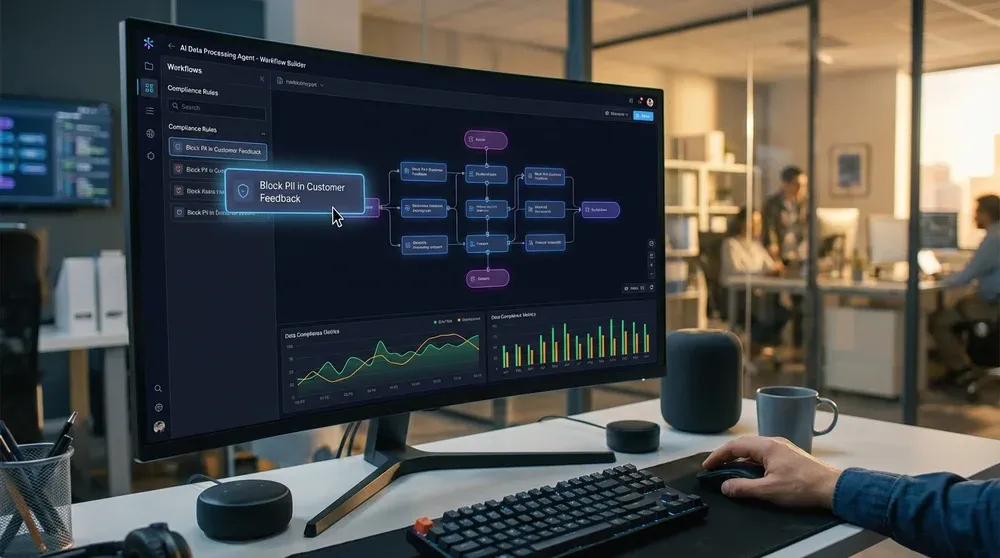
The first step is data mapping and policy definition. Businesses must identify the different contexts in which they handle data (e.g., customer support, financial transactions, HR reviews) and define clear privacy rules for each. These policies then become the rulebook that powers PrivacyChecker or the training data for a CI-CoT model. This process requires a collaboration between legal, compliance, and technical teams. The ultimate goal is to create an ecosystem of automated systems where privacy is not an afterthought but a foundational component. These systems must be monitored and audited, which requires robust internal tools. A well-designed dashboard, often developed through a professional website creation process, is essential for giving compliance officers a clear view into how the AI is interpreting and enforcing privacy policies in real-time.
A Phased Integration Approach
For most organizations, a phased approach to integration is most practical.
- Phase 1: Audit and Shield. Deploy a tool like PrivacyChecker across existing AI applications in a monitoring-only mode to understand current privacy risks. Then, activate its shielding capabilities to provide an immediate layer of protection.
- Phase 2: Develop a Core Privacy-Aware Model. Begin the process of fine-tuning a dedicated LLM using the CI-CoT + CI-RL methodology. Start with a specific, high-risk domain, like HR or customer financial data. This model will become your internal "privacy expert."
- Phase 3: Scale and Federate. As the core model matures, use it to handle all sensitive data queries across the organization. Other, less specialized AI agents can consult with this central model when they encounter a potentially sensitive request, creating a hub-and-spoke governance architecture. This allows you to leverage powerful, secure data processing AI agents as a centralized service.
Understanding the Risks and Limitations of New Privacy Tools
While Microsoft's innovations are a significant leap forward, they are not a silver bullet. It's crucial for businesses to understand their limitations to avoid developing a false sense of security. The effectiveness of PrivacyChecker, for example, is entirely contingent on the quality of the rules it's given. Poorly defined or incomplete privacy policies will result in a porous shield. Malicious actors will constantly be looking for new ways to phrase prompts to circumvent these rules—a cat-and-mouse game known as adversarial prompting. Organizations must commit to continuously updating and refining their policies in response to emerging threats.
For proactively trained models, the primary risk is "normative drift." The societal or organizational norms of privacy can change over time. A model trained with today's privacy standards might make inappropriate decisions a few years from now if it's not periodically retrained or fine-tuned with updated ethical guidelines. Furthermore, there is the risk of "over-correction," where the AI becomes too cautious and refuses to answer legitimate, non-sensitive queries, thereby hindering business operations. Finding the right balance between security and utility requires ongoing performance monitoring and adjustment. These tools reduce risk significantly, but they do not eliminate the need for human oversight and a robust governance framework.
Pro Tip: Establish a "red team" within your organization dedicated to stress-testing your AI's privacy controls. This team's job is to act like an adversary, constantly crafting novel prompts to try and trick the AI into revealing sensitive information. Their findings are crucial for strengthening your defenses.
A Strategic Roadmap for Deploying Privacy-Centric AI Agents
Successfully deploying privacy-centric AI is not just a technical challenge; it's a strategic one. Organizations need a clear, actionable roadmap to move from theory to implementation. The following steps provide a high-level framework for this journey.
| Step | Action | Key Objective |
|---|---|---|
| 1. Establish a Governance Council | Create a cross-functional team including legal, IT, compliance, and business leaders. | To define the organization's official privacy policies and risk tolerance for AI applications. |
| 2. Classify Data and Contexts | Conduct a thorough audit of all data sources used by AI. Classify data by sensitivity level and map the contexts in which it is used. | To create the foundational rulebook for configuring PrivacyChecker or training a CI-CoT model. |
| 3. Pilot Program with a Reactive Shield | Select a single, non-critical AI system and implement PrivacyChecker. | To gain practical experience with privacy controls and gather real-world data on potential violations with minimal risk. |
| 4. Develop a Long-Term Proactive Strategy | Based on the pilot's findings, allocate resources for fine-tuning a proprietary model using CI-CoT + CI-RL. | To build a core asset of inherently secure data processing AI agents for high-stakes applications. |
| 5. Implement Continuous Monitoring | Deploy tools to log and analyze all queries and AI responses, flagging any that are blocked or generate privacy warnings. | To enable ongoing auditing, threat detection, and continuous improvement of the privacy framework. |
Following this roadmap will enable businesses to not only comply with regulations but also to build a sustainable competitive advantage. In the coming years, trust will be the most valuable currency in the digital economy. Companies that can prove their AI systems are designed with user privacy at their core will be the ones that win and retain customer loyalty. The era of treating privacy as a checkbox exercise is over; it is now a central pillar of sound business strategy and a key differentiator in the market.
The future of enterprise automation depends on deploying AI that is not only powerful but also trustworthy. By integrating advanced privacy frameworks, you can unlock the full potential of your data while maintaining regulatory compliance and customer confidence.
Build Your Secure AI Agents Today[Article generated by AiSolve AI Content System]
Frequently Asked Questions
What is "contextual integrity" in AI?
Contextual integrity is the principle that information should only be used and shared in ways that are appropriate for the context in which it was originally collected. For an AI, this means understanding, for example, that employee performance data (professional context) should not be mixed with their personal health data (private context), even if both datasets are accessible. It's about respecting implicit social and ethical boundaries, not just technical data permissions.
What is the main difference between PrivacyChecker and the CI-CoT method?
The primary difference is reactive versus proactive control. PrivacyChecker is a reactive "shield" that inspects prompts and responses against a set of rules in real-time, blocking violations. It's added to an existing model. The CI-CoT + CI-RL method is a proactive training technique that fundamentally teaches a model to reason about privacy from the inside out. The model learns to understand and apply privacy principles, rather than just being policed by an external module.
How can a small business start implementing these AI privacy controls?
A practical first step for a small business is to start with a reactive approach. If using third-party AI APIs, they can implement a solution similar to PrivacyChecker as a wrapper around these API calls. This involves defining a clear, simple set of privacy policies relevant to their business—for example, "never store customer credit card information in chat logs." This provides a significant security upgrade without the immense cost of training a custom model from scratch.
Are these privacy tools a guarantee against data breaches?
No, they are not an absolute guarantee. They represent a significant advancement in mitigating privacy risks associated with LLMs, but they are not infallible. Their effectiveness depends on the quality of the configured policies and the thoroughness of the training. Malicious actors will always try to find new ways to trick AI systems. Therefore, these tools should be seen as a critical layer in a comprehensive, defense-in-depth security strategy, which must also include data encryption, access controls, and regular security audits.
Készen állsz a saját weboldaladra?
Ingyenes konzultáció során átbeszéljük, hogyan segíthetünk vállalkozásodnak növekedni egy modern, gyors és konverzióoptimalizált weboldallal. 14 nap alatt kész, 0 Ft induló költséggel.