TL;DR — Quick Summary
- Agentic AI is already available to Hungarian SMBs in 2026 for less than HUF 100,000 per month.
- The best first steps: chatbot, automated email reply, appointment booking — low risk, high ROI.
- No-code tools (n8n, Make.com) mean you don't need a developer to get started.
- 45% of Hungarian SMBs already use predictive analytics, but only ~12% use AI agents for operational tasks.
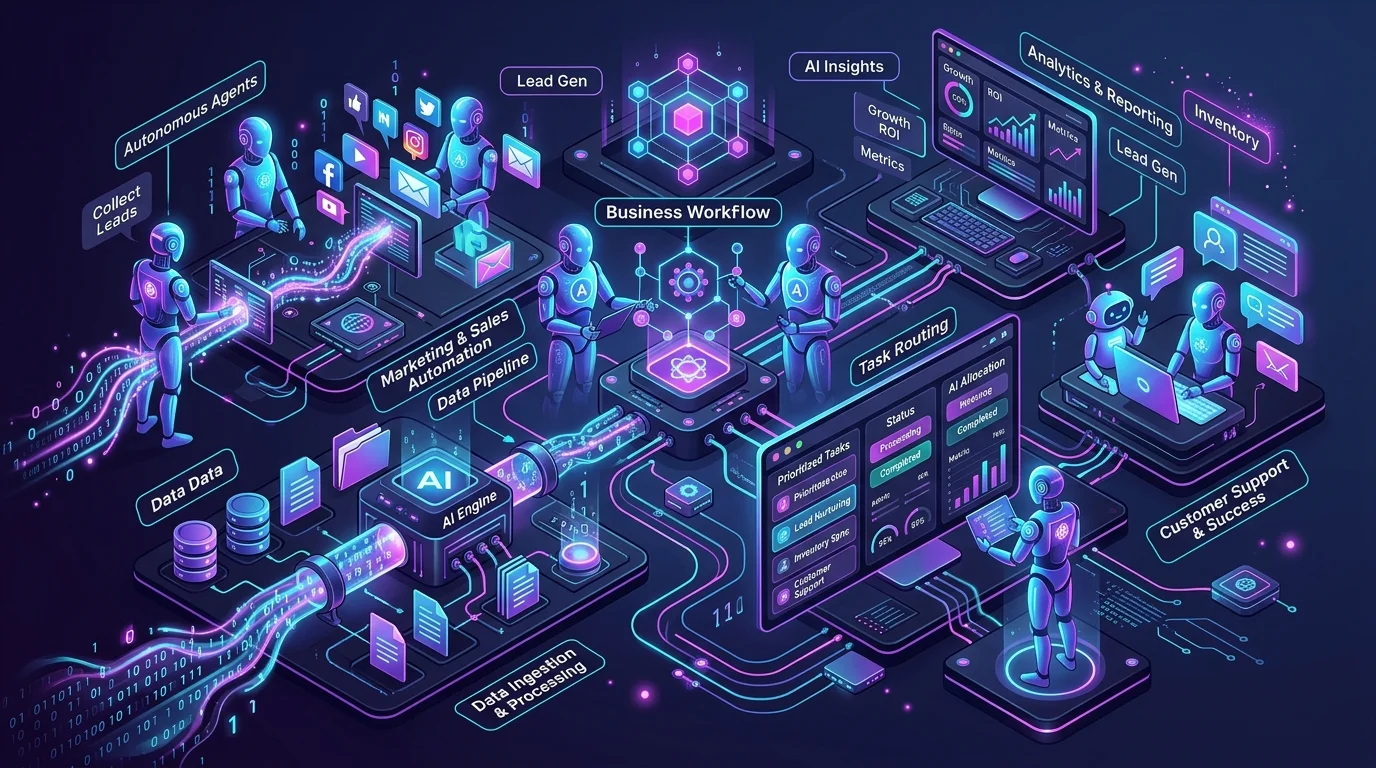
Péter Kovács is the owner of GépPlusz Ltd. in Debrecen. He spent twelve hours a week answering customer service emails. The questions were constantly repeated: quotes, service appointments, spare parts. And the replies were coming later and later. Péter had less and less time for product development and customer acquisition. In the evenings, he was still browsing his inbox. In March 2026, he deployed a full-fledged AI agent alongside an AI chatbot. Now he spends only two hours a week on email handling. Plus, he gets thirty percent more quote requests. Response time dropped to minutes. Customer satisfaction increased. This is not sci-fi. This is the reality of a Debrecen-based SMB in 2026.
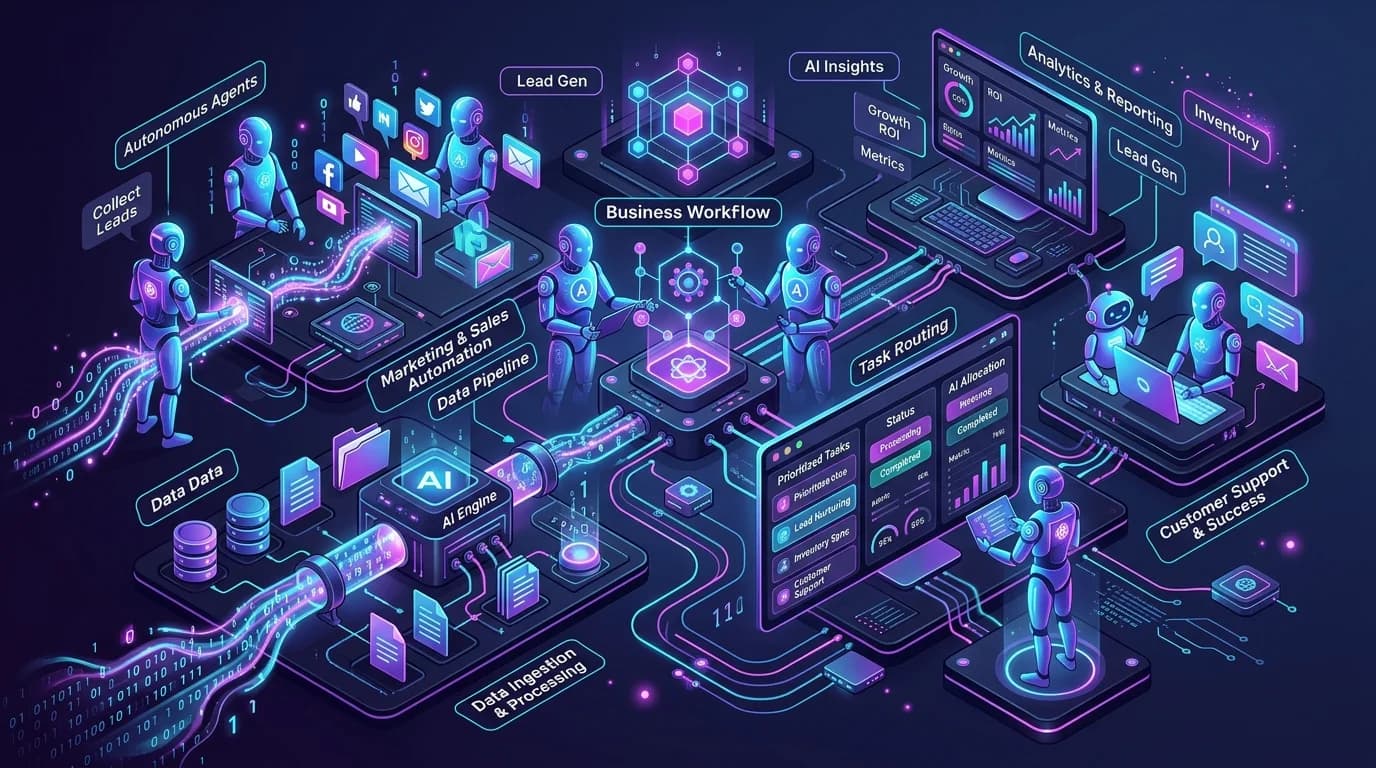
What is agentic AI? In short: artificial intelligence that does not just respond, like ChatGPT. It acts. It books appointments, sends quotes, updates inventory, queries data, and independently decides on the next step. Generative AI was born for content creation. Traditional automation, such as Zapier or Make.com, runs along predefined rules. If this, then that. Every step is fixed. Agentic AI, however, receives goals. For example: "Book a service appointment based on inventory, and send a quote." The agent does the rest. In a previous article we wrote in detail about AI chatbots. An agent-based system, however, is even more: a digital employee who doesn't just answer, but completes the task. It navigates independently between systems.
The statworx AI Trends Report 2026 and Gartner unanimously state: agentic AI is the most impactful enterprise trend of the year. The generative AI era is being replaced by agent-based AI. According to international research firms, more than sixty percent of large corporations will launch pilot projects with such systems in the next twelve months. Agentic AI solutions are expected to reduce administrative time by fifteen to thirty percent. The technological gap is closing quickly. Those who enter now gain a competitive advantage. Those who wait fall behind. In the next two years, agentic AI will be the difference between market average and market leader.
The competition is global, but capacity is local. A fifteen-person Debrecen company cannot compete with a multinational administrative team. But with AI agents, it can. Forty-five percent of Hungarian SMBs already use predictive analytics according to StateGlobe's 2026 research. Marketing automation increases ROI by an average of twenty-five percent. Businesses spend an average of three million two hundred thousand forints annually on marketing automation. Yet only about twelve percent of them use AI agents for daily operational tasks. This gap is where the opportunity lies. Whoever deploys an AI phone agent or launches custom automation today can dedicate more time to growth from tomorrow. The investment is less than the monthly salary of a new employee. The question is no longer whether you can afford it. It's whether you can afford to miss it.
What Can AI Agents Do in Your SMB?
Large enterprise AI projects are often characterized by unnecessary complexity and years-long implementation time. A Hungarian SMB, however, cannot afford this luxury. The good news: agentic AI was created precisely to automate routine tasks quickly, reliably, and under human supervision. In the following four areas, it can deliver measurable business results today.
1. Customer Service — 24/7 Responses at Human Quality
Customer service is the first point in most SMBs where an AI agent creates immediate value. A modern AI chatbot doesn't just spin pre-written FAQ answers. Thanks to the RAG (Retrieval-Augmented Generation) architecture, it contextually understands the customer's question, reviews the company's knowledge base, and provides an accurate, professional answer — whether about technical details or shipping terms.
The biggest advantage is continuous operation: no vacation, no sick leave, no "we'll reply tomorrow." The AI agent is just as polite and precise at 3 AM as in the afternoon. Incoming requests are automatically categorized and prioritized: a billing issue is immediately forwarded to the accountant, while a general inquiry is handled seamlessly on its own.
AiSolve's RAG chatbot and AI phone agent services bring exactly this quality to the Hungarian market. Special mention goes to the Gemini 3 Flash model, which now communicates excellently in Hungarian during live phone conversations — with natural intonation, correct word usage, and real-time reactions. You can read more about this in our AI phone customer service article.
It's important to note that the AI agent doesn't replace, but complements the human team. If the question is too complex, emotionally charged, or requires a unique decision, the system seamlessly hands it over to a human colleague — so human handoff is always ensured.
2. Sales and Quote Requests — Leads Don't Wait
Think about it: a potential customer fills out the quote request form on your website. In the traditional process, they'd get a response tomorrow morning, or Monday. By then, they're already at the competitor's. An AI agent sends a personalized, professional response within 2 minutes — with product parameters, pricing, and next steps.
The process doesn't stop at the first email. The AI agent automatically updates the CRM — whether it's HubSpot, Pipedrive, or even an initial Google Sheet. It tracks the lead's status, and if the customer doesn't respond for 3 days, it sends a gentle, valuable reminder. Automated follow-up is not pushy; quite the opposite: it creates the feeling that the company is paying attention and is proactive.
The data speaks for itself: automated follow-up processes increase conversion rates by an average of 35%. For an SMB, this can mean several million forints in additional monthly revenue.
AiSolve's custom automation service builds exactly such processes. The logic is not templated: it can handle B2B and B2C pricing differences, regional discounts, or seasonal offers — as we saw in the extrahasznaltruha.hu case study, where the system automatically decided between shipping method and price category.
3. Administration and Back-Office — The Invisible Time Thief
SMB owners spend an average of 8–12 hours per week on administrative tasks. This is one of the company's most expensive resources — the owner's time — and it's not being spent on strategic growth. AI agents take this burden off your shoulders.
Invoicing, for example, can be fully automated: through the Billingo or Számlázz.hu API, the AI agent immediately generates and sends the invoice after fulfillment, with the appropriate accounting category and data. Inventory management also doesn't require manual entry: after a purchase in the webshop, the AI automatically updates the warehouse inventory and sends an alert when a product level drops below the reorder threshold. The extrahasznaltruha webshop case study is also a great example of how this works in practice.
Appointment booking is another often neglected area. The customer selects a suitable time slot on the website, the AI agent books it in Google Calendar or a custom booking system, sends a confirmation email, and a reminder 24 hours before the meeting. No phone coordination, no double booking, no missed cancellations without reminders.
These processes are supported in an integrated way by AiSolve's website development and data processing services: the website is not just a "showcase," but an active part of business logic.
Attention: AI agents do not replace the accountant or legal advisor. Invoice automation works excellently for standard transactions, but for VAT refunds, complex contracts, or financial audits, a professional is still needed. The AI handles the routine, not the responsibility.
4. Marketing and Content — Your Machine Writes for You
The marketing team of a Hungarian SMB is often one person — or the owner themselves. Content production thus gets into constant time trouble. AI agents resolve this asymmetry: based on the company's latest news, blog posts, or product updates, they automatically generate social media posts for LinkedIn and Facebook, with the appropriate hashtags and tone.
Writing SEO blog posts is no longer science fiction either. The AI is capable of creating full-value, search-optimized content — from keyword research to heading structure to meta descriptions. The key is so-called Generative Engine Optimization (GEO), where AI and search optimization meet. AiSolve's GEO guide article details how to optimize for Google's AI Overview systems in 2026.
Personalized newsletters are the most effective tool. Not "Dear Customer" — but "Dear Péter, you inquired about machine repair last time, and we have fresh information on this topic." Emails with dynamic content produce 26% higher open rates, because the customer feels: this is not mass spam, but relevant communication.
Agentic AI doesn't mean the machine completely markets independently for you. It means it handles the draft, the first version, the scheduling, and the personalization, while you focus on strategy, branding, and fine-tuning. Your SMB can thus compete on equal terms with larger players — without having to introduce seventy-hour work weeks.
Concrete Tools for Hungarian SMBs in 2026
Theory is nice, but what do I install tomorrow morning? If you thought that agentic AI only works in large enterprise IT departments, I have to disabuse you: in 2026, a shopkeeper in Nyíregyháza can use the same tools as a San Francisco tech company. In this section, we present concrete tools, prices, and use cases. You don't need to be a programmer — the no-code revolution is already available in Hungary, and the costs are a fraction of classic software development projects.
No-Code / Low-Code Platforms — The Building Blocks of Your Workflow
| Tool | Price (estimated, monthly) | Strength | Ideal if... |
|---|---|---|---|
| n8n (self-hosted) | Free / ~$50/mo cloud | Visual workflow, full data privacy, open source | You're technically curious and keeping data on-premise matters |
| Make.com (formerly Integromat) | ~$30/mo starting | Very user-friendly, many integrations | You want quick results and don't want to manage a server |
| Zapier | ~$50/mo | Largest integration network (5000+ apps) | You use English-language tools and fastest setup is the goal |
| UiPath (Community) | Free | RPA — automating complex desktop applications | You need to connect legacy (old, non-API-friendly) software |
The n8n self-hosted version is completely free and runs on your own server — whether on a Raspberry Pi or a rented VPS. From a GDPR perspective, this is the safest solution, because customer data never leaves the company's infrastructure. Installation with Docker takes minutes, and the visual node-based editor allows you to connect your CRM, invoicing system, and email system without coding.
Make.com (formerly Integromat) is the fastest start if you're just getting to know automation: on the visual drag-and-drop interface, you can connect your Gmail account with Google Sheets, or your Facebook ads with your CRM system in minutes. For the $30 monthly fee, you don't have to run a server, and the system guarantees 99.9% availability. If you're curious about the details, check out our custom automation service.
Zapier is the most expensive of the listed options, but in exchange offers the largest integration network: it communicates with more than 5,000 applications. If you use English-language SaaS tools (Slack, Salesforce, HubSpot), setup is a few clicks. The drag-and-drop builder is easy to use even for less technically savvy staff, but the $50 monthly fee is only worth it if you need to connect less common apps.
UiPath Community Edition is the "big gun" if you need to handle old, non-API-friendly software: e.g., an accounting program inherited from the DOS era, where the robot literally "presses" the buttons. This RPA technology is particularly useful in manufacturing and logistics companies, where replacing legacy systems would be a multi-million forint investment. The Community Edition is free, but the enterprise version's monthly fee is already more substantial.
Tip: If you're just starting, launch with Make.com for a month ($30/mo). If it works, migrate to n8n self-hosted for long-term data privacy and cost reduction.
AI Models and APIs — The Brain in the Machine
| Model / Service | Use | Cost (estimated) |
|---|---|---|
| OpenAI GPT-4.1 mini | Text generation, email, chat, quotes | ~$0.15 / 1M tokens (practically ~$10-20 / mo for an SMB) |
| Google Gemini 3 Flash | Multimodal tasks, Hungarian language, image recognition | Free tier + pay-as-you-go (usually stays free at SMB level) |
| Mistral / Llama 3 (self-hosted) | Strict data privacy cases, banking, healthcare | Server cost (~HUF 15-25k/mo) |
| ElevenLabs | AI phone customer service, Hungarian voice synthesis | ~$20/mo |
OpenAI GPT-4.1 mini is the best price-to-value model for text tasks: email replies, quote generation, or even blog post writing. An average Hungarian SMB can expect 100-200 API calls per day, which costs $10-20 per month — less than a one-hour salary of a customer service employee. The model performs excellently in Hungarian too, and the "hallucination" rate has significantly decreased compared to previous versions.
Google Gemini 3 Flash is excellent for Hungarian-language communication, and thanks to its multimodal capabilities, it can even interpret invoices, contracts, or product photos. If you want to switch your phone customer service to AI too, it's worth reading our AI phone customer service article. Google's free tier is sufficient for most SMBs; pay-as-you-go only kicks in if you send thousands of requests per day.
If your industry is strict — for example, you process healthcare data or banking client information — the self-hosted Llama 3 or Mistral model is the solution. The data never leaves the server, and the model runs locally. The monthly HUF 15-25 thousand server cost is the price of GDPR compliance and customer trust. These open-source models are already approaching GPT-4 quality.
Hungarian Service Providers and Partners
You don't need to send your data abroad, and you don't need to struggle alone with setup. In Hungary, there are already hundreds of companies offering AI-based solutions for SMBs, and these providers not only know the technology but also Hungarian legislation, NAV invoicing rules, and local market conditions. Here are four key players:
- AiSolve.me (Nyíregyháza) — AI solutions, custom automation, website development, AI chatbot, AI phone agent. Designed for SMBs, in Hungarian, fast delivery (14 days). The service is also available with 0 Ft startup — no upfront cost. The company also installs its own n8n workflows and self-hosted LLM solutions if data privacy is a top priority.
- NeurálTech Hungary (Budapest) — industrial AI, computer vision, autonomous systems. Their most famous project is the visual inspection system running in Mercedes-Benz factories, which identifies mechanical part defects with artificial intelligence — with millimeter precision.
- Central European AI Dynamics (CEAD) (Budapest/Miskolc) — Hungarian large language models (Pannonia-LLM), legal AI assistant. The Pannonia-LLM is particularly valuable for processing Hungarian legal terminology, and CEAD's legal chatbot already helps at several law firms with contract analysis.
- Pannonian AI Solutions (Debrecen/Nyíregyháza) — agricultural AI, precision farming, drone spraying. They develop drone spraying maps, soil analysis data algorithms, and crop yield forecasting systems — already accessible to 20-50 hectare family farms.
You don't need to move to Budapest or hire a multinational IT company. The Hungarian AI ecosystem is already available at a regional level — from Nyíregyháza through Debrecen to Miskolc, you can find partners who not only understand the technology but also know the local market, Hungarian legislation, and the daily operations of SMBs. In the next section, we'll show you how to build your first agentic AI workflow step by step — whether alone or with a local partner.
Step by Step — How to Get Started?
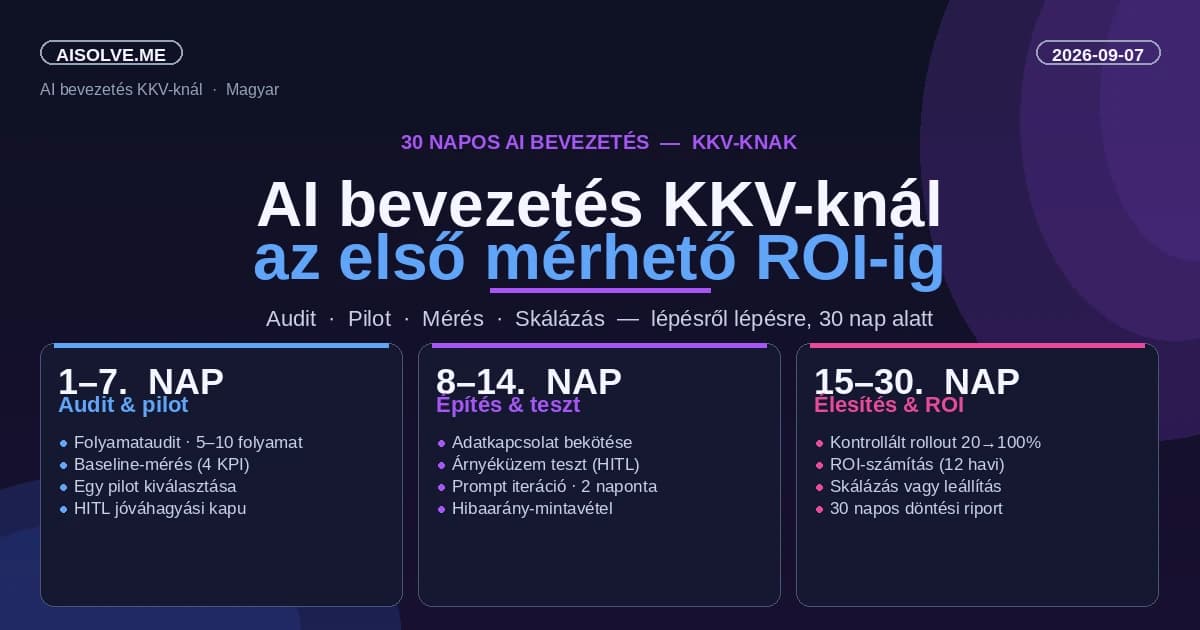
Don't try to do everything at once. The secret to successful agentic AI adoption is a focused, one-at-a-time pilot approach. Here's the 4-week schedule that the AiSolve team uses in its own projects.
Week 1: Assessment — Where Is Your Time Going?
Make a list of your daily/weekly repetitive tasks. Categorize them: customer service, sales, administration, marketing, accounting. The most important question you can ask your team: "Which task do you hate the most?" — that will be the best pilot, because frustration = savings potential.
Sample tasks:
- Email responses
- Quote preparation
- Appointment scheduling
- Invoicing
- Social media posting
- Monthly report creation
- Customer data entry into CRM
Week 2: Pilot Selection — One Process, Zero Risk
Choose one process that is: (1) repetitive, (2) low-risk, (3) well-measurable.
The best first steps:
- Website chatbot — our RAG chatbot service is ready for this, and answers customers' most common questions 24/7.
- Automated email reply for quote requests — upon receiving a request, the AI immediately sends a personalized, brand-aligned response.
- Online appointment booking with Google Calendar integration — the customer selects a time slot, the AI books it, and sends a reminder.
Don't start with these: invoicing (legal risk), contract signing (legal risk), complex B2B pricing (data security risk). Only automate these if you already have experience with the human-in-the-loop model.
Warning: Automating invoicing and legal processes is possible, but only if you use the AI in human-in-the-loop mode — every invoice is checked by a human before it goes out.
Weeks 3–4: Implementation — Build Your First Agent
Choose a no-code tool — Make.com or n8n is best for Hungarian SMBs. Build a workflow that works like this:
"If a quote request arrives from the website → automatically generate a response with GPT-4.1 mini → send a PDF → fill out the Google Sheet → send a follow-up email in 3 days if there's no response."
Test it on 5–10 real cases. Don't launch live, but in test mode, where you see every response before it goes out to the customer.
Milestone: Does the process work without human intervention 8 out of 10 times? If yes, you're ready to go live. If not, fine-tune the prompts and conditions.
If this is too technical, the AiSolve team builds your first agent in 14 days — tailored to your process, in Hungarian, connected to your existing systems.
Month 2: Measurement and Scaling — Prove with Numbers
Measure concrete KPIs by comparing the state before and after the pilot launch:
- Time saved (hours/week) — how much administrative work is eliminated?
- Response time (minutes → seconds) — how much faster do customers get feedback?
- Conversion rate (%) — do more people buy or book after AI introduction?
- Error rate (%) — how often does human intervention need to correct?
If the pilot is successful — e.g., 50%+ time savings and <5% error rate — scale to the next process. In an average Hungarian SMB, 5–7 agents can run in parallel within 3–4 months.
The monthly budget for a full agentic AI stack (no-code tools, API calls, hosting) is HUF 50,000 – 150,000. This is typically a fraction of a part-time administrator's salary — in exchange for 24/7 operation and zero sick leave.
What to Watch Out For? — Pitfalls and Security
AI agents are not magic wands. For them to truly help and not harm, a few basic rules must be followed — especially if, as a Hungarian SMB, your competitiveness and your customers' trust are at stake.
Data Privacy (GDPR) — AI Doesn't Exempt You from Responsibility
AI agents also need a privacy policy — fortunately, another AI agent can generate this too :). But beyond the joke: privacy is not optional. If your AI agent processes customer data, you are the data controller, and under GDPR you are responsible for ensuring the data is secure.
Don't send personal data (customer name, email, phone, address) to open APIs — for example, OpenAI's public chat interface — without checking the data processing terms. If customer data leaks, the fine can be millions.
If your industry is strict (healthcare, banking, law), use self-hosted models (Llama 3, Mistral) or specifically EU-server providers. The OpenAI API with EU servers is GDPR-compliant — but read the DPA (Data Processing Agreement) before launching live.
Read more about AI agent security in our AI agent security and web implementation article.
Human Supervision — AI Supports, Doesn't Replace
The human-in-the-loop (HITL) model is best practice: the AI makes a suggestion, the human approves it. This is especially important in areas like invoicing, contract signing, complaint handling, or refunds. An incorrectly issued invoice or a legally flawed contract costs more than the AI's annual cost.
"Shadow AI" risk: when employees send company data using their own ChatGPT account, Google Gemini, or other public tools. This can lead to data leakage, and you as a leader don't even see what's happening. A corporate AI policy is needed that regulates what tools the team can use.
Best practice: Configure every AI agent to automatically hand over to a human colleague in uncertain cases. This is not a failure — this is professionalism. AiSolve's security framework sets this "fallback" logic by default for every agent.
Technical Pitfalls — What Nobody Warns You About
Many SMBs fall into the trap of treating AI as a magic potion. In reality, most pitfalls are technical but preventable:
- Legacy software: Old accounting programs, DOS systems, or custom-developed CRMs are not API-friendly. Here, RPA (UiPath) may be the solution, or a "translator" agent that intermediates between the old system and the AI.
- Context window limitation: When processing long documents, the AI "forgets" earlier parts. Even 128K token models are not infinite — if you feed long contracts or multi-year customer histories, break them into smaller slices.
- Hallucination: The AI can state facts that are not true. Always have a validation step: the agent's response should not go directly to the customer if it contains data or time slots.
- Prompt injection: If malicious instructions are in the input data (e.g., a contact form), the AI can execute them. Use input validation and a sandbox environment.
- Model drift: AI model updates can change responses. What worked yesterday may behave differently tomorrow. Keep versioned prompts and run regular regression tests.
- Cost spiral: Token-based pricing can bring unexpectedly high bills if your agent gets into an infinite loop or sends too long a context. Set daily cost limits at the API provider.
If you don't want to navigate these technical obstacles alone, AiSolve's custom automation team assesses your systems, selects the right tools, and deploys your first agent — so that pitfalls are already filtered out during planning.
Case Study — How GépPlusz Ltd. from Debrecen Automated Its Customer Service in 30 Days
GépPlusz Ltd. is a 15-person machine repair company in Debrecen that deals with industrial machine repair and maintenance. The company's owner, Péter Kovács, faced the fact at the end of 2025 that with the growing order volume, administration also got out of hand. After a short analysis, it became clear: the company consumes all its resources on service, but the customer service processes still run manually. Their story shows how a Hungarian SMB can build effective AI agents without a huge budget or developer team.
The Problem
GépPlusz Ltd. received 40+ emails daily, more than 60% of which were quote requests. Péter Kovács spent 12 hours a week answering emails, coordinating appointments, and managing colleagues. The repairers constantly called him: "Who has an appointment tomorrow?", "Which client is waiting for a quote?" The company's website was outdated, almost unusable on mobile, so customers often requested information by phone or email, further increasing the manual load.
The most painful problem was that due to the lack of quick response, customers often turned to the competition. If a quote request had to wait 4-6 hours, the client already requested a quote elsewhere. The company manager got stuck in the administrative hamster wheel instead of strategic tasks — exploring new markets, B2B wholesale searches.
The Solution
The AiSolve team launched a 30-day pilot program at GépPlusz Ltd. The solution's foundation was an n8n workflow (self-hosted, free), connected with the OpenAI GPT-4.1 mini model, the Google Calendar API, and the Billingo invoicing system. Alongside this, we built a new Next.js-based website using AiSolve's 0 Ft model, which is mobile-optimized and contains an integrated quote request form.
The entire system's goal was to handle repetitive, low-risk processes completely autonomously, while providing human-in-the-loop control for complex or sales-critical decisions.
The Workflow Step by Step
- Quote request: The customer fills out the quote request form on the new website → the n8n webhook immediately captures the data.
- Intelligent response: GPT-4.1 mini generates a personalized response message based on the submitted data, presenting 3 predefined service packages (basic, complex, VIP).
- Automatic sending: The response message and PDF quote go out to the customer by email on average within 90 seconds of the query.
- Follow-up: If the customer doesn't respond for 3 days, the system automatically sends a reminder email referencing a discount period or free consultation.
- Appointment booking: If the customer books an appointment, Google Calendar automatically updates, and the appropriate repairer receives an SMS and email notification about the next job.
- Invoicing: After the work is completed, the system automatically generates the invoice in Billingo and sends it to the customer as a PDF.
Results After 3 Months
In the three months since the pilot launch, measurable, business-level changes occurred at GépPlusz Ltd. The first response time dropped from 4 hours to 35 minutes, which means an 85% improvement. This also showed up in customer retention and conversion: the ratio of closed quotes increased by 40%. The owner saved 10 hours of administrative time per week, which he can now dedicate to strategic tasks — exploring new markets, B2B wholesale negotiations.
On the technical side, the monthly cost was only ~HUF 45,000: the n8n cloud subscription ($20), OpenAI API calls (~$15), and the Billingo base fee together. This cost is a fraction of a part-time administrator's salary, yet brought the effectiveness of a full-time assistant.
"The biggest gain is not time, but that the company manager can finally focus on strategy. The AI didn't replace the repairers — it freed the manager from administration."
— Péter Kovács, owner, GépPlusz Ltd.
Curious how this would work in your business? The AiSolve team assesses your processes in a free consultation and builds your first agent in 14 days. Learn about our custom automation service.
Sources and Further Reading
- statworx — AI Trends Report 2026
- StateGlobe — Hungary Predictive Analytics Adoption 2026
- McKinsey Global Institute — The State of AI in 2026
- Gartner — Top Strategic Technology Trends 2026
- AiSolve.me — extrahasznaltruha.hu webshop case study
- AiSolve.me — GEO Guide 2026
- AiSolve.me — AI Agent Security
- n8n.io — Documentation and Community
- Make.com — Integromat Guides
- OpenAI API — Pricing and Documentation
Agentic AI is not the future — it's the present. The question is no longer whether it's worth diving in, but when.
Készen állsz a saját weboldaladra?
Ingyenes konzultáció során átbeszéljük, hogyan segíthetünk vállalkozásodnak növekedni egy modern, gyors és konverzióoptimalizált weboldallal. 14 nap alatt kész, 0 Ft induló költséggel.