

Introduction: The Dawn of Autonomous Commerce
In January 2026, the technology sector is witnessing a quiet but seismic shift: Google has officially launched the Universal Commerce Protocol (UCP), an open-source standard designed to facilitate agentic shopping. This development marks a transition from the traditional e-commerce model—where humans browse and click—to a future where intelligent data processing AI agents perform searches, comparisons, and transactions on behalf of users.
While this innovation promises to reduce friction in digital commerce, it arrives amidst a climate of intense regulatory scrutiny. As Google pushes the boundaries of automation, Data Protection Authorities in the EU, led by the Irish DPC, are enforcing GDPR with unprecedented strictness. This article explores the mechanics of UCP, the critical role of data processing AI agents, and how businesses must navigate the intersection of advanced automation and rigorous privacy compliance.
Table of Contents
| Key Insight | Business Impact |
|---|---|
| Google UCP Launch | Establishes a standardized language for AI agents and online stores, lowering integration barriers. |
| Rise of Agentic Shopping | Data processing AI agents can autonomously initiate transactions, shifting marketing focus to data structure. |
| Strict Data Privacy | With the Irish DPC's strict enforcement, AI solutions must incorporate "privacy by design" to avoid massive fines. |
| Structured Data Necessity | Websites must be machine-readable to remain competitive in an agent-driven market. |
What is Universal Commerce Protocol (UCP)?
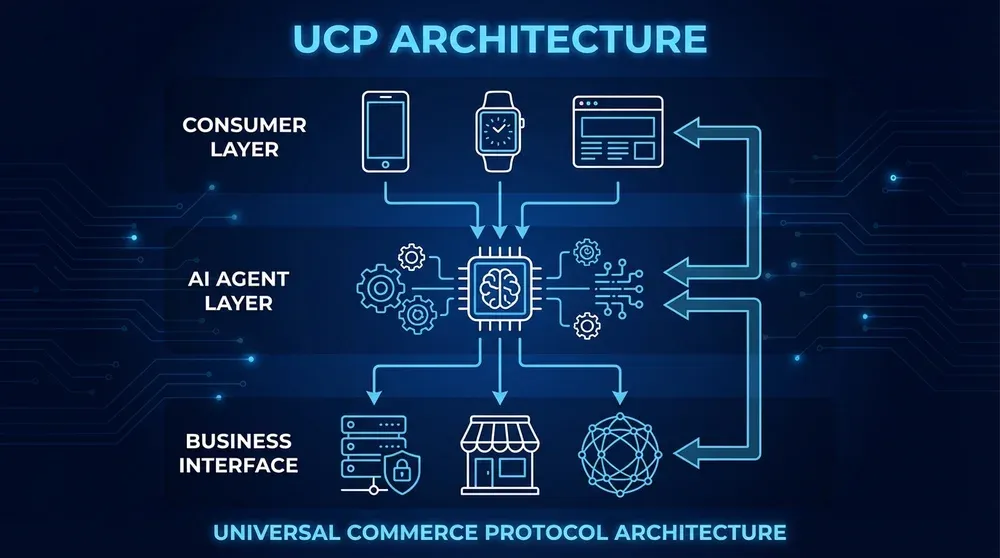
The Universal Commerce Protocol (UCP) is Google's solution to the fragmentation that currently plagues AI integration in e-commerce. Fundamentally, it is an open-source standard that creates a common language between consumers, businesses, payment providers, and data processing AI agents. The goal is to enable AI systems to interact seamlessly with online stores without requiring bespoke integrations for every single merchant.
According to Robert Krzaczyński from InfoQ, UCP enables the seamless interactions necessary to scale "agentic shopping." The protocol is not an app or a platform, but an infrastructure layer. Much like HTTP for websites, it is a standard upon which anyone can build. This implies that in the near future, professional website creation will require UCP compatibility as a baseline standard to ensure visibility to AI shoppers.
Strategic Tip: Do not wait for competitors to move first. Assess whether your current e-commerce engine supports structured data exchange via APIs, which is the foundation of UCP.
The Role of Data Processing AI Agents
With the introduction of UCP, the utility of data processing AI agents increases dramatically. These software robots are no longer just passive chatbots delivering pre-scripted answers. They are capable of executing complex tasks: interpreting user intent (e.g., "Buy me running shoes size 10, good for asphalt, under $100"), scanning UCP-compatible inventory, comparing prices and shipping terms, and preparing the order.
This process requires real-time processing of immense datasets. Modern data processing AI agents combine unstructured information (product descriptions, reviews) with structured data (pricing, stock) using advanced decision logic. For businesses, this means that the accuracy and machine-readability of product information will have a direct impact on sales. If an AI agent cannot clearly interpret shipping deadlines, it will simply bypass that vendor.
Privacy and GDPR Compliance
As technology accelerates, the regulatory environment is hardening. Coinciding with the Google UCP announcement, reports confirm that the Irish Data Protection Commission (DPC)—the primary regulator for tech giants in the EU—is enforcing rules with unprecedented rigor. According to Bitport, the Irish authority has imposed over €4 billion in fines since 2018, establishing a reputation as the EU's toughest privacy enforcer.
This context is critical for UCP and data processing AI agents. When an AI agent shops, it moves personal data (addresses, payment info, preferences) across platforms. Under GDPR, every such movement must be traceable, secure, and consensual. Due to the open nature of UCP, developers must guarantee that agents do not leak data and share only the information strictly necessary for the transaction.
Pro Tip: Apply the "Privacy by Design" principle during AI implementation. Ensure that automated processes log data access to prepare for potential regulatory audits.
Technical Implementation & Structure
The technical foundation of UCP relies on standardized APIs and semantic data models. The system does not force merchants to replace their entire platforms but rather forms a layer on top of existing systems (such as Shopify, Magento, or custom engines built during website creation). The most critical technical element is formatting product catalogs into AI-friendly structures.
For data processing AI agents, extensions of JSON-LD structure and Schema.org standards allow for the "understanding" of products. For instance, instead of a simple HTML product page, UCP expects product price, availability, and variations to be precisely defined in machine code. This structure enables agents to parse thousands of stores in seconds without hallucinations or errors.

Comparison: Traditional vs. Agentic Shopping
The following table illustrates how the commerce process changes with the advent of data processing AI agents.
| Feature | Traditional E-commerce | Agentic Shopping (UCP) |
|---|---|---|
| Initiator | Human User | AI Agent (on user instruction) |
| Search Method | Keywords, visual browsing | Semantic matching, parameter filtering |
| Comparison | Manual, time-consuming (multiple tabs) | Instant, across hundreds of sources |
| Interface | Graphical (GUI) | Programmable (API / Protocol) |
Risks and Limitations
While the technology is promising, it carries significant risks. The primary danger is "agentic hallucination," where the AI agent misinterprets the user's request and orders the wrong product. A poorly configured data processing AI agent could, for example, order 100 units of industrial cleaner instead of the household version if measurement units are not standardized.
Another critical point is the aforementioned data privacy. If sensitive data leaks through the UCP protocol, the example of the Irish Data Protection Commission shows that fines can be astronomical. Businesses must therefore prepare not just technologically, but legally. When implementing custom automation, a detailed Data Protection Impact Assessment (DPIA) is mandatory, especially if automation involves financial transactions.
Strategic Recommendations
This technological shift is not the distant future, but the present. Here are steps to prepare:
- Structured Data Audit: Verify that your online store's product data complies with the latest Schema.org standards.
- API-First Approach: Prioritize solutions with strong API support when starting new developments.
- Privacy Review: Consult with experts on how your systems handle automated requests and ensure GDPR compliance.
- Experiment with AI Agents: Start by deploying small-scale data processing AI agents for internal processes to gain experience with the technology.
Want to prepare your business for the era of AI commerce? Our experts can help you build structured data processing systems.
AI Data Processing ConsultationFrequently Asked Questions
What exactly is the Universal Commerce Protocol (UCP)?
UCP is an open-source standard launched by Google that allows AI agents and online stores to communicate using a unified language. This protocol provides the technical foundation for software robots to autonomously search for products, compare them, and initiate transactions.
How does the rise of data processing AI agents affect my online store?
If your online store lacks properly structured data and APIs, AI agents may perceive your inventory as "invisible." In the future, a significant portion of traffic may come from these agents rather than direct human visitors, making technical readiness a competitive advantage.
Is it safe to trust AI agents with shopping?
Security is a top priority for UCP and AI developers. While the technology uses secure protocols, users are advised to implement approval steps (e.g., "human-in-the-loop"), especially for high-value purchases, to prevent unwanted transactions.
What are the privacy risks of agentic shopping?
Automated shopping involves moving personal and financial data between systems. Due to strict EU regulations (GDPR), it is critical that data processing AI agents share only necessary data and handle it with encryption to avoid severe fines.
Recommended
- Website creation with AI-friendly structure
- Custom automation solutions for enterprises
- InfoQ: Google's Universal Commerce Protocol
[Article generated by AiSolve AI Content System]
Készen állsz a saját weboldaladra?
Ingyenes konzultáció során átbeszéljük, hogyan segíthetünk vállalkozásodnak növekedni egy modern, gyors és konverzióoptimalizált weboldallal. 14 nap alatt kész, 0 Ft induló költséggel.