

| Area | Key Insight |
|---|---|
| Market Need | Due to exponential data growth, manual processing is no longer scalable; AI tools are essential for competitiveness. |
| Tool Selection | Choosing the right tool depends on the use case, scalability, integration capabilities, and budget. There is no one-size-fits-all solution. |
| Integration | The key to successful implementation is gradual integration, compatibility with existing systems, and careful design of user interfaces. |
| Future Trends | The industry is moving towards autonomous, self-healing data pipelines and natural language queries, reducing the need for human intervention. |
| ROI | Investment in AI data processing yields a fast return through increased efficiency, more accurate forecasts, and reduced operational costs. |
By 2026, the amount of data generated and replicated worldwide is expected to exceed 180 zettabytes. This staggering volume of information presents both a massive opportunity and a colossal challenge for businesses. Raw data is worthless on its own; the real competitive advantage lies in unlocking the patterns, trends, and insights hidden within. This is where AI data processing tools come into play, which are no longer a technological luxury but a fundamental requirement for survival and growth. The era of manual data analysis is over; the age of automated, intelligent solutions has arrived, where speed and accuracy are paramount. This article introduces the market-leading tools and helps you navigate the maze of choosing the right solution.
Why are AI-based data processing tools essential in 2026?
As digital transformation accelerates, businesses are collecting more data points than ever from customer interactions, IoT devices, market transactions, and internal processes. Manually handling this "Big Data" tsunami has become unsustainable for several reasons. First, the sheer volume exceeds human capacity. A team of data analysts could spend weeks on a task that an AI algorithm can complete in minutes. Second, the factor of human error poses a significant risk, especially when cleaning and normalizing large datasets. A single typo or misinterpreted category can skew the final analysis.
Third, the modern business environment demands real-time decision-making. By the time an analyst manually processes quarterly data, market conditions have already changed. In contrast, AI-based tools can monitor continuous data streams, send instant alerts, and update predictive models on the fly. Solutions like data processing AI agents can autonomously perform data collection, cleaning, transformation, and even preliminary analysis, freeing up human experts for higher-level, strategic tasks. This increase in efficiency not only means cost savings but also enables proactive, data-driven business strategies.
| Feature | Traditional Data Processing | AI-Powered Data Processing |
|---|---|---|
| Speed | Slow, manual processes (hours, days) | Fast, automated (minutes, seconds) |
| Scalability | Limited, resource-intensive | High, easily scalable in the cloud |
| Accuracy | Prone to human error | Consistent and highly accurate |
| Insights | Descriptive (what happened?) | Predictive & Prescriptive (what will happen, what should we do?) |
| Cost | High labor costs | Higher initial, but lower operational cost |
The Top 10+ AI Data Processing Tools on the Market
The market is filled with excellent tools that cater to various needs. The following list is not a ranking but a curated selection of the most popular and innovative solutions across different categories.
1. Data Cleaning and Preparation
Trifacta (by Alteryx): An industry standard for visual data exploration and cleaning. Its AI-powered suggestions help users quickly identify and fix errors, inconsistencies, and missing values. Ideal for teams where technical and business users collaborate.
OpenRefine: A free, open-source tool that is extremely powerful for cleaning and transforming messy data. While it lacks the polished interface of commercial tools, its functionality and flexibility are unparalleled, especially popular among data analysts and journalists.
2. ETL (Extract, Transform, Load) and Data Integration
Fivetran: The champion of automated data integration. Fivetran can automatically extract and load data from hundreds of sources (e.g., Salesforce, Google Analytics, databases) into a central data warehouse. Its AI helps in automatically managing schema changes and optimizing data pipelines.
Talend: A robust platform available in both open-source and commercial versions. The Talend Data Fabric combines data integration, data quality, and big data capabilities. Its AI-powered features assist in automatically assessing and improving data quality.
3. Data Analysis and Business Intelligence (BI)
Tableau (with Einstein Discovery): Tableau is the king of visual analytics, but with the integration of Salesforce's Einstein Discovery, it has reached a new level. It can automatically find patterns and insights in data and explain trends in plain language.
Power BI (Microsoft): Microsoft's business intelligence platform is tightly integrated with Azure AI and Machine Learning services. It allows users to ask questions about their data in natural language and automatically generate predictive models.
Strategic Insight: Start with a small, well-defined problem. Instead of trying to overhaul the entire company's data strategy at once, pick a single process (e.g., cleaning marketing campaign data) and implement an AI tool there. A quick win will help build momentum for wider adoption.
4. Advanced and Developer-Focused Tools
Databricks: From the creators of Apache Spark, this platform unifies data science, engineering, and business analytics. Their "Lakehouse" architecture allows for unified management of unstructured and structured data, running AI and ML models at a massive scale.
H2O.ai: An open-source and commercial AI platform specializing in automated machine learning (AutoML). It enables developers and data analysts to quickly build and deploy world-class machine learning models without being deep experts.
Custom Solutions: In many cases, the best solution is a custom one. Services like custom automation solutions allow businesses to build data processing workflows tailored exactly to their needs, leveraging the power of the latest AI models.
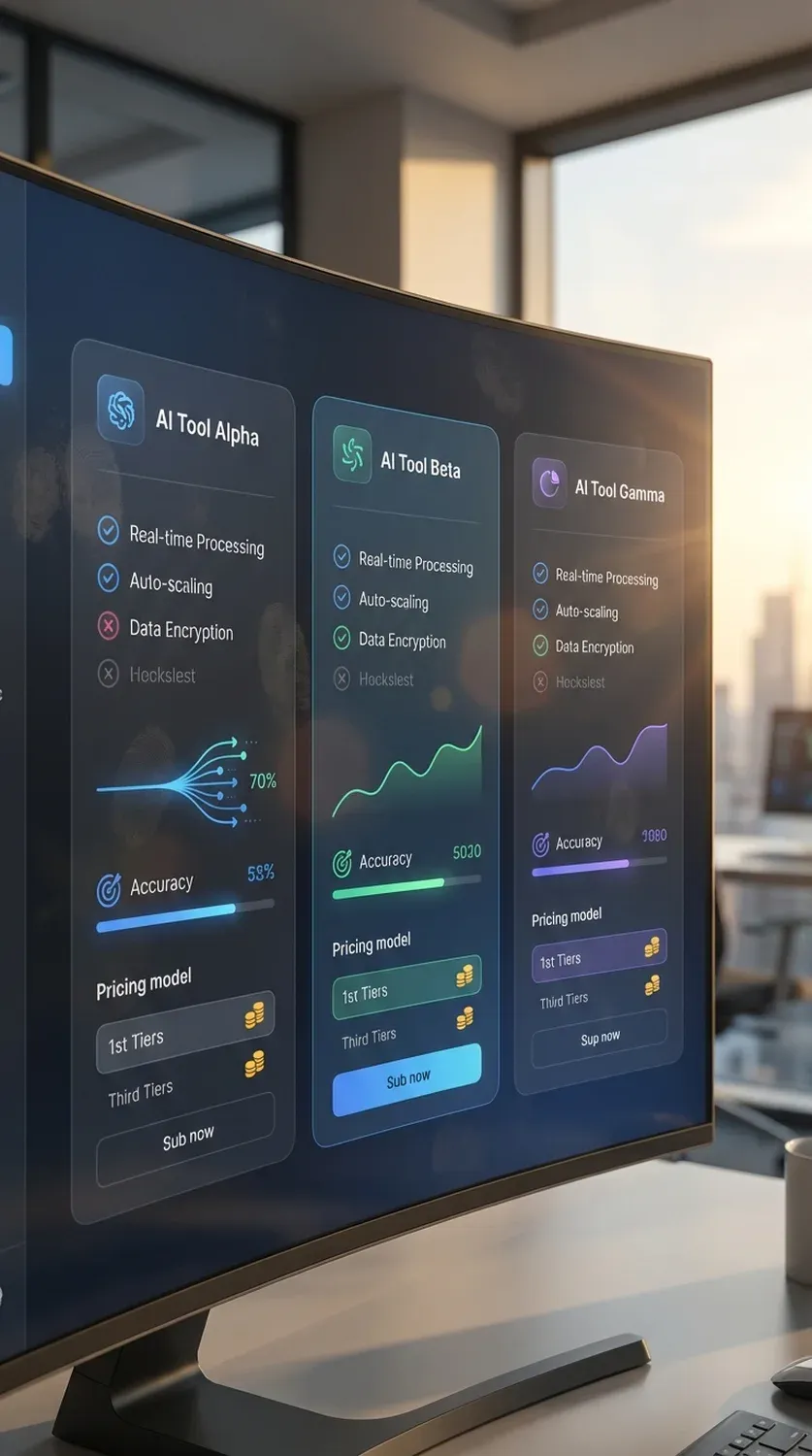
How to choose the right AI tool for your business?
Selecting the right tool is a critical step. A wrong decision can lead not only to financial loss but also to wasted time and frustration. Consider the following criteria when making your choice:
- Define the problem: What exactly do you want to solve? Data cleaning, real-time analysis, predictive modeling? A clear understanding of the problem will narrow down the list of potential tools.
- Assess your existing infrastructure: The new tool must be compatible with your current systems (databases, CRM, ERP). Do you need a cloud-based, on-premise, or hybrid solution?
- Consider user skills: Who is the tool for? Business analysts who need a visual, "low-code" interface, or data scientists who prefer a code-first, flexible environment?
- Scalability and performance: Will the tool be able to handle your future data growth? How quickly can it process your typical datasets? Request a demo or trial and test it with your real data.
- Total Cost of Ownership (TCO): Don't just look at the license fee. Factor in implementation, maintenance, training, and potential cloud infrastructure costs.
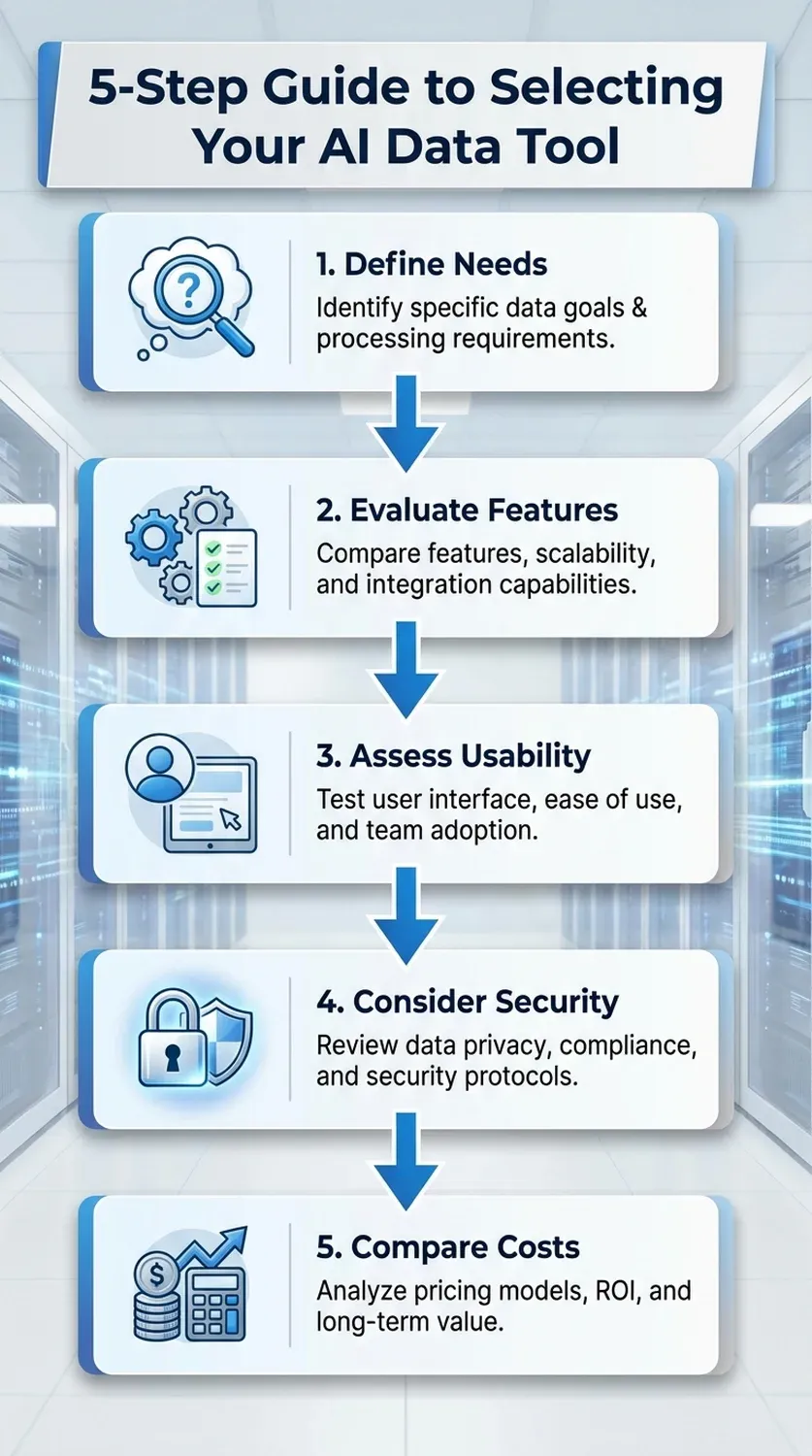
Integrating data processing AI agents into existing systems
Implementing an AI tool doesn't end with purchasing the software. The real value is created during integration, when the new capabilities are embedded into daily workflows. Modern AI platforms typically offer robust APIs (Application Programming Interfaces) that allow for seamless communication with other software. For example, an AI-powered data cleaning tool can automatically pull data from a CRM system via an API, clean it, and then load the clean data back without any human intervention.
Another crucial aspect of integration is the user interface. A brilliant algorithm working in the background is useless if users can't easily understand and act on its results. This is where professional professional website creation and custom dashboard development become critical. A well-designed dashboard presents AI-generated insights in a visual, intuitive way, enabling managers to make fast, informed decisions. Solutions like an intelligent RAG AI chatbot can further simplify interaction, allowing users to query data using natural language.
Implementation Advice: Adopt a "Human-in-the-Loop" approach during integration. Initially, let the AI make suggestions (e.g., for data corrections), but have a human expert approve them. This builds trust in the system and allows the model to be fine-tuned based on real-world feedback.
Common use cases and industry examples
AI data processing tools are not limited to a single industry. Their application is bringing revolutionary changes across almost every sector.
- E-commerce: Customer segmentation based on purchase history, personalizing product recommendations, predicting churn, and optimizing inventory management using real-time demand data.
- Finance: Fraud detection by analyzing anomalies in transaction patterns, automating credit scoring, algorithmic trading, and monitoring for anti-money laundering (AML) compliance. An AI phone customer service can also analyze call sentiment to improve customer experience.
- Healthcare: Analyzing clinical trial data, early disease diagnosis from medical imaging (e.g., X-rays, MRIs), optimizing hospital resource allocation, and developing personalized treatment plans.
- Manufacturing: Predictive maintenance by analyzing data from IoT sensors to forecast machine failures, automating quality control with image recognition, and optimizing the entire supply chain.

Future Trends: The Age of Autonomous Data Processing
Progress doesn't stop. In the coming years, data processing will become even more intelligent and autonomous. Three key trends are worth highlighting:
- Hyperautomation: Future systems will automate not just individual tasks but the entire end-to-end data processing pipeline. From data ingestion to insight generation and executing recommended actions, everything could happen without human intervention. Modern data processing AI agents are already heading in this direction.
- Natural Language Data Processing (NLP): With the rise of Large Language Models (LLMs), users will be able to interact with databases using simple, everyday language. Queries like "show me last month's sales by region" will be automatically translated into the correct database query and visualization.
- Self-Healing Data Pipelines: Future AI systems will be able to automatically detect data quality issues (e.g., the appearance of a new, inconsistent data format) and independently learn how to handle them, minimizing maintenance needs.
Risks and Limitations: What to watch out for when implementing AI tools?
While AI-powered data processing holds immense potential, it's important to be aware of the potential pitfalls. Managing these risks is essential for responsible implementation.
- Data Privacy and Security: When processing sensitive data, compliance with GDPR and other regulations must be ensured. It's particularly important to thoroughly vet the data handling policies of cloud-based service providers.
- Bias in Models: AI models learn from their training data. If the input data is biased (e.g., a certain demographic group is underrepresented), the model may make biased decisions. Regular auditing of models and the use of Explainable AI (XAI) techniques are crucial.
- The "Black Box" Problem: The workings of some more complex AI models (e.g., deep learning networks) can be difficult to interpret. For critical applications (e.g., credit scoring), it's important that the logic behind decisions is traceable and explainable.
- Over-reliance: One should not blindly trust AI-generated results. Human oversight and common sense remain key. AI is a tool that supports, but does not replace, expert decision-making. The performance of even the best data processing AI agents needs constant monitoring.
Pro Tip: Establish an internal AI ethics and governance committee. This multidisciplinary team (from legal, IT, and business departments) can be responsible for overseeing the implementation of AI tools, assessing risks, and developing internal policies for responsible use.
Conclusion: From Data to Value with AI
AI data processing tools are no longer a futuristic concept but a present-day business reality. The question is no longer *if* they should be implemented, but *how* and *which ones*. Transitioning from manual data processing to automated, intelligent solutions is essential for maintaining a competitive edge. By selecting the right tool, ensuring careful integration, and consciously managing risks, businesses can transform a sea of raw data into valuable, actionable insights.
Effective data processing relies on a customized approach. Instead of generic solutions, data processing AI agents can execute workflows optimized precisely for your business processes. This investment not only boosts efficiency but also uncovers new revenue streams, improves customer experiences, and lays the foundation for long-term, data-driven growth.
Ready to unlock the full potential hidden in your company's data? Discover how our custom data processing AI agents can help you automate workflows and gain deeper business insights.
Learn More About AI Data Processing[Article generated by AiSolve AI Content System]
Frequently Asked Questions
What is the difference between an AI data processing tool and a traditional BI tool?
Traditional BI tools primarily focus on descriptive analytics and visualization of past data (what happened?). In contrast, AI-powered tools also have predictive (what will happen?) and prescriptive (what should we do?) capabilities. They automate pattern recognition, anomaly detection, and forecasting of future trends, reducing manual analytical work.
Do I need a team of data scientists to use an AI tool?
Not necessarily. Modern AI data processing tools are increasingly adopting a "low-code" or "no-code" approach, allowing business users to perform complex analyses through visual interfaces. While a data scientist can build more advanced models, most day-to-day data preparation and analysis tasks no longer require deep programming skills.
How secure are cloud-based AI tools?
Leading cloud providers (like AWS, Azure, Google Cloud) employ extremely high-level security protocols that often exceed the internal security capabilities of most companies. However, it's important to understand the "shared responsibility" model: the provider is responsible for the security *of* the cloud infrastructure, but the customer is responsible for properly configuring and managing access *to* their data *in* the cloud.
How quickly can I expect a return on investment (ROI)?
The time to ROI largely depends on the use case. Projects that increase operational efficiency (e.g., automating manual data entry) can pay for themselves within a few months through reduced labor costs. Strategic projects (e.g., predicting customer churn) may take longer to show a return, but the potential business impact can be much greater.
Készen állsz a saját weboldaladra?
Ingyenes konzultáció során átbeszéljük, hogyan segíthetünk vállalkozásodnak növekedni egy modern, gyors és konverzióoptimalizált weboldallal. 14 nap alatt kész, 0 Ft induló költséggel.